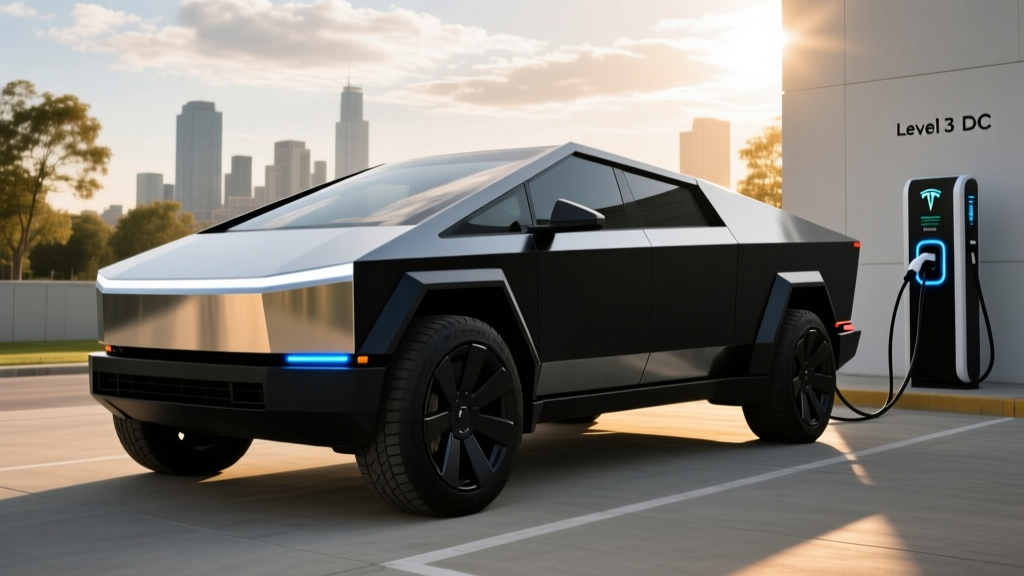
The Tesla Cybertruck Cyberbeast sits at the top of a three-truck lineup that redefined what a full-size electric pickup could look like — and how violently it could accelerate. With a tri-motor powertrain producing 845 horsepower, Tesla claims a 2.6-second 0-60 mph time that embarrasses most supercars, let alone a 6,800-pound stainless-steel truck. But beyond the headline numbers, the Cyberbeast raises practical questions every EV buyer should ask: What range will you actually see on the highway? How fast does it charge in the real world? And at its premium price, does it make financial sense compared to the Ford F-150 Lightning, Rivian R1T, or the dual-motor Cybertruck trims below it?
We've analyzed the Cyberbeast's EPA data, real-world efficiency patterns, charging behavior, and total ownership costs to give you the buyer's-guide breakdown you won't find in marketing brochures.
Cybertruck Cyberbeast: Key Specs at a Glance
| Specification | Cyberbeast (Tri-Motor AWD) |
|---|---|
| Base MSRP (2025/2026) | $99,990 |
| EPA Estimated Range | 320 miles |
| Battery Capacity (usable) | ~123 kWh (NMC chemistry) |
| Drivetrain | Tri-motor AWD (1 front, 2 rear) |
| Horsepower | 845 hp |
| Torque | ~740 lb-ft (estimated) |
| 0-60 mph | 2.6 seconds (manufacturer) |
| Top Speed | 130 mph |
| Max DC Fast Charge Rate | 350 kW (peak) |
| 10-80% DC Fast Charge | ~15-18 minutes (estimated) |
| Level 2 Home Charging | 11.5 kW (~37 mi/hr) |
| EPA Efficiency | 2.0 kWh/mi (~50 MPGe combined) |
| Towing Capacity | 11,000 lbs |
| Payload Capacity | 2,500 lbs |
| Bed Length | 6 ft (72 in) |
| Battery/Powertrain Warranty | 8 years / 120,000 miles |
Real-World Range: What the EPA Number Doesn't Tell You
EPA Estimate: 320 miles
Expected Highway (70-80 mph): ~240-270 miles
Expected Cold Weather (below 30°F): ~200-240 miles
Mixed Commuting (city + suburban): ~280-310 miles
The Cyberbeast's 320-mile EPA rating is the lowest among the three Cybertruck trims — the Rear-Wheel-Drive model achieves 340 miles and the All-Wheel-Drive dual-motor sits at 318 miles with range-extender option availability. That deficit comes from the tri-motor setup's added weight, rolling resistance from 35-inch all-terrain tires, and the aerodynamic penalty of a taller, more aggressive suspension stance.
In practice, the Cyberbeast's real-world range is heavily dependent on how you drive it. This is a truck that tempts you to use its 845 horsepower, and aggressive acceleration draws enormous current from the ~123 kWh battery pack. On sustained highway driving at 75-80 mph — where aerodynamic drag dominates — expect to see consumption around 2.2-2.4 kWh/mile, which translates to roughly 240-270 miles of usable range before you need to stop.
Cold weather compounds this. Tesla's heat pump system helps, but lithium-ion batteries lose efficiency in low temperatures, and cabin heating demands are significant in a stainless-steel cabin with a large glass roof. Owners in northern climates report 20-30% range reduction in sub-freezing conditions, putting realistic winter range around 200-240 miles. If you routinely tow, expect range to drop further — towing a 7,000-8,000 lb trailer can cut range by 40-50%, bringing usable range to approximately 150-180 miles between charges.
The Cyberbeast's battery uses NMC (nickel manganese cobalt) chemistry, which offers higher energy density than LFP but follows the typical 80% daily charge recommendation for longevity. Tesla's battery management system includes a substantial top and bottom buffer to protect the cells, so the usable ~123 kWh is already less than the gross pack capacity.
Charging Speed: DC Fast Charging and Home Setup
| Charging Level | Power | Speed (miles added per hour) | Notes |
|---|---|---|---|
| Level 1 (120V outlet) | ~1.4 kW | ~3-4 mi/hr | Emergency/trickle only |
| Level 2 (240V, 48A) | 11.5 kW | ~37 mi/hr | Full overnight charge (~9 hrs) |
| Level 2 (Tesla Wall Connector, 80A) | ~17 kW | ~44-52 mi/hr | Requires 100A circuit; fastest home option |
| DC Fast Charge (Tesla Supercharger V4) | Up to 350 kW peak | ~15-18 min (10-80%) | Peak rate not sustained; tapers above 60% |
| DC Fast Charge (CCS via adapter) | Up to ~250 kW | Varies by station | Non-Tesla networks; adapter included |
The Cyberbeast supports up to 350 kW peak DC fast charging on Tesla's latest V4 Supercharger stalls, and the 800-volt-class architecture enables strong charge rates in the 10-50% state-of-charge window. However, as with all large battery packs, the charge curve tapers significantly as the battery fills. You'll see peak rates in the low state-of-charge range (10-35%), with a step-down around 50-60% SoC and a pronounced taper above 80%. A realistic 10-80% session takes approximately 15-18 minutes at a V4 Supercharger — impressive for a 123 kWh pack, but not class-leading compared to vehicles with smaller batteries.
For home charging, the Cyberbeast's 11.5 kW onboard charger means a standard 48-amp Level 2 installation (like the Tesla Wall Connector on a 60-amp circuit) adds roughly 37 miles of range per hour. A full 0-100% charge takes about 9-10 hours. If your electrical panel supports a 100-amp circuit, the Wall Connector at 80 amps can push closer to 17 kW, shaving about 2 hours off a full charge. Most Cyberbeast owners will need a licensed electrician to install a NEMA 14-60 or hardwired Wall Connector — budget $800-$2,000 for installation depending on panel proximity and local permit costs.
The Cybertruck ships with a NACS (Tesla) connector natively, giving it seamless access to the 20,000+ Supercharger network. Tesla also includes a CCS adapter for access to Electrify America, EVgo, and other non-Tesla DC networks — a critical advantage for road trips outside Supercharger corridors.
Performance: 845 Horsepower in a Stainless-Steel Wedge
The Cyberbeast's tri-motor configuration places one motor on the front axle and two on the rear, enabling torque vectoring across the rear wheels and precise traction management. The result is a 2.6-second 0-60 mph time that Tesla has demonstrated repeatedly — though achieving it requires ideal conditions: warm battery (preconditioned), dry pavement, and launch mode engaged.
Beyond straight-line speed, the Cyberbeast's adaptive air suspension provides up to 12 inches of ground clearance in Off-Road mode and can lower the truck for highway efficiency. The steer-by-wire system — a first for a production vehicle sold in the US — eliminates the mechanical connection between the yoke and the wheels, using redundant electronic actuators instead. This enables a variable steering ratio: very quick at low speeds (fewer turns lock-to-lock for parking) and more stable at highway speeds. The learning curve is real, but most owners adapt within a few days.
Off-road capability is genuine, not cosmetic. With 17 inches of suspension travel, locking differentials (electronically simulated via the dual rear motors), and underbody armor, the Cyberbeast handles trails that would challenge dedicated off-road vehicles. The 35x22-inch all-terrain tires provide grip but contribute to the range penalty and produce noticeable road noise at highway speeds — a trade-off worth understanding before purchase.
Interior, Cargo, and Daily Usability
The Cybertruck's cabin is minimalist by design — a single 18.5-inch touchscreen dominates the dashboard, with a secondary 9.4-inch screen for rear passengers. The yoke steering wheel (round wheel available as an option) takes center stage. Material quality is a mixed story: the vegan leather seats and metal accents feel premium, but some interior panels and the headliner use harder plastics than you'd expect at a $100,000 price point.
Space is adequate but not class-leading:
- Front legroom: ~41.5 inches
- Rear legroom: ~38.2 inches (tighter than F-150 Lightning's ~43 inches)
- Bed volume: 67 cu ft (6-foot bed with tonneau cover)
- Front trunk (frunk): ~7.1 cu ft
- Seating: 6 passengers (3-across bench front and rear)
The motorized tonneau cover is a standout feature — it's strong enough to support 300 lbs, locks automatically, and integrates with the bed's 120V and 240V power outlets. The Cyberbeast's V2L (vehicle-to-load) capability lets you power tools, camping gear, or even a small appliance directly from the truck's battery, delivering up to 9.6 kW of continuous output through the bed outlets and frunk.
On the tech front, Tesla's infotainment system remains the EV benchmark for responsiveness and feature depth. Wireless Apple CarPlay and Android Auto are not supported — Tesla's native system handles navigation, media, and vehicle controls exclusively. Over-the-air updates continue to add features post-purchase, a Tesla hallmark.
Driver Assistance: Autopilot and FSD (Supervised)
The Cyberbeast comes with Tesla's Autopilot (adaptive cruise + lane centering). Full Self-Driving (Supervised) is available as an $8,000 add-on or $99/month subscription. Despite the name, FSD is an SAE Level 2 driver-assistance system. You must remain fully attentive, keep your hands on the yoke, and be prepared to take over at any moment. It is not autonomous driving.
Tesla's camera-only vision system (no lidar or radar) powers both Autopilot and FSD Supervised. On highways, the system handles lane changes, on-ramp to off-ramp navigation, and speed adjustment competently. In city streets, FSD Supervised manages traffic lights, stop signs, and turns — but intervention frequency varies dramatically by geography and road complexity. The system has improved substantially through 2025-2026 neural network updates, but it remains a driver-assist tool, not a replacement for an engaged driver. For true Level 4 autonomous service, only Waymo and Zoox currently qualify in limited metro areas.
Pricing, Trims, and Federal Tax Credit Eligibility
| Trim | MSRP | Est. After §30D Credit | Range (EPA) |
|---|---|---|---|
| Cybertruck RWD (base) | $60,990 | ~$53,490* | 340 mi |
| Cybertruck AWD (dual-motor) | $79,990 | ~$72,490* | 318 mi (up to 470 mi w/ range extender) |
| Cyberbeast (tri-motor) | $99,990 | ~$92,490* | 320 mi |
*Tax credit estimates assume full $7,500 eligibility under IRS §30D rules. Eligibility depends on buyer income caps, vehicle MSRP caps, battery component sourcing, and critical mineral requirements. Rules are subject to change — consult a tax professional before purchase.
The Cyberbeast's $99,990 MSRP puts it just under the IRS §30D $80,000 MSRP cap for trucks and SUVs — wait, no. The Cybertruck is classified as a light truck, and the MSRP cap for trucks, vans, and SUVs under §30D is $80,000. At $99,990, the Cyberbeast exceeds the MSRP cap and does not qualify for the $7,500 federal tax credit. This is a critical distinction that Tesla's marketing sometimes obscures.
The base RWD model at $60,990 and the AWD dual-motor at $79,990 both fall under the $80,000 truck cap and may qualify for the full $7,500 credit, subject to:
- Buyer income limits: $150,000 single / $225,000 head of household / $300,000 joint (MAGI)
- Battery component sourcing: Increasing percentages of battery components and critical minerals must be sourced from the US or FTA partners
- Point-of-sale transfer: As of 2024+, you can transfer the credit to the dealer at purchase for an immediate price reduction rather than waiting for tax filing
For the Cyberbeast specifically, buyers should budget the full $99,990 plus destination charges, and factor in state-level incentives (which vary by jurisdiction — check your state energy office for details). Options like FSD ($8,000), the Foundation Series package, and premium paint can push the as-tested price well above $110,000.
Ownership Costs: Efficiency, Insurance, and Depreciation
The Cyberbeast's efficiency is its weakest economic metric. At approximately 2.0 kWh per mile (roughly 50 MPGe combined), it consumes significantly more energy per mile than most EVs. For context, a Tesla Model Y uses about 0.28 kWh/mile — the Cyberbeast needs seven times more energy per mile. At the US average electricity rate of ~$0.16/kWh, a full charge costs approximately $19.70, giving a fuel cost of about $0.06 per mile — still cheaper than gasoline at current prices, but the gap narrows considerably with DC fast charging at $0.35-$0.48/kWh on the road.
Insurance premiums for the Cyberbeast are among the highest in the EV segment. The combination of a high MSRP, expensive stainless-steel body panels, specialized repair requirements, and 845 horsepower pushes annual premiums to an estimated $3,500-$5,000 depending on your location and driving record. Get quotes before purchasing — this is a non-trivial ownership cost.
Tesla's battery and powertrain warranty covers 8 years or 120,000 miles (whichever comes first) with a minimum 70% capacity retention threshold. Given NMC chemistry's typical degradation curve — approximately 10-15% loss over 150,000 miles based on current Tesla fleet data — most owners should remain well within warranty coverage during normal use.
Cyberbeast vs. Competitors: How It Stacks Up
| Attribute | Cyberbeast | Rivian R1T Tri-Motor | Ford F-150 Lightning Platinum | GMC Hummer EV Pickup |
|---|---|---|---|---|
| Price | $99,990 | ~$99,900 | ~$96,874 | ~$104,995 |
| EPA Range | 320 mi | ~328 mi | ~300 mi | ~314 mi |
| 0-60 mph | 2.6 sec | ~3.0 sec | ~3.8 sec | ~3.0 sec |
| Horsepower | 845 hp | ~850 hp | 580 hp | 1,000 hp |
| Towing | 11,000 lbs | 11,000 lbs | 10,000 lbs | 7,500 lbs |
| §30D Credit | No (MSRP cap) | No (MSRP cap) | No (MSRP cap) | No (MSRP cap) |
| Supercharger Access | Native NACS | Adapter required | Adapter required | Adapter required |
- You want the quickest production truck ever made
- Native Supercharger access and Tesla's charging network are priorities
- You value OTA updates and Tesla's software ecosystem
- Off-road capability with air suspension matters to you
- Rear passenger space is a priority (R1T and F-150 Lightning are roomier)
- You need a conventional steering wheel (yoke is standard, round is optional)
- Federal tax credit eligibility is important to your budget
- You prefer a traditional truck bed with a standard tailgate (Cybertruck uses a power-folding ramp)
Pros and Cons
- 2.6-second 0-60 — fastest production pickup
- Native NACS / Supercharger network access
- Genuine off-road capability with air suspension
- Stainless-steel exoskeleton: dent and corrosion resistant
- V2L with 9.6 kW output for tools and camping
- 11,000-lb towing capacity
- OTA updates add features over time
- 320-mi EPA range is low for the price class
- No federal §30D tax credit (exceeds $80K MSRP cap)
- Rear legroom is tight vs. F-150 Lightning and R1T
- Steer-by-wire yoke has a learning curve
- High insurance premiums ($3,500-$5,000/yr est.)
- 2.0 kWh/mi efficiency means costly DC fast charging
- Large footprint challenging in tight parking structures
- FSD Supervised remains Level 2 — not autonomous
Frequently Asked Questions
What is the real-world range of the Cybertruck Cyberbeast?
The EPA rates the Cyberbeast at 320 miles, but real-world highway driving at 70-80 mph typically yields 240-270 miles. Cold weather (below 30°F) can reduce this to 200-240 miles. Towing cuts range further — expect 150-180 miles with a heavy trailer. Plan charging stops conservatively on road trips.
How fast does the Cyberbeast charge?
On a Tesla V4 Supercharger, the Cyberbeast peaks at 350 kW and can charge from 10-80% in approximately 15-18 minutes. At home on a 48-amp Level 2 charger, it adds about 37 miles per hour, with a full charge taking roughly 9-10 hours. The 80-amp Wall Connector option reduces this to about 7-8 hours.
Does the Cybertruck Cyberbeast qualify for the federal EV tax credit?
No. The Cyberbeast's $99,990 MSRP exceeds the IRS §30D cap of $80,000 for trucks and SUVs. Only the base RWD ($60,990) and AWD dual-motor ($79,990) Cybertruck trims potentially qualify, subject to buyer income limits and battery sourcing requirements. Consult the IRS §30D guidelines and a tax professional for your specific situation.
Is the Cyberbeast worth buying over the Rivian R1T or F-150 Lightning?
It depends on your priorities. The Cyberbeast wins on acceleration (2.6s 0-60), native Supercharger access, and futuristic design. The Rivian R1T offers better rear-seat space, a more conventional truck bed, and competitive off-road chops. The F-150 Lightning provides the most traditional truck experience, the largest rear cabin, and Pro Power Onboard. None of the tri-motor/premium trims qualify for the federal tax credit. Test-drive all three before deciding.
What are the biggest drawbacks of the Cyberbeast?
Range (320 mi EPA, less in practice), no federal tax credit, tight rear legroom, high insurance costs, and the polarizing yoke/steer-by-wire system. The Cyberbeast's efficiency (2.0 kWh/mi) also makes DC fast charging expensive on road trips compared to more efficient EVs.
How long will the Cyberbeast's battery last?
Tesla warranties the battery for 8 years or 120,000 miles with a minimum 70% capacity retention. Based on current NMC fleet data, Tesla batteries typically degrade 10-15% over 150,000 miles. Charging to 80% daily (rather than 100%), avoiding frequent DC fast charging, and using preconditioning for charging sessions will maximize long-term battery health. Replacement costs, if needed out of warranty, are estimated at $15,000-$25,000 for a pack this size.
Can I charge the Cybertruck at a non-Tesla charger?
Yes. The Cybertruck ships with a CCS adapter, allowing access to Electrify America, EVgo, ChargePoint, and other CCS networks. The native connector is NACS (Tesla), so Supercharger access requires no adapter. As of 2025-2026, Tesla's Supercharger network has opened to other brands via the NACS standard, but the Cybertruck benefits from native compatibility and integrated navigation-to-charger preconditioning.
Data sourced from fueleconomy.gov, Tesla's official Cybertruck specifications, and IRS §30D clean vehicle credit guidelines. Specifications reflect the 2025 model year as currently sold. Always verify current pricing and credit eligibility with Tesla and your tax advisor before purchase.