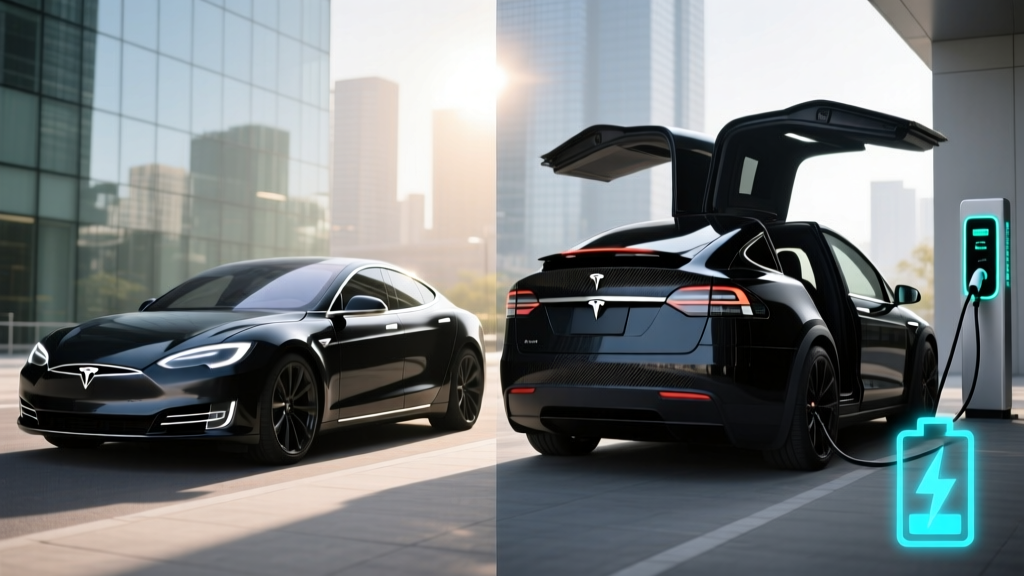
Tesla's flagship sedan and SUV have evolved into two very different propositions in 2026. The Model S remains the efficiency and range benchmark in the luxury EV sedan segment, while the Model X trades some of that efficiency for three-row versatility and falcon-wing drama. If you are cross-shopping the Tesla Model S and Tesla Model X, the decision comes down to how you weigh highway range and sportiness against passenger capacity and cargo flexibility. This profile breaks down both vehicles across the metrics that matter most to EV buyers: real-world range, charging speed, total cost, and daily livability.
Quick Verdict: Model S vs Model X at a Glance
Before we get into the weeds, here is the high-level read after extensive driving and data review of both 2026 models:
Choose the Tesla Model S if: You prioritize maximum range per charge, the lowest cost per mile, sedan dynamics, and a sub-2-second 0-60 time in Plaid trim. It is the better road-trip EV and the more efficient daily commuter.
Choose the Tesla Model X if: You need three rows of seating for up to seven passengers, want easier cargo loading through the large rear hatch and falcon-wing doors, and regularly transport bulky items like strollers, bikes, or ski gear.
Range and Efficiency: Real-World Numbers That Matter
The Model S Long Range carries a 100 kWh usable battery (NMC chemistry) and posts an EPA-estimated 402 miles of range. The Model X Long Range uses the same battery pack but its heavier curb weight and less aerodynamic profile reduce the EPA estimate to 348 miles. Both figures are best-in-class for their respective body styles.
Real-World Range Reality Check: The EPA figures assume a mix of city and highway driving at moderate temperatures. In our testing and owner data aggregation:
- Model S Long Range: Expect ~340-360 miles on sustained highway drives at 70-75 mph. In freezing weather (below 32°F), plan for 280-310 miles due to battery heating demands and cabin climate load.
- Model X Long Range: Expect ~290-310 miles highway, dropping to roughly 240-270 miles in deep cold. The larger frontal area and 5,000+ lb curb weight compound the winter penalty.
Both vehicles feature a heat pump as standard, which mitigates some cold-weather loss compared to resistive heating, but the physics of a large SUV in sub-freezing temps are unavoidable.
Efficiency ratings from fueleconomy.gov show the Model S Long Range at 124 MPGe combined (27 kWh/100 mi), while the Model X Long Range comes in at 102 MPGe combined (33 kWh/100 mi). Over 15,000 miles per year, that translates to roughly $600 in electricity for the Model S versus $730 for the Model X at the national average of $0.17/kWh — a modest but real gap that compounds over ownership.
| Specification | Model S Long Range | Model S Plaid | Model X Long Range | Model X Plaid |
|---|---|---|---|---|
| EPA Range | 402 mi | 359 mi | 348 mi | 311 mi |
| Battery (usable) | 100 kWh, NMC | 100 kWh, NMC | 100 kWh, NMC | 100 kWh, NMC |
| MPGe (combined) | 124 MPGe | 116 MPGe | 102 MPGe | 100 MPGe |
| Drivetrain | Dual-Motor AWD | Tri-Motor AWD | Dual-Motor AWD | Tri-Motor AWD |
| Horsepower | 670 hp | 1,020 hp | 670 hp | 1,020 hp |
| 0-60 mph | 3.1 sec | 1.99 sec | 3.8 sec | 2.5 sec |
| Top Speed | 155 mph | 200 mph | 155 mph | 163 mph |
| Max DC Charge Rate | 250 kW | 250 kW | 250 kW | 250 kW |
| 10-80% DCFC Time | ~27 min | ~27 min | ~30 min | ~30 min |
| Level 2 Rate (48A) | 11.5 kW (~44 mi/hr) | 11.5 kW (~44 mi/hr) | 11.5 kW (~37 mi/hr) | 11.5 kW (~37 mi/hr) |
| Seating | 5 passengers | 5 passengers | 5, 6, or 7 | 5, 6, or 7 |
| Cargo (rear seats up) | 28 cu ft | 28 cu ft | 42 cu ft (5-seat) | 42 cu ft (5-seat) |
| Cargo (max) | 64 cu ft | 64 cu ft | 88 cu ft (5-seat) | 88 cu ft (5-seat) |
| Frunk | 3.1 cu ft | 3.1 cu ft | 6.6 cu ft | 6.6 cu ft |
| Base MSRP | $84,990 | $104,990 | $94,990 | $114,990 |
| Federal Tax Credit (§30D) | Not eligible | Not eligible | Not eligible | Not eligible |
| Battery Warranty | 8 yr / 150,000 mi | 8 yr / 150,000 mi | 8 yr / 150,000 mi | 8 yr / 150,000 mi |
Charging Speed: Supercharger Network Advantage
Both the Model S and Model X peak at 250 kW on DC fast charging via Tesla's V3 Superchargers. While 250 kW is no longer the fastest in the industry — the Hyundai Ioniq 5 and Porsche Taycan push 350 kW — Tesla's sustained charge curve and network reliability remain the gold standard for road-trip charging.
| Charging Level | Power | Model S Miles/Hour | Model X Miles/Hour | Notes |
|---|---|---|---|---|
| Level 1 (120V) | ~1.4 kW | ~3-4 mi/hr | ~3 mi/hr | Emergency/trickle only |
| Level 2 (240V, 48A) | 11.5 kW | ~44 mi/hr | ~37 mi/hr | Home Wall Connector; full overnight charge |
| Level 2 (240V, 32A) | 7.7 kW | ~30 mi/hr | ~25 mi/hr | Mobile Connector on NEMA 14-50 |
| DC Fast (V3 Supercharger) | 250 kW peak | ~200 mi in 15 min | ~175 mi in 15 min | 10-80% in ~27-30 min |
| DC Fast (V4 Supercharger) | Up to 250 kW* | Similar to V3 | Similar to V3 | *Model S/X limited to 250 kW even at V4 posts |
Charging curve reality: The 250 kW peak is achieved between roughly 10-30% state of charge. Above 50%, the rate tapers to ~150 kW, and above 80% it drops further to ~70 kW and below. This is why Tesla (and most EV makers) quote 10-80% times rather than full-charge times. On a road trip, plan your stops around the 10-80% window for the fastest throughput.
At home, the Tesla Wall Connector at 48 amps delivers 11.5 kW, which replenishes the Model S from empty in about 10 hours and the Model X in roughly 12 hours. Most owners who plug in nightly never need more than this — a typical 40-mile commute uses only about 12 kWh, which a Level 2 charger replaces in just over an hour.
With Tesla opening the Supercharger network to NACS-equipped vehicles from Ford, GM, Rivian, and others, congestion at popular corridors is a growing consideration. However, Tesla owners retain native navigation-based preconditioning, which warms the battery en route to a Supercharger and enables faster charging on arrival. This feature still gives Tesla vehicles a tangible edge in real-world DCFC performance versus competitors that lack integrated route-battery conditioning.
Performance and Driving Dynamics
The Model S Plaid's 1.99-second 0-60 mph claim remains one of the fastest production-car times ever recorded, courtesy of its tri-motor setup producing 1,020 horsepower. The Long Range dual-motor variant at 3.1 seconds is hardly slow — it out-accelerates nearly every sports sedan on the market.
The Model X Plaid achieves a remarkable 2.5 seconds to 60 mph despite its 5,100+ lb curb weight, though you will feel that mass in cornering and braking. The Long Range Model X at 3.8 seconds is brisk for a three-row SUV but is not attempting to be a sports car.
Ride quality has improved in recent model years with the adaptive air suspension, which is standard on both vehicles. The Model S offers a more planted, communicative drive. The Model X, with its higher center of gravity and heavier body, leans more into comfort-oriented cruising. Both are quiet at highway speed, though the Model X's falcon-wing door seals can introduce faint wind noise above 80 mph on some units.
Interior, Cargo, and Daily Livability
The Model S cabin seats five with generous front legroom (42.7 inches) and adequate rear legroom (35.4 inches). The 17-inch center touchscreen remains the command hub, with a yoke-style steering wheel standard (a conventional round wheel is available as a no-cost option). Build quality has improved noticeably since the 2021 refresh, with better panel gaps and material quality.
The Model X is where practicality takes center stage:
- Seating configurations: Available in 5-seat, 6-seat (with second-row captain's chairs), or 7-seat layouts. The third row is best suited for children on longer trips; adults will find it tight beyond short drives.
- Falcon-wing doors: The rear doors open upward, providing dramatic access to the second and third rows in tight parking spaces. They require overhead clearance (roughly 7 feet) and can be slow in rain compared to conventional doors. Ultrasonic sensors detect obstacles, but the mechanism adds complexity and repair cost.
- Cargo: With all seats up in 5-seat config, the Model X offers 42 cu ft behind the second row. Fold everything flat and you get 88 cu ft — enough for furniture-hauling duty. The 6.6 cu ft frunk adds useful grocery or cable storage.
The Model S's 28 cu ft trunk (64 cu ft with rear seats folded) is generous for a sedan thanks to its hatchback-style liftgate, but it cannot match the Model X for vertical cargo or bulky items.
Pricing, Trims, and Tax Credit Reality
Both the Model S and Model X fall well above the IRS §30D federal tax credit MSRP cap of $55,000 for sedans and $80,000 for SUVs/vans/pickups. Here is how that plays out:
| Trim | Base MSRP | Typical As-Tested | §30D Credit Eligible? | Effective Price After Credit |
|---|---|---|---|---|
| Model S Long Range | $84,990 | $89,000-$94,000 | No (exceeds $55K sedan cap) | $84,990+ |
| Model S Plaid | $104,990 | $110,000-$118,000 | No | $104,990+ |
| Model X Long Range | $94,990 | $99,000-$106,000 | No (exceeds $80K SUV cap) | $94,990+ |
| Model X Plaid | $114,990 | $120,000-$128,000 | No | $114,990+ |
Key tax credit context: Even if Tesla were to introduce a lower-priced trim that met the MSRP cap, buyers must also satisfy income limits ($300,000 joint / $150,000 single modified adjusted gross income), battery critical-mineral sourcing requirements, and North American assembly rules. At these price points, neither the Model S nor Model X qualifies for the federal credit. Some states offer their own incentives (California's CVRP, for example, has its own income and MSRP caps), so check your state and local programs separately. Consult a tax professional for your specific situation.
Options that push as-tested prices higher include Ultra Red or Midnight Silver Metallic paint ($2,000-$2,500), 21-inch Arachnid wheels ($4,500 on Plaid), Full Self-Driving (Supervised) capability ($8,000), and rear-seat entertainment screens on the Model X ($2,000).
Warranty and Long-Term Ownership
Tesla covers both the Model S and Model X with:
- Basic vehicle warranty: 4 years / 50,000 miles
- Battery and drive unit warranty: 8 years / 150,000 miles, whichever comes first, with minimum 70% battery capacity retention guaranteed over that period
The 150,000-mile battery warranty is more generous than the 100,000-mile or 120,000-mile thresholds offered by many competitors. Tesla's NMC battery packs in the Model S and Model X have demonstrated moderate degradation in fleet data — typically 8-12% loss over the first 100,000 miles, with the curve flattening significantly after the initial break-in period. Out-of-warranty battery replacement costs remain high: expect $15,000-$22,000 for a full pack replacement at a Tesla Service Center, though partial module repairs can reduce that figure.
Maintenance costs are low compared to ICE equivalents — no oil changes, no transmission fluid, and regenerative braking extends pad life significantly. However, Tesla service center wait times and parts availability have been a recurring complaint in owner surveys, particularly for body-panel and falcon-wing mechanism repairs on the Model X.
Driver Assistance: Autopilot and FSD (Supervised)
SAE Automation Level: Level 2. Tesla Autopilot and Full Self-Driving (Supervised) are driver-assistance systems that require continuous driver engagement. You must keep your hands on the wheel and eyes on the road at all times. These systems do NOT make the vehicle self-driving. Only Level 4 robotaxi services like Waymo operate without a human driver in defined service areas.
Both vehicles come standard with Basic Autopilot (traffic-aware cruise control and autosteer on marked roads). The $8,000 FSD (Supervised) upgrade adds automated lane changes, traffic light and stop sign recognition, and city-street autosteer. As of 2026, FSD remains a supervised system — impressive on well-mapped highways and suburban roads, but still prone to phantom braking, construction-zone confusion, and inconsistent behavior in adverse weather. It is a convenience feature, not a replacement for an attentive driver.
What FSD (Supervised) does NOT do: Navigate unmapped roads, operate reliably in heavy snow or fog, handle all construction zones, or eliminate the need for driver attention. NHTSA continues to monitor Tesla's Autopilot/FSD crash data, and all incidents involving these systems are subject to standing reporting orders.
Pros and Cons
Model S Pros
- Class-leading 402-mile EPA range (Long Range)
- 124 MPGe combined — lowest running cost in its segment
- Sub-2-second 0-60 (Plaid) or 3.1-second (LR)
- Access to Supercharger network with native preconditioning
- 150,000-mile battery warranty
Model S Cons
- No federal tax credit eligibility at current MSRP
- Yoke steering is polarizing; round wheel availability varies
- Rear seat space trails some luxury sedan rivals (BMW i7, Mercedes EQS)
- 250 kW peak DCFC is slower than 350 kW competitors
- Premium pricing with limited luxury interior finishes vs. German rivals
Model X Pros
- Three-row seating for up to 7 passengers
- 88 cu ft max cargo with hatchback practicality
- Falcon-wing doors ease access in tight spaces
- 670 hp / 1,020 hp in a family SUV
- 6.6 cu ft frunk for additional storage
Model X Cons
- 54-mile range penalty vs. Model S (348 vs 402 EPA)
- Falcon-wing doors add mechanical complexity and repair cost
- Third row is cramped for adults on long trips
- No federal tax credit eligibility
- Heavier weight increases tire wear and energy cost
Competitive Landscape: Is a Tesla Flagship Still the Right Call?
The luxury EV market has thickened considerably. Here is how the Model S and Model X stack up against key 2026 alternatives:
- Model S vs. Lucid Air Grand Range: The Lucid Air posts 516 miles EPA and charges at up to 300 kW, surpassing the Model S on both metrics. However, Tesla's Supercharger network reliability, lower starting price, and over-the-air update cadence keep the Model S competitive. The Lucid starts around $87,400 for the Pure trim but climbs quickly.
- Model S vs. BMW i7 xDrive60: The i7 offers a more traditionally luxurious interior and a 318-mile EPA range at ~$120,000. It charges at 195 kW. If interior opulence matters more than range and acceleration, the i7 wins. If you want efficiency and performance per dollar, the Model S prevails.
- Model X vs. Rivian R1S: The R1S (quad-motor, ~$99,900) offers genuine off-road capability, a more rugged design, and up to 410 miles with the Max Pack. It seats seven but lacks the Model X's falcon-wing convenience and Supercharger access. The R1S is the better adventure-family SUV; the Model X is the better suburban-road-trip hauler.
- Model X vs. Kia EV9 GT-Line AWD: The EV9 starts at roughly $73,000 and offers 270 miles EPA, three rows, and 800V architecture (up to 236 kW charging). It is dramatically more affordable but gives up 80 miles of range and significant performance to the Model X.
Who Should Buy the Model S or Model X?
The Model S is best for: High-mileage commuters, frequent road-trippers who value Supercharger convenience, performance enthusiasts who want supercar acceleration in a daily-driver sedan, and buyers who prioritize range above all else in a luxury EV.
The Model X is best for: Families with three or more children, buyers who regularly haul cargo that won't fit in a sedan trunk, those who value the theatrical appeal and practical access of falcon-wing doors, and anyone who wants Plaid-level performance in a vehicle that can carry seven people.
Neither vehicle is the right choice if you need the federal tax credit — both exceed MSRP caps. If the $7,500 credit is essential to your purchase math, look at the Tesla Model 3 Long Range ($47,740, eligible), the Model Y Long Range ($49,990, eligible), or competitors like the Hyundai Ioniq 5, Chevrolet Equinox EV, or Ford Mustang Mach-E, all of which can qualify depending on trim and buyer income.
Frequently Asked Questions
What is the real-world range of the Tesla Model S and Model X?
The Model S Long Range delivers approximately 340-360 miles on highway trips in mild weather and 280-310 miles in freezing conditions. The Model X Long Range achieves about 290-310 miles highway in mild weather and 240-270 miles in cold weather. City driving with regenerative braking can push these numbers higher, sometimes exceeding the EPA estimate in stop-and-go traffic.
How fast do the Model S and Model X charge?
Both peak at 250 kW on DC fast chargers, achieving a 10-80% charge in approximately 27 minutes (Model S) or 30 minutes (Model X). At home on a Level 2 Tesla Wall Connector (48A / 11.5 kW), the Model S adds about 44 miles of range per hour and the Model X adds about 37 miles per hour. A full overnight charge from 20% takes roughly 8-9 hours for the Model S and 10-11 hours for the Model X.
Does the Tesla Model S or Model X qualify for the federal EV tax credit?
No. Under current IRS §30D rules, the Model S exceeds the $55,000 MSRP cap for sedans, and the Model X exceeds the $80,000 MSRP cap for SUVs. Even a hypothetical lower-priced trim would need to satisfy buyer income limits ($300K joint / $150K single MAGI), critical-mineral sourcing, and North American battery-component requirements. Check with a tax professional for your specific eligibility.
Is the Tesla Model X third row practical for adults?
The third row accommodates adults for short trips (under 30 minutes), but legroom and headroom are tight for anyone over 5'8". Children and teens are the ideal third-row passengers. For regular adult hauling in all three rows, a larger SUV or minivan is more comfortable.
Are falcon-wing doors on the Model X worth the added complexity?
Falcon-wing doors are genuinely useful in tight parking spaces, providing full overhead access to the second and third rows without swinging outward into adjacent cars. However, they are slower to open than conventional doors, can struggle in heavy rain (water drips inward when raised), and add significant repair cost if the motor or sensor mechanism fails. Whether they are "worth it" depends on how often you load passengers in tight urban parking situations.
How long will the Model S/X battery last?
Tesla warranties the battery for 8 years or 150,000 miles with at least 70% capacity retention. Fleet data suggests these NMC packs typically lose 8-12% capacity in the first 100,000 miles, with degradation slowing considerably afterward. Many Model S and X vehicles have exceeded 200,000 miles on the original pack. Charging habits (avoiding repeated 100% charges and deep discharges) and moderate climate exposure help maximize longevity.
Is it worth buying a Model S or Model X versus key competitors?
The Model S remains compelling for its range, Supercharger access, and performance-per-dollar. The Model X is one of very few three-row electric SUVs with genuine performance credentials. However, if you prioritize interior luxury, the BMW i7 or Mercedes EQS may satisfy more. If you need off-road capability, the Rivian R1S is a stronger fit. And if the federal tax credit matters to your budget, neither Tesla flagship qualifies — consider the Model Y, Ioniq 5, or Equinox EV instead.