The Tesla Model S in 2026: Still the Performance Benchmark?
The Tesla Model S has been the default answer for "fast luxury EV" for over a decade. But in 2026, with rivals like the Lucid Air Sapphire, Porsche Taycan Turbo GT, and BMW i7 M70 closing the gap, the question isn't just whether the Model S is quick — it's whether its combination of top speed, range, charging infrastructure, and daily usability still justifies a six-figure price tag.
This review covers both the Model S Long Range and the Model S Plaid, the latter being the variant most buyers search for when they ask about the top speed of the Tesla Model S. We'll break down EPA range versus what you'll actually see on the highway, real-world DC fast-charging behavior (not just the peak kW number), and the tax-credit math that has shifted significantly for luxury EVs under current IRS §30D rules.
Top Speed, 0-60, and Powertrain Specs
Let's address the headline number first. The Tesla Model S Plaid carries an electronically limited top speed of 200 mph when equipped with the optional Track Package (wheels, tires, and ceramic brake upgrades). Without the Track Package, the Plaid is governed to 175 mph. The Model S Long Range tops out at 155 mph.
Those top-speed figures matter for track use and autobahn-style driving, but for 99% of owners, the more relevant number is the 0-60 mph time — and here the Plaid remains one of the quickest production cars ever built.
| Spec | Model S Long Range | Model S Plaid |
|---|---|---|
| 0-60 mph | 3.1 seconds | 1.99 seconds |
| Top Speed | 155 mph | 175 mph (200 mph w/ Track Pkg) |
| Horsepower | 670 hp | 1,020 hp |
| Drivetrain | Dual-Motor AWD | Tri-Motor AWD |
| EPA Range | 402 miles | 359 miles |
| MPGe (combined) | 120 MPGe | 116 MPGe |
| Efficiency | 28 kWh/100 mi | 29 kWh/100 mi |
The Plaid's tri-motor setup uses one front motor and two rear motors with torque vectoring across the rear axle. This is what enables the sub-2-second 0-60 time on a prepped surface (with rollout subtracted, as Tesla reports). In independent testing by outlets like Car and Driver and Motor Trend, real-world 0-60 times typically land between 2.1 and 2.3 seconds — still devastatingly quick, and meaningfully faster than anything in its price class except the Lucid Air Sapphire (1.89 seconds claimed).
Real-World Range vs. EPA Estimates
The Model S uses a roughly 100 kWh battery pack (usable capacity approximately 95 kWh) with NMC (nickel manganese cobalt) chemistry. Tesla does not publish exact cell chemistry or capacity figures, but teardown analyses and charging data consistently place usable capacity in this range. NMC chemistry offers high energy density — critical for fitting 400+ miles of range into a sedan platform — but it does not tolerate sustained 100% state of charge as well as LFP (lithium iron phosphate) packs. Tesla recommends daily charging to 80-90% for NMC packs and only charging to 100% before long trips.
According to fueleconomy.gov, the Model S Long Range achieves 120 MPGe combined, which translates to roughly 28 kWh per 100 miles. That efficiency figure is impressive for a 4,500+ lb sedan with 670 hp, and it's a key reason the Model S still leads the luxury EV segment in range-per-kWh.
Charging Speed: DC Fast Charging and Home Level 2
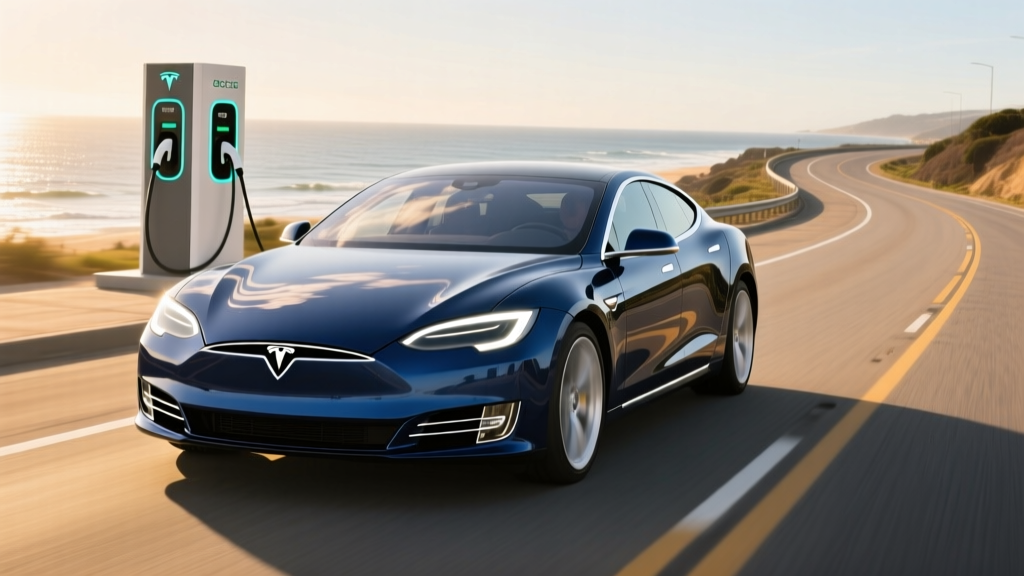
The Model S uses the NACS (North American Charging Standard) connector natively — Tesla designed it, and it's now the industry standard adopted by Ford, GM, Rivian, and most major automakers through 2025-2026. This gives the Model S seamless access to the Tesla Supercharger network, which remains the most reliable and widespread DC fast-charging network in the U.S.
| Charging Level | Power | Speed / Time |
|---|---|---|
| Level 1 (120V household) | ~1.4 kW | ~3-4 miles per hour |
| Level 2 (240V home/wall connector) | 11.5 kW (48A) | ~34 miles per hour; full charge in ~9 hours |
| DC Fast Charge (V3 Supercharger) | Peak 250 kW | 10-80% in ~27 minutes; ~200 miles in 15 min |
| DC Fast Charge (V4 Supercharger) | Peak 250 kW (Model S limited) | Similar to V3; V4 hardware supports higher rates for future platforms |
A critical nuance: while Tesla's V4 Supercharger posts can deliver up to 350+ kW to compatible vehicles, the Model S is currently limited to approximately 250 kW peak due to its 400V electrical architecture. Competitors on 800V+ platforms — like the Porsche Taycan (up to 320 kW peak) and the Lucid Air (up to 300 kW) — can sustain higher charge rates for longer portions of the session.
In practice, the Model S charge curve peaks near 250 kW only between roughly 10-30% state of charge, then tapers progressively. From 50-80%, you'll see rates closer to 100-130 kW. This is why the 10-80% time is ~27 minutes rather than the ~18 minutes you'd get if peak rate were sustained. Always precondition the battery (the car does this automatically when you navigate to a Supercharger) to reach peak charge rates — arriving at a Supercharger with a cold battery can add 10+ minutes to your session.
Pricing, Trims, and Federal Tax Credit Eligibility
| Trim | Base MSRP | As-Tested (typical options) |
|---|---|---|
| Model S Long Range | $74,990 | $78,000-$82,000 |
| Model S Plaid | $89,990 | $95,000-$105,000 |
Options that move the price include the Track Package for Plaid (~$8,000-$10,000, includes carbon-ceramic brakes, forged wheels, and the 200-mph top-speed unlock), premium paint colors ($1,500-$2,500), 21-inch Arachnid wheels ($4,500), and Full Self-Driving (Supervised) capability ($8,000 one-time or $99/month subscription).
The absence of the federal credit means the Model S is a full-price purchase for most buyers. Some states offer their own luxury-EV or high-income rebates that don't carry the same MSRP caps — check your state energy office or the Alternative Fuels Data Center for state-level incentives.
Interior, Cargo, and Daily Usability
The Model S interior has been substantially refreshed in recent years, moving past the minimalist controversy of the yoke-only era. A conventional round steering wheel is now available again (and, in our view, preferable for daily driving). The 17-inch center touchscreen remains the primary interface for virtually all vehicle controls, climate, navigation, and entertainment.
Cargo capacity: The Model S offers approximately 28 cubic feet of rear cargo space with the rear seats upright, expanding to roughly 50 cubic feet with the 60/40 split rear seats folded. The front trunk (frunk) adds approximately 3.1 cubic feet — enough for a charging cable kit and a small bag.
Passenger space: Rear legroom measures approximately 35.4 inches, which is adequate for adults but falls short of the BMW i7 or Mercedes EQS. Headroom is generous thanks to the glass roof, though the low-slung roofline does require some ducking on entry. The Model S seats five, though the optional rear-facing third-row jump seat (available in earlier model years) has been discontinued.
Tech highlights:
- 17-inch center touchscreen with 22-speaker, 960-watt audio system
- Rear-seat 8-inch touchscreen for climate and entertainment
- Over-the-air software updates that add features monthly
- Gaming-capable hardware (Cyberpunk 2077, Stardew Valley playable while parked)
- HEPA air filtration with Bioweapon Defense Mode
- Adaptive air suspension with automatic ride-height adjustment
Driver assistance: The Model S comes standard with Tesla's Basic Autopilot (adaptive cruise control, lane centering, automatic emergency braking). Full Self-Driving (Supervised) adds automated lane changes, Navigate on Autopilot, Smart Summon, and traffic light/stop sign recognition. However, it is critical to understand that FSD is SAE Level 2 — the driver must remain fully engaged, hands on the wheel, and eyes on the road at all times. It is not autonomous driving. For context on SAE automation levels, Level 2 requires continuous driver supervision, while true driverless operation (Level 4) is currently limited to geofenced robotaxi services like Waymo.
Warranty, Battery Longevity, and Ownership Costs
Tesla provides the following warranty coverage for the Model S:
- Basic Vehicle Limited Warranty: 4 years / 50,000 miles
- Battery and Drive Unit Warranty: 8 years / 150,000 miles (whichever comes first), with minimum 70% battery capacity retention guaranteed
The 8-year/150,000-mile battery warranty is competitive with other luxury EVs, though some rivals like Hyundai/Genesis offer 10-year/100,000-mile coverage. The 70% retention threshold means Tesla guarantees the pack will hold at least 70% of its original capacity during the warranty period — if degradation exceeds 30%, Tesla will repair or replace the battery at no cost.
Real-world degradation data from Tesla's fleet and third-party tracking (such as Recurrent Auto's battery health reports) suggests that NMC packs in the Model S typically lose approximately 10-12% capacity in the first 50,000 miles, then the degradation curve flattens significantly. Many high-mileage Model S vehicles (150,000+ miles) report 80-85% state of health, which is within the warranty threshold.
Ownership cost considerations:
- Insurance: Model S premiums are among the highest in the EV segment. Expect $3,500-$5,500 annually depending on state, driving record, and coverage level. Get quotes before purchasing.
- Maintenance: No oil changes, minimal brake wear (regen braking preserves pads), cabin air filter replacement every 2 years, tire rotation every 6,250 miles. Budget ~$500-$800/year for tires, which wear faster due to vehicle weight and instant torque.
- Charging cost: At the national average electricity rate of ~$0.16/kWh, a full home charge costs roughly $15-$16. Supercharger rates vary from $0.25-$0.50/kWh, making a full DC charge $25-$48 depending on location.
Tesla Model S vs. Key Competitors
Choose the Model S If:
- Supercharger network access is a priority for road trips
- You want 400+ miles of EPA range in a performance sedan
- Sub-2-second 0-60 (Plaid) is a non-negotiable
- OTA updates and software-first features matter to you
Consider Competitors If:
- Lucid Air Grand Touring: You want 500+ miles of range and faster 800V+ charging ($125,000+)
- Porsche Taycan Turbo GT: You prioritize handling precision and 800V architecture (320 kW peak charging) over raw range
- BMW i7 M70: You need executive-level rear-seat luxury and space (~$170,000)
- Mercedes EQS 580: You want the quietest, most isolated luxury sedan experience
The Model S occupies a unique position: it undercuts the Lucid Air Sapphire and Porsche Taycan Turbo GT on price while delivering comparable (or superior) straight-line acceleration. Its 402-mile EPA range in Long Range trim still leads most luxury EVs. The Supercharger network remains Tesla's strongest moat — while other brands now access Superchargers via NACS adapters, native Tesla integration (plug-and-charge with no app, no adapter, automatic billing) is still the most frictionless public charging experience available.
The trade-off is interior luxury that doesn't quite match BMW, Mercedes, or even Lucid at this price point, and a 400V charging architecture that limits DC fast-charge speeds relative to newer 800V platforms.
Pros and Cons
Pros
- Class-leading EPA range (402 mi Long Range)
- Sub-2-second 0-60 mph (Plaid)
- Native Supercharger access — best public charging UX
- Continuous OTA feature updates
- Strong efficiency (28 kWh/100 mi)
- Generous cargo space for a sedan (28 cu ft + frunk)
Cons
- No federal tax credit (MSRP exceeds $55K sedan cap)
- 400V architecture limits DC fast-charge speed vs. 800V rivals
- Interior materials and ride refinement trail German luxury competitors
- High insurance premiums ($3,500-$5,500/yr)
- FSD (Supervised) requires constant driver attention — not autonomous
- NMC battery requires 80-90% daily charge limit for longevity
Frequently Asked Questions
What is the top speed of the Tesla Model S?
The Model S Plaid has a top speed of 175 mph standard, or 200 mph with the optional Track Package. The Model S Long Range is limited to 155 mph.
What is the real-world range of the Tesla Model S?
The EPA rates the Long Range at 402 miles and the Plaid at 359 miles. In real-world highway driving at 70-75 mph, expect 330-360 miles (Long Range) and 290-320 miles (Plaid). Cold weather below freezing can reduce range by an additional 15-25%.
How fast does the Model S charge at home and on the road?
At home on a Level 2 Tesla Wall Connector (240V, 48A), the Model S charges at 11.5 kW, adding roughly 34 miles of range per hour — a full charge takes about 9 hours. On a V3 Supercharger, it peaks at 250 kW and charges from 10-80% in approximately 27 minutes.
Does the Tesla Model S qualify for the federal EV tax credit?
No. Under current IRS §30D rules, the federal tax credit has a $55,000 MSRP cap for sedans. The Model S Long Range starts at $74,990 and the Plaid at $89,990, both well above the cap. Income limits ($150K single / $300K joint) and battery-sourcing requirements would further restrict eligibility even if the price cap were met.
Is the Tesla Model S worth buying in 2026 vs. competitors?
The Model S Long Range remains the best value in the 400+ mile luxury EV segment, especially if road-trip charging convenience is a priority. The Plaid offers supercar acceleration at a fraction of a Bugatti or Rimac price. However, if interior luxury, 800V fast-charging architecture, or 500+ mile range are higher priorities, the Lucid Air, Porsche Taycan, or BMW i7 may be better fits.
What battery does the Model S use, and how long will it last?
The Model S uses an approximately 100 kWh (usable) NMC lithium-ion battery pack. Tesla's warranty guarantees 70% capacity retention for 8 years or 150,000 miles. Fleet data suggests typical degradation of 10-12% in the first 50,000 miles, with a flattened curve thereafter. Many high-mileage examples report 80-85% state of health at 150,000+ miles.