Tesla has never built a traditional station wagon. No long-roof Model 3, no lifted Model Y Avant. But for buyers searching for a Tesla station wagon — an electric vehicle that blends sedan efficiency with wagon-like cargo versatility — the 2026 Tesla Model S remains the closest answer in the lineup. With a hatchback liftgate, fold-flat rear seats, a front trunk (frunk), and over 400 miles of EPA-rated range, the Model S occupies a unique niche: a luxury EV that can actually swallow road-trip gear, dog crates, or a week's worth of groceries without resorting to a taller SUV.
This review examines whether the Model S delivers on the station-wagon promise in 2026, with exact figures on range, charging, cargo dimensions, pricing, and federal tax-credit eligibility.
Range, Battery, and Real-World Efficiency
The 2026 Model S Long Range uses a ~100 kWh usable battery pack with NMC (nickel manganese cobalt) chemistry — Tesla's higher-energy-density choice for its premium vehicles. The EPA rates it at 402 miles of combined range, placing it among the longest-range EVs sold in the U.S. Efficiency comes in at 124 MPGe combined (approximately 27 kWh/100 mi), per fueleconomy.gov.
EPA estimate: 402 miles. In mixed highway driving at 70–75 mph, expect roughly 330–360 miles before needing a charge. In cold weather (below 30°F), range can drop 20–30%, yielding 280–320 miles. City driving with regenerative braking can match or slightly exceed the EPA figure.
The gap between the EPA sticker and real-world highway range isn't a Tesla flaw — it's physics. The EPA test cycle includes substantial low-speed and stop-and-go segments where regenerative braking recovers energy. Sustained highway speeds, headwinds, and elevation changes push consumption higher. The Model S heat pump helps mitigate cold-weather cabin-heating losses, but battery chemistry itself is less efficient at low temperatures.
| Spec | Value |
|---|---|
| EPA Range | 402 miles |
| Battery (usable) | ~100 kWh, NMC |
| Efficiency | 124 MPGe / ~27 kWh/100 mi |
| Peak DC Fast Charge | 250 kW |
| 10–80% DC Charge | ~30 minutes |
| Level 2 Home Charge | 11.5 kW (~44 mi/hr) |
| 0–60 mph | 3.1 seconds |
| Horsepower | 670 hp (dual motor) |
| Drivetrain | AWD (dual motor) |
| Base MSRP | $79,990 |
| Battery Warranty | 8 yr / 150,000 mi |
Charging Speed: DC Fast, Level 2, and the Supercharger Advantage
The Model S charges at up to 250 kW on a V3 Tesla Supercharger or any CCS-equipped DC fast charger (via the Model S's CCS-compatible charge port introduced in recent model years). On a preconditioned battery, the charge curve peaks near 250 kW at low state of charge and tapers progressively above 50%, with the 10–80% session taking approximately 30 minutes.
| Charge Level | Power | Speed (approx.) |
|---|---|---|
| Level 1 (120V) | ~1.4 kW | ~5 miles/hour |
| Level 2 (240V, 48A) | 11.5 kW | ~44 miles/hour |
| DC Fast (V3 Supercharger) | 250 kW peak | 10–80% in ~30 min |
| DC Fast (CCS station) | Up to 250 kW | Varies by station output |
Home charging on a Level 2 Wall Connector at 48 amps adds roughly 44 miles of range per hour — an overnight session easily replenishes a full day's driving. Tesla's NACS connector remains the native standard, and with most major automakers adopting NACS for their 2025+ models, the Model S benefits from the industry's broadest fast-charging network: over 25,000 Superchargers across North America.
Charging-curve reality check: The 250 kW figure is a peak, not a sustained rate. Expect roughly 150–180 kW average over a 10–80% session. Preconditioning the battery (automatic when navigating to a Supercharger) is essential for hitting peak rates — arriving at a charger cold can double your session time.
Cargo Space: Does the Model S Qualify as a Tesla Station Wagon?
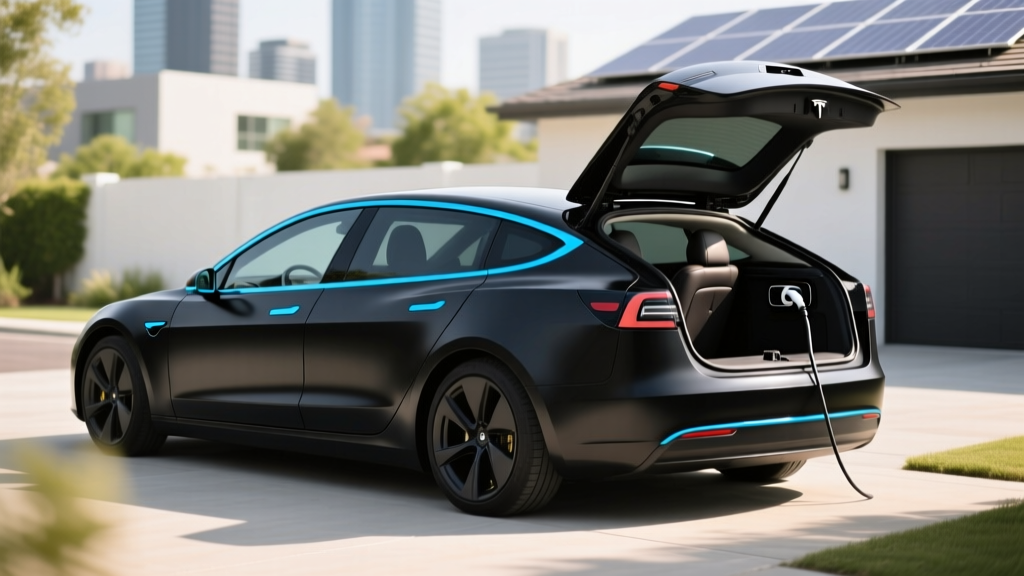
Here's where the station-wagon comparison gets interesting. The Model S is technically a liftback sedan, but its hatchback-style rear opening and fold-flat second row give it cargo flexibility that rivals midsize wagons and compact SUVs.
- Cargo behind rear seats: 28 cu ft
- Cargo with rear seats folded: 64.9 cu ft
- Front trunk (frunk): ~3.1 cu ft
- Total enclosed volume: ~68 cu ft
- Rear legroom: 35.4 inches
- Front headroom: 38.8 inches
For comparison, the discontinued Audi A4 Avant offered 50.5 cu ft with seats folded. The Model S surpasses that figure and adds the frunk for charging cables or a soft bag. The wide, flat load floor accommodates full-size suitcases, strollers, or a large dog crate without stacking. The hatch opening is tall enough for upright boxes.
Where the Model S falls short of a true wagon: roof height. You can't stand items vertically the way you could in a Subaru Outback or Volvo V90. Tall cargo must lay flat. If you need to haul furniture or stand-up gear (kayaks on edge, tall plants), a Model Y or Model X will serve better.
Performance and Driving Impressions
The 2026 Model S Long Range produces 670 horsepower from its dual-motor all-wheel-drive powertrain, launching to 60 mph in 3.1 seconds. The Plaid variant (1,020 hp, 1.99-second 0–60) remains available for buyers who want supercar acceleration in a family hauler, though it sacrifices a modest amount of range (EPA 396 miles).
Adaptive air suspension is standard, allowing ride-height adjustment for highway efficiency or rough-road clearance. The steering is quick and precise — more sports sedan than luxury barge. At highway speeds, cabin noise is well-managed, with minimal wind rush around the frameless door glass.
Tesla's Autopilot comes standard and includes adaptive cruise control, lane centering, and automatic emergency braking. Full Self-Driving (Supervised) remains a $8,000 option. It's critical to understand: FSD is SAE Level 2 driver-assist — you must remain engaged, hands on or near the wheel, and eyes on the road at all times. It is not autonomous driving.
Tesla Autopilot and FSD (Supervised) are SAE Level 2 systems. The driver is fully responsible for vehicle operation at all times. Do not use these systems while fatigued, distracted, or impaired. NHTSA continues to investigate Autopilot-related incidents — stay current on recalls and software updates via the NHTSA website.
Pricing, Trims, and Federal Tax Credit Eligibility
The 2026 Model S lineup includes two trims:
| Trim | MSRP | Federal Tax Credit (§30D) | Effective Price |
|---|---|---|---|
| Long Range | $79,990 | $0 (exceeds MSRP cap) | $79,990 |
| Plaid | $94,990 | $0 (exceeds MSRP cap) | $94,990 |
Tax credit reality: Under IRS §30D rules, new electric vehicles must have an MSRP at or below $55,000 for sedans (or $80,000 for SUVs/trucks/vans) to qualify for the up-to-$7,500 federal tax credit. The Model S is classified as a sedan, meaning the $55,000 cap applies — and both trims exceed it. Additionally, buyer income caps ($150,000 single / $300,000 joint MAGI) and critical-mineral/battery-sourcing requirements further narrow eligibility. Consult IRS.gov §30D guidelines and a tax professional before assuming credit eligibility.
Destination charges, paint upgrades ($2,000 for non-white), FSD ($8,000), and premium interior options can push an as-tested Model S Long Range past $90,000.
Warranty and Long-Term Ownership
Tesla covers the Model S battery and drive unit for 8 years or 150,000 miles, whichever comes first, with a minimum 70% capacity retention guarantee. The limited vehicle warranty runs 4 years / 50,000 miles.
NMC battery chemistry in the Model S has demonstrated favorable long-term degradation profiles in fleet data. Most owners report 5–10% capacity loss over the first 100,000 miles, with degradation slowing substantially after the initial break-in period. Tesla's thermal management system — liquid cooling and heating — is a key factor in preserving cell health across climates.
Insurance costs remain a consideration: the Model S typically carries premiums 30–50% above comparable internal-combustion sedans, driven by repair costs and performance classification. Get a quote before purchasing.
Who Should Buy the Tesla Model S as a Station Wagon Alternative?
- You want 400+ miles of range for road trips without frequent charging stops
- You need sedan-class efficiency with hatchback cargo flexibility (28–65 cu ft)
- You value Supercharger network access for cross-country travel
- You want dual-motor AWD with sub-3.5-second acceleration
- You need tall, upright cargo space (consider Model Y or Model X)
- You want federal tax-credit eligibility (the Model S exceeds the sedan MSRP cap)
- You're on a budget below $60,000 (consider Model 3 or competitors)
- You prefer physical controls and traditional infotainment over Tesla's touchscreen-centric UI
Pros and Cons
- 402-mile EPA range — among the longest of any EV sold in the U.S.
- Hatchback cargo versatility: 64.9 cu ft with seats folded
- 250 kW DC fast charging with Supercharger network access
- 670 hp dual-motor AWD; 3.1-second 0–60
- Over-the-air updates continuously add features
- Air suspension standard for adjustable ride height
- $79,990 starting price — no federal tax credit (exceeds §30D sedan cap)
- Real-world highway range ~330–360 mi; cold-weather loss of 20–30%
- Touchscreen-only controls; no physical buttons for climate or volume
- Rear visibility limited by sloping roofline
- Insurance premiums significantly above segment average
- FSD (Supervised) is Level 2 — not autonomous despite the name
Frequently Asked Questions
Does Tesla make a station wagon?
No. Tesla does not produce a traditional station wagon. The Model S liftback sedan is the closest equivalent, offering hatchback cargo access with 64.9 cu ft of space when rear seats are folded — comparable to or exceeding many midsize wagons.
What is the real-world range of the 2026 Model S?
The EPA rates the Model S Long Range at 402 miles. In real-world highway driving at 70–75 mph, expect 330–360 miles. Cold weather (below 30°F) can reduce range to 280–320 miles. City driving with regenerative braking may match or exceed the EPA figure.
How fast does the Model S charge at home and on the road?
On a Level 2 home charger (240V, 48A), the Model S charges at 11.5 kW, adding approximately 44 miles of range per hour. On a V3 Supercharger or CCS DC fast charger, it peaks at 250 kW, completing a 10–80% session in roughly 30 minutes with a preconditioned battery.
Does the 2026 Model S qualify for the federal EV tax credit?
No. Under IRS §30D rules, the Model S exceeds the $55,000 MSRP cap for sedans, making it ineligible for the up-to-$7,500 new clean vehicle credit regardless of buyer income or battery sourcing. State-level incentives may still apply — check your local energy office.
Is the Model S worth buying over the Model Y or competitors?
The Model S makes sense if you prioritize maximum range (402 mi vs. Model Y's ~310 mi), sedan-class driving dynamics, and hatchback cargo flexibility without the taller SUV profile. If you need more upright cargo space, third-row seating, or a lower price point, the Model Y or a competitor like the Lucid Air (400+ mi, starts ~$69,900) may be better fits. The Model S's lack of federal tax-credit eligibility is a meaningful cost disadvantage versus credit-qualifying alternatives.
What is the battery warranty on the Model S?
Tesla covers the Model S battery and drive unit for 8 years or 150,000 miles (whichever comes first), guaranteeing a minimum of 70% capacity retention over that period. The general vehicle warranty is 4 years / 50,000 miles.