Does Tesla Own Starlink? The Short Answer
No — Tesla does not own Starlink. Starlink is a satellite internet constellation operated by SpaceX, a separate company founded and led by Elon Musk. While Musk serves as CEO of both Tesla and SpaceX, the two companies are independent public/private entities with distinct ownership structures, balance sheets, and product lines. Tesla is a publicly traded automaker and energy company (NASDAQ: TSLA); SpaceX is privately held, with Starlink operating as a division within it.
That said, the two companies share more than a founder. Tesla vehicles leverage cellular connectivity (primarily AT&T and T-Mobile networks in the U.S.) for their built-in navigation, streaming, and over-the-air updates — not Starlink satellites. However, speculation persists about future integration: a Tesla vehicle equipped with a Starlink terminal could theoretically offer connectivity in areas where cellular coverage is nonexistent. As of early 2026, no production Tesla vehicle ships with a Starlink antenna, and Tesla's Premium Connectivity subscription ($9.99/month) still routes through terrestrial cellular networks.
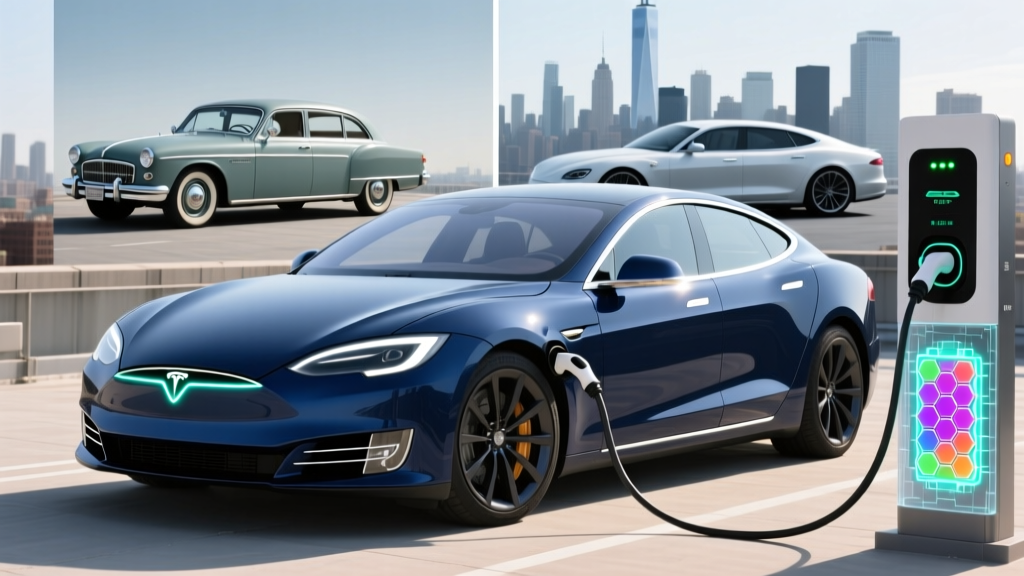
With that corporate question settled, let's turn to what matters for EV buyers: a thorough, numbers-driven review of the 2026 Tesla Model S — the flagship sedan that anchors Tesla's lineup and competes against the Lucid Air, Mercedes-Benz EQS, and BMW i7.
2026 Tesla Model S: Spec Sheet at a Glance
| Specification | Model S Long Range | Model S Plaid |
|---|---|---|
| EPA Range | 402 miles | 396 miles |
| Battery (usable) | ~100 kWh (NMC) | ~100 kWh (NMC) |
| Drivetrain | Dual-Motor AWD | Tri-Motor AWD |
| Horsepower | 670 hp | 1,020 hp |
| 0–60 mph | 3.1 seconds | 1.99 seconds |
| Top Speed | 155 mph | 200 mph |
| Max DC Fast Charge | 250 kW | 250 kW |
| 10–80% DC Charge | ~30 minutes | ~30 minutes |
| Level 2 Home Charge | 11.5 kW (~34 mi/hr) | 11.5 kW (~34 mi/hr) |
| MPGe (combined) | 120 MPGe | 116 MPGe |
| Efficiency | 28 kWh/100 mi | 29 kWh/100 mi |
| Cargo (rear + frunk) | 26.3 + 3.1 = 29.4 cu ft | 26.3 + 3.1 = 29.4 cu ft |
| Base MSRP | $74,990 | $89,990 |
| Battery Warranty | 8 yr / 150,000 mi | 8 yr / 150,000 mi |
Source: fueleconomy.gov, Tesla official specifications (2026 model year).
Range and Efficiency: EPA vs. Real World
Real-World Expectation: ~330–360 miles highway (70–80 mph); ~280–310 miles in freezing weather with cabin heat; ~370+ miles city/commuter driving with regen.
The Model S Long Range's 402-mile EPA figure remains one of the highest of any production EV sold in the U.S. in 2026, trailing only the Lucid Air Grand Touring (516 miles EPA). But the EPA cycle includes generous city-regen assumptions. On a sustained 75-mph highway run in moderate temperatures (65–75°F), expect roughly 340–360 miles before the battery indicator hits zero — a meaningful but manageable reduction.
Cold weather is the equalizer. In sub-30°F conditions, lithium-ion internal resistance increases and cabin heating draws significant energy (even with Tesla's standard heat pump). Plan for 280–310 real-world miles in deep winter. Preconditioning the battery while plugged in — a feature accessible through the Tesla app — recovers some of that loss by warming the pack before departure.
Efficiency of 28 kWh/100 miles (Long Range) is excellent for a 4,500+ lb luxury sedan, reflecting Tesla's industry-leading thermal management system and low drag coefficient (Cd 0.208). For context, the Mercedes EQS 450+ achieves roughly 32 kWh/100 mi, and the BMW i7 xDrive60 sits near 35 kWh/100 mi.
Charging Speed: Supercharger Network and Home Setup
| Charging Level | Power | Miles Added per Hour | Notes |
|---|---|---|---|
| Level 1 (120V outlet) | ~1.4 kW | ~3–4 mi/hr | Emergency/trickle only |
| Level 2 (240V, 48A) | 11.5 kW | ~34 mi/hr | Wall Connector, full overnight charge |
| DC Fast (Supercharger V3) | Up to 250 kW | ~200 mi in 15 min (peak) | 10–80% in ~30 min |
| DC Fast (CCS adapter, non-Tesla) | Up to 250 kW | Varies by station | Magic Dock / CCS adapter required |
The Model S charges at a peak of 250 kW on Tesla's V3 Superchargers. The charge curve is aggressive in the 10–50% SoC window but tapers noticeably above 60%, and sharply above 80%. This is normal lithium-ion behavior to protect cell longevity, but it means the last 20% can take nearly as long as the first 60%. For road trips, the practical strategy is charging to 80% and moving on.
At home, Tesla's Gen 3 Wall Connector on a 60-amp circuit (48A continuous) delivers 11.5 kW, adding roughly 34 miles of range per hour. A full 10–100% charge takes approximately 9–10 hours — easily managed overnight on a standard residential schedule. Expect a Level 2 installation cost of $800–$2,000 depending on panel proximity and local permitting, assuming your electrical panel has sufficient capacity (typically a 200-amp service).
Tesla now provides a CCS adapter (or integrates NACS natively on newer builds) enabling access to non-Tesla DC fast-charging networks like Electrify America and EVgo, though reliability on those networks remains less consistent than the Supercharger network based on J.D. Power EV Experience Index data.
Performance: Long Range vs. Plaid
The Long Range's dual-motor AWD setup produces 670 hp and a 3.1-second 0–60 time — figures that would have defined a supercar a decade ago. The Plaid's tri-motor configuration (one front, two rear) pushes to 1,020 hp and a claimed 1.99-second 0–60 mph, making it one of the quickest production cars ever built, period.
In real-world driving, both variants deliver instant torque with zero lag, smooth one-pedal regenerative braking, and a low center of gravity courtesy of the skateboard-mounted battery pack. The adaptive air suspension on both trims adjusts ride height and firmness, offering a comfortable highway cruise or a firm, planted feel on canyon roads. The Plaid adds track-oriented cooling and a carbon-sleeved rotor option for sustained high-speed runs.
Interior, Cargo, and Technology
The Model S cabin centers on a 17-inch landscape touchscreen running Tesla's proprietary infotainment OS. The 12.3-inch digital instrument cluster sits behind the yoke-style (or optional round) steering wheel. A rear 8-inch screen serves passengers with climate and media controls. Wireless Apple CarPlay is not offered — Tesla's native system handles navigation, Spotify, Tidal, Netflix/YouTube (while parked), and gaming.
Cargo space: 26.3 cubic feet behind the rear seats (liftback design makes loading easy) plus a 3.1-cubic-foot front trunk (frunk). With the 60/40 rear seats folded, cargo volume expands to approximately 64.9 cu ft. Rear legroom measures 35.4 inches — adequate for adults but tighter than the Lucid Air (36.3 in) or Mercedes EQS (39.2 in).
Autopilot and FSD (Supervised): Tesla's standard Autopilot provides adaptive cruise control and lane-centering on highways. The optional Full Self-Driving (Supervised) package ($8,000 one-time or $99/month) adds automatic lane changes, traffic-light recognition, and city-street navigation. Critical caveat: FSD is SAE Level 2 — the driver must remain fully attentive with hands on the wheel at all times. It is not autonomous driving. Tesla's camera-only vision system has improved substantially, but phantom braking and inconsistent behavior at complex intersections remain documented concerns per NHTSA recall filings.
Pricing, Trims, and Federal Tax Credit Eligibility
| Trim | Base MSRP | Destination | As-Tested (typical) | §30D Credit Eligible? |
|---|---|---|---|---|
| Model S Long Range | $74,990 | $1,995 | $78,000–$82,000 | No — exceeds $55,000 sedan MSRP cap |
| Model S Plaid | $89,990 | $1,995 | $93,000–$100,000 | No — exceeds $55,000 sedan MSRP cap |
The Model S is a premium product with a premium price. Tesla frequently adjusts pricing, so check the configurator for current figures. The $8,000 FSD add-on, $2,500 premium paint options, and $4,500 21-inch wheel upgrades can push a Plaid well past $100,000.
How the Model S Stacks Up Against Key Rivals
At this price point, the Model S competes with the Lucid Air Pure/Grand Touring, Mercedes-Benz EQS, and BMW i7. Here's a decision framework:
- Choose the Model S if: You want Supercharger network access, the quickest acceleration available (Plaid), strong range (402 mi), and Tesla's software/OTA ecosystem.
- Choose the Lucid Air if: Maximum range (516 mi EPA on Grand Touring) and rear-seat space are your top priorities, and you don't mind a smaller (but growing) charging network.
- Choose the Mercedes EQS if: Traditional luxury build quality, dealer service, and a quieter, more plush ride matter more than performance metrics.
- Choose the BMW i7 if: You want a full-size luxury sedan experience with executive rear seating and don't need 400+ miles of range (318 mi EPA).
Pros and Cons
Pros
- 402-mile EPA range — among the highest of any EV sedan
- Supercharger network: 50,000+ global fast chargers with excellent uptime
- Plaid acceleration is unmatched (1.99s 0–60)
- Class-leading efficiency (28 kWh/100 mi)
- Over-the-air updates continuously add features
- Strong cargo utility with liftback + frunk
- 8-year/150,000-mile battery warranty
Cons
- No federal §30D tax credit (MSRP cap)
- Rear seat legroom trails Lucid Air and EQS
- No Apple CarPlay or Android Auto
- Yoke steering polarizing; round wheel optional
- FSD (Supervised) still requires full driver attention (Level 2)
- 250 kW peak charge rate trails Hyundai/Kia 800V architecture (~350 kW)
- Panel gaps and interior material quality below German rivals at this price
Who Should Buy the 2026 Tesla Model S?
Road-trippers and commuters alike benefit from the 402-mile range and Supercharger access. The Model S is ideal for buyers who prioritize performance, software sophistication, and charging infrastructure over traditional luxury brand cachet. Families will find the liftback practical, though rear-seat space is tighter than rivals. If you need the absolute longest range and don't care about 0–60 bragging rights, the Lucid Air Grand Touring is a compelling alternative. If you want a $7,500 tax credit to offset your purchase, look at the Tesla Model 3 (starting ~$38,990, credit-eligible) or Model Y instead — the Model S simply prices itself out of federal incentive eligibility.
Frequently Asked Questions
Does Tesla own Starlink?
No. Starlink is owned by SpaceX, a separate company. Both are led by Elon Musk, but they have independent ownership structures. Tesla vehicles use cellular networks (not Starlink) for connectivity.
What is the real-world range of the 2026 Tesla Model S?
The EPA rates the Long Range at 402 miles. Real-world highway driving at 75 mph yields roughly 330–360 miles; freezing temperatures reduce that to approximately 280–310 miles. City driving with regenerative braking can match or slightly exceed the EPA figure.
How fast does the Model S charge?
On a V3 Supercharger, the Model S peaks at 250 kW and charges from 10–80% in approximately 30 minutes. At home on a Level 2 Wall Connector (11.5 kW), a full charge takes about 9–10 hours.
Does the Tesla Model S qualify for the federal EV tax credit?
No. The IRS §30D credit requires sedans to have an MSRP of $55,000 or less. The Model S starts at $74,990, disqualifying it. Additionally, buyers must meet income caps and battery-sourcing requirements. See IRS.gov for current rules.
Is the Model S worth buying vs. the Lucid Air or Mercedes EQS?
It depends on priorities. The Model S wins on Supercharger access, acceleration (Plaid), and efficiency. The Lucid Air wins on range and rear-seat space. The EQS wins on traditional luxury build quality and dealer service. All three are excellent — your decision hinges on which attributes matter most.
Is Tesla's Full Self-Driving actually self-driving?
No. FSD (Supervised) is an SAE Level 2 driver-assistance system. The driver must remain fully attentive, with hands on the steering wheel, at all times. It does not make the vehicle autonomous.
What is the battery warranty on the Model S?
Tesla covers the Model S battery and drive unit for 8 years or 150,000 miles (whichever comes first), with a minimum 70% capacity retention guarantee during that period.
Pricing and specifications reflect 2026 model-year data available at time of publication. Federal tax credit rules under IRS §30D are subject to change. Always verify current eligibility at IRS.gov and confirm vehicle specs at Tesla.com before purchasing.