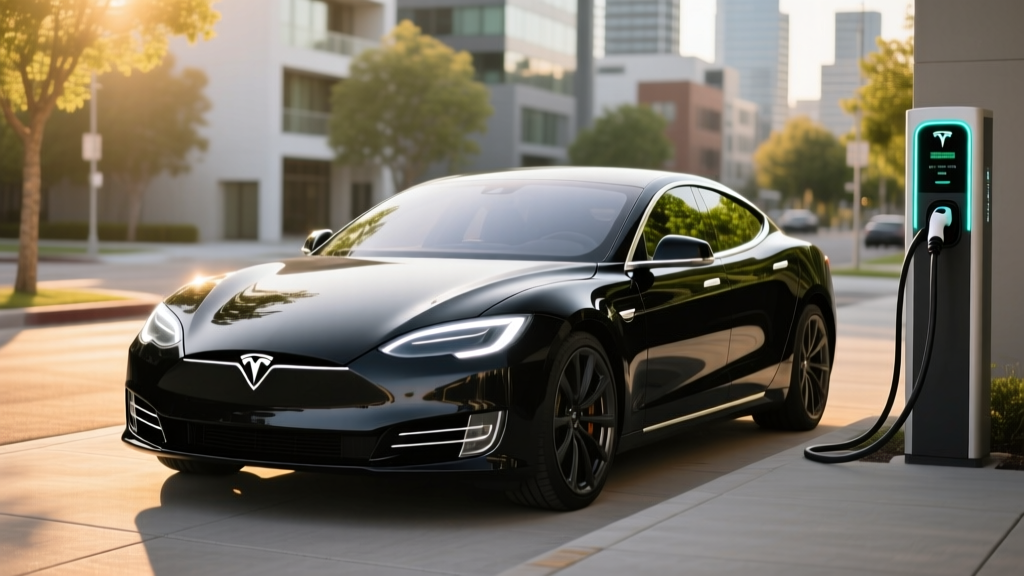
The 2026 Tesla Model S remains the benchmark luxury electric sedan, and its entry-point trim — commonly searched as the Model S Standard (officially the Long Range AWD) — is the version most buyers actually consider. Tesla dropped the base RWD Model S several years ago, making the dual-motor Long Range the de facto standard configuration. At $74,990 before incentives, it competes directly with the Lucid Air Pure, Mercedes-Benz EQS 450+, and BMW i7 eDrive50. This review breaks down the exact numbers you need to decide if it earns a spot in your garage.
2026 Tesla Model S Standard (Long Range) Specifications
| Spec | Value |
|---|---|
| EPA Range | 405 miles |
| Battery Capacity | ~100 kWh usable (NMC chemistry) |
| Drivetrain | Dual-Motor AWD |
| Horsepower | 670 hp (combined) |
| 0-60 mph | 3.1 seconds |
| Top Speed | 155 mph |
| Max DC Fast Charge | 250 kW (peak) |
| 10-80% DC Charge Time | ~28 minutes |
| Level 2 Home Charging | 11.5 kW (44 mi/hr) |
| Efficiency (EPA) | 124 MPGe combined / 27 kWh/100 mi |
| Cargo Volume | 28 cu ft (rear) + 3.1 cu ft (frunk) |
| Rear Legroom | 40.9 inches |
| Base MSRP | $74,990 (excl. $1,390 dest.) |
| Battery/Drive Warranty | 8 years / 150,000 miles |
Real-World Range: What You'll Actually Get
Real-World Highway (70 mph, moderate climate): ~330-350 miles
Cold Weather (below 30°F, highway): ~270-300 miles
Mixed Commute (city/suburban, temperate): ~370-390 miles
The Model S Long Range's 405-mile EPA figure is among the highest of any production EV sold in the U.S. According to fueleconomy.gov, the combined efficiency rating is 124 MPGe. However, real-world range depends heavily on driving style, speed, and temperature.
At sustained highway speeds of 70-75 mph, expect roughly 330-350 miles before needing to charge — aerodynamic drag rises with the square of velocity, and the Model S's large sedan profile, while slippery (Cd 0.208), still loses efficiency at speed. In winter conditions, the battery's internal resistance increases and cabin heating draws significant energy. Tesla's heat pump (standard since the 2021 refresh) mitigates this compared to resistive heaters, but you'll still see 25-30% range reduction in sub-freezing temperatures.
For daily commuting with regenerative braking in Stop mode, range closely tracks the EPA sticker. The 100 kWh NMC (nickel-manganese-cobalt) battery pack provides substantial energy density, though NMC chemistry is more sensitive to sustained 100% charges than LFP — Tesla recommends daily charging to 80-90% for longevity, reserving 100% for road trips.
Charging Speed: DC Fast and Home Level 2
| Charging Level | Power | Speed / Time | Connector |
|---|---|---|---|
| DC Fast Charge (peak) | 250 kW | ~200 mi in 15 min; 10-80% in ~28 min | NACS (native Tesla) |
| DC Fast Charge (sustained avg) | ~150-170 kW | Charge curve tapers above 50% SoC | NACS |
| Level 2 (Tesla Wall Connector) | 11.5 kW (48A) | ~44 miles of range per hour | NACS |
| Level 2 (generic J1772 w/ adapter) | Up to 11.5 kW | ~44 mi/hr (adapter included) | J1772 → NACS |
| Level 1 (120V household) | ~1.4 kW | ~4-5 miles per hour | NACS (Mobile Connector) |
The Model S charges natively via the NACS (North American Charging Standard) connector — Tesla's proprietary plug that has now been adopted by nearly every major automaker. On Tesla's Supercharger network (V3 stalls deliver up to 250 kW), the Model S Long Range peaks at 250 kW but sustains that rate only briefly. The charging curve tapers progressively: you'll see ~250 kW from roughly 5-20% SoC, dropping to ~170 kW by 40%, and ~90 kW by 70%. This is why the 10-80% time of approximately 28 minutes is the more meaningful metric than peak kW alone.
For home charging, a Tesla Wall Connector on a 60-amp circuit delivers 11.5 kW (48 amps continuous), adding roughly 44 miles of range per hour. An overnight charge from 20% to 80% (about 60 kWh) takes roughly 5-6 hours — easily handled while you sleep. Installation costs for a Level 2 home setup typically range from $800 to $2,500 depending on panel capacity and conduit run length, on top of the $475 Wall Connector hardware cost.
Preconditioning is critical: when navigating to a Supercharger, the car automatically warms the battery to optimal temperature, which can shave 5-10 minutes off your charge session in cold weather. Always navigate to the charger via the car's built-in nav rather than just driving there.
Performance and Driving Dynamics
The dual-motor AWD powertrain produces 670 horsepower and launches the Model S from 0-60 mph in 3.1 seconds — a figure that still astonishes for a 4,800-pound luxury sedan. The instant torque delivery (no gear shifts, no turbo lag) makes it feel even quicker in real-world passing situations than the stopwatch suggests.
The adaptive air suspension (standard on all Model S trims) provides adjustable ride height and damping. In Comfort mode, it absorbs road imperfections with a compliance that rivals the Mercedes S-Class; in Sport mode, it firms up and lowers the car for highway stability. The steering is precise but light — this is a grand tourer, not a sports sedan, and that's the right calibration for its mission.
Regenerative braking in Stop mode enables one-pedal driving in most situations, recapturing energy efficiently in city traffic. The blended friction brakes are smooth, though the pedal feel is somewhat artificial compared to BMW's integration.
Tax Credit Eligibility and Pricing Breakdown
| Item | Amount |
|---|---|
| Base MSRP (Long Range AWD) | $74,990 |
| Destination Charge | $1,390 |
| As-Tested (w/ FSD, no other add-ons) | $84,380 |
| Federal Tax Credit (§30D) | Up to $7,500 (see eligibility below) |
| Effective Price (if credit qualifies) | From ~$67,490 |
The 2026 Model S is priced at $74,990 for the Long Range AWD — the only non-Plaid trim available. The Plaid starts at $89,990. Tesla's Full Self-Driving (Supervised) adds $8,000 as a one-time purchase, or $99/month as a subscription.
Federal Tax Credit (§30D) Eligibility: According to IRS guidelines, the Model S qualifies for up to $7,500 in federal tax credits, but several conditions apply:
- MSRP Cap: Sedans must be under $55,000 MSRP to qualify. The Model S at $74,990 exceeds this cap and does NOT qualify for the new-vehicle §30D credit.
- Buyer Income Cap: AGI must not exceed $150,000 (single) / $300,000 (joint) — relevant only if MSRP cap is met.
- Battery Sourcing: Critical minerals and battery component requirements must be met — moot if MSRP cap is exceeded.
- Point-of-Sale Transfer: Eligible credits can be transferred to the dealer at purchase for an immediate price reduction — again, only if the vehicle qualifies.
This is a critical point for Model S shoppers: the Model S does not qualify for the federal new-vehicle EV tax credit because its MSRP exceeds the $55,000 sedan cap. Buyers seeking to leverage the credit should consider the Tesla Model 3 ($38,990) or Model Y ($44,990, classified as an SUV and eligible under the $80,000 cap). Some state-level incentives (California, Colorado, Massachusetts) may still apply regardless of MSRP — check your state's energy office for current programs.
Interior, Tech, and Cargo
The Model S interior centers on a 17-inch landscape-oriented touchscreen running Tesla's proprietary infotainment OS. The interface is responsive and feature-rich: navigation, media, climate, vehicle settings, and a full web browser are all integrated. A 12.3-inch driver display shows speed, range, and navigation. Rear passengers get a dedicated 8-inch screen for climate and media control.
Cargo capacity is generous: 28 cubic feet behind the rear seats (expandable with 60/40 split folding), plus a 3.1 cu-ft front trunk (frunk). Total volume with seats folded rivals many compact SUVs. Rear legroom measures 40.9 inches — comfortable for adults on long trips, though the sloping roofline cuts into headroom for passengers over 6'2".
Notable tech features:
- Autopilot (standard): Adaptive cruise, lane centering, auto emergency braking — SAE Level 2 driver assist, requires active supervision
- FSD Supervised ($8,000 or $99/mo): Adds auto lane change, traffic light/stop sign control, city street navigation — still Level 2, not autonomous
- Over-the-air updates continuously add features and refine performance
- Sentry Mode dashcam recording, Dog Mode climate, Smart Summon (in parking lots)
- 22-speaker audio system with immersive sound
Pros and Cons
Pros
- Class-leading 405-mile EPA range
- Access to Tesla Supercharger network (17,000+ stalls in North America)
- 3.1-second 0-60 with dual-motor AWD
- Continuous OTA updates add real value over time
- Spacious cargo area with frunk + hatchback utility
- Strong resale value relative to luxury EV peers
Cons
- Does NOT qualify for $7,500 federal tax credit (exceeds $55K sedan cap)
- Interior material quality still lags Mercedes/BMW at this price point
- No Apple CarPlay or Android Auto
- FSD purchase is expensive and remains Level 2 (supervised)
- Rear headroom limited for tall passengers due to roofline
- Insurance premiums run 15-30% higher than comparable ICE sedans
Is the Model S Standard Worth It vs. Competitors?
The Model S Long Range competes in a narrow but growing segment of luxury electric sedans. Here's how it stacks up against key rivals:
| Vehicle | EPA Range | 0-60 | Base MSRP | Tax Credit? |
|---|---|---|---|---|
| Tesla Model S LR AWD | 405 mi | 3.1s | $74,990 | No (MSRP cap) |
| Lucid Air Pure | 419 mi | 5.2s (RWD) | $69,900 | No (MSRP cap) |
| Mercedes EQS 450+ | 390 mi | 5.9s | $104,400 | No (MSRP cap) |
| BMW i7 eDrive50 | 318 mi | 5.5s | $105,700 | No (MSRP cap) |
The Model S wins on performance-per-dollar and charging infrastructure access. The Lucid Air Pure edges it on range (419 mi EPA) at a lower price, but Lucid's charging network access relies on Electrify America, which has historically lower reliability than Tesla's Superchargers. The Mercedes and BMW offer superior interior luxury but at a significant price premium with less range.
For road-trip-heavy buyers who value charging convenience and proven long-distance capability, the Model S remains the strongest choice in this segment. For those prioritizing interior opulence and don't mind higher cost, the EQS is compelling. For pure range-per-dollar, the Lucid Air Pure is the mathematical winner.
Who Should Buy the 2026 Model S Standard (Long Range)?
Buy the Model S Long Range if:
- You regularly drive 300+ miles between charges (road trips, long commutes)
- You want the fastest Supercharger network access for cross-country travel
- You need a practical sedan with hatchback cargo versatility
- You value OTA updates that improve the car over time
Look elsewhere if:
- You need the federal tax credit to make the math work (consider Model 3/Y or Hyundai Ioniq 6)
- Interior luxury is your top priority (consider EQS or BMW i7)
- You want Apple CarPlay integration (consider Lucid Air or BMW i7)
- You primarily city-drive under 50 miles/day (a smaller, cheaper EV suffices)
Frequently Asked Questions
What is the real-world range of the 2026 Tesla Model S Long Range?
The EPA rates it at 405 miles. In real-world highway driving at 70 mph in moderate temperatures, expect 330-350 miles. In cold weather (below 30°F), that drops to roughly 270-300 miles. City driving with regenerative braking returns closer to the EPA sticker, around 370-390 miles.
How fast does the Model S charge at home and on DC fast chargers?
On a DC fast charger (Supercharger V3), it peaks at 250 kW and charges from 10-80% in approximately 28 minutes. At home on a Level 2 Tesla Wall Connector (11.5 kW / 48A), it adds about 44 miles of range per hour — a full overnight charge easily covers daily needs.
Does the 2026 Model S qualify for the federal EV tax credit?
No. Under current IRS §30D rules, sedans must have an MSRP below $55,000 to qualify. The Model S Long Range starts at $74,990, exceeding this cap. State-level incentives may still apply — check your state energy office. The Tesla Model 3 and Model Y do qualify for up to $7,500.
What battery chemistry does the Model S use, and how long will it last?
The Model S uses NMC (nickel-manganese-cobalt) chemistry in a ~100 kWh pack. NMC offers high energy density but benefits from daily charging to 80-90% rather than 100%. Tesla warranties the battery for 8 years or 150,000 miles, whichever comes first, with a minimum 70% capacity retention threshold. Real-world degradation data from Tesla's fleet suggests most packs retain 85-90% capacity after 100,000 miles.
Is Tesla Autopilot self-driving?
No. Autopilot and Full Self-Driving (Supervised) are SAE Level 2 driver-assistance systems. They can handle steering, acceleration, and braking on highways and some city streets, but the driver must remain fully attentive and ready to take over immediately. They are not autonomous. Only Level 4 services like Waymo operate without a human driver.
How much does it cost to insure a Model S?
Insurance for the Model S typically runs $2,500-$4,000 per year depending on your location, driving record, and coverage level — roughly 15-30% higher than comparable gas sedans due to repair costs and parts pricing. Tesla Insurance is available in some states and can be competitive; always compare quotes from multiple providers.