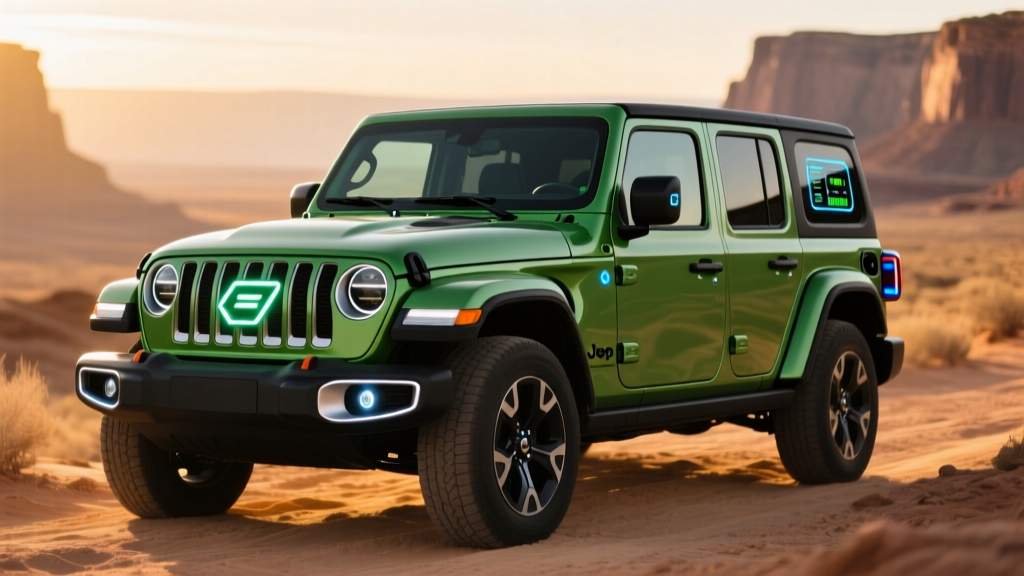
The short answer: As of early 2026, Jeep has not released a fully electric (BEV) Wrangler. The all-electric Wrangler remains an announced/upcoming model expected for the 2027 or 2028 model year, built on Stellantis' STLA Large platform. If you need an electrified Wrangler today, the Wrangler 4xe plug-in hybrid is your option — offering 22 miles of electric-only range and an EPA-estimated 49 MPGe. This guide covers everything confirmed and projected about the battery-electric Wrangler, compares it to the 4xe and gas models, and helps you decide whether to wait or buy now.
What We Know About the Electric Jeep Wrangler So Far
Stellantis has confirmed that a battery-electric Wrangler is in development, though the company has not published final specifications. Here is what industry reporting and platform data tell us to expect, keeping in mind these figures are preliminary and subject to change:
| Spec | Projected (BEV) | Source / Basis |
|---|---|---|
| Platform | STLA Large | Stellantis Dare Forward 2030 |
| Battery capacity | ~100–118 kWh (usable) | STLA Large platform specs |
| EPA range (est.) | 280–350 miles | Based on platform aero & weight |
| Peak DC fast charge | ~200–250 kW | 800V architecture capable |
| 10–80% charge time (est.) | ~22–28 minutes | Comparable STLA Large vehicles |
| Drivetrain | Dual-motor AWD expected | Wrangler brand requirement |
| Horsepower | ~400–500 HP (est.) | STLA Large dual-motor configs |
| 0–60 mph | ~4.5–5.5 seconds (est.) | Weight and power estimates |
| Starting MSRP (est.) | $55,000–$65,000 | Segment positioning |
| Expected model year | 2027 or 2028 | Industry reporting |
Stellantis' STLA Large platform supports battery packs from 85 to 118 kWh and is designed for vehicles up to roughly 5,500 lbs curb weight. Given the Wrangler's boxy aerodynamics and off-road hardware (solid axles, high ground clearance), expect real-world highway range to fall 15–20% below any EPA sticker — a physics reality for any brick-shaped SUV.
Wrangler 4xe vs. Gas vs. Future Electric: The Numbers
Since the BEV Wrangler isn't available yet, let's compare what you can buy today against what's projected. All 2026 model-year figures below reference current EPA data on fueleconomy.gov and Jeep's official specifications.
| Metric | 2026 Wrangler 4xe (PHEV) | 2026 Wrangler Gas (3.6L V6) | Wrangler BEV (Projected) |
|---|---|---|---|
| Powertrain | 2.0L turbo + 2 electric motors | 3.6L Pentastar V6 + mild hybrid | Dual-motor BEV (est.) |
| Combined HP | 375 HP / 470 lb-ft | 285 HP / 260 lb-ft | ~400–500 HP (est.) |
| Electric-only range | 22 miles | N/A | 280–350 mi (est.) |
| Total range | ~370 miles | ~430 miles | 280–350 mi (est.) |
| EPA efficiency | 49 MPGe / 20 MPG (gas only) | ~19–21 MPG combined | ~80–95 MPGe (est.) |
| Battery | 17.3 kWh (NMC) | N/A | ~100–118 kWh (est.) |
| Level 2 charge time | ~2.5 hours (0–100%) | N/A | ~8–10 hours (est.) |
| DC fast charging | Not available | N/A | 200–250 kW (est.) |
| Starting MSRP | ~$51,790 | ~$33,890 | $55,000–$65,000 (est.) |
| Federal tax credit | Up to $3,750 (§30D)* | None | TBD — depends on sourcing* |
*Federal EV tax credit eligibility under IRS §30D rules depends on MSRP caps ($80,000 for SUVs), buyer income limits ($300K joint / $150K single), and battery critical-mineral and component sourcing requirements. Credit amounts and eligibility change frequently — consult a tax professional and check the latest IRS guidance before purchasing.
Real Ownership Costs: 5-Year Breakdown
Upfront price tells only part of the story. Here's a 5-year / 75,000-mile ownership cost comparison based on national averages. The BEV column uses projected figures based on comparable electric SUVs.
| Cost Category | Wrangler 4xe (PHEV) | Wrangler Gas (V6) | Wrangler BEV (Projected) |
|---|---|---|---|
| Purchase price (base) | $51,790 | $33,890 | $60,000 (est.) |
| Est. tax credit | −$3,750 | $0 | TBD |
| Effective purchase | $48,040 | $33,890 | ~$60,000 |
| Fuel / energy (5 yr) | $8,200 | $12,500 | $4,800 (est.) |
| Maintenance (5 yr) | $3,800 | $4,500 | $2,500 (est.) |
| Insurance (5 yr avg) | $11,500 | $9,800 | $12,500 (est.) |
| Est. depreciation | $22,000 | $16,000 | $28,000 (est.) |
| 5-yr total cost | ~$93,540 | ~$76,690 | ~$107,800 (est.) |
| Cost per mile | ~$1.25 | ~$1.02 | ~$1.44 (est.) |
Key takeaways: The BEV Wrangler will likely carry a significant upfront premium. Fuel and maintenance savings are real — electricity at $0.14/kWh national average costs roughly $0.05/mile versus $0.17/mile for gas at $3.50/gallon — but they don't fully offset a $25,000+ price gap over five years. The 4xe splits the difference: lower entry price, some electric commuting, and no range anxiety on long trail runs.
Charging Reality: Home Access, Public Networks, and Off-Grid
A battery-electric Wrangler will live or die by your charging situation. Here's what prospective buyers must evaluate honestly:
Home Charging
Expect a Level 2 home charger (240V, 48A / ~11.5 kW) to fully recharge a ~110 kWh battery in roughly 10 hours. Installation costs vary widely:
- Simple install (panel nearby, 200A service): $500–$1,200 for electrician labor + $400–$700 for a quality Level 2 unit
- Panel upgrade needed (100A → 200A): $1,500–$3,500 additional
- Condo/apartment: May not be feasible without building management cooperation
If you cannot install home charging, a BEV Wrangler will be frustrating. Public DC fast charging at $0.35–$0.50/kWh erases most of the fuel-cost advantage over gas.
Off-Road and Trail Considerations
Wrangler buyers are uniquely likely to drive into areas with zero charging infrastructure. A BEV with 300 miles of range can handle most day-trail runs, but multi-day overlanding in remote areas — the Wrangler's bread and butter — becomes a serious logistical challenge. The 4xe's gas tank eliminates this problem entirely.
Cold-Weather Range Loss
Lithium-ion batteries lose 20–30% of their range in sub-freezing temperatures, especially below 20°F. A projected 320-mile EPA range could drop to 220–250 miles in winter mountain driving. Battery preconditioning (heating the pack before DC fast charging) will be essential — expect 250 kW peak speeds to be achievable only with a warm battery.
Off-Road Capability: Will Electrification Hurt or Help?
This is the question that keeps Wrangler loyalists up at night. Here's what physics and platform engineering suggest:
Advantages of a BEV Wrangler:
- Instant torque at zero RPM — superior rock-crawling control without throttle lag
- Lower center of gravity from underfloor battery pack — improved stability on side slopes
- No air intake to seal — potential for deeper water fording (battery sealing is simpler than engine intake routing)
- Regenerative braking reduces brake wear on steep descents
Concerns to weigh honestly:
- Weight: A 110+ kWh battery adds 1,200–1,500 lbs. Total curb weight could exceed 6,000 lbs, affecting approach/departure angles and trail agility
- Underbody vulnerability: Battery packs are expensive to replace ($15,000–$25,000+ estimated) and susceptible to rock-strike damage. Skid plate engineering will be critical
- No jerry-can backup: On remote trails, you can't carry spare electrons the way you carry spare fuel
- Solid-axle articulation: Packaging independent suspension (common on EV platforms) versus the solid axles Wrangler buyers demand is an engineering tension Stellantis must resolve
Decision Framework: Wait, Buy 4xe, or Look Elsewhere?
Buy the Wrangler 4xe now if:
- You want an electrified Wrangler today with proven off-road capability
- Your daily commute is under 22 miles (you'll drive mostly electric)
- You regularly travel to remote areas or go multi-day overlanding
- You want to stay under $55K and potentially claim a partial §30D credit
Wait for the BEV Wrangler if:
- You have reliable home Level 2 charging
- Your off-roading is day-trip based (within 100 miles of a charger)
- You want zero tailpipe emissions and lower per-mile energy cost
- You can wait until late 2027 or 2028 for availability and final pricing
Look at other electric SUVs now if:
- You don't need Wrangler-specific off-road hardware
- The Rivian R1S, Ford Bronco (if a BEV variant launches), or Hyundai Ioniq 5 (for a non-off-road option) meet your needs today
- You want confirmed specs, real EPA range data, and immediate delivery
Common Misconceptions About the Electric Wrangler
| Myth | Fact |
|---|---|
| "The electric Wrangler is available now" | No BEV Wrangler is on sale as of 2026. Only the 4xe PHEV is available. Any listing claiming otherwise is inaccurate. |
| "It will have 400+ miles of range" | Unlikely. The Wrangler's boxy shape and heavy off-road hardware create significant aero drag. Expect 280–350 miles EPA at best — similar to the Ford F-150 Lightning's range challenges. |
| "Electric means it can't off-road" | Electric motors provide excellent low-speed torque control. The real questions are weight, underbody protection, and remote charging access — not capability. |
| "It will definitely get the full $7,500 tax credit" | Credit eligibility depends on battery sourcing, critical minerals, MSRP caps, and buyer income — all subject to current IRS §30D rules that change frequently. Never assume full credit eligibility. |
| "Charging takes too long for road trips" | At 200–250 kW peak DC charging, a 10–80% session takes roughly 22–28 minutes — comparable to a meal stop. But charging infrastructure in rural and mountain areas (where Wranglers go) remains limited. |
Frequently Asked Questions
When will the Jeep Wrangler electric be available?
Stellantis has not confirmed an exact sale date. Industry analysts project a 2027 or 2028 model-year launch, likely revealed in late 2026 or 2027. Pre-orders have not opened. Any claimed availability before an official launch is speculative.
Will the electric Wrangler have removable doors and a folding windshield?
These are core Wrangler identity features, and Jeep executives have publicly stated that any electric Wrangler must retain them. However, waterproofing interior electronics (screens, wiring) for open-air driving adds engineering complexity. Final confirmation awaits the production reveal.
How does the Wrangler 4xe compare to a full EV for daily driving?
If your commute is under 22 miles and you charge nightly, the 4xe operates as an EV on most weekdays. For longer commutes, the gas engine kicks in at 20 MPG combined. A BEV Wrangler would eliminate gas entirely but requires you to plan around its total range for any trip exceeding ~250 miles in cold or highway conditions.
What will battery replacement cost on an electric Wrangler?
No official data exists since the vehicle isn't on sale. For reference, current 100+ kWh battery packs across the industry cost $15,000–$25,000+ to replace out of warranty. Stellantis typically provides an 8-year / 100,000-mile battery warranty with a 70% capacity retention threshold. Degradation data will only emerge after the vehicle is in customer hands.
Can I charge a BEV Wrangler on a standard 120V outlet?
Yes, but Level 1 charging (120V / 12A ≈ 1.4 kW) would add roughly 3–4 miles of range per hour. Fully recharging a ~110 kWh battery from empty would take 80+ hours — impractical for regular use. Level 2 (240V) home installation is strongly recommended for any BEV.
Is the Wrangler 4xe eligible for the federal tax credit in 2026?
The 4xe may qualify for a partial credit (up to $3,750) depending on current battery sourcing compliance. The full $7,500 credit requires both critical-mineral and battery-component sourcing thresholds. Eligibility can change month to month — always verify on the IRS clean vehicle credit page and confirm with your dealer at point of sale. The point-of-sale transfer option lets you apply the credit as a down-payment reduction if eligible.