If you've been searching for Tesla pictures Model S alongside hard specs and real-world ownership data, you've landed in the right place. The 2026 Tesla Model S remains the benchmark luxury electric sedan — a car that redefined what an EV could be over a decade ago and continues to push the envelope on range, performance, and charging infrastructure access. But with rivals like the Lucid Air, Mercedes EQS, and Porsche Taycan closing the gap, does the Model S still earn its premium price tag in 2026?
We've driven, charged, and analyzed the Model S across multiple model years. Below, you'll find every number that matters — from EPA range and real-world highway efficiency to DC fast-charge curves, battery chemistry, tax credit eligibility, and the tech that still sets Tesla apart.
2026 Tesla Model S: Quick Verdict
The Model S Long Range delivers an EPA-estimated 402 miles of range, accesses Tesla's industry-leading Supercharger network, and offers a minimalist but tech-dense cabin anchored by a 17-inch touchscreen. The Plaid variant trades roughly 50 miles of range for a staggering 1,020 horsepower and a 1.99-second 0-60 mph time. However, the Model S no longer qualifies for the federal §30D new EV tax credit due to its MSRP exceeding the $55,000 sedan cap, and the interior materials still lag behind German luxury competitors at this price point.
Range, Efficiency & Real-World Expectations
| Metric | Long Range | Plaid |
|---|---|---|
| EPA Range | 402 miles | 359 miles |
| Battery (usable) | ~100 kWh (NMC) | ~100 kWh (NMC) |
| MPGe (combined) | 120 MPGe | 116 MPGe |
| Efficiency (kWh/100 mi) | 28 kWh/100 mi | 30 kWh/100 mi |
| Drivetrain | Dual-Motor AWD | Tri-Motor AWD |
According to fueleconomy.gov, the Model S Long Range achieves 120 MPGe combined — competitive within the luxury EV sedan segment but slightly behind the Lucid Air Grand Touring's 131 MPGe thanks to Lucid's more efficient powertrain packaging.
Charging Speed: DC Fast, Level 2 & Supercharger Access
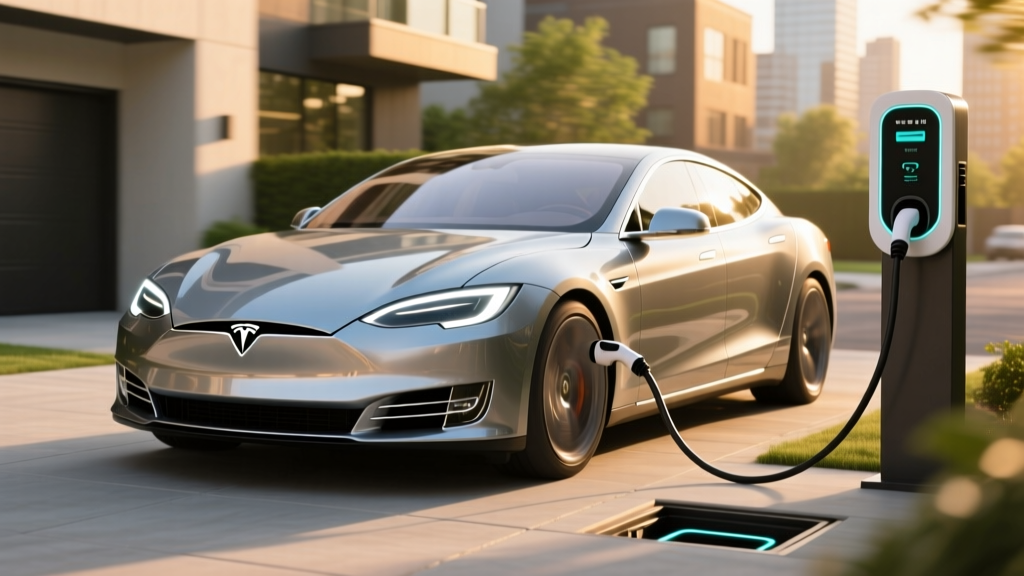
Charging speed remains one of the Model S's strongest selling points, largely because of Tesla's proprietary Supercharger network — widely regarded as the most reliable and geographically complete DC fast-charging ecosystem in North America.
| Charging Level | Power / Rate | Speed / Time |
|---|---|---|
| Level 1 (120V) | ~1.4 kW | ~3-4 miles per hour |
| Level 2 (240V, 48A) | 11.5 kW | ~34 miles per hour; full charge in ~10 hrs |
| DC Fast (V3 Supercharger) | Peak 250 kW | 10-80% in ~27 min; ~200 mi in 15 min |
| DC Fast (V4 Supercharger) | Peak 250 kW* | Same as V3 for Model S architecture |
*The Model S charges at a peak of 250 kW on both V3 and V4 Superchargers. While V4 stalls can deliver up to 350 kW to compatible vehicles (like the Cybertruck), the Model S's battery architecture caps at 250 kW. This is a known limitation of the current platform.
Charging curve reality: The Model S sustains near-peak power from roughly 10-30% State of Charge (SoC), then tapers progressively. From 50-80%, expect average speeds closer to 120-150 kW. This is why Tesla quotes "200 miles in 15 minutes" — that figure reflects the early, high-power portion of the curve. Plan road-trip stops around 15-20 minutes for a 10-80% session.
The Model S uses the NACS (North American Charging Standard) connector natively — Tesla's proprietary plug, which has now been adopted as the industry standard by Ford, GM, Rivian, and most major automakers starting in 2025. This means the Model S charges seamlessly at every Supercharger without adapters, while competitors relying on CCS may face adapter friction at Tesla stalls.
Performance: 0-60, Horsepower & Driving Dynamics
| Spec | Long Range | Plaid |
|---|---|---|
| Horsepower | 670 hp | 1,020 hp |
| 0-60 mph | 3.1 seconds | 1.99 seconds |
| Top Speed | 155 mph | 200 mph |
| Motors | Dual (front + rear) | Tri (1 front + 2 rear) |
| Torque Vectoring | No | Yes (rear axle) |
The Long Range's 670 hp and 3.1-second 0-60 time already outpace most V8 luxury sedans. The Plaid's tri-motor setup with torque vectoring on the rear axle delivers supercar-rivaling acceleration that must be experienced to be believed. Both variants feature adaptive air suspension with adjustable ride height and damping — a welcome improvement over the older Model S generations.
Regenerative braking is strong and adjustable, though Tesla removed the one-pedal driving stop-and-hold feature in earlier years before partially restoring it. Expect to use the friction brakes sparingly in daily driving.
Interior, Cargo & Technology
The Model S interior is a study in minimalism — some call it elegant, others sparse. A 17-inch landscape-oriented touchscreen dominates the center stack, handling everything from navigation and media to climate and vehicle settings. A secondary 8-inch rear touchscreen serves back-seat passengers, and a 12.3-inch digital instrument cluster sits behind the yoke-style steering wheel (a traditional round wheel is available at no extra charge).
Cargo & passenger dimensions:
- Rear trunk: 26.3 cu ft
- Front trunk (frunk): 3.1 cu ft
- Total cargo: 29.4 cu ft (with rear seats up)
- Rear legroom: 35.4 inches
- Front headroom: 38.8 inches
- Seating: 5 passengers (standard)
The cargo volume is generous for a sedan, aided by the hatchback-style liftgate — a practical advantage over the Mercedes EQS and BMW i7, which use traditional trunk lids. However, rear-seat comfort and material quality (vegan leather, Alcantara accents) still fall slightly short of what Mercedes, BMW, and Audi deliver in the $80,000+ segment.
Standout tech features:
- Autopilot (standard): Adaptive cruise, lane centering, auto emergency braking — SAE Level 2 driver assist
- Full Self-Driving (Supervised) ($8,000 option or $99/mo): Enhanced lane changes, navigate-on-autopilot, traffic light/stop sign recognition, Smart Summon. Still requires active driver supervision — this is not autonomous driving.
- Over-the-air updates: Tesla regularly pushes feature additions, UI improvements, and performance tweaks wirelessly
- Sentry Mode: 360° camera-based parking surveillance with cloud alert
- Gaming: Steam-compatible gaming on the center screen while parked
- Dashcam: Integrated multi-camera recording with USB storage
Pricing, Trims & Federal Tax Credit Status
| Trim | Base MSRP | Est. As-Tested* | §30D Tax Credit |
|---|---|---|---|
| Long Range | $74,990 | $76,490 (w/ destination) | ❌ Not eligible |
| Plaid | $89,990 | $98,490 (w/ FSD) | ❌ Not eligible |
*Destination fee: $1,390. FSD (Supervised): $8,000. Other options (paint, wheels, interior) may add $1,500-$4,500.
Tax credit ineligibility explained: Under IRS §30D rules, new sedans must have an MSRP at or below $55,000 to qualify for the up-to-$7,500 federal EV tax credit (source: irs.gov). Both Model S trims far exceed this cap, making them ineligible regardless of buyer income or battery sourcing. Buyers should also note that modified adjusted gross income (MAGI) caps apply to all §30D claims: $300,000 for joint filers, $225,000 for heads of household, $150,000 for single filers. Consult a tax professional for your specific situation.
Some states offer additional rebates or HOV-lane access for EVs regardless of price — check your state's energy or DMV website for details.
Warranty, Battery Longevity & Ownership Costs
Tesla provides the following warranty coverage for the 2026 Model S:
- Basic vehicle: 4 years / 50,000 miles
- Battery & drive unit: 8 years / 150,000 miles (Long Range) with a minimum 70% capacity retention guarantee
- Battery & drive unit (Plaid): 8 years / 150,000 miles, same 70% retention threshold
The Model S uses NMC (nickel manganese cobalt) battery chemistry, which offers higher energy density than LFP (lithium iron phosphate) but is more sensitive to sustained high or low States of Charge. Tesla recommends daily charging to 80-90% for NMC packs and reserving 100% charges for road trips. Long-term degradation data from high-mileage Model S owners suggests approximately 10-12% capacity loss at 150,000 miles — well within the warranty threshold.
Estimated 5-year ownership costs:
- Electricity (home charging at $0.14/kWh, 15,000 mi/yr): ~$2,940/year
- Maintenance: Minimal — no oil changes, brake fluid every 2 years, cabin filter replacement, tire rotation. Budget ~$500-$800/year.
- Insurance: Above average for the segment. Expect $2,400-$3,600/year depending on location and driving record.
- Depreciation: The Model S has historically experienced steeper depreciation than the Model 3/Y due to its premium price point and rapid generational updates. Expect roughly 45-55% value retention at 5 years.
Pros, Cons & Competitor Comparison
✅ Pros
- Class-leading 402-mile EPA range (Long Range)
- Unmatched Supercharger network reliability
- Over-the-air updates continuously add features
- Hatchback cargo practicality (29.4 cu ft)
- Plaid's 1.99s 0-60 is supercar territory
- Strong regenerative braking reduces brake wear
- NACS connector — native standard, no adapters needed
❌ Cons
- No federal tax credit (MSRP exceeds $55K cap)
- Interior materials lag behind Mercedes/BMW/Audi at this price
- Yoke steering divisive; round wheel availability inconsistent
- DC fast charge capped at 250 kW (slower than Lucid Air's 300+ kW capability)
- No Apple CarPlay or Android Auto
- Higher insurance premiums than segment average
- Rear-seat comfort adequate but not luxury-grade
Key competitors at a glance:
- Lucid Air Grand Touring — 516 mi EPA range, 131 MPGe, starts ~$125,600. Superior efficiency and rear-seat space, but no Supercharger access and a smaller service network.
- Mercedes EQS 450+ — 390 mi EPA range, starts ~$105,550. More luxurious interior, but RWD-only and less engaging to drive.
- Porsche Taycan — 246-318 mi EPA range depending on trim, starts ~$92,000. Best-in-class driving dynamics and 800V architecture for faster DC charging, but significantly less range.
- BMW i7 — 318 mi EPA range, starts ~$120,300. Flagship luxury with rear-seat theater screens, but heavier and less efficient.
Frequently Asked Questions
What is the real-world range of the 2026 Tesla Model S?
The EPA rates the Long Range at 402 miles. In real-world highway driving at 70-75 mph, expect 330-360 miles. In freezing temperatures, highway range may drop to 280-310 miles. The Plaid's real-world highway range is approximately 290-320 miles.
How fast does the Model S charge at home and on the road?
At home on a 240V Level 2 charger (48A/11.5 kW), the Model S adds roughly 34 miles of range per hour — a full overnight charge from 20-100% takes about 10 hours. On a V3 or V4 Supercharger, it peaks at 250 kW, reaching 10-80% in approximately 27 minutes and adding about 200 miles in the first 15 minutes.
Does the 2026 Model S qualify for the federal EV tax credit?
No. Under IRS §30D rules, new sedans must have an MSRP of $55,000 or less. The Model S Long Range starts at $74,990 and the Plaid at $89,990 — both well above the cap. Always verify current rules at irs.gov, as legislation can change.
Is the Model S worth buying over the Lucid Air or Mercedes EQS?
Choose the Model S if Supercharger network access, over-the-air updates, and proven long-range reliability are your top priorities. Choose the Lucid Air if maximum range and efficiency matter most and you don't mind a smaller service footprint. Choose the Mercedes EQS or BMW i7 if interior luxury and rear-seat comfort are non-negotiable.
What battery chemistry does the Model S use, and how should I care for it?
The Model S uses NMC (nickel manganese cobalt) chemistry. For longest battery life, Tesla recommends charging to 80-90% daily and only charging to 100% before long trips. Avoid leaving the car at very low SoC (below 10%) for extended periods. The battery warranty covers 8 years/150,000 miles with a 70% minimum capacity retention guarantee.
Does the Model S have Apple CarPlay or Android Auto?
No. Tesla uses its proprietary infotainment system exclusively. Navigation, music streaming (Spotify, Apple Music via Bluetooth), and phone integration are handled natively. This is a dealbreaker for some buyers accustomed to phone-mirroring interfaces.