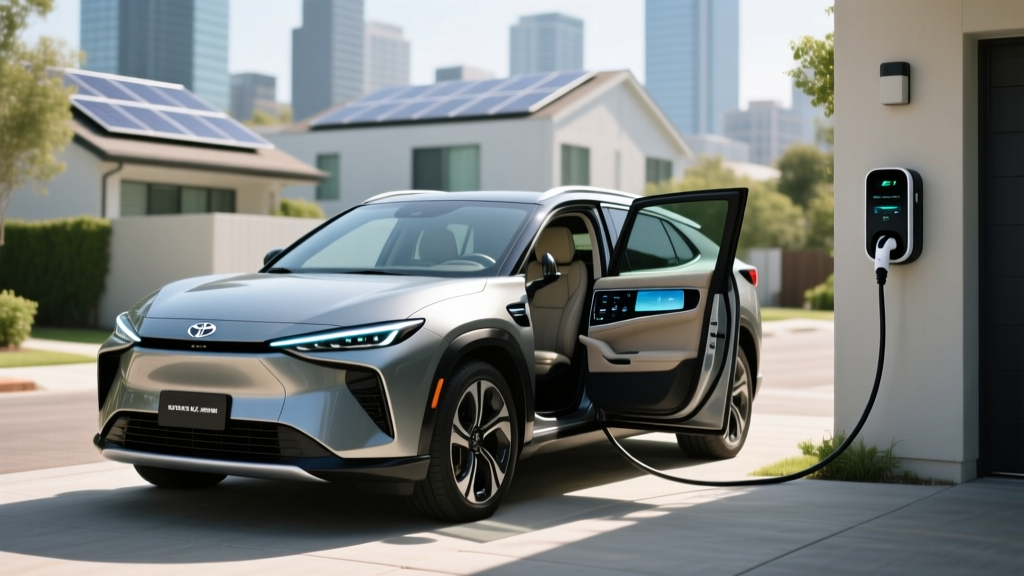
Quick Answer: Toyota's 2026 electric lineup centers on the bZ4X crossover SUV, offering 222–252 miles of EPA-estimated range depending on trim and drivetrain, with DC fast charging up to 150 kW (10–80% in approximately 30 minutes). Starting at $38,465 before destination, the bZ4X qualifies for a partial or full $7,500 federal tax credit under IRS §30D depending on battery sourcing and buyer income. For buyers who want Toyota reliability but aren't ready for full electric, Toyota's hybrid lineup (RAV4 Hybrid, Camry Hybrid, Highlander Hybrid) remains a lower-risk alternative with 40+ MPG combined and no charging infrastructure dependency.
Toyota's 2026 EV Lineup: What You Can Actually Buy
Toyota has been cautious in its battery-electric transition, and the 2026 model year reflects that measured approach. The bZ4X remains Toyota's sole mass-market battery-electric vehicle (BEV) available in the United States. While Toyota has announced future electric platforms and additional bZ models globally, the bZ4X is what you can walk into a dealership and purchase today.
The 2026 bZ4X carries over with minor updates following the platform refresh that improved charging speeds and thermal management in the prior model year. It's built on Toyota's e-TNGA platform, shared with the Subaru Solterra, and is available in two trims: XLE and Limited, with front-wheel drive (FWD) or all-wheel drive (AWD) configurations.
| Spec | XLE FWD | XLE AWD | Limited FWD | Limited AWD |
|---|---|---|---|---|
| EPA Range | 252 mi | 228 mi | 236 mi | 222 mi |
| Battery (usable) | 71.4 kWh, NMC lithium-ion | |||
| Horsepower | 201 hp | 214 hp | 201 hp | 214 hp |
| 0–60 mph | 7.1 sec | 6.5 sec | 7.1 sec | 6.5 sec |
| DC Fast Charge (peak) | 150 kW (CCS1) | |||
| 10–80% DC Charge | ~30 min | |||
| Level 2 Charge Rate | 7.2 kW (~9.5 hrs 0–100%) | |||
| MPGe (combined) | 131 MPGe | 114 MPGe | 125 MPGe | 112 MPGe |
| Base MSRP | $38,465 | $40,065 | $43,715 | $45,315 |
| Battery Warranty | 8 years / 100,000 miles (70% capacity retention) | |||
Source: EPA fueleconomy.gov and Toyota Motor Corporation specifications.
Real-World Range Expectations: The EPA 252-mile figure for the XLE FWD is achievable in mixed suburban driving at moderate temperatures. Expect approximately 200–220 miles on sustained highway trips at 70+ mph, and 170–195 miles in sub-freezing winter conditions. The AWD Limited's 222-mile EPA rating drops to roughly 175–190 miles in real-world highway winter driving. Toyota's battery thermal management has improved but still lags behind Hyundai/Kia's heat-pump-equipped platforms in cold-weather efficiency.
bZ4X vs. Gas and Hybrid: The Cost and Efficiency Math
Toyota dominates the hybrid market, so the natural question for most Toyota shoppers is: why go full electric instead of choosing a RAV4 Hybrid or RAV4 Prime PHEV? The answer depends on your driving pattern, home charging access, and how long you plan to keep the vehicle.
| Metric | bZ4X XLE FWD | RAV4 Hybrid (AWD) | RAV4 Gas (AWD) |
|---|---|---|---|
| EPA Combined Efficiency | 131 MPGe (26 kWh/100mi) | 39 MPG combined | 30 MPG combined |
| Annual "Fuel" Cost (15,000 mi) | $585 (home charging avg $0.15/kWh) | $1,346 (gas at $3.50/gal) | $1,750 (gas at $3.50/gal) |
| Annual Fuel Savings vs. Gas | $1,165 | $404 | — |
| Base MSRP | $38,465 | $33,975 | $30,425 |
| Fed. Tax Credit (§30D) | Up to $7,500* | None (HEV) | None |
| Effective Price After Credit | ~$30,965* | $33,975 | $30,425 |
* §30D credit eligibility depends on buyer income (≤$150K single / $300K joint), MSRP caps ($80K SUVs), and battery mineral/component sourcing requirements. Credit can be transferred to the dealer at point of sale for an upfront price reduction. Verify current eligibility at IRS.gov before purchasing.
The math becomes compelling when the bZ4X qualifies for the full $7,500 credit — it effectively undercuts the RAV4 Hybrid on purchase price while delivering roughly $760 more in annual energy savings. Over a 5-year ownership period, the bZ4X can save approximately $5,825 in energy costs compared to the gas RAV4, and $3,800 compared to the hybrid, assuming stable electricity and gas prices and consistent home charging.
However, if you lack access to home or workplace Level 2 charging, the calculus shifts. Public DC fast charging costs $0.35–$0.55/kWh on networks like Electrify America and EVgo, which pushes the bZ4X's annual energy cost to $1,365–$2,145 — erasing most of the savings advantage over the hybrid. This is why charging access is the single most important ownership variable.
Charging the bZ4X: Home, Public, and What to Expect
The bZ4X uses a CCS1 connector for DC fast charging and a J1772 inlet for Level 1 and Level 2 AC charging. With Toyota's gradual adoption timeline, the bZ4X has not transitioned to the NACS (Tesla-style) connector as of the 2026 model year, though Toyota has committed to NACS adoption in future models. For now, CCS1 works with Electrify America, EVgo, ChargePoint DC stations, and most non-Tesla networks.
| Charging Level | Power | Miles Added per Hour | Best For |
|---|---|---|---|
| Level 1 (120V household) | ~1.2 kW | ~3–4 mi/hr | Emergency top-ups, low daily mileage |
| Level 2 (240V home/public) | 7.2 kW | ~22–25 mi/hr | Daily home charging, overnight full charge |
| DC Fast Charging | 150 kW peak | ~150+ mi in 30 min (10–80%) | Road trips, quick replenishment |
Charging curve reality check: The bZ4X peaks at 150 kW only at a low state of charge (roughly 10–30%) and optimal battery temperature. Expect sustained rates of 80–110 kW through the mid-range, tapering sharply above 80% SoC. Charging from 80–100% on DC fast charging can take as long as the 10–80% portion. For road trips, plan stops at 15–20% remaining and charge to 80% to minimize total trip time.
For home charging, a Level 2 setup is strongly recommended. The bZ4X's 71.4 kWh battery means a full Level 1 charge from empty takes approximately 60 hours — impractical for most owners. A 240V Level 2 home charger (such as a ChargePoint Home Flex or Emporia Level 2) delivers a full overnight charge in roughly 9.5 hours.
| Item | Estimated Cost Range |
|---|---|
| Level 2 charger (hardware) | $350 – $700 |
| Electrician labor (standard install, 240V/40A circuit) | $500 – $1,500 |
| Permit & inspection | $50 – $250 |
| Electrical panel upgrade (if needed, 100A → 200A) | $1,500 – $3,500 |
| Total (no panel upgrade) | $900 – $2,450 |
| Total (with panel upgrade) | $2,400 – $5,950 |
Always get quotes from a licensed electrician. Some utilities offer rebates of $250–$500 for home charger installation, and the federal Residential Clean Energy Credit may cover 30% of charger and installation costs up to $1,000.
Total 5-Year Ownership Cost: bZ4X vs. RAV4 Hybrid
Purchase price is only part of the equation. Here's a realistic 5-year / 75,000-mile ownership cost comparison, assuming the bZ4X qualifies for the full §30D credit and is charged primarily at home.
| Cost Category | bZ4X XLE FWD | RAV4 Hybrid XLE AWD |
|---|---|---|
| Purchase Price (after credit) | $30,965 | $33,975 |
| Home Charger Install | $1,500 | $0 |
| Energy/Fuel (75K mi) | $2,925 | $6,730 |
| Maintenance (5 yr) | $1,200 | $2,800 |
| Insurance (5 yr avg) | $8,500 | $7,000 |
| Estimated Depreciation | $12,500 | $10,500 |
| Total 5-Year Cost | $57,590 | $61,005 |
| Cost Per Mile | $0.77 | $0.81 |
Key takeaways: The bZ4X wins on energy and maintenance (no oil changes, fewer brake replacements due to regenerative braking), but loses ground on insurance (EV premiums average 15–25% higher) and depreciation (EV resale values remain more volatile than Toyota's historically strong hybrid retention). If the §30D credit is unavailable to you due to income limits or battery sourcing disqualification, the RAV4 Hybrid becomes the lower-cost option over 5 years.
Common Misconceptions About the bZ4X and Toyota EVs
| Myth | Fact |
|---|---|
| "Toyota EVs have terrible range." | The bZ4X FWD delivers 252 miles EPA — competitive with the Hyundai Ioniq 5 (303 mi) and Volkswagen ID.4 (275 mi) in its price bracket. It's not class-leading, but it's sufficient for 90% of daily driving and regional road trips. |
| "The battery will need expensive replacement." | Toyota warranties the bZ4X battery for 8 years/100,000 miles with a 70% capacity retention guarantee. NMC batteries in modern thermal-managed packs typically retain 85–90% capacity at 100K miles based on industry data. Full replacement, if ever needed out of warranty, is estimated at $8,000–$14,000 — but this is rare within the vehicle's usable lifespan. |
| "I can charge at any Tesla Supercharger." | Not yet. The 2026 bZ4X still uses CCS1. Toyota has announced NACS adoption for future models, and some existing Toyotas may gain Supercharger access via adapter, but confirm current compatibility with Toyota and Tesla's network before relying on it. |
| "The §30D tax credit is guaranteed $7,500." | Eligibility depends on your adjusted gross income, the vehicle's MSRP, and battery critical-mineral and component sourcing. The credit amount can range from $0 to $7,500 depending on sourcing compliance percentages, which shift annually. Always verify on fueleconomy.gov and with a tax professional. |
| "EVs don't work in cold climates." | The bZ4X operates in cold weather, but expect 20–30% range reduction in sustained sub-freezing temperatures. Preconditioning the battery while plugged in mitigates charging-speed loss. For extreme cold climates (regular sub-0°F), a PHEV like the RAV4 Prime may be a more practical Toyota option. |
Decision Framework: Should You Buy the bZ4X or a Toyota Hybrid?
Choose the bZ4X if:
- You have reliable home Level 2 charging (garage or driveway with 240V access)
- Your daily commute is under 80 miles round-trip
- You qualify for the §30D federal tax credit (income and sourcing requirements met)
- You want the lowest per-mile energy cost and minimal maintenance
- You take road trips 2–4 times per year and are comfortable planning 30-minute DC fast-charge stops
Choose a Toyota Hybrid (RAV4 Hybrid, Camry Hybrid) if:
- You live in an apartment or lack home/workplace charging access
- You regularly drive 300+ miles between stops in rural areas with sparse charging infrastructure
- You live in an extreme cold climate (frequent sub-0°F winters)
- You don't qualify for the §30D credit and need the lowest upfront cost
- You want proven long-term resale value with minimal depreciation risk
Consider the RAV4 Prime (PHEV) if:
- You want 42 miles of electric-only range for daily commuting but gas-engine flexibility for road trips
- You can charge at home but have range anxiety for longer trips
- You want a bridge solution while public charging infrastructure matures in your area
Frequently Asked Questions
Does the 2026 Toyota bZ4X qualify for the $7,500 federal EV tax credit?
It may qualify for a partial or full credit depending on current battery sourcing compliance and your personal income. Under §30D, single filers must have an adjusted gross income ≤$150,000 (≤$300,000 joint). The bZ4X's MSRP is well under the $80,000 SUV cap. However, the critical-minerals and battery-component sourcing requirements determine whether you receive the full $7,500, a partial $3,750, or nothing. Check the latest status on fueleconomy.gov and consult a tax professional.
How long does it take to charge the bZ4X at home?
On a 240V Level 2 charger at 7.2 kW, a full 0–100% charge takes approximately 9.5 hours — easily achievable overnight. On a standard 120V outlet (Level 1), a full charge takes roughly 60 hours, making Level 1 practical only for emergency or very low-mileage use.
Is the bZ4X good for road trips?
It's adequate but requires planning. With 222–252 miles of range and 150 kW peak DC fast charging, you'll stop every 150–180 miles on the highway (accounting for real-world range loss at speed) and charge for approximately 25–30 minutes per stop. That's slower than the Hyundai Ioniq 5 (which peaks at 240 kW with an 800V architecture and charges 10–80% in ~18 minutes). If road trips are a primary use case, the bZ4X works but isn't class-leading.
What is the bZ4X's real-world range in winter?
In sustained temperatures below 32°F, expect 20–30% range reduction. The FWD XLE's 252-mile EPA rating drops to roughly 175–200 miles. The AWD trims, starting with lower EPA ratings, may see real-world winter ranges of 155–175 miles. Preconditioning the cabin and battery while plugged in helps preserve range and charging speed.
Are there more Toyota EVs coming after the bZ4X?
Toyota has announced plans for a broader electric lineup using its next-generation battery platforms, including models with LFP chemistry for cost reduction and potential solid-state batteries later this decade. However, as of the 2026 model year, the bZ4X is the only Toyota BEV available in the U.S. market. Any additional models remain announced/preliminary and should not be factored into current purchase decisions.
How does the bZ4X compare to the Subaru Solterra?
The Solterra shares the same e-TNGA platform and 71.4 kWh battery but comes exclusively with AWD, resulting in slightly lower EPA range (222–227 mi) and a marginally higher starting price. The Solterra includes some additional off-road-oriented driving modes and standard features that Toyota charges extra for. Choose based on which brand's feature content and pricing works better for your needs — the underlying EV hardware is essentially identical.
Sources consulted: EPA fueleconomy.gov, IRS §30D Clean Vehicle Credits, Toyota Motor Corporation U.S.A. product specifications. Tax credit eligibility and vehicle specifications are subject to change — always verify with official sources before purchasing.