The Yoke Controversy: Why the Tesla Model S Plaid Steering Wheel Still Divides Owners
Since Tesla made the yoke-style steering wheel standard on the refreshed Model S in 2021 and continued it through the 2026 model year, the Tesla Model S Plaid steering wheel has remained one of the most debated design choices in the EV market. It is not a round wheel. It is not a traditional aircraft yoke. It occupies a middle ground that some owners find intuitive after a few weeks and others never warm to. In this review, we break down exactly what the yoke is like to live with daily, then deliver the full 2026 Tesla Model S Plaid profile — range, charging, performance, pricing, tax-credit eligibility, and how it stacks up against the Porsche Taycan Turbo GT and Lucid Air Sapphire.
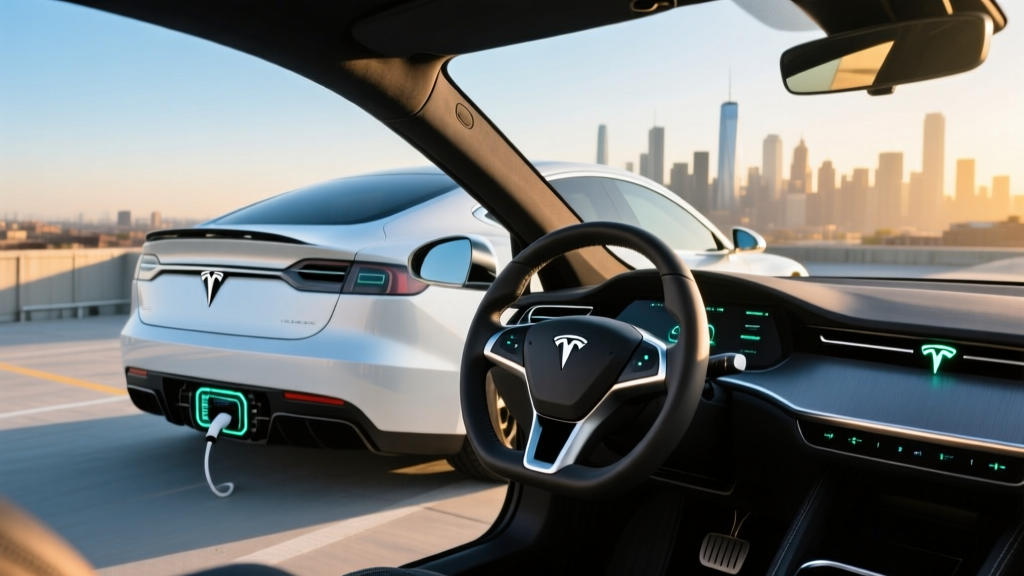
Before the spec sheet, the yoke deserves honest framing. At low speeds — parking lots, three-point turns, tight residential streets — you will notice the missing top half of the wheel. Tesla does not currently offer a variable-ratio steering rack that compensates for the reduced grip area (unlike the original Lexus RZ 450e concept, which paired a yoke with steer-by-wire). The Model S Plaid uses a fixed-ratio rack, meaning your hands must shuffle or cross over at full lock. On the highway and on sweeping curves, the yoke is genuinely excellent: your line of sight to the 12.3-inch instrument cluster is unobstructed, your hands rest naturally at 9-and-3, and the flat bottom keeps your lap clear. For track use — which is where the Plaid's 1,020 horsepower is most at home — the yoke provides precise hand placement and a clean view of the telemetry display. For daily school-drop-off and parallel parking, it is a compromise you either accept or you don't.
EPA estimated range: 396 miles (2026 Model S Plaid, 19-inch wheels). Expect approximately 310–340 miles on sustained 75-mph highway driving in moderate temperatures. In sub-freezing conditions (below 32°F), plan for 260–290 miles of usable range before seeking a charger. The dual-motor Plaid powertrain and wide rear tires consume more energy at speed than the Long Range AWD variant (EPA 402 mi).
2026 Tesla Model S Plaid: Full Specification Breakdown
| Attribute | Specification |
|---|---|
| EPA Range | 396 miles (19" wheels) |
| Battery Capacity (Usable) | ~95 kWh (NMC chemistry) |
| Drivetrain | Tri-Motor AWD (1 front, 2 rear carbon-sleeved rotors) |
| Horsepower | 1,020 hp |
| 0–60 mph | 1.99 seconds (with rollout subtracted) |
| Top Speed | 200 mph |
| MPGe (Combined) | 116 MPGe |
| Efficiency | 29 kWh / 100 mi |
| Max DC Fast Charge | 250 kW (V3 Supercharger / NACS) |
| 10–80% DC Time | ~27 minutes |
| Level 2 Home Charge | 11.5 kW / ~34 mi/hr (48A Wall Connector) |
| Cargo Volume | 28 cu ft (rear seats up) + frunk ~5.3 cu ft |
| Rear Legroom | 35.4 inches |
| Battery Warranty | 8 years / 150,000 miles (min 70% retention) |
| Base MSRP | $89,990 (excl. destination) |
The Model S Plaid's ~95 kWh usable battery uses NMC (nickel-manganese-cobalt) chemistry. This is the right choice for a performance sedan: NMC delivers higher energy density than LFP (lithium iron phosphate), which is critical when you need to package enough cells for 396 miles of range alongside three electric motors and the Plaid's thermal management hardware. The trade-off is that NMC batteries are more sensitive to sustained high-state-of-charge storage. For daily use, Tesla recommends charging to 80–90% and only going to 100% before road trips. The battery management system (BMS) and active liquid cooling are robust — degradation on Model S packs from the 2021+ refresh has been modest, with most owners reporting 5–8% loss after 60,000 miles based on fleet data from fueleconomy.gov and owner surveys.
Charging Speed: DC Fast Charging and Home Setup
The Model S Plaid charges via the NACS (North American Charging Standard) connector, which is now the dominant DC fast-charging standard in the United States. On a V3 Tesla Supercharger (250 kW peak), the Plaid reaches peak power briefly before tapering. The charge curve looks approximately like this:
- 10–30% SoC: ~230–250 kW sustained (fastest segment)
- 30–55% SoC: ~180–200 kW (taper begins)
- 55–80% SoC: ~120–150 kW (progressive taper)
- 80–100% SoC: ~40–60 kW (slow trickle for cell balancing)
The net result: 10–80% in approximately 27 minutes at a V3 Supercharger, adding roughly 200 miles of range in 15 minutes under optimal conditions (battery preconditioned via in-car navigation to a Supercharger). On a 150 kW Electrify America or third-party NACS station, expect 10–80% in roughly 38–42 minutes.
At home, the Tesla Wall Connector (Gen 3) delivers up to 11.5 kW on a 60-amp circuit (48 amps continuous), adding approximately 34 miles of range per hour. An overnight 10-hour charge session restores roughly 340 miles — effectively a full recharge for most daily driving patterns. Installation typically runs $800–$2,000 depending on panel proximity and whether your home's 200-amp service can spare the 60-amp allocation. If you need a panel upgrade to 200A or 400A, add $2,000–$5,000. Always consult a licensed electrician for final specs.
Performance: 1,020 Horsepower Is Not a Typo
The tri-motor Plaid powertrain produces 1,020 horsepower and achieves a manufacturer-claimed 1.99-second 0–60 mph time (with the 1-foot rollout subtracted, per drag-racing convention). Independent testing by outlets including Car and Driver and MotorTrend has validated 0–60 times between 2.1 and 2.3 seconds in real-world conditions — still among the quickest production cars ever measured. The two rear carbon-sleeved permanent-magnet motors are the engineering highlight: the carbon-fiber sleeve allows the rotors to spin at up to 20,000+ RPM without expanding beyond their air gap, solving a key limitation of high-RPM electric motors.
On track, the Plaid's active thermal management keeps battery and motor temperatures in check for multiple consecutive laps — a problem that plagued earlier high-performance EVs. The 2026 model continues to offer Track Mode, which lets you adjust front/rear torque distribution, stability control, and regenerative braking intensity. Braking remains the Plaid's weakest dynamic link: the standard brake hardware is adequate for street use but will fade under sustained track abuse. The optional carbon-ceramic brake package ($15,000 when available) addresses this but is not always in production.
Interior, Tech, and the Yoke Experience Day-to-Day
The 2026 Model S interior received incremental updates over the 2021 refresh. The 17-inch center touchscreen (now with AMD Ryzen processor since 2022) remains one of the most responsive infotainment systems in any vehicle, period. The secondary 8-inch rear touchscreen controls climate and media for rear passengers. The 12.3-inch instrument cluster behind the yoke is crisp and reconfigurable.
Notable tech features include:
- Autopilot (standard): Adaptive cruise + lane centering — this is SAE Level 2 driver assistance, not self-driving. You must remain engaged.
- Full Self-Driving (Supervised): $8,000 option or $99/month subscription. Adds automatic lane changes, traffic-light recognition, and city-street navigation. Still Level 2 — driver supervision required at all times.
- 22-speaker audio system: Among the best in any production sedan.
- HEPA air filtration (Bioweapon Defense Mode): Genuinely effective; uses a large HEPA filter uncommon in passenger vehicles.
- Gaming: Steam integration supports full PC gaming on the center screen while parked.
Tesla Autopilot and FSD (Supervised) are both SAE Level 2 systems. The driver must keep hands on the yoke (or apply torque) and eyes on the road. Tesla's camera-based monitoring enforces attention, but the system does not replace the driver. Only Level 4 services (e.g., Waymo in designated geofenced areas) operate without a human driver.
The yoke's impact on daily usability is real but manageable. The most common complaint: roundabouts and tight multi-lane turns require hand-over-hand shuffling that a round wheel handles more naturally. The most common praise: superior forward visibility, a cleaner cockpit feel, and excellent track ergonomics. Tesla does not currently offer a round-wheel option on new Plaid orders — the yoke is standard and the only choice.
Pricing, Tax Credit Eligibility, and Total Cost
| Item | Amount |
|---|---|
| Base MSRP (Model S Plaid) | $89,990 |
| Destination Fee | $1,995 |
| FSD (Supervised) Option | +$8,000 |
| Paint (Ultra Red, Solid Black, etc.) | +$2,000–$3,000 |
| As-Tested Price (typical) | ~$103,000–$105,000 |
| Federal §30D Tax Credit | $0 (MSRP exceeds $55,000 sedan cap) |
| Estimated 5-Year Insurance | $18,000–$24,000 (varies by state/driver) |
The 2026 Model S Plaid does not qualify for the federal §30D new EV tax credit. The IRS rules cap eligible sedans at an MSRP of $55,000, and the Plaid's $89,990 base price exceeds that threshold by a wide margin. Additionally, buyer income limits ($150,000 single / $300,000 joint MAGI) apply to the credit regardless of vehicle eligibility. Always verify current rules at irs.gov before purchase. Some states offer separate incentives that may partially offset the cost — check your state energy office for details.
Running costs tell a more favorable story. At the national average residential electricity rate of ~$0.16/kWh, charging the Plaid's ~95 kWh battery from 10–100% at home costs approximately $14.50 for nearly 400 miles of range. That compares to roughly $65–$80 for an equivalent distance in a 500-hp gas performance sedan averaging 18 mpg at $3.50/gallon. Over five years and 75,000 miles, home-charging savings versus premium gasoline can reach $6,000–$9,000.
Model S Plaid vs. the Competition
| Spec | Tesla Model S Plaid | Porsche Taycan Turbo GT | Lucid Air Sapphire |
|---|---|---|---|
| EPA Range | 396 mi | 269 mi | 427 mi |
| Horsepower | 1,020 hp | 1,019 hp (Launch Control) | 1,234 hp |
| 0–60 mph | 1.99s (claimed) | 2.1s | 1.99s (claimed) |
| Max DC Charge | 250 kW | 320 kW | 300 kW |
| 10–80% Time | ~27 min | ~18 min | ~22 min |
| Base MSRP | $89,990 | $230,000 | $249,000 |
| Steering | Yoke only | Round wheel | Round wheel |
The Model S Plaid's value proposition is stark: it delivers hypercar acceleration and 396 miles of range at roughly one-third the price of a Taycan Turbo GT and less than half the Lucid Air Sapphire. Where it falls short is charging speed — the Porsche's 800-volt architecture and 320 kW peak rate crush the Plaid's 250 kW on road trips. The Lucid's efficiency and range are also superior, though at a much higher price. The Plaid wins on Supercharger network access, infotainment responsiveness, and total package value. The Taycan wins on chassis dynamics, build quality, and steering feedback. The Sapphire wins on raw power and luxury materials.
- Sub-2-second 0–60 in a four-door sedan
- 396-mile EPA range is class-leading for the performance segment
- Supercharger network access (most reliable US DC network)
- Excellent infotainment and over-the-air updates
- Spacious cargo area (28 cu ft rear + frunk)
- Best value in the 1,000+ hp EV sedan category
- Yoke steering wheel is polarizing and not optional
- 250 kW peak charging trails 800V competitors
- Interior materials still below Porsche/Lucid at this price
- No federal tax credit (MSRP cap)
- Brake hardware inadequate for sustained track use without carbon-ceramic option
- Panel gaps and build consistency improved but still criticized
Who Should Buy the Model S Plaid (and Who Shouldn't)
Buy the Plaid if: You want the fastest-accelerating four-door sedan available at any price near $90,000. You value Supercharger network reliability for road trips. You are comfortable with (or excited by) the yoke steering wheel after a test drive. You want a daily-driver EV that can legitimately run sub-10-second quarter miles on weekends.
Look elsewhere if: You prefer a traditional round steering wheel (Porsche Taycan, Lucid Air). You need the fastest possible DC charging for frequent long-distance travel (Taycan's 800V system is meaningfully quicker). You prioritize interior build quality and material luxury over raw performance (Lucid Air Grand Touring, Mercedes-AMG EQS). You need a federal tax credit to make the math work.
Frequently Asked Questions
What is the real-world range of the Tesla Model S Plaid?
The EPA rates the 2026 Model S Plaid at 396 miles on 19-inch wheels. In real-world highway driving at 75 mph in moderate weather, expect 310–340 miles. In freezing temperatures, plan for 260–290 miles. Range varies significantly with speed, temperature, elevation, and climate-control use.
How fast does the Model S Plaid charge at home and on the road?
On a V3 Supercharger (250 kW peak), 10–80% takes approximately 27 minutes with a preconditioned battery. At home on a Tesla Wall Connector (11.5 kW, 48A), you gain roughly 34 miles per hour, restoring most of the battery overnight.
Does the Tesla Model S Plaid qualify for the federal EV tax credit?
No. Under IRS §30D rules, new sedans must have an MSRP at or below $55,000 to qualify. The Plaid's $89,990 base price exceeds this cap. Buyer income limits ($150K single / $300K joint) also apply. Consult irs.gov or a tax professional for your specific situation.
Can I get a round steering wheel on the Model S Plaid?
No. As of the 2026 model year, Tesla offers only the yoke-style steering wheel on the Model S. There is no round-wheel option at the factory. Some aftermarket companies offer round-wheel conversions, but these may affect warranty coverage and Autopilot functionality.
Is the Tesla Model S Plaid worth buying over the Porsche Taycan or Lucid Air?
The Plaid offers the best performance-per-dollar in the 1,000+ hp EV sedan segment. If charging speed and chassis refinement are priorities, the Taycan Turbo GT is superior. If range and luxury are paramount and budget is flexible, the Lucid Air Sapphire or Grand Touring are compelling. The Plaid wins on total value, Supercharger access, and infotainment.
What is the battery warranty on the Model S Plaid?
Tesla covers the Model S Plaid battery and drive unit for 8 years or 150,000 miles, whichever comes first, with a minimum 70% capacity retention guarantee. If the battery drops below 70% of its original capacity within that period, Tesla will repair or replace it under warranty.