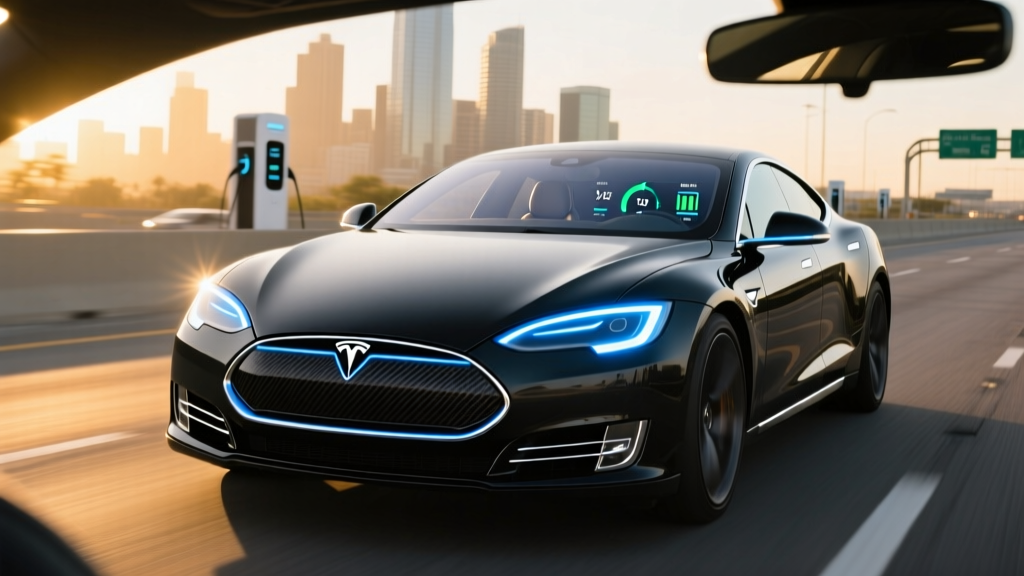
The Tesla Model S Plaid occupies a strange corner of the EV market: a four-door luxury sedan that can outrun most supercars at a stoplight while still offering over 350 miles of usable range. For buyers searching the Tesla Plaid 1/4 mile time, the headline number is well documented — 9.23 seconds at roughly 155 mph in stock trim, verified by multiple independent tests at prepped drag strips. But a car this extreme demands more than a single stat. Below, we break down the Plaid's real-world range, charging behavior, ownership economics, and whether its 1,020 horsepower justifies a six-figure price tag in 2026.
Performance: The Numbers Behind the Tesla Plaid 1/4 Mile Time
The Model S Plaid uses a tri-motor all-wheel-drive layout — one motor on the front axle and two on the rear — producing a combined 1,020 horsepower and 1,050 lb-ft of torque. Tesla's carbon-sleeved rotors allow the motors to spin to 20,000+ RPM without disintegrating under centrifugal force, which is the engineering trick that separates the Plaid from earlier dual-motor Performance models.
| Metric | Value |
|---|---|
| 0–60 mph | 1.99 seconds (with rollout subtracted) |
| 1/4 mile time | ~9.23 sec @ ~155 mph (stock, prepped surface) |
| Horsepower | 1,020 hp (combined tri-motor) |
| Torque | 1,050 lb-ft |
| Drivetrain | AWD, tri-motor (1 front / 2 rear) |
| Top speed | 200 mph (with paid hardware upgrade) |
| Curb weight | ~4,766 lbs |
A few real-world caveats on the 1/4 mile figure: Tesla's published 1.99-second 0–60 time subtracts a one-foot rollout (standard in drag racing but not how most people experience acceleration). Independent testers at Motor Trend and Car and Driver have recorded 0–60 times between 2.1 and 2.3 seconds without rollout, and 1/4 mile passes between 9.2 and 9.4 seconds depending on surface prep, tire temperature, and battery state of charge. For maximum launch performance, Tesla requires the battery to be above 95% SoC and the powertrain to be preconditioned via Drag Strip mode, which takes roughly 15–20 minutes of thermal prep.
For context, the Plaid's 1/4 mile time rivals a Ferrari SF90 Stradale and demolishes the Dodge Challenger SRT Demon 170's 9.27-second pass — though the Demon achieves its number on a prepped track with drag radials and race fuel, while the Plaid does it on its stock Michelin Pilot Sport 4S tires.
EPA Range, Battery, and Real-World Efficiency
Real-world expectation: Plan for ~280–310 miles on highway road trips at 70–80 mph. In cold weather (below 32°F), expect a 20–30% reduction, dropping effective range to ~250 miles on the Plaid. City driving with regen braking recovers more energy and can push closer to the EPA sticker.
The Model S Plaid uses a ~100 kWh battery pack (approximately 95 kWh usable) built on NMC (nickel manganese cobalt) chemistry. Unlike the standard-range Model 3 and Model Y, which have shifted to LFP (lithium iron phosphate) for cost and longevity, Tesla reserves NMC for its performance and long-range vehicles because of its higher energy density — critical when you need to pack enough cells to feed 1,020 hp while still crossing 350 miles of range.
The trade-off with NMC: it degrades slightly faster than LFP over many charge cycles and is more sensitive to sitting at 100% SoC for extended periods. Tesla recommends daily charging to 80–90% for NMC packs and saving 100% charges for road trips. Following this guideline, most owners report 5–8% degradation over the first 50,000 miles based on fleet data aggregated by Recurrent Auto.
Efficiency on the EPA cycle comes in at 116 MPGe combined (29 kWh/100 mi) for the Plaid — impressive for a 4,766-lb car with this much power, but noticeably thirstier than the Long Range AWD variant at 122 MPGe. On a real-world 75-mph highway loop, expect closer to 33–35 kWh/100 mi, which is how the effective highway range drops to the 280–310 mile window.
Charging Speed: DC Fast, Level 2, and the Charge Curve
The Model S Plaid charges exclusively via the NACS (North American Charging Standard) connector — Tesla's proprietary plug that has now been adopted by nearly every major automaker for their 2025+ models.
| Charging Level | Power / Rate | Time / Miles Added |
|---|---|---|
| Level 1 (120V household) | ~1.4 kW | ~3–4 miles per hour |
| Level 2 (240V home / Wall Connector) | 11.5 kW (48A) | ~34 miles per hour; 0–100% in ~9 hours |
| DC Fast Charge (Supercharger V3/V4) | Peak 250 kW | 10–80% in ~27 minutes; ~175 miles in 15 min |
The Plaid's peak DC charge rate of 250 kW remains a sore point compared to competitors. The Hyundai Ioniq 5 and Kia EV6 can peak at 350 kW on an 800V architecture, and the Porsche Taycan Turbo GT pushes 320 kW. Tesla has stuck with a ~400V architecture on the Model S, which caps peak charge speed.
The charge curve matters more than the peak number. The Plaid holds close to 250 kW from roughly 10% to 35% SoC, then tapers to ~180 kW through 50%, drops to ~120 kW near 70%, and crawls below 50 kW above 85%. This is typical for NMC chemistry — charging above 80% is where the battery management system deliberately slows current to protect cell longevity. For road trips, the practical move is to charge from 10–80% (about 27 minutes at a V3 Supercharger) and hit the road rather than wait for a full top-off.
Home charging with the Tesla Wall Connector at 11.5 kW adds roughly 34 miles of range per hour — enough to fully replenish the pack overnight on a 60-amp circuit. If your home has a standard 40-amp circuit (common in older panels), you'll be limited to ~9.6 kW or ~28 miles per hour. A panel upgrade to 200A service runs $1,500–$3,500 depending on your electrician and local permitting, so factor that into the total cost of ownership.
Interior, Cargo, and Daily Livability
The Model S interior received a significant refresh in 2021 (the "Palladium" platform), and the 2026 model carries forward that architecture with incremental updates. The cabin is dominated by a 17-inch center touchscreen, a 12.3-inch digital instrument cluster, and — for rear passengers — an 8-inch screen for climate and entertainment controls.
The yoke steering wheel remains standard on the Plaid, with a round wheel available as a no-cost option. The yoke is polarizing: excellent for visibility and track use, awkward for low-speed parking maneuvers and three-point turns where you'd normally hand-over-hand the wheel.
| Measurement | Value |
|---|---|
| Front legroom | 42.4 in |
| Rear legroom | 35.4 in |
| Cargo (rear trunk) | 26.3 cu ft |
| Cargo (front trunk / frunk) | ~5.3 cu ft |
| Total cargo volume (seats folded) | ~64.9 cu ft |
| Seating capacity | 5 passengers |
The rear hatchback design gives the Model S an enormous practical advantage over traditional sedans like the Porsche Taycan (which has a conventional trunk lid). With rear seats folded, you can fit a full set of golf clubs, several suitcases, or a week's worth of groceries for a family of four. The frunk adds enough space for a charging cable bag and a small soft cooler.
Rear seat comfort is acceptable for adults on shorter trips, but the floor is high due to the battery pack underneath, which forces a knees-up seating position. On longer drives, rear passengers may find the seat bottom too flat and the thigh support lacking compared to a BMW i7 or Mercedes EQS.
Pricing, Trim Levels, and Federal Tax Credit Eligibility
The 2026 Tesla Model S Plaid starts at an MSRP of $89,990 (including destination), placing it in rarefied pricing territory. The Long Range AWD variant, which offers 396 miles of range and a still-quick 3.1-second 0–60, starts at $74,990. Both trims sit well above the federal tax credit MSRP cap.
| Trim | Base MSRP | §30D Federal Credit | Effective Price |
|---|---|---|---|
| Model S Long Range AWD | $74,990 | Not eligible (MSRP exceeds $55,000 sedan cap) | $74,990 |
| Model S Plaid | $89,990 | Not eligible (MSRP exceeds $55,000 sedan cap) | $89,990 |
Under current IRS §30D clean vehicle credit rules, the Model S does not qualify for the up-to-$7,500 federal tax credit. The law caps eligible sedans at an MSRP of $55,000 — a threshold the Model S has exceeded since its 2023 price restructuring. Additionally, buyer income caps ($150,000 single / $300,000 joint modified AGI) and battery critical-mineral sourcing requirements further limit eligibility even for lower-priced EVs.
Some state-level incentives may apply (California's CVRP, for example, has its own income and price caps that also typically exclude the Model S), so check your state energy office. Tesla's referral program occasionally offers price reductions or Supercharging credits that can shave $500–$1,000 off the purchase, though these promotions rotate.
- Sedan MSRP cap: $55,000 (Model S Plaid is $89,990)
- Buyer income cap: $150K single / $225K HOH / $300K joint
- Battery critical minerals must meet annual sourcing thresholds
- Vehicle must be assembled in North America (Model S: Fremont, CA — passes)
- Point-of-sale transfer available for qualifying vehicles (not applicable here)
Warranty, Ownership Costs, and Longevity
Tesla covers the Model S Plaid with the following warranty structure:
- Basic vehicle: 4 years / 50,000 miles
- Battery and drive units: 8 years / 150,000 miles (whichever comes first), with a minimum 70% capacity retention guarantee over that period
The 8-year/150,000-mile battery warranty is competitive with the industry standard. If the pack degrades below 70% of its original capacity within the warranty window, Tesla will repair or replace it. In practice, NMC packs in Tesla vehicles have shown strong longevity: data from Recurrent Auto indicates that most Model S batteries retain 90%+ capacity at 50,000 miles and roughly 85% at 100,000 miles when charged responsibly (avoiding constant 100% charges and extreme heat exposure).
Insurance is a real cost factor. The Model S Plaid's combination of high repair costs, expensive parts, and 1,020 hp pushes average annual premiums to $3,500–$5,500 depending on your state, age, and driving record — roughly 60–100% more than a comparable gas-powered luxury sedan. Get quotes before committing.
Maintenance is minimal compared to ICE vehicles: no oil changes, no transmission fluid, no spark plugs. Expect to spend on tire rotations ($50–$80 every 6,000 miles — the Plaid burns through rear tires quickly given the torque), cabin air filter replacement ($50–$100 annually), brake fluid checks, and wiper fluid. The regenerative braking system means brake pads often last 100,000+ miles.
Autopilot, FSD, and Smart Driving Features
Tesla Autopilot and Full Self-Driving (Supervised) are Level 2 driver-assistance systems, not self-driving. The driver must remain fully attentive, keep hands on the wheel (or apply torque as monitored by the steering column), and be prepared to take over at any moment. No currently sold Tesla vehicle is capable of unsupervised autonomous driving.
The Model S Plaid ships with Basic Autopilot, which includes Traffic-Aware Cruise Control and Autosteer (lane centering) for highway use. The optional Full Self-Driving (Supervised) package — currently priced at $8,000 or $99/month — adds Navigate on Autopilot (automatic highway interchanges and exits), Auto Lane Change, Autopark, Summon, and traffic light/stop sign recognition.
FSD (Supervised) has improved substantially through 2025–2026 with Tesla's end-to-end neural network architecture (v13.x), which handles complex urban scenarios more smoothly than earlier rule-based versions. However, it still makes errors — particularly in construction zones, with temporary lane markings, and during heavy rain or glare. The driver monitoring system uses the interior camera to track eye gaze and will issue escalating warnings before disengaging if you look away from the road.
- Drive without a fully attentive, licensed driver in the seat
- Handle all weather conditions (heavy rain, snow, fog degrade performance)
- Navigate unmapped roads or construction zones reliably
- Replace your auto insurance or absolve you of liability in a collision
Model S Plaid vs. the Competition
At this price and performance tier, the Plaid's direct competitors are limited but formidable:
| Tesla Model S Plaid | Porsche Taycan Turbo GT | Lucid Air Sapphire | |
|---|---|---|---|
| Price | $89,990 | ~$165,000 | $249,000 |
| Horsepower | 1,020 hp | 1,092 hp (Launch Control) | 1,234 hp |
| 0–60 mph | 1.99 sec | ~2.1 sec | ~1.89 sec |
| EPA Range | 359 mi | ~269 mi | 427 mi |
| Peak DC Charge | 250 kW | 320 kW | 300+ kW |
| 1/4 Mile | ~9.23 sec | ~9.3 sec | ~8.95 sec |
| Supercharger Access | Native | NACS adapter (2025+) | NACS adapter (2025+) |
The Porsche Taycan Turbo GT is the driver's choice: its 800V architecture delivers faster peak charging (320 kW), its chassis tuning is leagues ahead on a road course, and its build quality and interior materials are a class above. But it costs nearly double the Plaid and gives up 90 miles of EPA range.
The Lucid Air Sapphire is the only sedan that outruns the Plaid in both the 1/4 mile and EPA range — but at $249,000, it's a low-volume halo car, not a realistic cross-shop for most buyers. The standard Lucid Air Grand Touring ($125,600, 516 mi EPA) is a more practical range competitor but can't match the Plaid's acceleration.
- Sub-9.3-second 1/4 mile at a fraction of supercar pricing
- 359-mile EPA range is genuinely road-trip capable
- Native Tesla Supercharger network (17,000+ V3/V4 stalls in North America)
- Hatchback cargo versatility (26.3 cu ft rear + 5.3 cu ft frunk)
- Over-the-air updates continue to add features years after purchase
- Minimal scheduled maintenance vs. ICE performance sedans
- No federal tax credit eligibility (MSRP exceeds $55K sedan cap)
- 250 kW peak charge rate lags 800V competitors (Porsche, Hyundai/Kia)
- Insurance premiums 60–100% higher than comparable gas sedans
- Yoke steering is awkward for daily low-speed driving (round wheel optional)
- Rear seat comfort trails German luxury competitors
- Panel gaps and interior rattles still reported by some owners
- NMC battery requires mindful charging habits (avoid sustained 100% SoC)
Who the Model S Plaid Is For
The Model S Plaid makes sense for a narrow but enthusiastic buyer: someone who wants hypercar acceleration in a practical daily driver, has access to home Level 2 charging, and values the Tesla Supercharger network for road trips. It's a strong choice for:
- Performance enthusiasts who want 1/4 mile bragging rights without sacrificing four doors and a usable back seat
- Tech-forward commuters who appreciate OTA updates, the 17-inch screen, and FSD (Supervised) for highway drudgery
- One-car households that need a single vehicle to handle school runs, weekend canyon drives, and 400-mile road trips
It's a poor fit for budget-conscious buyers (no tax credit, high insurance), luxury traditionalists who prioritize build quality and dealer service (BMW, Mercedes, Porsche still win here), and anyone who can't install a Level 2 charger at home or work.
Frequently Asked Questions
What is the Tesla Model S Plaid's real-world range on a road trip?
On a highway road trip at 70–80 mph in moderate temperatures (60–80°F), expect 280–310 miles before needing to charge. In winter conditions below freezing, that drops to roughly 250 miles. City driving with frequent regen braking can push range closer to the 359-mile EPA sticker. For trip planning, use Tesla's built-in navigation, which factors in elevation, temperature, and driving style to estimate arrival SoC with good accuracy.
How fast does the Model S Plaid charge at home and on the road?
At home on a Tesla Wall Connector (240V, 48A), the Plaid charges at up to 11.5 kW, adding about 34 miles of range per hour — a full charge from empty takes roughly 9 hours. On the road at a V3 Supercharger, it peaks at 250 kW and charges from 10–80% in about 27 minutes. The charge curve tapers significantly above 80%, so plan to charge to 80% and keep driving rather than waiting for a full top-off.
Does the Tesla Model S Plaid qualify for the $7,500 federal EV tax credit?
No. Under current IRS §30D rules, the federal clean vehicle credit caps sedan eligibility at an MSRP of $55,000. The Model S Plaid's $89,990 sticker price disqualifies it. Buyer income limits and battery sourcing requirements add further restrictions even for lower-priced vehicles. Always consult a tax professional for your specific situation.
Is the Tesla Plaid 1/4 mile time faster than a gas supercar?
The Plaid's ~9.23-second 1/4 mile at ~155 mph is competitive with or faster than many gas-powered supercars, including the Chevrolet Corvette Z06 (~10.0 sec) and the Ferrari F8 Tributo (~10.5 sec). It trades blows with the Ferrari SF90 Stradale and beats the Dodge Challenger SRT Demon 170 on a prepped surface. However, dedicated drag cars and hypercars like the Bugatti Chiron (~9.4 sec at 255+ mph trap speed) still hold advantages at the top end.
How does the Model S Plaid compare to the Porsche Taycan Turbo GT?
The Plaid is quicker to 60 mph (1.99 vs ~2.1 sec), has 90 more miles of EPA range, and costs roughly $75,000 less. The Taycan Turbo GT charges faster (320 kW peak vs 250 kW), handles better on a road course thanks to superior chassis tuning and rear-axle steering, and offers a more luxurious interior with higher-quality materials. If track driving and build quality are priorities, the Porsche is the better car. If straight-line speed, range, and value matter more, the Plaid wins.
What is the battery warranty on the Model S Plaid?
Tesla covers the Model S Plaid's battery and drive units for 8 years or 150,000 miles, whichever comes first. The warranty guarantees a minimum of 70% battery capacity retention over that period. If the pack degrades below 70% within the warranty window, Tesla will repair or replace it at no cost. Real-world data suggests most Tesla NMC packs retain 85–90%+ capacity at 100,000 miles when charged responsibly.
Is the Model S Plaid practical as a daily driver?
Yes, with caveats. The hatchback design provides excellent cargo space (26.3 cu ft), the ride quality in Comfort mode is compliant for a performance sedan, and the 359-mile range eliminates daily charging anxiety if you have home Level 2 access. The main daily-driver drawbacks are the yoke steering (round wheel available as a no-cost option), the wide 75.5-inch body making tight parking garages stressful, and premium insurance costs. For families needing more rear-seat space, the Model X or a three-row EV SUV may be more practical.