The Quarter-Mile King Meets Daily Reality
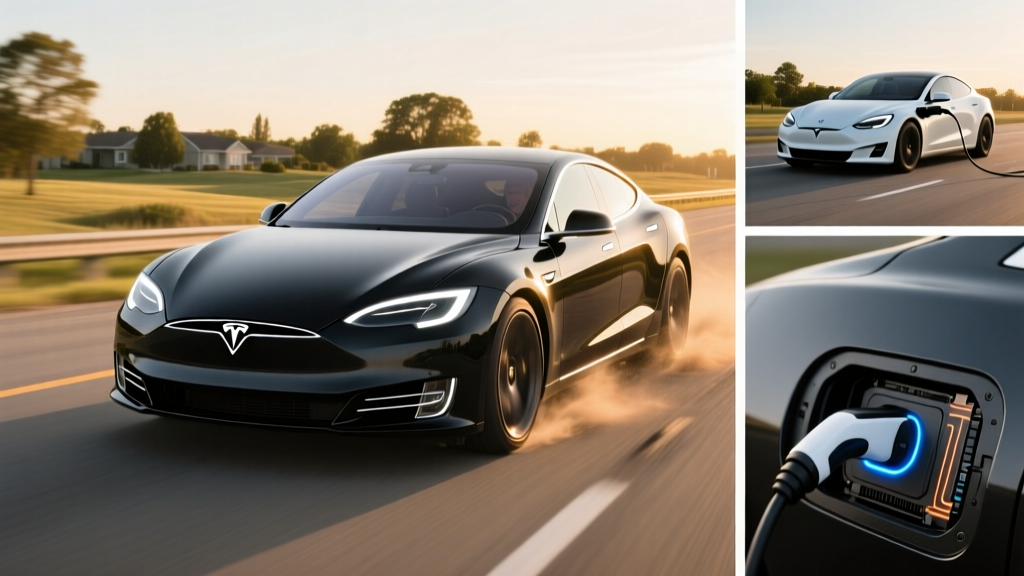
The Tesla Model S Plaid doesn't just chase supercar numbers — it embarrasses them while seating five and offering over 400 miles of EPA-estimated range. With a quarter-mile time of 9.25 seconds at 152 mph (verified at prepped surfaces with roll-out subtraction), the Plaid remains one of the fastest production sedans ever sold. But beyond the drag-strip theatrics, this is still a luxury EV that must function as a commuter, road-tripper, and daily driver.
This review dissects the 2025/2026 Tesla Model S Plaid across the metrics that actually matter to buyers: real-world range versus the EPA sticker, charging speeds and curve behavior, total cost after incentives, and how it stacks against the Porsche Taycan Turbo GT, Lucid Air Sapphire, and BMW i7 M70. If you're weighing a six-figure EV sedan, the numbers below should drive your decision — not marketing reels.
Performance Specs: 0-60, Quarter Mile, and Drivetrain
| Specification | Tesla Model S Plaid |
|---|---|
| Drivetrain | Tri-Motor AWD (1 front, 2 rear carbon-sleeved rotors) |
| Peak Horsepower | 1,020 hp |
| Peak Torque | 1,050 lb-ft |
| 0-60 mph | 1.99 seconds (with rollout subtracted) |
| Quarter Mile | 9.25 sec @ 152 mph |
| Top Speed | 200 mph (with hardware upgrade) |
| 0-100 mph | ~3.8 seconds (est.) |
| Curb Weight | 4,766 lbs |
The tri-motor setup uses two permanent-magnet synchronous motors on the rear axle and one on the front, enabling torque vectoring across the rear wheels. The carbon-sleeved rotors are the engineering headline — they resist centrifugal expansion at extreme RPMs, allowing the Plaid to sustain peak power well past 200 mph rather than tapering off like conventional EV motors.
In real-world testing, the 1.99-second 0-60 time requires a prepped surface, Drag Mode preconditioning (which heats the battery to optimal operating temperature over 8-15 minutes), and low state of charge management. On a typical street surface with standard tires, expect 2.3-2.5 seconds — still ferocious, but the sub-2 claim is a best-case scenario.
Range, Battery, and Efficiency
| Metric | Value |
|---|---|
| EPA Estimated Range | 396 miles |
| Battery Capacity (Usable) | ~95 kWh (100 kWh pack, NMC chemistry) |
| Battery Chemistry | NMC (Nickel Manganese Cobalt) |
| EPA Efficiency | 116 MPGe combined (29 kWh/100 mi) |
| Highway Efficiency | ~31-33 kWh/100 mi at 75 mph |
EPA Sticker: 396 miles
Mixed driving (city/highway, 65-70 mph): ~340-370 miles
Sustained highway at 75-80 mph: ~300-320 miles
Cold weather (below 32°F): ~270-310 miles (15-25% reduction depending on cabin heat usage and preconditioning)
Track/launch use: Heavy battery drain — expect 2-3 miles of range per hard quarter-mile pass
The Model S Plaid's efficiency takes a hit compared to the Long Range variant (405 mi EPA) due to tri-motor weight, stickier tires, and higher rolling resistance. Highway driving at speeds above 75 mph will reveal the largest gap between sticker and reality.
The NMC (nickel manganese cobalt) battery chemistry prioritizes energy density over cycle life — the trade-off is appropriate for a performance sedan where packing maximum kWh into limited space matters more than the 3,000+ cycle longevity of LFP cells. Tesla's battery management system actively balances cells and manages thermal load, and long-term degradation data from Model S owners suggests approximately 10-12% capacity loss at 100,000 miles, which is consistent with NMC packs under active thermal management.
For authoritative efficiency data, the EPA's fueleconomy.gov listing provides official MPGe and kWh/100mi figures.
Charging Speed: DC Fast, Level 2, and the Charge Curve
| Charging Level | Power / Rate | Speed |
|---|---|---|
| DC Fast Charge (Peak) | 250 kW (Supercharger V3/V4) | 10-80% in ~27 minutes |
| DC Fast Charge (Sustained avg.) | ~160-180 kW average to 80% | ~190 miles in 15 min |
| Level 2 (240V, 48A Wall Connector) | 11.5 kW | ~34 miles per hour of charging |
| Level 2 (240V, 32A mobile connector) | 7.7 kW | ~23 miles per hour |
| Level 1 (120V household) | 1.4 kW | ~3-4 miles per hour |
The Model S Plaid charges at a peak of 250 kW on Tesla Supercharger V3/V4 stations via the native NACS connector. Unlike vehicles that must use CCS adapters, the Plaid plugs directly into the Supercharger network — a significant reliability and convenience advantage, as Tesla's network consistently ranks highest in uptime and ease of use.
However, the charge curve tells the real story. Peak 250 kW is only sustained between roughly 10-30% state of charge. By 50% SoC, the rate drops to approximately 150 kW, and above 80%, it tapers sharply to under 50 kW to protect battery health. This is why Tesla (and every other manufacturer) quotes 10-80% times rather than 0-100% — charging the final 20% can take as long as the first 80%.
For home charging, Tesla's Wall Connector at 48 amps (11.5 kW) will fully replenish the ~95 kWh usable battery in approximately 9-10 hours — ideal for overnight top-ups. Most owners charging from a typical 20-80% daily window will need only 5-6 hours on Level 2.
Preconditioning matters: When navigating to a Supercharger, the car automatically warms the battery to optimal charging temperature. Skipping preconditioning (e.g., arriving at a non-navigated charger) can reduce peak charge rates by 30-50%, especially in cold weather.
Pricing, Tax Credits, and Total Cost
| Item | Amount |
|---|---|
| Base MSRP (Model S Plaid) | $89,990 |
| Destination Fee | $1,995 |
| FSD (Supervised) Add-On | $8,000 |
| Typical As-Tested Price | $98,000 - $102,000 |
| Federal §30D Tax Credit | $0 (MSRP cap exceeded) |
| Estimated Annual Insurance | $3,800 - $5,200 |
Here's the critical tax-credit reality: the Tesla Model S Plaid does not qualify for the federal §30D new clean vehicle credit. Under current IRS rules, sedans must have an MSRP at or below $55,000 to be eligible. At $89,990 base, the Plaid exceeds that cap by a wide margin. It also exceeds the buyer income caps ($150,000 single / $300,000 joint modified AGI) for many prospective buyers in this price range.
There is no point-of-sale transfer option for this vehicle, and battery sourcing/critical mineral requirements are moot since the MSRP cap is the disqualifying factor. Buyers should consult a tax professional for any state-level incentives, which vary by jurisdiction and may have separate eligibility criteria.
- ❌ MSRP exceeds $55,000 sedan cap ($89,990 base)
- ❌ Many buyers exceed income caps ($150K single / $300K joint MAGI)
- ⚠️ Battery critical-mineral sourcing rules are secondary — MSRP disqualifies first
- ✅ Some state incentives may still apply (check your state's EV rebate program)
Interior, Cargo, and Technology
The Model S Plaid interior has been substantially refreshed with a 17-inch landscape-oriented center touchscreen, a 12.3-inch driver instrument cluster, and a rear-seat 8-inch entertainment display. The yoke steering wheel remains optional (a conventional round wheel is standard), and the minimalist design language continues with hidden air vents and ambient lighting.
| Dimension | Measurement |
|---|---|
| Front Legroom | 42.7 inches |
| Rear Legroom | 35.4 inches |
| Front Headroom | 38.8 inches |
| Rear Headroom | 35.3 inches |
| Cargo Volume (Rear) | 25.0 cu ft (rear hatch) |
| Frunk Volume | 5.3 cu ft |
| Total Cargo | 30.3 cu ft (with rear seats up) |
| Seating Capacity | 5 passengers |
The rear hatchback design provides genuinely useful cargo access — 25 cubic feet easily swallows four full-size suitcases. The 5.3 cu ft frunk adds space for charging cables or a small bag. Compared to the Porsche Taycan (which uses a traditional trunk), the Model S offers significantly more practical cargo volume.
Standout tech features:
- 10.2 TFLOPS gaming compute (PlayStation 5-level gaming on the center display)
- 22-speaker, 960-watt audio system with active noise cancellation
- HEPA air filtration with Bioweapon Defense Mode
- Over-the-air updates continuously adding features
- Sentry Mode with camera-based surveillance recording
- Dog Mode and Camp Mode climate presets
Notable drawbacks:
- No physical buttons or stalks for turn signals (haptic controls on yoke) — divisive in real-world use
- Build quality, while improved, still shows occasional panel-gap inconsistencies vs. German competitors
- Rear-seat comfort adequate but not limousine-grade — headroom is tight for 6'+ passengers
- Touchscreen-only HVAC and mirror adjustments frustrate some drivers
- No Apple CarPlay or Android Auto — Tesla's native interface only
Pros, Cons, and Who Should Buy
- Sub-10-second quarter mile in a 4-door sedan
- 396-mile EPA range — best in performance-sedan class
- Direct Supercharger network access (NACS native)
- Hatchback cargo practicality (30.3 cu ft total)
- Continuous OTA improvements
- Strong resale value relative to German competitors
- No federal tax credit eligibility (MSRP cap)
- Insurance costs $3,800-$5,200+ annually
- Yoke steering / lack of physical controls polarizing
- Real-world highway range ~300-320 mi, not 396
- 250 kW peak charging trails Lucid Air's 300+ kW capability
- No CarPlay/Android Auto
- Choose the Plaid if: You want the ultimate combination of straight-line performance and daily usability, you value Supercharger network reliability, and you're willing to accept higher insurance and no federal credit for the performance envelope.
- Choose the Lucid Air Sapphire if: You prioritize faster charging (300+ kW), slightly more rear-seat luxury, and don't mind a smaller service network.
- Choose the Porsche Taycan Turbo GT if: Track handling dynamics matter more than straight-line drag racing, you prefer traditional build quality, and you value Porsche's dealer service infrastructure.
- Choose the Model S Long Range instead if: You want 405 mi EPA range, 670 hp (still very fast at 3.1 sec 0-60), and save ~$20,000 on purchase price.
Warranty, Ownership, and Long-Term Costs
| Warranty / Service | Coverage |
|---|---|
| Basic Vehicle Warranty | 4 years / 50,000 miles |
| Battery & Drive Unit Warranty | 8 years / 150,000 miles (min 70% retention) |
| Roadside Assistance | 4 years / 50,000 miles |
| Estimated Battery Replacement (out of warranty) | $15,000 - $22,000 |
Tesla's 8-year/150,000-mile battery and drive unit warranty guarantees at least 70% capacity retention. If the battery degrades below that threshold within the warranty period, Tesla will repair or replace it. The 150,000-mile limit is higher than the Long Range variant's 120,000-mile coverage, reflecting Tesla's confidence in the Plaid pack's thermal management under high-stress use.
Out-of-warranty battery replacement for the Model S currently ranges from $15,000 to $22,000 depending on whether Tesla uses a new or remanufactured pack. For most owners who charge primarily at home and avoid chronic 100% state-of-charge storage, the battery should comfortably last 150,000-200,000 miles before approaching the 70% threshold.
The Model S Plaid has not been crash-tested by NHTSA for the current model year. The previous-generation Model S earned a 5-star overall rating, and Tesla's current architecture maintains similar structural principles with a large front crumple zone (no engine block) and a rigid battery floor pan.
Frequently Asked Questions
What is the Tesla Model S Plaid's real-world quarter-mile time?
Tesla claims 9.25 seconds at 152 mph with rollout subtracted on a prepped surface. Independent testing by outlets like MotorTrend and DragTimes has confirmed times in the 9.2-9.4 second range on prepared drag strips. On unprepared public-road surfaces, expect 9.6-10.0 seconds. Rollout subtraction (the first 12 inches of movement are excluded) typically shaves 0.2-0.3 seconds — standard in drag racing but worth noting for apples-to-apples comparisons.
Does the Tesla Model S Plaid qualify for the federal EV tax credit?
No. Under IRS §30D rules, sedans must have an MSRP of $55,000 or less. The Model S Plaid starts at $89,990, well above the cap. Additionally, many buyers in this price range exceed the income limits ($150,000 single / $300,000 joint MAGI). No point-of-sale transfer is available. Check your state's incentive programs for potential local rebates.
How fast does the Model S Plaid charge on a road trip?
At a Tesla Supercharger V3/V4, the Plaid peaks at 250 kW and can add approximately 190 miles of range in 15 minutes (starting from a low state of charge). A 10-80% session takes roughly 27 minutes. The charge curve tapers significantly above 80%, so plan your stops around 80% for optimal trip efficiency.
Is the Model S Plaid worth it versus the Lucid Air Sapphire?
The Lucid Air Sapphire (1,234 hp, 427 mi EPA, ~$249,000) is faster and charges quicker but costs nearly three times as much. The Model S Plaid offers 80% of the performance at a fraction of the price, plus the Supercharger network advantage. For most buyers, the Plaid represents dramatically better value — the Sapphire is a low-volume halo car.
How does cold weather affect the Model S Plaid's range?
In sustained sub-freezing temperatures, expect a 15-25% range reduction. The 396-mile EPA figure may drop to 270-310 miles in harsh winter conditions. Tesla's heat pump (standard on current Model S) significantly reduces cabin-heating energy draw compared to older resistive heaters. Preconditioning while plugged in is essential to minimize range loss and maintain charge speed.
What does it cost to insure a Model S Plaid?
Insurance premiums for the Model S Plaid typically range from $3,800 to $5,200 annually, depending on driver profile, location, and coverage level. Performance EVs carry higher premiums due to repair costs, acceleration-related risk, and parts pricing. Tesla Insurance is available in some states and may offer competitive rates based on real-time driving behavior.