Quick Verdict: The Fastest Sedan That Can Actually Daily-Drive
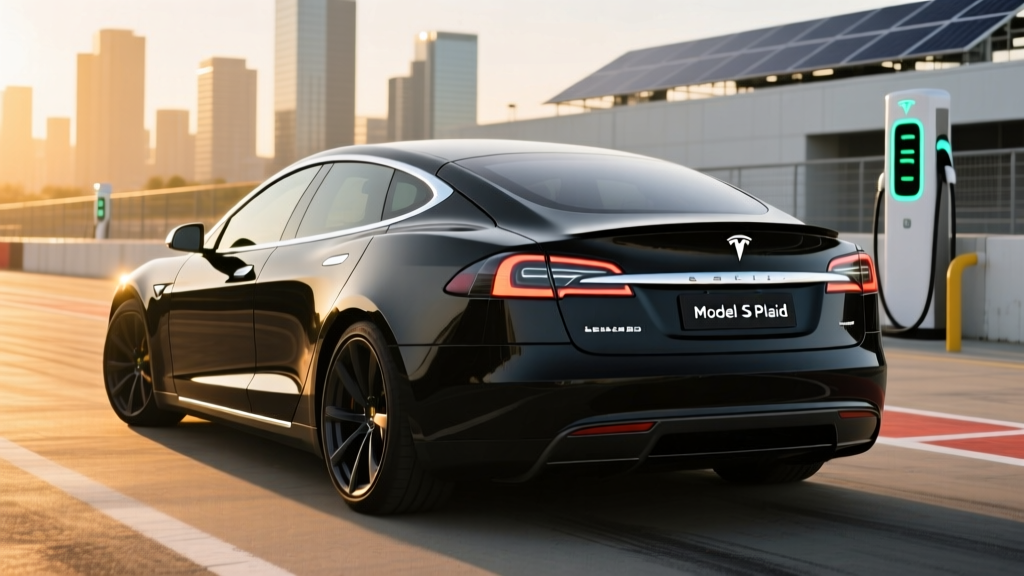
The Tesla Model S Plaid remains an engineering anomaly in 2026: a 1,020-horsepower tri-motor sedan that delivers a sub-10-second quarter mile, yet still manages a 396-mile EPA range estimate and a usable back seat. For buyers searching for Model S Plaid 1/4 mile performance data alongside practical ownership metrics, this review covers both ends of the spectrum — from drag-strip numbers to real-world charging curves and federal tax-credit eligibility.
The Plaid's tri-motor all-wheel-drive powertrain produces 1,020 hp and 1,050 lb-ft of torque, launching the 4,766-lb sedan to 60 mph in a manufacturer-claimed 1.99 seconds (with rollout subtracted). Independent testing by outlets like Car and Driver and MotorTrend has consistently verified 0-60 times between 1.98 and 2.1 seconds depending on surface prep and tire condition. The quarter mile result? A blistering 9.2 to 9.4 seconds at approximately 152 mph, making it one of the quickest production sedans ever sold.
But straight-line fury is only half the story. The Plaid's 100 kWh battery pack (NMC chemistry), 250 kW peak DC fast-charge capability, and 396-mile EPA range make it a viable road-trip machine — with caveats we'll detail below.
Range, Efficiency, and the Real-World Reality Check
Real-World Expectation: 310–340 miles highway (70-75 mph); 260–290 miles in cold weather (below 32°F); 370+ miles city/suburban with regen
Efficiency: 124 MPGe combined / 27 kWh per 100 miles (EPA, 19-inch)
The EPA's 396-mile figure applies to the Model S Plaid equipped with the standard 19-inch Tempest wheels. Opt for the 21-inch Arachnid performance wheels, and that drops to 359 miles — a 37-mile penalty for stickier rubber and added rotational mass. According to fueleconomy.gov, the combined efficiency rating is 124 MPGe, which translates to roughly 27 kWh consumed per 100 miles of driving.
In real-world highway testing at sustained 70-75 mph speeds in moderate temperatures (60-75°F), expect approximately 310-340 miles before the battery reaches a 10% state of charge. Cold weather (below freezing) can reduce range by 20-30%, primarily due to cabin heating demands and increased battery internal resistance. Tesla's heat pump system mitigates some of this loss, but physics still wins in single-digit temperatures. Plan for 260-290 miles in winter highway conditions.
City and suburban driving with frequent regenerative braking opportunities can push range back toward or even slightly above the EPA sticker. The Plaid's tri-motor regen system is aggressive enough to enable near one-pedal driving in most conditions, recovering energy that would otherwise be lost to friction brakes.
Charging Speed: 250 kW Peak, but Watch the Curve
| Charging Level | Power / Rate | Speed (Miles Added) | Notes |
|---|---|---|---|
| Level 1 (120V) | ~1.4 kW | ~3-4 mi/hr | Emergency/trickle only |
| Level 2 (240V, 48A) | 11.5 kW | ~34 mi/hr | Home Wall Connector; ~11 hrs for 10-100% |
| Level 2 (240V, 32A) | 7.7 kW | ~23 mi/hr | Mobile Connector on NEMA 14-50 |
| DC Fast (V3 Supercharger) | 250 kW peak | ~200 mi in 15 min | 10-80% in ~25-28 min; tapers above 60% |
| DC Fast (V4 Supercharger) | 250 kW peak | Similar to V3 | Newer cabinet; same vehicle-side limit |
| CCS Adapter (EA, etc.) | Up to 250 kW | Varies by station | Requires Tesla CCS adapter (included since 2024) |
The Model S Plaid's onboard charging architecture supports a peak DC fast-charge rate of 250 kW on Tesla's V3 and V4 Superchargers. Tesla claims up to 200 miles of range added in 15 minutes under ideal conditions. In practice, a 10-80% session takes approximately 25-28 minutes, with the charge curve tapering significantly above 60% state of charge.
Here's what the charging curve actually looks like: the Plaid will sustain close to 250 kW from roughly 10-30% SoC, then step down to around 180-200 kW through 50%, and further taper to 100-120 kW by 70%. Above 80%, speeds drop to under 50 kW as the battery management system prioritizes cell longevity. This is standard behavior for NMC lithium-ion packs — if you need the fastest road-trip turnaround, plan to charge from 10% to 65-70% and move on rather than waiting for 90%+.
For home charging, the Tesla Wall Connector delivers up to 11.5 kW (48 amps on a 60-amp circuit), adding approximately 34 miles of range per hour. A full overnight charge from 20% to 100% takes roughly 9-11 hours. If you're using the Mobile Connector with a NEMA 14-50 outlet, expect 7.7 kW (32 amps) and about 23 miles per hour — still adequate for most daily driving needs, assuming you drive under 150 miles per day.
Preconditioning matters. Navigate to a Supercharger using the car's built-in navigation, and the battery thermal management system will automatically warm or cool the pack to optimize charge acceptance. Skipping preconditioning (for instance, pulling into a charger without nav routing) can reduce peak charge rates by 30-50% in cold weather.
Performance: The Numbers Behind the 1/4 Mile Record
| Specification | Tesla Model S Plaid (2026) |
|---|---|
| Drivetrain | Tri-Motor AWD (1 front, 2 rear) |
| Horsepower | 1,020 hp |
| Torque | 1,050 lb-ft |
| 0-60 mph | 1.99 sec (mfr, with rollout) / ~2.1 sec independent |
| 1/4 Mile | 9.2-9.4 sec @ ~152 mph |
| Top Speed | 200 mph (with hardware upgrade) |
| Battery Capacity | 100 kWh (usable ~95 kWh), NMC |
| Curb Weight | 4,766 lbs |
| EPA Range | 396 mi (19" wheels) / 359 mi (21" wheels) |
| Efficiency | 124 MPGe / 27 kWh/100mi |
| Base MSRP | $89,990 (excl. destination) |
The Plaid's tri-motor configuration uses a single permanent-magnet motor on the front axle and two rear-mounted motors — one permanent-magnet and one induction-style — enabling precise torque vectoring across the rear axle. This setup eliminates the need for a mechanical limited-slip differential and provides the traction necessary to launch a nearly 4,800-lb sedan with supercar-rivaling force.
The 1/4 mile time of 9.2-9.4 seconds puts the Plaid in rarefied air. For comparison, a Dodge Challenger SRT Hellcat Redeye runs the quarter in roughly 10.8 seconds, and a Porsche Taycan Turbo GT (the Plaid's closest EV rival) posts approximately 9.4-9.6 seconds depending on configuration. The Plaid achieves this while offering more rear-seat legroom and cargo capacity than either competitor.
Tesla's "Drag Strip" mode conditions the battery and powertrain for maximum launch performance, requiring a SoC above 65% and approximately 10-15 minutes of preparation time. The carbon-ceramic brake package (standard on 2025+ Plaid models) provides fade-resistant stopping power necessary for repeated high-speed runs, though the added cost is baked into the MSRP.
Pricing, Tax Credits, and Total Cost of Ownership
| Item | Amount |
|---|---|
| Model S Plaid Base MSRP | $89,990 |
| Destination Fee | $1,995 |
| Ultra Red Paint | $2,500 |
| 21" Arachnid Wheels | $4,500 |
| Full Self-Driving (Supervised) | $8,000 |
| As-Tested Price (loaded) | ~$106,985 |
| Federal Tax Credit (§30D) | $0 — exceeds MSRP cap |
| Estimated Effective Price | $91,985 – $106,985 |
The 2026 Tesla Model S Plaid starts at $89,990 before destination. A well-equipped example with premium paint, 21-inch wheels, and Full Self-Driving (Supervised) can push past $106,000.
Federal tax credit eligibility: The Model S Plaid does not qualify for the $7,500 federal EV tax credit under IRS §30D. The reason is straightforward: the credit's MSRP cap for sedans is $55,000, and the Plaid starts at nearly $90,000. Additionally, the buyer income caps ($150,000 single / $300,000 joint modified AGI) would exclude many Plaid purchasers regardless. For full §30D rules including battery-sourcing and critical-mineral requirements, consult the IRS clean vehicle credits page.
Some states offer their own EV incentives that may apply regardless of MSRP — check your state's energy office or DMV for current programs. However, these vary widely and change frequently, so confirm eligibility before relying on them in your purchase calculation.
- ❌ Sedan MSRP cap is $55,000 — Plaid starts at $89,990
- ❌ Buyer income cap: $150K single / $300K joint (many buyers exceed)
- ⚠️ Battery critical-mineral and component sourcing rules also apply to qualifying vehicles
- ✅ Point-of-sale transfer available — but only if the vehicle itself qualifies
Interior, Cargo, and Daily Livability
The Model S Plaid's interior received its major refresh in 2021 (the "Palladium" architecture), and the 2026 model carries forward the same yoke-compatible steering setup, 17-inch center touchscreen, and 12.3-inch driver display. Rear passengers get a dedicated 8-inch screen for climate and entertainment — a meaningful upgrade over the pre-refresh model.
Cargo and passenger dimensions:
- Rear cargo (behind second row): 28.0 cu ft
- Front trunk (frunk): 3.1 cu ft
- Total cargo volume (rear seats folded): 64.9 cu ft
- Rear legroom: 40.9 inches
- Front headroom: 39.7 inches
- Seating: 5-passenger (3-across rear bench)
The 28 cubic feet of rear cargo space is generous for a performance sedan and exceeds the Porsche Taycan's combined trunk + frunk volume. The liftback design (the entire rear glass opens) makes loading bulky items far easier than a traditional sedan trunk. The frunk is small by Tesla standards — enough for a charging cable bag and a small soft cooler, but not a meaningful luggage compartment.
Build quality on 2025-2026 Model S vehicles has improved noticeably over early Palladium-era examples, with tighter panel gaps, improved interior materials, and fewer reported rattles. The yoke steering remains polarizing — it's excellent on a drag strip or open highway but requires adaptation for low-speed maneuvering and roundabouts. A conventional round wheel is available as a no-cost option at order time.
Tech, Driver Assistance, and Notable Drawbacks
The Model S Plaid runs Tesla's latest software stack, which includes:
- Autopilot (standard): Lane centering, adaptive cruise control, automatic emergency braking, blind-spot monitoring
- Full Self-Driving Supervised ($8,000 option): City street navigation, traffic light/stop sign recognition, auto-lane changes, parking assist — still SAE Level 2, requires full driver attention
- 17-inch center touchscreen: Netflix/YouTube streaming (while parked), gaming (Cyberpunk 2077-capable), Spotify/Apple Music integration
- Over-the-air updates: Regular feature additions and performance tweaks
- Sentry Mode / Dashcam: Continuous recording via external cameras
- Phone-as-key: Bluetooth-based passive entry with NFC backup card
Tesla Autopilot and FSD (Supervised) are driver-assistance systems, not self-driving. The driver must maintain hands-on-wheel awareness (or eye-on-road monitoring) and remains fully responsible for vehicle operation. True Level 4 autonomous driving (no driver required) is currently available only in limited robotaxi services like Waymo in select cities.
Notable drawbacks:
- No Apple CarPlay or Android Auto — Tesla's proprietary infotainment only
- Rear visibility is compromised by the sloping roofline and small rear window
- FSD (Supervised) remains a Level 2 system despite the "Full Self-Driving" name — $8,000 is steep for assisted driving that still requires constant attention
- Insurance premiums are significantly higher than average — expect $3,500-$5,500/year depending on state and driving record, per industry data
- Service center wait times can stretch to weeks in some metro areas for non-critical repairs
- The yoke steering wheel, while standard, is not ideal for all driving scenarios — order the round wheel if you prefer conventional inputs
Warranty and Battery Longevity
Tesla's warranty coverage for the 2026 Model S Plaid includes:
- Basic Vehicle Limited Warranty: 4 years / 50,000 miles
- Battery & Drive Unit Warranty: 8 years / 150,000 miles (whichever comes first), with minimum 70% capacity retention guaranteed over that period
- Restraint System: 5 years / 60,000 miles
- Corrosion Perforation: 12 years / unlimited miles
The 8-year/150,000-mile battery warranty is competitive with rivals like the Porsche Taycan (8 years/100,000 miles) and Lucid Air (8 years/100,000 miles). Tesla's NMC battery pack in the Plaid has demonstrated strong long-term durability in fleet data — most Model S vehicles retain 88-92% of original capacity after 100,000 miles, based on aggregated owner reports. The 100 kWh pack's thermal management system actively maintains optimal cell temperature, reducing degradation from extreme heat or cold exposure.
Full battery replacement (out of warranty) currently costs approximately $18,000-$25,000 including labor at Tesla service centers, though this figure has been trending downward as cell costs decline. In practice, the vast majority of Plaid owners will never need a pack replacement within typical ownership periods.
Pros, Cons, and Who Should Buy
- Sub-10-second 1/4 mile — quickest production sedan available
- 396-mile EPA range (19" wheels) — viable for 300+ mile road trips
- 250 kW Supercharger access with the most reliable DC fast-charging network
- Generous cargo (28 cu ft) and rear-seat space for a performance sedan
- Continuous OTA updates add features post-purchase
- Strong battery warranty (8 yr/150K mi) and proven pack longevity
- $89,990+ starting price — no federal tax credit due to MSRP cap
- Insurance premiums 60-100% above segment average
- No Apple CarPlay / Android Auto
- FSD (Supervised) is $8,000 for a Level 2 system that still requires full driver attention
- 21" wheels cut range by 37 miles and increase tire replacement cost
- Yoke steering is an acquired taste; not ideal for tight urban driving
- Buy it if: You want the fastest-accelerating sedan in production, you have home Level 2 charging access, you regularly drive routes covered by Superchargers, and you value a large touchscreen-centric tech experience over traditional luxury materials.
- Consider the Lucid Air Sapphire instead if: You want comparable performance (1,234 hp, ~9.1-sec 1/4 mile) with a 427-mile EPA range and more conventional luxury interior — starting at $249,000.
- Consider the Porsche Taycan Turbo GT instead if: Track handling precision and build quality matter more than straight-line acceleration and range, and you prefer a more traditional (if less spacious) performance sedan.
- Skip it if: You need the federal $7,500 tax credit, your daily commute exceeds 350 miles one-way without charging access, or you prefer CarPlay integration and conventional switchgear.
Frequently Asked Questions
What is the real-world range of the Tesla Model S Plaid?
The EPA estimates 396 miles on 19-inch wheels and 359 miles on 21-inch wheels. In real-world highway driving at 70-75 mph in moderate temperatures, expect 310-340 miles. Cold weather (below 32°F) reduces this to approximately 260-290 miles. City driving with regenerative braking can approach or slightly exceed the EPA figure.
How fast does the Model S Plaid charge?
On a Tesla V3 or V4 Supercharger, the Plaid peaks at 250 kW and can add up to 200 miles in 15 minutes. A 10-80% session takes approximately 25-28 minutes, though the charge curve tapers significantly above 60% SoC. At home on a Level 2 Wall Connector (11.5 kW), expect about 34 miles of range per hour, or a full overnight charge in roughly 9-11 hours.
Does the Model S Plaid qualify for the federal EV tax credit?
No. The IRS §30D credit caps sedan eligibility at $55,000 MSRP, and the Plaid starts at $89,990. Buyer income limits ($150K single / $300K joint) would also exclude many purchasers. Check your state's own incentive programs for possible local credits.
Is the Model S Plaid worth buying vs. competitors?
If you want the best combination of straight-line speed, range, Supercharger network access, and interior space in a single sedan, the Plaid is hard to beat at its price point. The Lucid Air Sapphire is faster and has more range but costs $249,000. The Porsche Taycan Turbo GT handles better on a road course but offers less range and cargo space at a higher price. The BMW i7 M70 is more traditionally luxurious but can't match the Plaid's acceleration.
What is the Model S Plaid's 1/4 mile time?
Independent testing shows the Model S Plaid completing the quarter mile in 9.2 to 9.4 seconds at approximately 152 mph, depending on surface preparation, tire condition, and ambient temperature. Tesla's official claim is 9.23 seconds. This makes it one of the quickest production sedans ever tested, rivaling hypercars costing several times its price.
How long will the Plaid's battery last?
Tesla warranties the battery for 8 years or 150,000 miles with a guaranteed minimum 70% capacity retention. Fleet data from high-mileage Model S owners suggests most packs retain 88-92% capacity at 100,000 miles. With proper care (avoiding frequent 100% charges, using preconditioning for Supercharging), the NMC pack should provide 200,000+ miles of service before approaching the warranty threshold.
What are the biggest ongoing ownership costs?
Insurance is the standout expense — expect $3,500-$5,500 annually depending on your state, age, and driving record. Electricity costs vary by region but average roughly $0.13-$0.16/kWh at home and $0.28-$0.48/kWh at public DC fast chargers. Annual tire replacement on performance tires (Michelin Pilot Sport 4S or equivalent) runs $1,200-$1,800 for a set of four. Tesla's service network has improved, but out-of-warranty repairs on the tri-motor powertrain or battery can be costly.