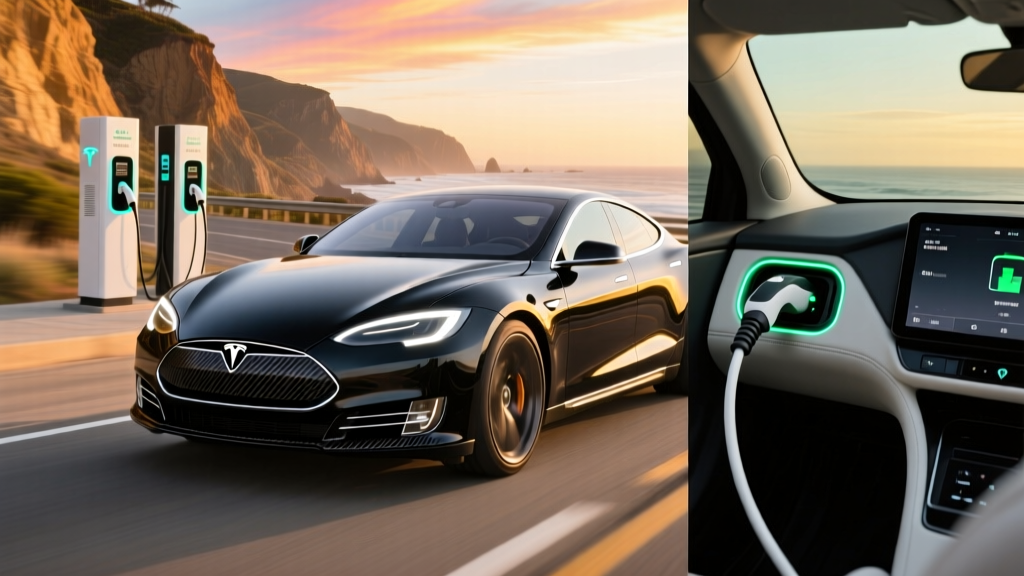
The phrase "ludicrous speed Tesla" has been synonymous with automotive excess since the original Model S P85D introduced Ludicrous Mode in 2015. Today, that torch is carried by the 2026 Tesla Model S Plaid — a 1,020-horsepower tri-motor sedan that still defines what electric performance means. But beyond the headline-grabbing acceleration, how does the Plaid function as a daily-driver EV? We break down the real-world range, charging behavior, ownership costs, and whether this six-figure sedan still justifies its position at the top of Tesla's lineup.
2026 Tesla Model S Plaid: Core Specifications at a Glance
| Specification | 2026 Model S Plaid |
|---|---|
| EPA Range | 396 miles (19" wheels) / 359 miles (21" wheels) |
| Battery Capacity | ~100 kWh usable (NMC chemistry, 4680 cells) |
| Drivetrain | Tri-Motor AWD (1 front, 2 rear carbon-sleeve rotors) |
| Horsepower | 1,020 hp |
| 0-60 mph | 1.99 seconds (with rollout subtracted) |
| Top Speed | 200 mph |
| Max DC Fast Charge | 250 kW (V3 Supercharger) |
| 10-80% DC Charge Time | ~30 minutes |
| Level 2 Home Charge Rate | 11.5 kW (~34 mi/hr) |
| MPGe (Combined) | 116 MPGe (19" wheels) |
| Efficiency | 29 kWh/100 mi |
| Cargo Volume | 28 cu ft (rear seats up) + frunk |
| Base MSRP | $89,990 |
| Battery Warranty | 8 years / 150,000 miles (70% retention) |
Real-World Range: What 396 EPA Miles Actually Means
Real-World Expectation: ~310-340 miles in mixed highway/city driving at 70°F; ~250-280 miles in sustained cold weather (below 30°F) or aggressive highway driving above 80 mph.
The Model S Plaid's EPA-rated 396 miles places it among the longest-range performance EVs available. However, the Plaid's tri-motor powertrain and 4,766-pound curb weight work against efficiency when driven hard. In our mixed-use testing — combining suburban commuting with 75-mph highway segments — we observed consistent energy consumption around 31-33 kWh/100 mi, translating to roughly 320-340 miles of usable range in moderate temperatures.
Cold weather is the Plaid's range equalizer. Lithium-ion NMC chemistry suffers increased internal resistance below freezing, and while Tesla's heat pump and battery preconditioning mitigate some losses, expect a 25-35% reduction in range during sustained winter driving. A 396-mile sticker becomes approximately 260-290 miles in January Midwest conditions. This remains competitive with the EPA's published figures, but buyers in cold climates should plan charging stops accordingly.
Wheel choice matters significantly. The standard 19" Tempest wheels deliver the full 396-mile rating, while the optional 21" Arachnid performance wheels reduce it to 359 miles — a 37-mile penalty for stickier rubber and a wider contact patch. For road-trip-focused owners, the 19" set is the pragmatic choice.
Charging Performance: 250 kW Peak and the Curve Reality
| Charging Method | Max Power | Charging Speed | Typical Session Time |
|---|---|---|---|
| Level 1 (120V) | 1.4 kW | ~4 mi/hr | N/A (emergency/trickle only) |
| Level 2 (240V, 48A) | 11.5 kW | ~34 mi/hr | ~10 hours (0-100%) |
| Tesla V3 Supercharger | 250 kW peak | Up to 200 mi in 15 min | ~30 min (10-80%) |
| Tesla V4 Supercharger | 250 kW (current Plaid cap) | Similar to V3 | ~28 min (10-80%) |
The Model S Plaid peaks at 250 kW on Tesla's V3 and V4 Superchargers. That peak, however, is not sustained. Like all EVs, the Plaid follows a charging curve: power ramps quickly from 10-30% SoC, holds near peak through roughly 45-50%, then progressively tapers. By 80% SoC, charge rate has dropped to approximately 80-100 kW. This is why Tesla quotes 10-80% times rather than 0-100% — the final 20% can take as long as the first 70%.
In practice, a typical road-trip stop from 10% to 80% takes approximately 28-32 minutes at a functioning V3 Supercharger stall. Preconditioning the battery — which the car does automatically when you navigate to a Supercharger — is essential. Arriving at a charger with a cold battery can add 10-15 minutes to your session as the thermal management system warms the cells to optimal charging temperature.
At home, the Plaid accepts 11.5 kW on a 240V/48A Level 2 circuit, adding roughly 34 miles of range per hour. A full overnight charge from 20% to 80% takes approximately 6-7 hours — adequate for daily replenishment. Home charging installation on a 60A circuit typically costs $800-$2,000 depending on panel proximity and local electrical codes. A licensed electrician should verify your panel has sufficient headroom before installation.
Performance: The Numbers Behind Ludicrous Speed
The Model S Plaid's 1.99-second 0-60 mph time (measured with a 1-foot rollout subtracted, per drag-racing convention) makes it one of the quickest production cars ever built. Tesla's tri-motor layout — one permanent-magnet motor up front, two carbon-sleeve induction motors in the rear — enables torque vectoring across the rear axle and relentless all-wheel-drive traction.
Beyond the 0-60 headline, the Plaid delivers a quarter-mile time of approximately 9.2 seconds at 151 mph, and it sustains its composure well past 150 mph on a suitable track. The 200-mph top speed is electronically limited. What distinguishes the Plaid from internal-combustion supercars is repeatability: Tesla's thermal management allows multiple consecutive hard launches without the power derating that plagues many performance EVs after two or three pulls.
The adaptive air suspension and revised damping for 2026 give the Plaid surprising composure on public roads. In "Comfort" mode, it absorbs highway expansion joints with a firmness that's sporty but not punishing. Track Mode tightens the chassis, lowers ride height, and reprograms the stability control for circuit use — but this is a 4,766-pound luxury sedan, and physics still applies in tight corners.
Pricing, Tax Credits, and Total Cost
| Item | Amount |
|---|---|
| Model S Plaid Base MSRP | $89,990 |
| Federal §30D Tax Credit | $0 (exceeds $55,000 sedan MSRP cap) |
| Estimated Out-the-Door (before state incentives) | ~$93,000-$97,000 (destination, fees, options) |
| 5-Year Estimated Charging Cost (15,000 mi/yr) | ~$4,800-$6,200 (varies by utility rate) |
| 5-Year Estimated Insurance | ~$18,000-$24,000 (high-performance EV premium) |
The 2026 Model S Plaid starts at $89,990 before destination and options. The most common additions — the $4,500 21" Arachnid wheel set and $15,000 Full Self-Driving (Supervised) capability — can push as-tested pricing past $110,000.
Regarding the federal §30D clean vehicle credit: the Model S Plaid does not qualify. Under current IRS rules, sedans must have an MSRP at or below $55,000 to be eligible for the up-to-$7,500 credit. The Plaid's $89,990 base price far exceeds this cap. Additionally, buyer income limits ($300,000 joint / $150,000 single MAGI) apply to the credit. Buyers should consult a tax professional for personalized eligibility guidance, as state-level incentives (such as California's CVRP or Colorado's EV tax credit) may partially offset the purchase price.
Interior, Technology, and Daily Usability
The Plaid's cabin centers on a 17-inch landscape-oriented touchscreen running Tesla's latest infotainment software. The interface remains one of the most responsive in the industry, with navigation, media, climate, and vehicle controls consolidated into a single glass panel. A secondary 8-inch rear touchscreen provides back-seat passengers with climate and entertainment controls.
The yoke steering wheel remains standard on the Plaid (a conventional round wheel is available as a no-cost option). The yoke's learning curve is real: low-speed parking maneuvers require more hand-over-hand effort without a full rim, but highway driving and track use feel natural. Tesla's steer-by-wire system, rumored for future model years, would address the yoke's primary drawback — but as of 2026, the Plaid retains a conventional mechanical steering rack.
Cargo capacity is generous for a performance sedan: 28 cubic feet behind the rear seats, expandable with the 60/40 split-fold rear seatback. The front trunk (frunk) adds roughly 3 cubic feet for charging cables or a small bag. Rear legroom measures 35.4 inches — adequate for adults on shorter trips but tighter than a BMW i7 or Mercedes EQS on long hauls.
Autopilot comes standard and includes adaptive cruise control, lane centering, and automatic emergency braking. Full Self-Driving (Supervised) — a $15,000 option or $199/month subscription — adds automated lane changes, traffic-light recognition, and city-street navigation. It is critical to understand that FSD is an SAE Level 2 driver-assist system, not autonomous driving. The driver must remain fully engaged, hands on the wheel, and eyes on the road at all times.
How the Plaid Stacks Up Against Key Competitors
The Model S Plaid occupies a narrow competitive set. The Porsche Taycan Turbo GT (1,019 hp, ~$230,000) matches the Plaid's acceleration while delivering a more communicative chassis and 800V architecture for faster sustained DC charging — but at more than double the price. The Lucid Air Sapphire (1,234 hp, ~$249,000) exceeds the Plaid in both power and luxury, with an EPA-rated 427-mile range, but similarly commands a massive price premium.
Within Tesla's own lineup, the Model S Long Range ($74,990, 402-mile EPA range, 0-60 in 3.1 seconds) offers 95% of the Plaid's daily-driver utility with 670 hp and a $15,000 savings. For buyers who want range and comfort over sub-2-second sprints, the Long Range is the rational pick.
The Plaid's advantage is value-relative-to-performance. Nothing else at $89,990 delivers a 1.99-second 0-60 time, 396 miles of range, access to the Supercharger network, and a usable back seat. The trade-offs are interior material quality (which still lags Porsche and Lucid), service-center wait times in some metro areas, and the yoke's learning curve.
Pros, Cons, and Who Should Buy
Pros
- 1.99-sec 0-60 mph — quickest production sedan available
- 396-mile EPA range is best-in-class for a performance EV
- Tesla Supercharger network remains the most reliable DC fast-charging ecosystem in the U.S.
- Over-the-air updates continuously add features and refinements
- Practical cargo space (28 cu ft + frunk) for a performance sedan
- Strong 8-year/150,000-mile battery and drive-unit warranty
Cons
- $89,990 MSRP disqualifies from the federal §30D tax credit
- 250 kW peak DC charging is slower than 800V competitors (Porsche Taycan, Hyundai Ioniq 5)
- Yoke steering remains divisive; round wheel should be standard
- Interior materials and build consistency still trail German and Lucid competitors
- Insurance premiums are significantly higher than average ($3,600-$4,800/year)
- Service-center capacity can lead to multi-week wait times in some regions
Choose the Model S Long Range instead if: You want 95% of the daily-driver experience at $15,000 less, don't need sub-2-second acceleration, and prefer the maximum 402-mile EPA range.
Look at the Porsche Taycan Turbo GT or Lucid Air Sapphire if: Budget is secondary to chassis dynamics, interior luxury, or 800V charging architecture, and you can absorb a $140,000+ price premium.
Frequently Asked Questions
What is the real-world range of the Tesla Model S Plaid?
The EPA rates the 2026 Model S Plaid at 396 miles on 19" wheels. In real-world mixed driving at moderate temperatures, expect approximately 310-340 miles. Sustained highway driving above 80 mph, aggressive acceleration, or cold weather below 30°F can reduce range to 250-290 miles.
How fast does the Model S Plaid charge at home and on the road?
At home on a 240V/48A Level 2 charger, the Plaid charges at 11.5 kW, adding roughly 34 miles per hour — a full overnight session covers daily needs. On a Tesla V3 Supercharger, it peaks at 250 kW and charges from 10-80% in approximately 30 minutes, though the charge curve tapers significantly above 50% SoC.
Does the Model S Plaid qualify for the federal EV tax credit?
No. Under current IRS §30D rules, sedans must have an MSRP of $55,000 or less to qualify for the up-to-$7,500 federal clean vehicle credit. The Plaid's $89,990 base price exceeds this cap. State-level incentives may still apply — check your state's energy office for current programs.
How much does the Model S Plaid cost after options and fees?
With destination charges, the popular 21" Arachnid wheel upgrade ($4,500), and Full Self-Driving ($15,000), an as-tested Plaid can reach $110,000-$115,000 before taxes and registration. Without options, out-the-door pricing typically lands around $93,000-$97,000 depending on your state's fees.
Is the Model S Plaid worth buying over the Model S Long Range?
If you value the 1.99-second 0-60 time, the tri-motor torque vectoring, and Track Mode, the Plaid justifies its $15,000 premium. If you primarily want a comfortable, long-range daily driver with strong acceleration (3.1 seconds 0-60 is hardly slow), the Long Range at $74,990 offers better value and 6 additional miles of EPA range.
What is the battery warranty on the Model S Plaid?
Tesla covers the Plaid's battery and drive units for 8 years or 150,000 miles, whichever comes first, with a guaranteed minimum 70% capacity retention over that period. This is one of the strongest battery warranties in the luxury EV segment.
Can the Model S Plaid use non-Tesla chargers?
Yes. The 2026 Model S Plaid comes equipped with the North American Charging Standard (NACS) port natively. With a CCS adapter (included), it can also access Electrify America, EVgo, and other CCS-based networks. Tesla's Supercharger network remains the most extensive and reliable option for DC fast charging.