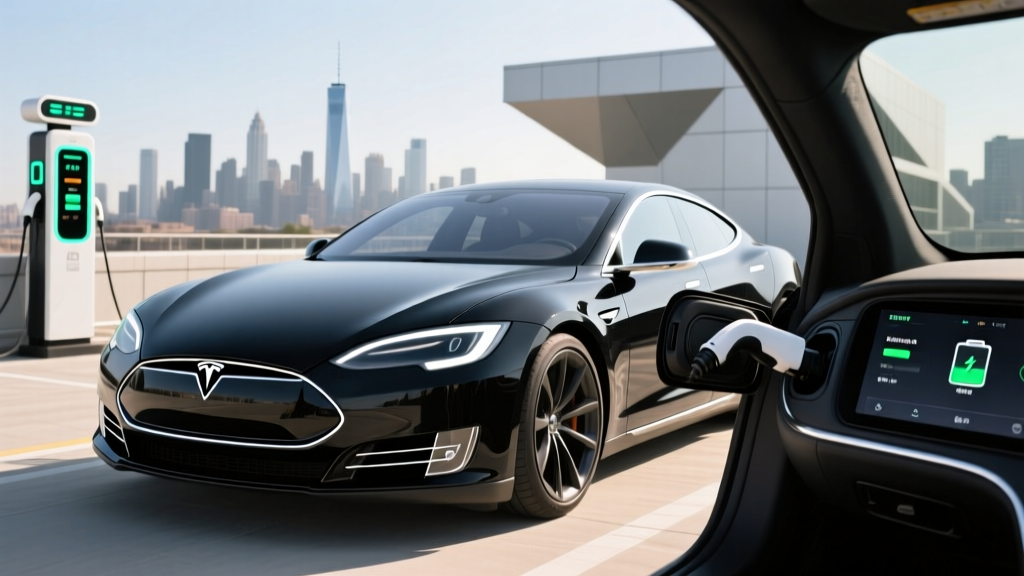
The phrase "ludicrous Tesla Model S" isn't just internet hyperbole — it's a direct callback to the Plaid trim's 1,020-horsepower tri-motor powertrain that rockets this luxury sedan to 60 mph in under two seconds. But beyond the headline-grabbing acceleration, the 2026 Tesla Model S Plaid remains one of the most capable long-range electric sedans on the market, pairing brutal performance with a 396-mile EPA range and access to Tesla's Supercharger network. This review breaks down the real numbers that matter for buyers: actual highway range, charging-curve behavior, total cost after incentives, and whether the Plaid justifies its premium over the Long Range trim and key rivals like the Lucid Air and Porsche Taycan.
2026 Tesla Model S Plaid: Core Specifications
| Spec | Value |
|---|---|
| EPA Range | 396 miles (19" wheels) / 359 miles (21" wheels) |
| Battery Capacity | ~100 kWh usable (NMC chemistry) |
| Drivetrain | Tri-Motor AWD (1 front, 2 rear) |
| Horsepower | 1,020 hp |
| 0–60 mph | 1.99 seconds (with rollout subtracted) |
| Top Speed | 200 mph (with hardware upgrade) |
| Max DC Fast Charge | 250 kW (peak) |
| 10–80% DC Charge Time | ~27 minutes |
| Level 2 Home Charging | 11.5 kW / ~34 miles per hour |
| Efficiency (EPA) | 120 MPGe combined / 28 kWh/100 mi |
| Cargo Volume | 28 cu ft (rear seats up) + frunk |
| Base MSRP | $89,990 (before destination) |
| Battery Warranty | 8 years / 150,000 miles (70% retention) |
Real-World Range: What the EPA Sticker Doesn't Tell You
EPA Estimate: 396 miles (19" Tempest wheels)
Real-World Highway (70 mph, moderate climate): ~310–340 miles
Real-World Highway (cold weather, below 32°F): ~250–280 miles
City / Commuter Driving (with regen): ~360–390 miles
The Model S Plaid's 396-mile EPA figure assumes a mix of city and highway driving under moderate conditions. In practice, the tri-motor Plaid is heavier and more power-hungry than the dual-motor Long Range variant (which achieves a 402-mile EPA rating). On sustained highway runs at 70–75 mph, expect to consume roughly 30–32 kWh/100 mi, yielding approximately 310 to 340 miles before needing a charge. This is consistent with independent testing from fueleconomy.gov and real-world road-trip logs from owners.
Cold weather compounds the deficit. Lithium-ion NMC cells lose efficiency in sub-freezing temperatures, and while the Model S heat pump helps cabin efficiency, battery preconditioning still draws energy. In winter highway driving below 32°F, plan for 250–280 miles of usable range. Tesla's navigation system automatically accounts for this by routing through Superchargers with conservative buffers, but it's a real planning factor for northern-climate owners.
City driving is where the Plaid shines closest to its sticker number. Aggressive regenerative braking recaptures energy in stop-and-go traffic, and the lack of idling losses means urban efficiency can approach or even exceed the EPA combined figure.
Charging Speed: DC Fast Charging and Home Setup
| Charging Level | Power (kW) | Miles Added per Hour | Notes |
|---|---|---|---|
| Level 1 (120V outlet) | ~1.4 kW | ~4 mi/hr | Emergency/trickle only |
| Level 2 (240V, 48A Wall Connector) | 11.5 kW | ~34 mi/hr | Full overnight charge in ~10 hrs |
| DC Fast Charge (V3 Supercharger) | 250 kW peak | ~200 mi in 15 min | 10–80% in ~27 min |
| DC Fast Charge (V4 Supercharger) | Up to 250 kW | Similar to V3 for Model S | CCS-adapter not needed (NACS native) |
The Model S Plaid peaks at 250 kW on Tesla's V3 and V4 Superchargers. However, peak rate is not sustained rate — a critical distinction many buyers overlook. The charge curve ramps quickly from 10% to about 40% state of charge (SoC) near the 250 kW peak, then progressively tapers. From 60% to 80%, you'll see rates drop to roughly 100–120 kW. This is why the 10–80% time is approximately 27 minutes rather than the ~15 minutes a flat 250 kW rate would suggest.
On a road trip, the practical rhythm is: stop for 15–20 minutes, add 150–200 miles, and go. The vast Supercharger network — now with over 6,000 U.S. stations — remains Tesla's strongest ownership advantage. Non-Tesla networks (Electrify America, EVgo) are accessible via Tesla's CCS adapter, though speeds and reliability vary.
For home charging, the Tesla Wall Connector on a 60-amp circuit delivers 11.5 kW (48 amps continuous). That translates to roughly 34 miles of range per hour of charging, or a full 0–100% charge in about 10 hours. Most owners who plug in nightly never think about range — a 300-mile daily buffer is typical. Installation costs vary widely: expect $500–$1,500 for a straightforward install near the panel, or $2,000–$4,000+ if a panel upgrade to 200 amps is needed. Always get a quote from a licensed electrician before committing.
Performance: What 1,020 Horsepower Actually Feels Like
The tri-motor Plaid powertrain uses one permanent-magnet motor on the front axle and two on the rear, with torque vectoring across the rear wheels. The result is 1,020 horsepower and a manufacturer-claimed 0–60 mph time of 1.99 seconds — though this figure includes a one-foot rollout subtraction common in drag racing. Independent tests by outlets like MotorTrend and Car and Driver have recorded 0–60 times between 2.1 and 2.3 seconds without rollout, which is still ferociously quick and puts the Plaid in hypercar territory.
Beyond straight-line speed, the Plaid's torque vectoring gives it genuine cornering composure that earlier Model S variants lacked. The adaptive air suspension (standard on Plaid) adjusts ride height and damping, and the 21" Arachnid wheels with Michelin Pilot Sport 4S tires provide serious grip. Track mode adjusts stability control and cooling for sustained lapping, though this is a heavy sedan — it'll heat-soak faster than a purpose-built sports car on repeated hot laps.
The dual-motor Long Range variant (670 hp, 3.1-second 0–60) is the more rational choice for most buyers. It's $20,000 cheaper, slightly more efficient, and still absurdly quick by any normal standard. The Plaid exists for buyers who want the absolute ceiling of EV performance in a sedan package.
Interior, Tech, and Daily Livability
The Model S interior received a significant refresh in 2021, and the 2026 model carries forward that updated cabin with a 17-inch landscape touchscreen, a 12.3-inch digital instrument cluster, and a rear-seat 8-inch display. The yoke steering wheel remains standard on the Plaid (a conventional round wheel is available as a no-cost option). Build quality has improved markedly over pre-2021 cars, though some owners still report minor panel-gap inconsistencies.
Passenger space is generous for a performance sedan: front legroom measures 42.7 inches, rear legroom is 35.4 inches — adequate for adults on shorter trips but tighter than a BMW 5 Series or Mercedes E-Class. The 28 cubic feet of rear cargo (with seats up) plus a usable frunk make the Model S practical for airport runs and weekly groceries, though the sloping roofline limits taller items.
Tech highlights include:
- Autopilot (standard): SAE Level 2 driver-assist with adaptive cruise, lane centering, and automatic emergency braking. The driver must remain engaged at all times.
- Full Self-Driving (Supervised) ($8,000 option): Adds automatic lane changes, Navigate on Autopilot, traffic-light recognition, and Smart Summon. Still SAE Level 2 — not autonomous driving.
- Over-the-air updates: Tesla regularly pushes feature additions, UI refinements, and performance tweaks remotely.
- Gaming: The 17-inch screen supports AAA-level gaming while parked, using a connected controller.
Autopilot and FSD (Supervised) are SAE Level 2 driver-assistance systems. The driver must keep hands on the wheel (or demonstrate attention via the cabin camera) and is fully responsible for vehicle operation. These are not Level 4 autonomous systems like Waymo's driverless robotaxis. Treat them as advanced cruise control with lane-keeping, not as self-driving.
Pricing, Trims, and Federal Tax Credit Eligibility
| Trim | Base MSRP | Estimated As-Tested | Federal §30D Credit |
|---|---|---|---|
| Long Range (Dual Motor) | $69,990 | $72,000–$78,000 | Not eligible (MSRP exceeds $55,000 sedan cap) |
| Plaid (Tri Motor) | $89,990 | $92,000–$105,000 | Not eligible (MSRP exceeds $55,000 sedan cap) |
The 2026 Model S Plaid starts at $89,990 before the $1,390 destination fee. Adding FSD ($8,000), premium paint ($2,000–$3,000), and 21" Arachnid wheels ($4,500) pushes a fully loaded Plaid past $105,000.
Federal tax credit reality: The Model S does not qualify for the $7,500 federal EV tax credit under IRS §30D rules. The credit imposes an MSRP cap of $55,000 for sedans (and $80,000 for SUVs/trucks/vans), and even the base Long Range Model S at $69,990 exceeds the sedan threshold. Additionally, buyer income caps apply ($150,000 single / $300,000 joint filers for modified AGI), and battery critical-mineral and component sourcing requirements must be met. Per IRS guidelines, always verify current-year eligibility with a tax professional before relying on any credit in your purchase decision.
Some states offer separate EV rebates or HOV-lane access that may apply regardless of the federal credit — check your state's energy or DMV website for current programs.
Model S Plaid vs. Key Competitors
| Spec | Tesla Model S Plaid | Lucid Air Sapphire | Porsche Taycan Turbo GT |
|---|---|---|---|
| Price | $89,990 | $249,000 | $230,000 |
| Horsepower | 1,020 hp | 1,234 hp | 1,019 hp (Launch Control) |
| 0–60 mph | 1.99 sec | ~2.0 sec | ~2.1 sec |
| EPA Range | 396 mi | 427 mi | ~269 mi |
| Max DC Charge | 250 kW | 300+ kW | 320 kW |
| Charging Network | Supercharger (native NACS) | CCS + NACS adapter | CCS + NACS adapter |
The Plaid's value proposition is stark: it delivers roughly the same 0–60 performance as cars costing two to three times as much. The Lucid Air Sapphire offers more range and power but at $249,000, it occupies a different stratosphere. The Porsche Taycan Turbo GT is a sharper driver's car with superior chassis feedback and faster sustained charging (320 kW), but sacrifices nearly 130 miles of range and costs $140,000 more.
For buyers who prioritize charging infrastructure and software integration, Tesla's Supercharger network and OTA update cadence remain unmatched. For those who value build quality, dealer service, and driving dynamics, the Taycan makes a compelling case despite the price premium.
Ownership Costs and Warranty Coverage
Tesla's warranty on the Model S Plaid includes:
- Basic Vehicle: 4 years / 50,000 miles
- Battery & Drive Units: 8 years / 150,000 miles (with at least 70% capacity retention guaranteed)
The 70% retention threshold is industry-standard but worth noting: if your 100 kWh pack degrades to 69 kWh within the warranty period, Tesla will repair or replace it. Real-world data from high-mileage Model S owners suggests NMC packs in Tesla's thermally managed system typically lose 10–15% capacity over the first 100,000 miles, with degradation slowing significantly afterward.
Insurance costs for the Plaid are substantial — expect quotes 30–50% higher than the Long Range trim due to the powertrain's repair complexity and the vehicle's performance profile. Average annual premiums in the U.S. range from $3,500 to $5,500 depending on state, driving history, and coverage level. Always get quotes before purchasing.
Electricity costs are the Plaid's ongoing advantage. At a national average of $0.16/kWh and an efficiency of 28 kWh/100 mi, fueling costs roughly $4.48 per 100 miles — compared to approximately $14–$16 per 100 miles for a comparable gas-powered performance sedan getting 18–20 mpg on premium fuel.
Pros, Cons, and Who Should Buy
- Sub-2-second 0–60 mph — hypercar performance at sedan pricing
- 396-mile EPA range covers most road trips with a single charge stop
- Tesla Supercharger network reliability and coverage
- OTA updates continuously add features
- Spacious cargo area with frunk for a performance sedan
- Tri-motor torque vectoring improves handling over older Model S
- No federal tax credit eligibility (exceeds $55K sedan MSRP cap)
- Insurance premiums significantly above average
- Yoke steering is polarizing and not ideal for low-speed maneuvering
- Rear seat space tighter than German luxury rivals
- 250 kW peak charge rate lags behind Porsche's 320 kW and Lucid's 300+ kW
- Service center wait times can be long in some markets
The Model S Plaid is best for: Performance-enthusiast buyers who want a daily-drivable electric sedan with extreme acceleration, strong range, and reliable fast-charging infrastructure. It suits tech-forward commuters and road-trippers who value software integration and don't need rear-seat luxury on par with an S-Class.
Look elsewhere if: You need federal tax credit eligibility (consider the Model 3, Model Y, or rival sedans under $55K), prioritize traditional luxury build quality (BMW i5, Mercedes EQE), or want the sharpest possible chassis dynamics (Porsche Taycan).
Frequently Asked Questions
What is the real-world range of the Tesla Model S Plaid?
The EPA rates the Model S Plaid at 396 miles with 19-inch wheels. In real-world highway driving at 70 mph, expect approximately 310–340 miles. In cold weather (below 32°F), highway range drops to roughly 250–280 miles. City driving with regenerative braking can approach the EPA figure.
How fast does the Model S Plaid charge at home and on the road?
On a Tesla V3/V4 Supercharger, the Plaid peaks at 250 kW and charges from 10% to 80% in approximately 27 minutes. At home on a Level 2 Wall Connector (11.5 kW), it adds about 34 miles of range per hour, fully charging overnight in roughly 10 hours.
Does the Tesla Model S Plaid qualify for the federal EV tax credit?
No. Under current IRS §30D rules, the federal clean vehicle credit has an MSRP cap of $55,000 for sedans. The Model S Plaid at $89,990 (and even the Long Range at $69,990) exceeds this cap. Buyer income limits and battery-sourcing requirements add further restrictions. Consult IRS.gov or a tax professional for your specific situation.
Is the Model S Plaid worth buying over the Long Range trim?
If outright performance matters to you, the Plaid's 1,020 hp and tri-motor torque vectoring are transformative. For most buyers, the Long Range offers 95% of the daily experience — similar interior, slightly better range (402 mi EPA), and 670 hp that still hits 60 mph in 3.1 seconds — for $20,000 less. The Plaid is a passion purchase, not a rational one.
How does the Model S Plaid compare to the Lucid Air and Porsche Taycan?
The Plaid delivers comparable 0–60 performance to the Lucid Air Sapphire and Porsche Taycan Turbo GT at a fraction of their price ($89,990 vs. $230,000–$249,000). The Lucid offers more range (427 mi EPA) and the Porsche offers sharper handling and faster charging (320 kW), but neither matches Tesla's Supercharger network or software ecosystem.
What is the battery warranty on the Model S Plaid?
Tesla covers the Model S Plaid's battery and drive units for 8 years or 150,000 miles, whichever comes first, with a guaranteed minimum 70% capacity retention. If degradation exceeds 30% within that period, Tesla will repair or replace the battery at no cost.