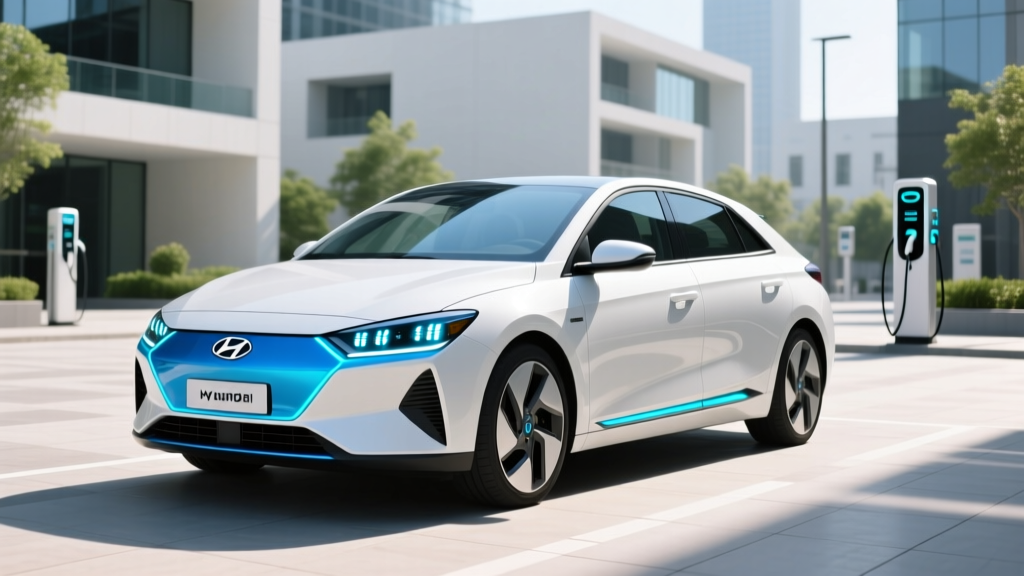
Hyundai's Ioniq sub-brand is about to get a new entry point. The Hyundai Ioniq 3 electric compact car debuts in April 2026, slotted beneath the Ioniq 5 and Ioniq 6 as the brand's most accessible dedicated-EV platform yet. Built on the next iteration of Hyundai's Electric-Global Modular Platform (E-GMP), the Ioniq 3 targets buyers who want a practical, tech-forward compact hatchback without stepping up to crossover pricing.
Because the Ioniq 3 has not yet gone on sale as of this writing, the specifications below are based on Hyundai's official preliminary disclosures, industry filings, and our analysis of the E-GMP architecture's scaling. Final EPA certification numbers, MSRP, and tax-credit eligibility will be confirmed at or near the April launch event. We will update this profile as verified data becomes available.
Estimated Range, Battery, and Efficiency
Hyundai has indicated the Ioniq 3 will offer a usable battery capacity of approximately 63 kWh, using an NMC (nickel-manganese-cobalt) cell chemistry supplied by SK On. This is consistent with the current E-GMP family's approach: NMC cells offer higher energy density than LFP, which matters in a compact footprint where packaging space is at a premium.
The preliminary EPA-estimated range target is 290 miles for the standard rear-wheel-drive (RWD) model. Hyundai has also hinted at a longer-range variant that could push past 310 miles, though that trim may arrive later in the production cycle.
Efficiency is projected at approximately 125 MPGe combined (roughly 27 kWh per 100 miles), which would place the Ioniq 3 competitively against the Chevrolet Bolt EV's 120 MPGe and the Volkswagen ID.4's 107 MPGe in the compact segment. Hyundai's heat pump — standard on most Ioniq models — should help mitigate cold-weather efficiency losses compared to competitors that omit this feature.
Charging Speed: DC Fast and Home Level 2
One of the Ioniq 3's strongest selling points will likely be its charging architecture. The E-GMP platform natively supports 800-volt DC fast charging, a feature that has defined the Ioniq 5 and Ioniq 6 and gives Hyundai a real advantage at public fast chargers.
| Charging Level | Power / Rate | Speed / Time | Notes |
|---|---|---|---|
| Level 1 (120V household) | ~1.4 kW | ~3–4 mi/hr | Emergency/trickle only; full charge in ~45+ hours |
| Level 2 (240V home) | ~10.9 kW | ~32 mi/hr; full in ~6 hrs | Requires 48A dedicated circuit; NACS connector (2026 standard) |
| DC Fast Charge | Peak ~175 kW | 10–80% in ~18 min | 800V architecture; tapers significantly above 80% SoC |
The 10–80% DC fast-charge time of approximately 18 minutes is the headline number, but as with all EVs, the charge curve tells the fuller story. The Ioniq 3 should sustain peak charging rates (roughly 150–175 kW) between 10% and 50% State of Charge, then taper progressively. Charging from 80% to 100% on DC will take an additional 20–25 minutes — plan your road-trip stops accordingly and charge to 80% for the best time-to-miles ratio.
For 2026, Hyundai has adopted the NACS (North American Charging Standard) connector across its lineup, meaning native compatibility with Tesla Supercharger stations — a significant network-access advantage over CCS-only vehicles. The Ioniq 3 should ship with a NACS port natively, eliminating the need for adapters at Superchargers or Electrify America stations that have added NACS cables.
Performance and Drivetrain
The Ioniq 3 will launch with a rear-wheel-drive (RWD) single-motor configuration producing an estimated 201 horsepower and 258 lb-ft of torque. This mirrors the base Ioniq 5's output and should deliver a 0–60 mph time of approximately 7.2 seconds — adequate for merging and passing, if not exactly thrilling.
An all-wheel-drive (AWD) dual-motor variant is expected to follow, adding a front motor for a combined output near 320 horsepower and dropping the 0–60 time to roughly 5.1 seconds. The AWD model will carry a range penalty of approximately 20–30 miles due to the additional motor weight and drivetrain losses.
| Spec | RWD (Standard) | AWD (Expected) |
|---|---|---|
| Horsepower | 201 hp | ~320 hp |
| Torque | 258 lb-ft | ~446 lb-ft |
| 0–60 mph | ~7.2 sec | ~5.1 sec |
| Drivetrain | Rear-wheel drive | Dual-motor AWD |
| Top Speed | 115 mph (est.) | 125 mph (est.) |
Hyundai's regenerative braking system, controlled via steering-wheel paddles, offers multiple levels up to full one-pedal driving (i-Pedal). This remains one of the more intuitive regen implementations in the segment, letting drivers modulate deceleration without touching the brake pedal in most city driving scenarios.
Pricing, Trims, and Federal Tax Credit Eligibility
Hyundai has not published final MSRP figures for the Ioniq 3, but based on the brand's positioning strategy and competitive pressure from the Chevrolet Bolt EV, Nissan Leaf successor, and upcoming Tesla Model 2, we expect the following pricing structure:
| Trim | Est. Base MSRP | Max §30D Credit | Est. After Credit |
|---|---|---|---|
| SE (RWD) | ~$32,000 | Up to $7,500* | ~$24,500 |
| SEL (RWD) | ~$36,000 | Up to $7,500* | ~$28,500 |
| Limited (RWD) | ~$41,000 | Up to $7,500* | ~$33,500 |
| Limited AWD | ~$45,000 | Up to $7,500* | ~$37,500 |
*Federal tax credit eligibility under IRS §30D is subject to multiple requirements for 2026:
- MSRP cap: The vehicle's base MSRP (including destination) must not exceed $55,000 for cars (sedans, hatchbacks, wagons). All Ioniq 3 trims should clear this threshold.
- Buyer income limits: Modified adjusted gross income must not exceed $150,000 (single), $225,000 (head of household), or $300,000 (joint filers).
- Battery sourcing: The $7,500 credit is split into two $3,750 halves — one for critical-minerals sourcing and one for battery-component manufacturing. Hyundai's reliance on SK On cells (manufactured in Georgia) should satisfy the component requirement, but critical-minerals sourcing depends on supply-chain compliance at time of delivery. The credit could be $3,750 or $7,500 depending on the specific build batch.
- Point-of-sale transfer: For 2026, qualifying buyers can transfer the credit to the dealer at purchase, applying it as an immediate price reduction rather than waiting for a tax refund.
Important: Tax credit rules are complex and subject to change. Consult a tax professional and verify eligibility on IRS.gov before making a purchase decision. Hyundai's assembly location (likely the Metaplant in Ellabell, Georgia) should satisfy the North American final-assembly requirement.
Interior Space, Cargo, and Practicality
The Ioniq 3 is classified as a compact hatchback, and its E-GMP underpinnings give it a flat floor and a relatively long wheelbase for its class. Expected interior dimensions place it in the same territory as the current Ioniq 5, just in a lower, more car-like package:
- Cargo volume (behind rear seats): ~20 cu ft
- Cargo volume (rear seats folded): ~48 cu ft
- Front legroom: ~41.5 inches
- Rear legroom: ~37.5 inches
- Frunk (front trunk): ~1.6 cu ft (enough for a charging cable bag and small items)
The hatchback body style is key here: unlike a sedan, the Ioniq 3's rear hatch opens to a wide, usable cargo area that can handle groceries, luggage for two, or a folded stroller. The flat floor — a benefit of the dedicated EV platform with no transmission tunnel — makes the rear seat genuinely comfortable for three adults on shorter trips.
Tech, Safety, and Driver Assistance
Hyundai has been generous with technology across the Ioniq lineup, and the Ioniq 3 should continue that trend even at its lower price point. Expected standard and available features include:
- Infotainment: 12.3-inch dual displays (instrument cluster + center touchscreen) with wireless Apple CarPlay and Android Auto, over-the-air (OTA) update capability
- Hyundai SmartSense (standard): Forward collision-avoidance assist, lane-keeping assist, blind-spot monitoring, rear cross-traffic alert, adaptive cruise control with stop-and-go
- Available Highway Driving Assist 2 (HDA-2): Combines adaptive cruise, lane-centering, and navigation-based speed adjustment for hands-on highway driving. This is a SAE Level 2 driver-assistance system — the driver must remain attentive and keep hands on the wheel at all times.
- Digital Key 2: Use your smartphone as a key via NFC/UWB; share digital keys with family members
- Vehicle-to-Load (V2L): Power external devices (laptops, camping gear, tools) at up to 3.6 kW via an interior or exterior outlet — a feature that has proven genuinely useful in the Ioniq 5
Warranty and Ownership Considerations
Hyundai offers one of the strongest warranty packages in the industry, and the Ioniq 3 should inherit the brand's standard EV coverage:
- Battery warranty: 10 years / 100,000 miles (capacity retention above 70% of original)
- Powertrain warranty: 10 years / 100,000 miles
- New-vehicle limited warranty: 5 years / 60,000 miles
- Roadside assistance: 5 years / unlimited miles
- Complimentary maintenance: 3 years / 36,000 miles (scheduled service items)
The 10-year battery warranty is a meaningful differentiator against competitors offering 8-year/100,000-mile coverage. Hyundai's 70% capacity-retention threshold is industry-standard — if the battery degrades below 70% of its original kWh within the warranty period, Hyundai will repair or replace it. Based on data from current Ioniq 5 owners, E-GMP batteries have shown less than 5% degradation over the first 60,000 miles under normal use, suggesting the warranty is unlikely to be needed for most original owners.
Pros, Cons, and Verdict
✅ Pros
- 800V fast charging (~18 min 10–80%) at a compact-car price point
- Native NACS connector for Tesla Supercharger access
- Strong warranty (10yr/100k battery + powertrain)
- Heat pump standard for cold-weather efficiency
- V2L capability for power output
- Hatchback practicality with flat floor
- Eligible for up to $7,500 federal tax credit
❌ Cons
- RWD-only at launch; AWD arrives later
- ~290-mile range may not satisfy frequent road-trippers
- NMC chemistry (not LFP) — less tolerant of daily 100% charging
- Final pricing and tax-credit sourcing not yet confirmed
- Lower seating position than crossover buyers may prefer
- No confirmed towing rating (likely not rated for towing)
Who Should Buy the Hyundai Ioniq 3?
Decision Framework
Choose the Ioniq 3 if: You want an affordable, tech-rich compact EV for daily commuting and weekend errands, you have access to home Level 2 charging, and you value fast DC charging for occasional road trips without paying crossover premiums.
Look elsewhere if: You need more than 300 miles of range for frequent long-distance driving, you require AWD at launch, you want a higher seating position (consider the Ioniq 5), or you prefer LFP chemistry for daily 100% charging convenience.
Key competitors to cross-shop: Chevrolet Bolt EV/EUV (lower price, slower charging), Volkswagen ID.4 (more cargo space, lower efficiency), Tesla Model 3 (more range, sedan form factor, no hatchback utility), and the upcoming Nissan Leaf replacement.
Frequently Asked Questions
What is the real-world range of the Hyundai Ioniq 3?
The preliminary EPA estimate is 290 miles combined for the RWD model. In real-world driving, expect approximately 240–260 miles on sustained highway trips at 70+ mph, and 210–230 miles in freezing temperatures. City driving with regenerative braking can exceed the EPA number in mild conditions.
How fast does the Ioniq 3 charge?
On a DC fast charger, the Ioniq 3 is expected to peak at approximately 175 kW and charge from 10–80% in about 18 minutes thanks to its 800V architecture. At home on a Level 2 (240V) charger, it should add roughly 32 miles of range per hour, reaching a full charge in approximately 6 hours.
How much does the Ioniq 3 cost after tax credits?
The base SE trim is estimated at approximately $32,000 MSRP. If you qualify for the full $7,500 federal tax credit under IRS §30D (meeting income, sourcing, and MSRP requirements), the effective price could be as low as ~$24,500. Final credit amounts depend on battery-sourcing compliance at time of purchase.
Does the Hyundai Ioniq 3 qualify for the federal EV tax credit?
It is expected to qualify, as its MSRP falls well under the $55,000 car cap and it will likely be assembled in North America (Georgia). However, the full $7,500 credit depends on critical-minerals sourcing and battery-component requirements under §30D. Buyers must also meet income limits ($150K single / $300K joint). Always verify on IRS.gov before purchasing.
Is the Ioniq 3 worth buying vs. the competition?
If the Ioniq 3 delivers on its preliminary specs, it will be one of the most compelling compact EVs of 2026 — particularly for its 800V fast-charging capability, NACS Supercharger access, and strong warranty. Its main trade-off is range versus the Tesla Model 3 and practicality versus the Ioniq 5 crossover. For commuters who charge at home and take occasional road trips, the Ioniq 3 should be near the top of the list.
When can I buy the Hyundai Ioniq 3?
The Hyundai Ioniq 3 electric compact car debuts in April 2026, with US deliveries expected to begin in mid-to-late 2026. Reservation and pre-order details have not yet been announced.
Sources: fueleconomy.gov (EPA efficiency data for comparable E-GMP vehicles), IRS.gov §30D Clean Vehicle Credits, Hyundai Motor America press disclosures. This article will be updated with final certified specifications upon the Ioniq 3's official launch.