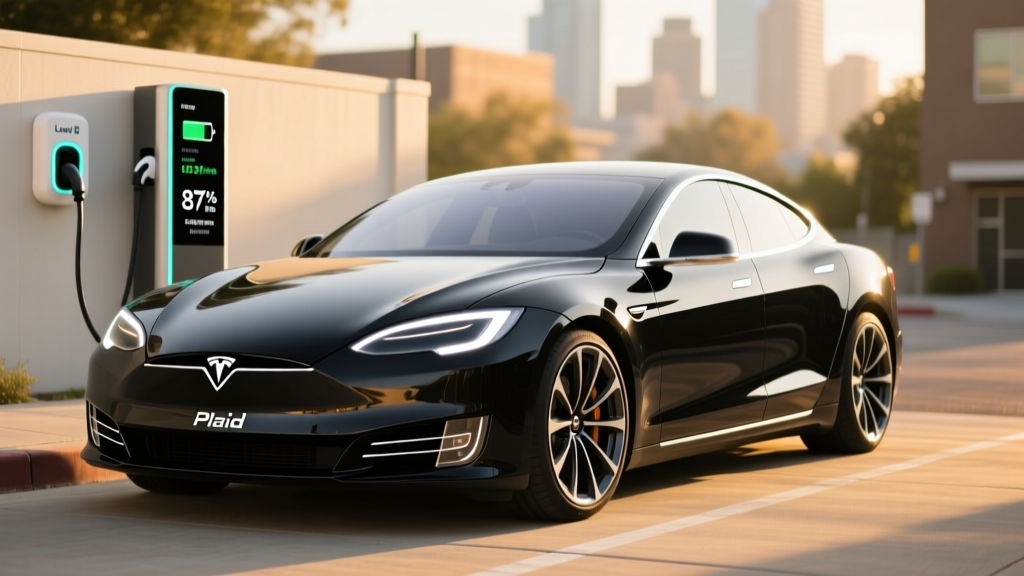
The 2026 Tesla Model S Plaid remains one of the quickest production sedans on the planet, delivering 1,020 horsepower and a 1.99-second 0-60 mph time in a package that doubles as a practical daily driver. But at a base MSRP of $89,990, many buyers are exploring a Tesla Model S Plaid lease as a way to access tri-motor performance without committing to six-figure depreciation. This review breaks down the real-world range, charging behavior, ownership economics, and whether leasing this flagship EV makes financial sense in 2026.
2026 Tesla Model S Plaid: Core Specs at a Glance
| Spec | 2026 Tesla Model S Plaid |
|---|---|
| Base MSRP | $89,990 |
| EPA Range | 396 miles (19" wheels) / 359 miles (21" wheels) |
| Battery Capacity | ~100 kWh usable (NMC chemistry) |
| Drivetrain | Tri-Motor AWD |
| Horsepower | 1,020 hp |
| 0-60 mph | 1.99 seconds |
| Top Speed | 200 mph |
| Max DC Fast Charge | 250 kW (peak) |
| 10-80% DC Charge Time | ~28 minutes |
| Level 2 Home Charge Rate | 11.5 kW (~41 mi/hr) |
| MPGe (Combined) | 116 MPGe |
| Efficiency | 29 kWh/100 mi |
| Cargo Volume | 28.0 cu ft (rear) + 3.1 cu ft (frunk) |
| Seating | 5 passengers |
| Battery Warranty | 8 years / 150,000 miles (70% retention) |
| Federal Tax Credit | Not eligible (exceeds MSRP cap) |
Range and Efficiency: What the EPA Number Doesn't Tell You
The EPA rates the 2026 Model S Plaid at 396 miles with the standard 19-inch Tempest wheels and drops to 359 miles on the optional 21-inch Arachnid wheels. According to fueleconomy.gov, the combined efficiency sits at 116 MPGe (29 kWh/100 mi).
EPA 396 mi (19" wheels) — expect approximately 310-340 miles on the highway at 75 mph sustained speeds, and 280-310 miles in cold weather (below 32°F). The Plaid's tri-motor drivetrain draws more energy under hard acceleration and at high speeds compared to the dual-motor Long Range variant. City driving with regenerative braking can approach or slightly exceed the EPA number in mild climates.
The Plaid's NMC (nickel manganese cobalt) battery pack prioritizes energy density and power delivery over the cycle longevity of LFP chemistry. Tesla's thermal management system is among the best in the industry, but tri-motor energy consumption is inherently higher than a dual-motor setup. If maximum range is your priority, the Long Range AWD (402 mi EPA, $74,990) is the more efficient choice.
Charging Speed: DC Fast Charging and Home Setup
The Model S Plaid supports a peak DC fast-charge rate of 250 kW on Tesla's V3 and V4 Superchargers via the native NACS connector. On a preconditioned battery at a V3 stall, the charge curve peaks near 250 kW around 10-20% state of charge, then tapers progressively. The 10-80% charge takes approximately 28 minutes — competitive but not class-leading compared to 800V architectures from Hyundai/Kia and Porsche that achieve 10-80% in under 20 minutes.
| Charging Level | Power (kW) | Miles Added per Hour | Use Case |
|---|---|---|---|
| Level 1 (120V) | ~1.4 kW | ~5 mi/hr | Emergency top-up |
| Level 2 (240V, 48A) | 11.5 kW | ~41 mi/hr | Overnight home charging |
| DC Fast (V3 Supercharger) | 250 kW (peak) | ~750 mi/hr (peak) | Road trips |
| DC Fast (V4 Supercharger) | 250 kW (peak) | ~750 mi/hr (peak) | Road trips (newer stalls) |
For home Level 2 charging, a Tesla Wall Connector on a 60-amp circuit delivers the full 11.5 kW (48 amps). A full 10-100% charge takes roughly 9-10 hours — ideal for overnight replenishment. Installation of a dedicated 240V/60A circuit typically costs $800-$2,000 depending on panel proximity and whether a panel upgrade to 200A service is needed. Always consult a licensed electrician for final specifications.
One important caveat: the Model S Plaid uses the native NACS port, which is now the industry standard adopted by Ford, GM, Rivian, and others. Non-Tesla DC fast chargers with CCS connectors require a NACS-to-CCS adapter for use on networks like Electrify America, though Tesla's Supercharger network remains the most reliable option.
Performance and Driving Dynamics
The numbers are staggering: 1,020 horsepower from three permanent-magnet synchronous motors, a 1.99-second 0-60 mph time, and a 200-mph top speed (with the appropriate tire and track package). The Plaid uses a carbon-sleeved rotor design in its rear motors to handle the extreme rotational speeds required. On track, the torque-vectoring AWD system delivers exceptional corner-exit grip, and the revised suspension tuning for 2026 manages body roll better than earlier Plaid iterations.
But the Plaid isn't just a dragstrip weapon. Daily driving reveals a compliant ride in Comfort mode, and the cabin remains reasonably quiet at highway speeds. The yoke steering wheel — still standard on the Plaid — remains polarizing. It offers excellent forward visibility of the instrument cluster but requires adaptation for low-speed maneuvers and parking. A conventional round steering wheel is available as a no-cost option.
Tesla Model S Plaid Lease: Pricing and Economics
Tesla does not offer traditional factory leases for the Model S Plaid. Instead, buyers typically lease through third-party leasing companies or finance directly. As of early 2026, the Model S Plaid starts at $89,990 before options and delivery fees.
| Configuration | MSRP |
|---|---|
| Model S Plaid (19" Tempest Wheels) | $89,990 |
| Model S Plaid (21" Arachnid Wheels) | $94,490 |
| + Full Self-Driving (Supervised) | +$8,000 |
| + Premium Interior (Cream or White) | +$2,000 |
| Destination / Order Fee | +$1,800 |
A typical third-party lease for the Model S Plaid in 2026 runs approximately $1,400-$1,800/month for a 36-month term with 10,000 miles per year and $5,000-$7,000 due at signing, depending on money factor, residual value assumptions, and state taxes. Leasing a Plaid can make sense for buyers who want to avoid the steepest portion of the depreciation curve — luxury EVs can lose 40-55% of their value over three years.
The Model S Plaid does not qualify for the $7,500 IRS §30D federal EV tax credit. Under current IRS rules, the MSRP cap for sedans is $55,000 — the Plaid at $89,990 far exceeds this threshold. Income caps ($300,000 joint / $150,000 single) and battery critical-mineral sourcing requirements also apply. Consult a tax professional for your specific situation.
Interior, Cargo, and Technology
The Model S cabin received its major refresh in 2021, and the 2026 Plaid carries forward with the 17-inch cinematic touchscreen, 12.3-inch instrument cluster, and a rear-seat 8-inch display. The infotainment system runs Tesla's latest software with native navigation, streaming apps, and a gaming suite capable of running AAA titles via the onboard AMD Ryzen processor.
Cargo and Passenger Space:
- Rear cargo: 28.0 cu ft (competitive with midsize luxury sedans)
- Front trunk (frunk): 3.1 cu ft
- Rear legroom: 35.4 inches
- Front headroom: 39.7 inches
- Seating: 5 passengers
The rear seat remains a weak point relative to competitors like the Mercedes EQS or BMW i7. Headroom is tight for passengers over 6 feet due to the sloping roofline, and the seat cushion sits relatively low. The 28 cu ft trunk, however, is practical for road trips, and the liftback design provides a wide opening for larger items.
Driver Assistance: The Model S Plaid comes standard with Tesla's Basic Autopilot (adaptive cruise control, lane-keeping). Full Self-Driving (Supervised) is an $8,000 add-on that enables automatic lane changes, Navigate on Autopilot, and Smart Summon.
Tesla Autopilot and FSD (Supervised) are SAE Level 2 driver-assistance systems. The driver must remain fully engaged, keep hands on the wheel, and maintain situational awareness at all times. These are not self-driving systems. Only Level 4 services like Waymo operate without a driver in defined geofenced areas.
Warranty and Long-Term Ownership
Tesla provides the following warranty coverage for the 2026 Model S Plaid:
- Basic Vehicle: 4 years / 50,000 miles
- Battery & Drive Units: 8 years / 150,000 miles (with minimum 70% battery capacity retention)
The 8-year/150,000-mile battery warranty is generous and covers degradation below 70% state of health. NMC batteries in high-performance applications like the Plaid typically see 10-15% degradation over 100,000 miles based on fleet data, though Tesla's active thermal management helps mitigate accelerated wear. Battery replacement outside of warranty for a Plaid pack can cost $15,000-$22,000 based on current service estimates.
For leaseholders, the battery warranty concern is largely moot — you'll return the vehicle before reaching high-mileage thresholds. This is one of the strongest arguments for leasing a high-performance EV.
Pros and Cons: The Honest Assessment
- 1.99-sec 0-60 — fastest production sedan available
- 396-mi EPA range is excellent for a 1,020-hp vehicle
- Access to Tesla Supercharger network (most reliable DC network)
- OTA software updates continuously add features
- Strong liftback cargo practicality (28 cu ft)
- Leasing avoids steep luxury-EV depreciation
- No federal tax credit (exceeds $55K sedan MSRP cap)
- 250 kW peak charge rate trails 800V competitors
- Yoke steering is polarizing and impractical for some
- Rear seat headroom is tight for tall passengers
- No Apple CarPlay or Android Auto support
- Insurance premiums run 30-50% above comparable gas sedans
- Build quality inconsistencies still reported by owners
Who Should Lease the Model S Plaid?
- You want hypercar-rivaling performance in a four-door daily driver
- You want to avoid luxury-EV depreciation risk (40-55% over 3 years)
- You have reliable home Level 2 charging access
- You frequently road-trip and value the Supercharger network
- You don't need maximum rear-seat comfort for tall adults
Look Elsewhere If:
- Tax credit eligibility is a dealbreaker (consider the Model 3 or Model Y)
- You need the fastest possible DC charging (Porsche Taycan, Hyundai Ioniq 5 N)
- Chauffeur-grade rear-seat luxury is a priority (Mercedes EQS, BMW i7)
- You prefer traditional luxury dealership service experiences
Frequently Asked Questions
Does the Tesla Model S Plaid qualify for any tax credits in 2026?
No. The federal §30D EV tax credit has a $55,000 MSRP cap for sedans, and the Plaid starts at $89,990. Some states offer separate incentives that may apply — check your state's energy office or the AFDC state incentive database for local programs. No state credit has an MSRP cap as restrictive as the federal one, but income and residency requirements vary.
How much does a Tesla Model S Plaid lease typically cost per month?
Third-party leases in 2026 generally range from $1,400 to $1,800/month on a 36-month term with 10,000 miles annually and $5,000-$7,000 due at signing. Exact payments depend on your credit tier, state tax structure, negotiated selling price, and the leasing company's residual value projection. Tesla does not offer direct factory leases for the Plaid.
What's the real-world highway range of the Model S Plaid?
Expect 310-340 miles at sustained highway speeds (70-75 mph) in moderate temperatures with the 19-inch wheels. Cold weather (below freezing) can reduce this to 280-310 miles. The 21-inch Arachnid wheels reduce EPA range to 359 miles and real-world highway range to approximately 280-300 miles.
Is the Model S Plaid worth it over the Long Range AWD?
The Long Range AWD offers 402 miles of EPA range, 670 hp, and a 3.1-second 0-60 time for $74,990 — $15,000 less than the Plaid. Unless you specifically need tri-motor track capability and sub-2-second acceleration, the Long Range is the more rational choice for daily driving and road trips. The Long Range is also still ineligible for the federal credit due to the $55K sedan cap.
How does the Plaid's charging compare to the Porsche Taycan Turbo GT?
The Taycan Turbo GT uses an 800V architecture supporting peak DC charging up to 320 kW, achieving 10-80% in roughly 18 minutes — about 10 minutes faster than the Plaid. However, the Taycan's EPA range is significantly lower (around 269 miles for the Turbo GT), and it lacks access to the native Supercharger network without adapters. It's a trade-off between charging speed and total range plus network convenience.
What happens if the battery degrades during a lease?
Tesla's 8-year/150,000-mile battery warranty covers capacity loss below 70% state of health. Over a typical 3-year lease (30,000-36,000 miles), NMC battery degradation is generally 3-5%, well within the warranty threshold. The leasing company may assess excess wear charges at return, but normal battery degradation is not typically penalized. Confirm specific battery wear terms in your lease agreement.