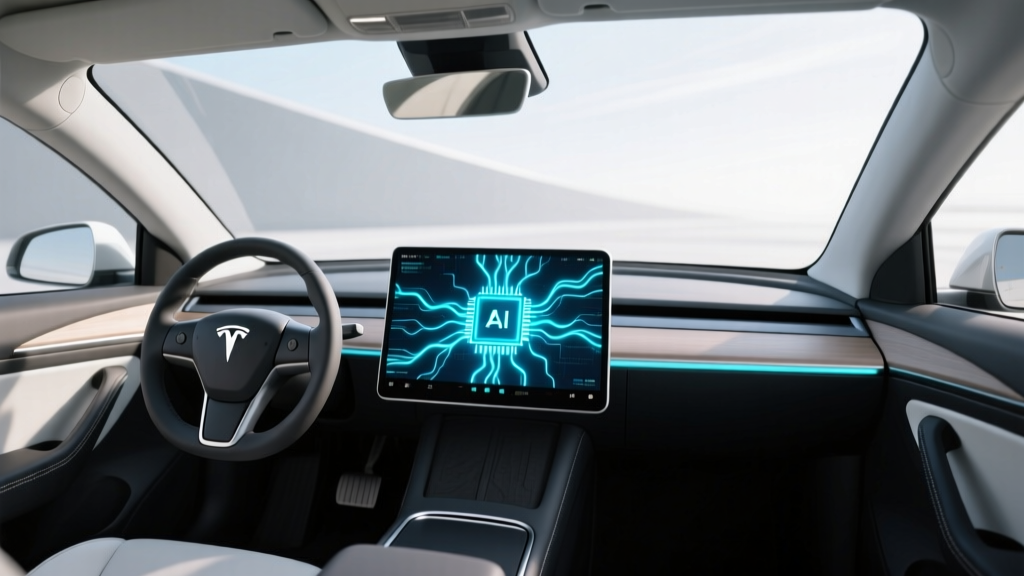
If you have been following Tesla's hardware roadmap, you have likely encountered the term Tesla Cortex. It is not a new vehicle, a trim level, or a battery pack — it is the codename for Tesla's next-generation AI inference processor, the silicon brain expected to power Full Self-Driving (Supervised) in future Tesla models. As of early 2026, Tesla has not released a production vehicle equipped with the Cortex chip, and official specifications remain preliminary. What follows is a synthesis of confirmed statements from Tesla earnings calls, industry analysis, and the trajectory of Tesla's in-house silicon development.
What Is Tesla Cortex and Why Does It Matter?
Tesla Cortex is the designation for Tesla's next-generation neural-network inference chip, designed to succeed the dual-chip FSD Computer (Hardware 3 and the incremental Hardware 4) that currently powers Autopilot and FSD (Supervised) in the Model S, 3, X, Y, and Cybertruck. Unlike general-purpose GPUs from NVIDIA or AMD, Cortex is an application-specific integrated circuit (ASIC) purpose-built to run Tesla's vision-based neural networks at extreme throughput with minimal power draw.
The strategic importance is significant. By designing its own silicon, Tesla controls the full stack — from training neural networks on its Dojo supercomputer and NVIDIA H100 clusters to deploying optimized inference models on chips it designs in-house. This vertical integration eliminates dependency on third-party chip suppliers and allows Tesla to tailor hardware precisely to its evolving FSD architecture.
The Silicon Roadmap: HW3 → HW4 → Cortex (HW5)
| Generation | Chip Designation | Status (2026) | Estimated Inference Performance |
|---|---|---|---|
| Hardware 3 (HW3) | Dual FSD Chips (Samsung 14nm) | In production since 2019 | ~144 TOPS combined |
| Hardware 4 (HW4) | Updated FSD Chip (Samsung/TSMC) | In production since 2023 | ~300+ TOPS (est.) |
| Hardware 5 (HW5) | Tesla Cortex | Announced / Pre-production | Target: 2,000–5,000 TOPS (est.) |
The leap from HW4 to Cortex is expected to be generational, not incremental. Elon Musk has publicly stated that HW5 would represent roughly a 10x improvement in compute capability over HW4, though Tesla has not published a formal TOPS (trillions of operations per second) figure. Industry analysts at firms like SemiAnalysis and Yole Group estimate the Cortex chip will deliver between 2,000 and 5,000 TOPS of INT8 inference performance — a figure that would place it well above NVIDIA's Orin platform used by competing OEMs.
Projected Cortex Specifications and Architecture
Because Tesla has not published a formal datasheet for Cortex, the following specifications are compiled from earnings call commentary, patent filings, and semiconductor industry analysis. Treat all numbers as preliminary estimates.
Tesla Cortex — Estimated Spec Sheet (HW5)
| Chip Type | Custom AI inference ASIC |
| Process Node | TSMC 4nm or 3nm (estimated) |
| TOPS (INT8 Inference) | 2,000–5,000 (target, unconfirmed) |
| Power Envelope | ~70–100W per chip (est.) |
| Chip Count per Vehicle | Expected dual-chip redundancy (like HW3/HW4) |
| Camera Support | Up to 11+ cameras at higher resolution/framerate |
| Memory | LPDDR5X or HBM (est.) |
| Neural Net Architecture | Transformer-based end-to-end FSD models |
| Target SAE Level | Level 2 (Supervised) — potential Level 4 pathway |
| Expected Production Start | Late 2026 or 2027 (unconfirmed) |
Why TOPS Matter for FSD
TOPS (trillions of operations per second) measures how many neural-network calculations a chip can execute each second. Tesla's FSD software has moved toward increasingly large transformer-based models — the same class of architecture that powers large language models — which require substantially more compute than the earlier convolutional neural networks Tesla used. More TOPS means the car can process more camera frames per second, run larger and more accurate models, and maintain redundancy across dual chips for safety.
However, raw TOPS alone do not determine real-world driving capability. Software optimization, model compression, sensor quality, and training data volume are equally critical. A 5,000-TOPS chip running a poorly trained model will underperform a 300-TOPS chip running a well-optimized one. Tesla's advantage lies in controlling both the silicon and the training pipeline.
How Cortex Fits Into Tesla's EV Lineup
When Cortex enters production, it is expected to debut in a new or refreshed Tesla model — likely the next-generation Model Y, a refreshed Model S/X, or potentially the Robotaxi platform Tesla has previewed. Existing HW3 and HW4 vehicles are not expected to receive a Cortex retrofit; the chip architecture and board layout are fundamentally different, much as HW3 owners could not simply swap in an HW4 board without significant modification.
For current Tesla buyers in 2026, this raises a practical question: should you wait for HW5/Cortex, or buy now with HW4?
Decision Framework: Buy Now (HW4) or Wait for Cortex (HW5)?
Buy now with HW4 if:
- You need a vehicle in the next 6–12 months
- You are satisfied with FSD (Supervised) as a Level 2 driver-assist system that requires your full attention
- You do not plan to keep the vehicle beyond 5–6 years
- Current Tesla pricing and §30D tax credit eligibility align with your budget
Wait for Cortex/HW5 if:
- You can defer purchase 12–18+ months with no hardship
- You believe Tesla will achieve meaningful Level 3 or Level 4 autonomy and want hardware capable of supporting it
- You plan to keep the vehicle 8+ years and want the most future-proof compute platform
- You are specifically interested in Tesla's Robotaxi vision and want hardware that may enable it
What Cortex Means for FSD (Supervised) Buyers
Tesla currently sells FSD (Supervised) as an $8,000 one-time purchase or a $99/month subscription on top of the base vehicle price. FSD (Supervised) is a SAE Level 2 driver-assistance system — it does not make the vehicle self-driving, and the driver must remain fully engaged, hands on or near the wheel, eyes on the road at all times. This is a critical distinction that Tesla's marketing has sometimes blurred, and regulators at NHTSA have scrutinized.
The Cortex chip's significance for FSD buyers is twofold:
- Near-term: More compute allows Tesla to run larger, more capable neural networks that may improve lane-keeping, intersection handling, and edge-case recognition — making FSD (Supervised) smoother and more reliable, even though it remains Level 2.
- Long-term: If Tesla ever achieves regulatory approval for Level 3 (eyes-off in specific conditions) or Level 4 (driverless in geofenced areas), the Cortex chip's compute headroom would be necessary to support the redundant perception and decision-making those levels require.
However, hardware capability does not guarantee regulatory approval. Even with a 5,000-TOPS chip, Tesla must demonstrate to NHTSA and state regulators that its software meets safety thresholds for higher automation levels. This is a legal and validation challenge as much as a technical one.
Tesla Cortex vs. Competing ADAS Silicon
Tesla is not the only automaker investing in high-performance driving chips. Here is how Cortex's estimated capabilities compare to platforms used by competing OEMs for their advanced driver-assistance systems:
| Platform | Manufacturer | TOPS (Est.) | Used By | SAE Level (Current) |
|---|---|---|---|---|
| Tesla Cortex (HW5) | Tesla (in-house) | 2,000–5,000 | Tesla (upcoming) | Level 2 (announced) |
| NVIDIA DRIVE Orin | NVIDIA | 254 | Mercedes, Hyundai, Volvo, Jaguar Land Rover | Level 2–3 |
| NVIDIA DRIVE Thor | NVIDIA | 2,000 | Mercedes, BYD, XPeng (announced) | Level 2–4 (target) |
| Mobileye EyeQ Ultra | Intel/Mobileye | 176 | Volkswagen, Porsche, various | Level 2–3 |
| Qualcomm Snapdragon Ride | Qualcomm | Up to 800+ | GM (Super Cruise next-gen), BMW | Level 2–3 |
Tesla's primary advantage is not just raw TOPS but vertical integration. NVIDIA's Thor chip is formidable on paper, but OEMs using it must integrate it with their own software stacks, sensor configurations, and validation processes. Tesla designs the chip, the sensors, the training infrastructure (Dojo + NVIDIA H100 clusters), and the inference software as a unified system.
The primary risk for Tesla is manufacturing execution. Designing a 3nm or 4nm ASIC at scale requires partnership with TSMC or Samsung Foundry, and Tesla has historically experienced production delays when transitioning between hardware generations. HW4 rollout was slower than initially projected, and Cortex may follow a similar pattern.
Impact on Vehicle Pricing and Tax Credits
Because Cortex has not entered production, there is no pricing specific to a Cortex-equipped Tesla. However, we can assess the cost dynamics that will apply when it does arrive:
- Vehicle MSRP: Tesla has historically absorbed hardware generational changes without significant price increases at the base-trim level. The transition from HW3 to HW4 did not result in a price bump for the Model 3 or Model Y. Expect a similar approach with Cortex — the chip will likely ship in refreshed or new models at pricing consistent with Tesla's competitive positioning at that time.
- FSD (Supervised) pricing: Tesla has adjusted FSD pricing multiple times. The current $8,000 purchase or $99/month subscription may change by the time Cortex-equipped vehicles ship. Tesla has also offered promotional FSD transfers and limited-time pricing.
- Federal §30D tax credit: Any future Cortex-equipped Tesla will be subject to the same IRS §30D clean vehicle credit rules that apply today — including MSRP caps ($55,000 for sedans, $80,000 for SUVs/trucks/vans), buyer income limits ($150K single / $300K joint AGI), and battery component and critical mineral sourcing requirements. These rules are subject to legislative change. Consult a tax professional before assuming eligibility.
- Vehicle MSRP must not exceed $55,000 (sedans) or $80,000 (SUVs, trucks, vans)
- Buyer modified AGI must not exceed $150,000 (single) / $225,000 (head of household) / $300,000 (joint)
- Battery components must meet increasing domestic-content thresholds (phased annually)
- Critical minerals must meet sourcing requirements from the U.S. or FTA partners
- Vehicle must be assembled in North America
- Credit can be transferred to the dealer at point of sale for an upfront price reduction
- Rules subject to change — verify at IRS.gov before purchasing
Should You Factor Cortex Into Your 2026 Tesla Purchase Decision?
For most buyers shopping for a Tesla in 2026, the Cortex chip should be a background consideration, not a purchase blocker. Here is the practical reality:
If you need a car now: Current HW4-equipped Teslas (Model 3 Highland, Model Y Juniper, Cybertruck) offer robust FSD (Supervised) capability, competitive EPA range, access to the Supercharger network, and are available for immediate delivery. Waiting 12–24 months for an unconfirmed chip generation means going without a vehicle or extending a lease on a car you may have already outgrown.
If you are a tech-forward buyer who upgrades frequently: Be aware that HW4 vehicles will not be upgradable to Cortex. If Tesla eventually enables Level 3 or Level 4 features that require HW5 hardware, HW4 owners may be locked out. This is the same dynamic that prevented HW3 owners from accessing HW4-specific features. Factor this into your ownership horizon planning.
If you are considering FSD (Supervised): Evaluate it based on what it is today — a Level 2 assist system — not on what Cortex might enable in 2027 or beyond. The $8,000 FSD purchase or $99/month subscription should be justified by the current driving experience, not speculative future capabilities.
Frequently Asked Questions About Tesla Cortex
Is Tesla Cortex a car or a chip?
Tesla Cortex is a chip — specifically, a next-generation AI inference processor expected to power Tesla's Hardware 5 (HW5) FSD computer. It is not a vehicle model or trim level.
When will the first Tesla with Cortex ship?
Tesla has not confirmed a production date. Based on statements from earnings calls and the typical 2–3 year cadence between hardware generations, industry estimates point to late 2026 or 2027 for initial production. This timeline is subject to delay.
Can I upgrade my current Tesla to Cortex?
Almost certainly not. Previous hardware transitions (HW3 to HW4) required different board layouts, connectors, and cooling systems. A Cortex retrofit for existing vehicles would be technically complex and economically unlikely. Tesla has offered paid ECU upgrades for HW2.5→HW3 in the past, but a Cortex upgrade would be a far larger engineering undertaking.
Will Cortex make Tesla vehicles self-driving?
No chip alone makes a vehicle self-driving. Autonomous capability requires validated software, regulatory approval, and extensive real-world safety data. Cortex provides the compute headroom that could support higher SAE automation levels, but Tesla must still clear regulatory and safety hurdles for anything beyond Level 2 supervised driving.
How does Cortex compare to NVIDIA's DRIVE Thor?
On paper, both target the 2,000+ TOPS range. Tesla's advantage is full-stack vertical integration — it controls the chip, sensors, training data, and inference software. NVIDIA's advantage is broad industry adoption and a proven semiconductor manufacturing partnership with TSMC. Real-world performance comparisons will not be possible until Cortex-equipped vehicles are independently tested.
Does a Cortex-equipped Tesla qualify for the federal EV tax credit?
Eligibility will depend on the same §30D rules that apply to all Tesla vehicles at the time of purchase — MSRP caps, buyer income limits, battery sourcing requirements, and North American assembly. The chip itself does not affect credit eligibility. Verify current rules at IRS.gov before purchasing.