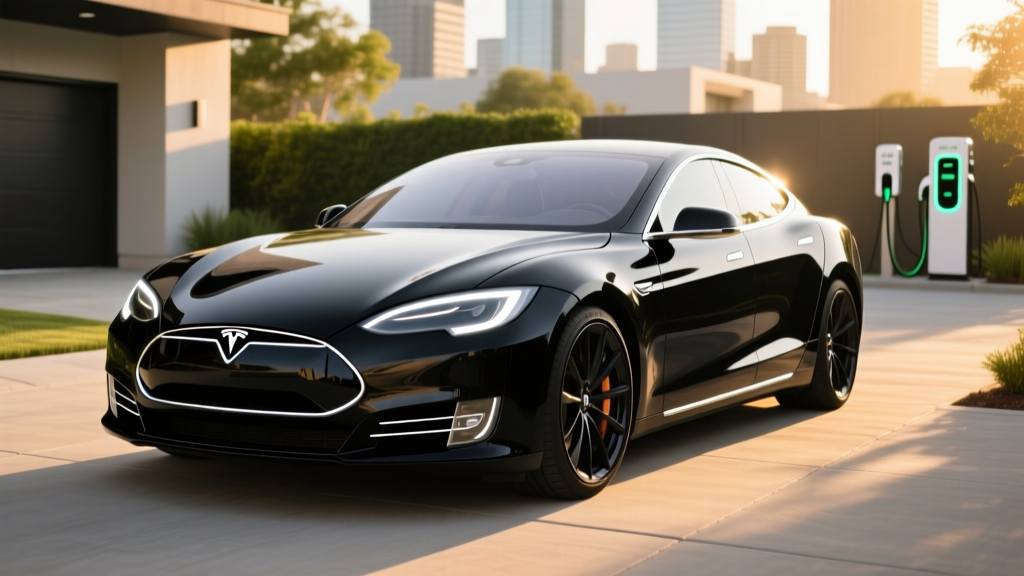
The Tesla Model S Plaid remains one of the most extreme performance statements in the electric-vehicle market. With tri-motor all-wheel drive and a reputation for demolizing supercars at stoplights, buyers searching for Model S Plaid horsepower figures usually already know the headline number: 1,020 hp. But raw output is only part of the ownership equation. This review covers what it actually takes to live with Tesla's flagship sedan in 2026 — from real-world range and charging behavior to tax-credit reality and whether competitors like the Lucid Air Sapphire or Porsche Taycan Turbo GT make a stronger case for six-figure EV money.
Model S Plaid Horsepower and Performance Specs
The 2026 Tesla Model S Plaid uses a tri-motor architecture: one permanent-magnet motor on the front axle and two carbon-sleeved permanent-magnet motors on the rear axle. Tesla rates the combined system output at 1,020 horsepower and approximately 1,050 lb-ft of torque. Unlike many combustion supercars that peak at a specific RPM, the Plaid's electric motors deliver maximum torque from zero, which is why a four-door sedan weighing over 4,700 lbs can credibly claim supercar acceleration.
| Spec | Value |
|---|---|
| Horsepower | 1,020 hp (combined tri-motor) |
| Torque | ~1,050 lb-ft |
| Drivetrain | AWD (tri-motor) |
| 0-60 mph | 1.99 seconds (with rollout subtracted) |
| Quarter-Mile | 9.23 seconds @ 155 mph |
| Top Speed | 200 mph (with track package) |
| Battery Usable Capacity | ~95 kWh (NMC chemistry) |
A note on the 1.99-second 0-60 claim: Tesla measures this with a 1-foot rollout subtracted, standard in drag racing but roughly 0.2-0.3 seconds quicker than a true standing-start measurement. Independent tests by outlets like Motor Trend and Car and Driver have recorded 0-60 times in the 2.1 to 2.3 second range from a true standstill — still astonishingly quick, and firmly in hypercar territory. Sustained full-power pulls also generate significant heat; repeated launches will trigger thermal management intervention, which is expected behavior for any battery-electric system at this output level.
EPA Range and Real-World Expectations
The 2026 Model S Plaid carries an EPA-estimated range of 396 miles on its standard 19-inch Tempest wheels. Opting for the 21-inch Arachnid wheels drops that figure to approximately 359 miles due to increased rolling resistance and aerodynamic drag. The battery pack uses NMC (nickel manganese cobalt) chemistry, which offers higher energy density than LFP — important for a performance sedan where weight distribution and packaging matter.
- EPA Sticker: 396 miles (19" wheels) / 359 miles (21" wheels)
- Highway driving (70-80 mph): Expect 290-320 miles. The Plaid's tri-motor drag and performance-oriented tuning reduce efficiency at sustained high speed.
- Cold weather (below 32°F): Expect a 20-30% reduction, yielding roughly 260-300 miles in freezing conditions. The heat pump helps, but battery chemistry inherently loses capacity in cold.
- City/commute driving: Closest to EPA — 360-390 miles is achievable with regenerative braking doing heavy lifting.
Source: EPA Fuel Economy
On a real-world road trip from Los Angeles to Las Vegas (roughly 270 miles), the Plaid can complete the journey on a single charge in moderate weather at legal highway speeds — but with minimal buffer if you're running the 21-inch wheels. Plan a brief Supercharger stop if temperatures are low or you're driving aggressively. Efficiency is rated at approximately 120 MPGe combined, or about 28 kWh/100 miles, which is notably less efficient than the dual-motor Model S Long Range (124 MPGe) due to the third motor and performance calibration.
Charging Speed: DC Fast and Home Level 2
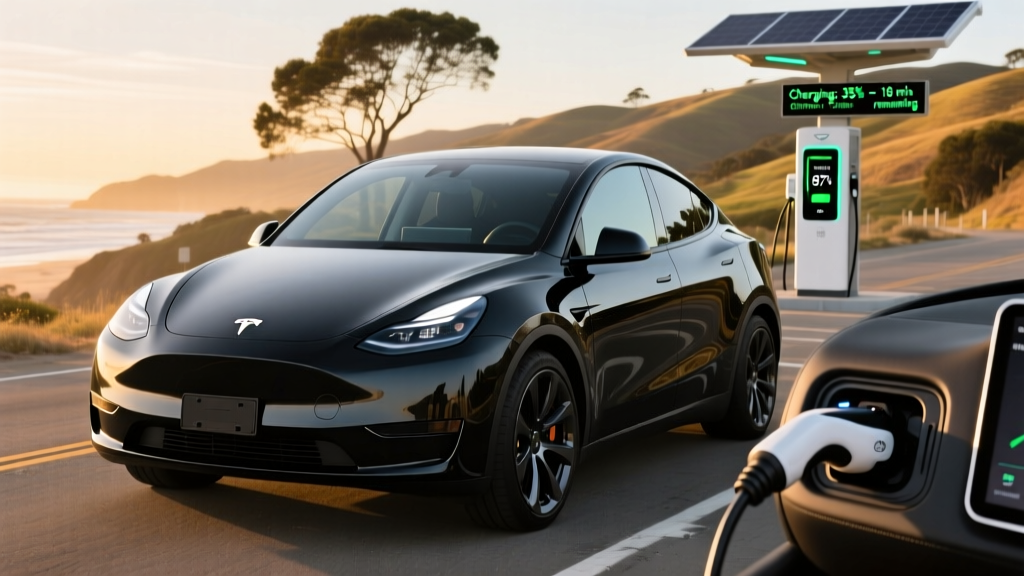
The Model S Plaid supports a peak DC fast-charge rate of 250 kW on V3 Tesla Superchargers. Tesla claims a 10-80% charge in approximately 30 minutes, though real-world charging curves tell a more nuanced story. The pack ramps quickly to ~150-170 kW, sustains near-peak rates between 10-40% SoC, then tapers progressively. From 80-100%, expect very slow topping — Tesla's battery management system is conservative at high SoC to protect long-term cell health.
| Charging Method | Power | Rate / Time |
|---|---|---|
| DC Fast Charge (V3 Supercharger) | 250 kW peak | ~200 miles in 15 min; 10-80% in ~30 min |
| DC Fast Charge (CCS adapter / third-party) | Up to 250 kW (station dependent) | Varies by station output curve |
| Level 2 Home (Tesla Wall Connector, 48A) | 11.5 kW | ~44 miles per hour of charging |
| Level 2 Home (NEMA 14-50, 40A) | 9.6 kW | ~37 miles per hour of charging |
| Level 1 (standard 120V outlet) | ~1.4 kW | ~5 miles per hour of charging |
For home charging, the Tesla Wall Connector on a 60-amp circuit (48A continuous) is the practical standard, adding roughly 44 miles of range per hour. Overnight charging from 20% to 80% takes about 6-7 hours — more than adequate for daily use. Note that the Model S Plaid uses Tesla's proprietary NACS connector natively. If you need to use Electrify America or other CCS-based networks, Tesla sells a CCS adapter, though the expanding Supercharger network (now open to other brands via NACS) makes this less critical for Tesla owners.
Preconditioning matters: Navigate to a Supercharger using the car's built-in navigation, and the battery will automatically warm to optimal charging temperature before you arrive. Skip this step (e.g., pulling into a charger without nav guidance) and your initial charge rate may be significantly lower, especially in cold weather.
Pricing, Tax Credits, and Ownership Cost
The 2026 Model S Plaid starts at an MSRP of approximately $89,990 (before destination). Adding options like the 21-inch Arachnid wheels, Full Self-Driving (Supervised) capability, or premium interior colors can push an as-tested price to $97,000-$102,000+.
| Item | Cost |
|---|---|
| Base MSRP (Model S Plaid) | $89,990 |
| Destination Fee | $1,390 |
| 21" Arachnid Wheels | $4,500 |
| FSD (Supervised) | $8,000 |
| Typical As-Tested Price | $95,000 - $102,000 |
Federal Tax Credit Eligibility (§30D)
This is where the math gets unfavorable for most Plaid buyers. Under current IRS §30D rules, the federal EV tax credit has a sedan MSRP cap of $55,000. At $89,990 base, the Model S Plaid far exceeds this threshold, making it ineligible for the $7,500 federal tax credit. Additionally, buyer income caps apply ($300,000 joint / $150,000 single), and battery critical-mineral sourcing requirements must be met — but the MSRP cap alone disqualifies the Plaid regardless of income.
- ❌ MSRP under $55,000 (sedan cap): FAILS — Plaid is $89,990
- ⚠️ Buyer income under $300k joint / $150k single: Varies by buyer
- ⚠️ Battery sourcing / critical minerals: Varies by production batch
- ✅ Vehicle assembled in North America: PASSES (Fremont, CA)
Source: IRS §30D Clean Vehicle Credit
No state-level rebates universally cover the Plaid either, though some states like California's CVRP have their own MSRP caps and income limits that similarly exclude it. Check your specific state's energy office for local incentive details, but budget without expecting a credit.
Interior, Cargo, and Daily Practicality
The Model S cabin has been substantially refreshed since the 2021 Palladium redesign. The 17-inch center touchscreen is now mounted in a landscape orientation with an adjustable tilt, running Tesla's latest infotainment software with Netflix, YouTube, and a surprisingly capable gaming suite (the AMD Ryzen processor handles AAA-level titles when parked). A second 8-inch screen serves rear passengers for climate and media controls.
| Measurement | Value |
|---|---|
| Front Legroom | 42.4 inches |
| Rear Legroom | 35.4 inches |
| Cargo Volume (rear trunk) | 26.3 cu ft |
| Frunk (front trunk) | ~3.1 cu ft |
| Total Cargo (rear seats folded) | ~64 cu ft |
| Seating | 5 passengers |
The liftback design is a practicality win — the entire rear glass lifts, providing SUV-like loading access that a traditional sedan trunk cannot match. Rear legroom is adequate for adults on shorter trips but tighter than a Mercedes EQS or Lucid Air for six-foot passengers on long hauls. The yoke steering wheel remains standard on the Plaid; a round wheel is available as a no-cost swap at order time, and most buyers should seriously consider it for daily driving ease.
Driver Assistance and Technology
Every Model S Plaid includes Tesla's Autopilot suite: adaptive cruise control, lane-keeping assist, and automatic emergency braking. The optional Full Self-Driving (Supervised) package ($8,000) adds Navigate on Autopilot (automated highway lane changes and off-ramp transitions), Smart Summon, and traffic-light/stop-sign recognition.
Tesla's Autopilot and FSD (Supervised) are SAE Level 2 driver-assistance systems. The driver must remain fully engaged, with hands on the wheel and eyes on the road, at all times. These systems do not make the car self-driving. Only Level 4 robotaxi services (Waymo, Zoox) operate without a human driver in defined service areas.
On the highway, Autopilot is competent and confidence-inspiring for long-distance cruising. FSD (Supervised) handles complex urban scenarios impressively in many situations but can still make unexpected decisions at construction zones or unusual intersections. Treat it as an advanced co-pilot, not a replacement for attention.
Other standout tech includes over-the-air updates that have historically added meaningful features post-purchase, a 22-speaker audio system with active noise cancellation, and Tesla's Sentry Mode / Dashcam suite for security recording. The glass roof provides an airy cabin but lacks a retractable shade — a notable drawback in hot climates where solar heat gain is substantial.
Warranty and Long-Term Battery Outlook
Tesla covers the Model S Plaid with a 4-year/50,000-mile basic vehicle warranty and an 8-year/150,000-mile battery and drive unit warranty. The battery warranty guarantees retention of at least 70% of original capacity during the coverage period — if degradation drops below that threshold, Tesla will repair or replace the pack.
The NMC pack in the Plaid is proven technology, and Tesla's active thermal management (liquid cooling/heating) has demonstrated strong longevity in the broader Model S fleet. Real-world data from high-mileage Model S owners suggests 10-15% degradation over 100,000 miles is typical, though the Plaid's higher-performance usage patterns (frequent hard acceleration, fast charging) may accelerate wear slightly. Avoid routinely charging to 100% for daily use; Tesla recommends a daily limit of 80-90% for NMC packs, reserving 100% for road trips.
Model S Plaid vs. Key Competitors
| Spec | Tesla Model S Plaid | Lucid Air Sapphire | Porsche Taycan Turbo GT (w/ Weissach) |
|---|---|---|---|
| Horsepower | 1,020 hp | 1,234 hp | 1,019 hp (1,092 w/ Launch Control) |
| 0-60 mph | 1.99s | 1.89s | 2.1s |
| EPA Range | 396 mi | 427 mi | 269 mi |
| Battery (usable) | ~95 kWh (NMC) | ~118 kWh (NMC) | ~97 kWh (NMC) |
| Peak DC Charge | 250 kW | 300+ kW | 320 kW |
| Base MSRP | $89,990 | $249,000 | $230,000 |
| Federal Tax Credit | No (MSRP cap) | No (MSRP cap) | No (MSRP cap) |
The Lucid Air Sapphire is quicker and has more range, but at $249,000, it occupies a different universe of pricing. The Porsche Taycan Turbo GT offers superior build quality and track-focused chassis dynamics but sacrifices significant range (269 miles EPA). The Model S Plaid's value proposition is clear: it delivers 90%+ of the Sapphire's performance at roughly one-third the price, with a more mature charging network behind it. The Supercharger ecosystem remains a tangible daily advantage over CCS-dependent competitors, even as NACS adoption spreads.
Pros, Cons, and Who Should Buy
- 1,020 hp and sub-2-second 0-60 at under $100k — unmatched performance-per-dollar
- 396-mile EPA range is excellent for a performance EV
- Tesla Supercharger network — most reliable and extensive DC fast-charging infrastructure
- Liftback cargo design offers SUV-level utility
- Over-the-air updates continuously add features
- Spacious front seating and strong infotainment hardware
- No federal tax credit eligibility (well above $55k MSRP cap)
- Yoke steering is divisive; round wheel should be default
- Rear seat legroom is tight for tall adults on long trips
- Panel gaps and interior material quality still lag Porsche/Mercedes at this price
- Glass roof lacks a shade — hot in summer climates
- 250 kW peak charge rate is slower than newer 800V competitors (Taycan, Ioniq 5 N)
- Insurance premiums are high — expect $3,500-$5,000+/year depending on profile
- Choose the Plaid if: You want supercar performance in a daily-drivable four-door sedan, prioritize Supercharger access for road trips, and don't need tax-credit assistance.
- Look elsewhere if: Rear-seat comfort for adults is a priority (consider Lucid Air Grand Touring), you want track-focused chassis dynamics (Porsche Taycan Turbo GT), or you need the absolute maximum range (Lucid Air Grand Touring at 516 mi EPA).
Frequently Asked Questions
What is the real-world range of the Tesla Model S Plaid?
The EPA rates the Model S Plaid at 396 miles on 19-inch wheels and 359 miles on 21-inch wheels. In real-world highway driving at 70-80 mph, expect 290-320 miles. In freezing weather, plan for 260-300 miles. City driving with regenerative braking recovers the most range, often approaching the EPA figure.
How fast does the Model S Plaid charge?
On a V3 Tesla Supercharger (250 kW peak), the Plaid adds roughly 200 miles in 15 minutes and charges from 10-80% in about 30 minutes. At home on a Tesla Wall Connector (11.5 kW / 48A), it adds approximately 44 miles per hour. The car uses a 400V architecture, so it doesn't match the 350 kW+ rates of 800V competitors like the Porsche Taycan or Hyundai Ioniq 5.
Does the Model S Plaid qualify for the federal EV tax credit?
No. Under IRS §30D rules, sedans must have an MSRP at or below $55,000 to qualify. The Model S Plaid starts at $89,990, making it ineligible regardless of buyer income or battery sourcing. Budget accordingly — there is no $7,500 credit to factor in.
How much horsepower does the Model S Plaid actually make?
Tesla rates the tri-motor system at 1,020 horsepower combined. This is a sustained output figure achievable with adequate battery state of charge and thermal conditions. Unlike combustion engines, electric motors deliver peak torque from zero RPM, which is why the Plaid feels even more explosive than its horsepower figure alone might suggest.
Is the Model S Plaid worth buying over the competition?
At roughly $90,000, the Plaid delivers performance that rivals or beats vehicles costing two to three times as much (Lucid Air Sapphire at $249k, Rimac Nevera at $2M+). For pure straight-line performance per dollar combined with practical daily usability and Supercharger access, it has no direct equal. If build quality, rear-seat space, or track handling matter more to you, the Porsche Taycan or Lucid Air are compelling — but significantly more expensive alternatives.
What is the battery warranty on the Model S Plaid?
Tesla provides an 8-year/150,000-mile warranty on the battery and drive units, guaranteeing at least 70% capacity retention over that period. The basic vehicle warranty is 4 years/50,000 miles. For a $90,000+ vehicle, some buyers opt for an extended service agreement — check Tesla's current offerings at purchase time.