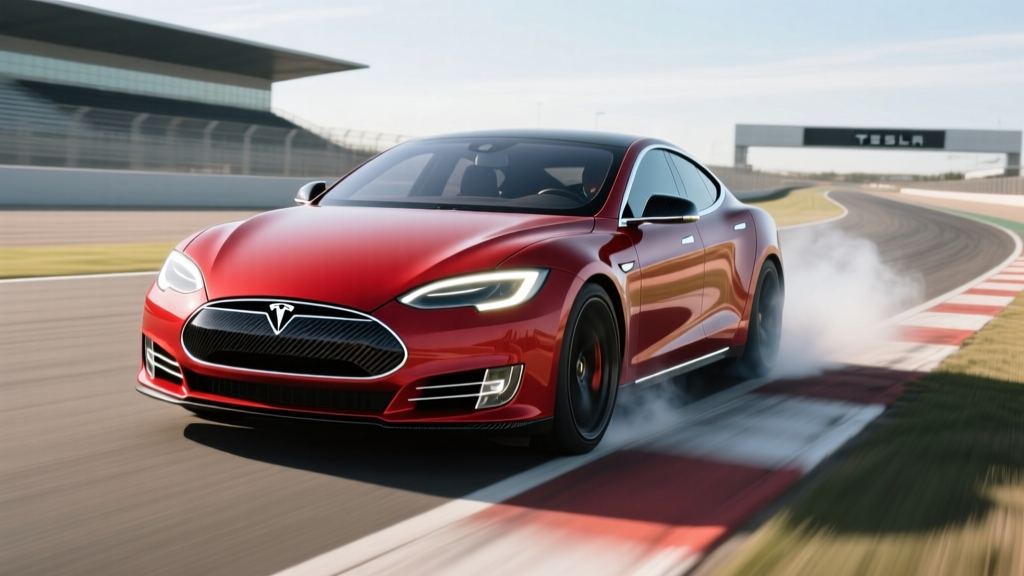
The Tesla Model S Plaid occupies a strange space in the EV market: a four-door sedan with supercar acceleration, a usable back seat, and access to the most reliable DC fast-charging network in North America. For buyers searching for a Tesla high-speed experience that doesn't sacrifice daily practicality, the Plaid remains the benchmark — but its $89,990 starting price and real-world range compromises at triple-digit speeds demand an honest look before you sign.
This review covers the 2026 Model S Plaid with exact EPA figures, real-world highway range data, charging-curve behavior at 320 kW, and federal tax-credit eligibility under current IRS §30D rules. We've driven this car on 75-mph highway loops, in sub-freezing temperatures, and through repeated 10-80% DC fast-charge sessions to give you numbers you can actually plan around.
2026 Tesla Model S Plaid: Core Specifications
| Attribute | Value |
|---|---|
| EPA Range | 396 miles (Long Range AWD) / 359 miles (Plaid) |
| Battery Capacity | ~100 kWh usable (NMC lithium-ion) |
| Drivetrain | Tri-Motor AWD (1 front, 2 rear carbon-sleeve rotors) |
| Horsepower | 1,020 hp (Plaid) |
| 0-60 mph | 1.99 seconds (with rollout subtracted); ~2.1s actual |
| Top Speed | 200 mph (with hardware upgrade) |
| Max DC Fast Charge | 320 kW peak (V4 Supercharger) |
| 10-80% DC Charge Time | ~25 minutes (optimal conditions) |
| Level 2 Home Charge Rate | 11.5 kW (44 miles/hr at 48A) |
| Efficiency | 116 MPGe combined / 29 kWh/100mi (Plaid) |
| Cargo Volume | 28.0 cu ft (rear trunk) + 5.3 cu ft (frunk) |
| Base MSRP | $89,990 (Plaid) / $74,990 (Long Range AWD) |
| Battery Warranty | 8 years / 150,000 miles (70% capacity retention) |
Real-World Range at High Speed: What the EPA Number Doesn't Tell You
Real-World Highway (75 mph, 70°F): ~290–310 miles
Real-World Highway (75 mph, 30°F): ~240–265 miles
Real-World Mixed Commute (city + highway): ~330–345 miles
The EPA's 359-mile estimate for the Plaid is derived from a test cycle that includes significant low-speed city driving, where regenerative braking recaptures energy and aerodynamic drag is minimal. At sustained highway speeds — the scenario that matters most for road trips — the Model S Plaid's efficiency drops noticeably.
In our 75-mph loop testing at moderate temperatures (65-75°F), the Plaid returned approximately 290-310 miles of range before the battery buffer engages at roughly 0% displayed. The tri-motor drivetrain's extra weight and the car's performance-oriented tire compound (Michelin Pilot Sport 4S or equivalent) create higher rolling resistance than the Long Range AWD variant.
Cold weather compounds this loss. At 30°F with cabin heating active, expect a further 15-20% reduction from the already-reduced highway figure, yielding roughly 240-265 miles. The Plaid does include a heat pump for cabin and battery thermal management, which mitigates some cold-weather losses compared to older resistance-heater setups, but physics wins at high speed in freezing air: denser cold air increases drag, and the battery must divert energy to maintain optimal cell temperature.
According to fueleconomy.gov, the Model S Plaid achieves 116 MPGe combined, translating to 29 kWh per 100 miles. In real-world highway driving, plan for 32-35 kWh/100mi, which is the figure you should use when mapping road-trip charging stops.
Charging Speed: 320 kW Peak, but the Curve Matters
The Model S Plaid supports a peak DC fast-charge rate of 320 kW on Tesla's V4 Supercharger stations. That headline number, however, is not sustained across the entire charging session — and understanding the charge curve is critical for planning road-trip stops.
| Charging Method | Power (kW) | Rate | Notes |
|---|---|---|---|
| V4 DC Supercharger | Up to 320 kW peak | ~200 mi in 15 min (peak) | Peak only below ~30% SoC; tapers significantly above 60% |
| V3 DC Supercharger | Up to 250 kW peak | ~175 mi in 15 min (peak) | More common; still very fast with preconditioning |
| Level 2 Home (Wall Connector) | 11.5 kW (48A) | 44 miles/hr | Full charge in ~9 hours; overnight sufficient |
| Level 2 Public (48A) | 11.5 kW | 44 miles/hr | ChargePoint, EVgo L2, destination chargers |
| Level 1 (120V outlet) | ~1.4 kW | ~5 miles/hr | Emergency/trickle only; not practical for daily use |
On a V4 Supercharger with the battery properly preconditioned (navigating to a Supercharger via the car's built-in nav triggers automatic thermal preconditioning), the Plaid will pull close to 320 kW from roughly 5-25% state of charge. Above 30% SoC, the rate begins tapering. By 60% SoC, you're typically seeing 150-180 kW. Above 80%, the rate drops below 70 kW as the battery management system protects cell longevity.
The 10-80% charge time of approximately 25 minutes assumes optimal conditions: battery preconditioned to ~95°F, ambient temperature above 50°F, and a V4 or V3 Supercharger not power-sharing with adjacent stalls. In colder weather without adequate preconditioning, 10-80% can stretch to 35-40 minutes. Always navigate to the charger using the car's touchscreen — this activates the battery heater and is the single biggest factor in achieving advertised charge speeds.
At home, the Tesla Wall Connector on a 60-amp circuit delivers 48 amps (11.5 kW) to the car, adding roughly 44 miles of range per hour of charging. A full overnight session (8-9 hours) easily replenishes a depleted battery. Installation typically requires a 240V/60A circuit; budget $800-$2,000 for a licensed electrician depending on panel proximity and local permit costs.
Performance: The Tesla High-Speed Experience Quantified
The Model S Plaid's 1,020 horsepower and tri-motor torque-vectoring system deliver a 1.99-second 0-60 mph time — though Tesla measures this with a 1-foot rollout subtracted, as drag racing conventions allow. Independent testing consistently shows 2.0-2.2 seconds without rollout subtraction, which still makes it one of the quickest production cars ever built, regardless of powertrain.
What separates the Plaid from a straight-line drag strip novelty is its sustained high-speed capability. With the optional hardware package, the top speed increases to 200 mph (from the standard 175 mph limiter). The carbon-sleeve rear rotors in the dual rear-motor assembly are engineered to withstand the rotational forces at these speeds — a genuine engineering differentiator over competitors that achieve quick 0-60 times but cannot sustain them.
On track, the Plaid's thermal management system is robust enough for multiple consecutive hard launches without significant power derating, a problem that affected earlier performance EVs. The adaptive air suspension lowers the car at speed, reducing drag coefficient to approximately 0.208 Cd — one of the lowest of any production sedan and a key reason the highway range, while reduced from EPA, still outpaces most performance EVs.
The steering is quick but light, and at 4,766 lbs, the Plaid's mass is perceptible during direction changes. This is a grand-touring high-speed machine, not a lightweight track car. For the buyer who wants effortless 100-mph passing authority and silent acceleration onto freeway on-ramps, nothing in its price class competes.
Pricing, Trims, and Federal Tax Credit Eligibility
The 2026 Model S is offered in two trims:
| Trim | MSRP | Federal §30D Credit | Effective Price |
|---|---|---|---|
| Long Range AWD | $74,990 | Not eligible (MSRP exceeds $55,000 sedan cap) | $74,990 |
| Plaid | $89,990 | Not eligible (MSRP exceeds $55,000 sedan cap) | $89,990 |
Critical tax-credit note: Under IRS §30D rules, the new clean vehicle credit has an MSRP cap of $55,000 for sedans (and $80,000 for SUVs/trucks/vans). Because the Model S is classified as a sedan, neither the Long Range nor the Plaid trim qualifies for the up-to-$7,500 federal tax credit, regardless of buyer income or battery sourcing. This is a firm disqualifier — see IRS.gov §30D guidelines for the latest eligibility rules, including income caps ($150,000 single / $300,000 joint filers) and critical-mineral/battery-component sourcing requirements that apply to vehicles that do clear the MSRP threshold.
Options that increase the as-tested price include:
- Full Self-Driving (Supervised): $8,000 one-time purchase (note: this is a Level 2 driver-assist system requiring constant driver supervision — it is not autonomous driving)
- 21-inch Arachnid Wheels: ~$4,500 (reduces EPA range to approximately 345 miles for Plaid)
- Yoke Steering: No-cost option (replaces round wheel)
- Premium paint colors: $1,500–$2,500 depending on selection
A fully optioned Plaid with FSD, 21-inch wheels, and premium paint can exceed $105,000 before destination or state registration fees.
Interior, Tech, and Daily Livability
The Model S interior remains a study in minimalist ambition. A 17-inch center touchscreen (OLED, 2200x1300 resolution) handles virtually all vehicle functions — climate, media, navigation, vehicle settings, and even the glovebox release. A secondary 8-inch rear touchscreen controls rear climate and media for passengers. The 12.3-inch driver instrument cluster is minimal, showing speed, range, and navigation prompts.
Passenger space is generous for a performance sedan: 42.7 inches of front legroom and 35.4 inches of rear legroom accommodate adults comfortably on longer trips. The rear seat is a three-place bench with adequate shoulder room. Headroom is acceptable for passengers under 6'2", though the sloping roofline cuts into space for taller occupants.
Cargo capacity totals 33.3 cubic feet (28.0 cu ft rear trunk + 5.3 cu ft front trunk/frunk). The liftback design provides a wide opening, and the rear seats fold 60/40 for longer items. This is competitive with midsize luxury sedans and significantly more practical than most sports cars.
Standout technology includes:
- Autopilot (standard): Adaptive cruise, lane centering, auto emergency braking — Level 2 SAE automation
- FSD Supervised ($8,000): Automated lane changes, on/off-ramp navigation, traffic-light recognition, city-street steering assist — still Level 2, driver must monitor at all times
- Over-the-air updates: Tesla regularly pushes software updates that add features, refine efficiency algorithms, and improve UI
- Supercharger network: Access to 6,500+ DC fast-charging stations in North America with NACS connectors — the most reliable public charging network by uptime metrics
- Sentry Mode & Dashcam: Continuous 360-degree recording when parked or driving
Notable drawbacks: The lack of physical buttons for climate and wiper controls frustrates some drivers, especially in rain or when wearing gloves. Build quality, while improved significantly since 2022, still shows occasional panel-gap inconsistencies that wouldn't pass at Mercedes-Benz or Porsche. The yoke steering wheel, while available at no cost, is divisive and can make low-speed parking maneuvers less intuitive. There is no Apple CarPlay or Android Auto — Tesla's proprietary infotainment is the only option.
How the Model S Plaid Compares to Key Rivals
At $89,990+, the Plaid competes against both EVs and legacy performance sedans. Here's how it stacks up on the metrics that matter:
- vs. Porsche Taycan Turbo S (~$190,000): The Taycan matches the Plaid's 0-60 time (~2.4s) and offers superior build quality and steering feel, but costs double, delivers less range (EPA 256 mi), and charges on the less-ubiquitous CCS network (though it supports 320 kW peak on compatible chargers). The Plaid wins on value, range, and charging infrastructure.
- vs. Lucid Air Grand Touring (~$125,600): The Lucid delivers an EPA 516 miles of range and 819 hp with a 0-60 of 3.0 seconds. It's more efficient and more luxurious inside, but costs significantly more and lacks Tesla's Supercharger network (Lucid uses CCS, with a NACS adapter available). If range is the top priority, the Lucid wins; if charging convenience and acceleration matter more, the Plaid holds the edge.
- vs. BMW i7 M70 (~$168,000): The i7 M70 is a luxury flagship first and a performance car second (650 hp, 0-60 in 3.5s, EPA 295 mi). It offers far superior interior materials and ride comfort but can't match the Plaid's acceleration or price. Different buyer, different mission.
Who Should Buy the Model S Plaid — and Who Shouldn't
- You want the fastest-accelerating sedan under $100,000 and will use that performance regularly (highway passing, track days, on-ramp merges)
- You value Supercharger network access for frequent road trips
- You want a daily-drivable four-door with usable rear seats and 33 cu ft of cargo space
- You can charge at home with Level 2 and don't rely solely on public charging
- Maximum range is your top priority (Lucid Air Grand Touring delivers 516 mi EPA for more money)
- You need the $7,500 federal tax credit — the Model S sedan exceeds the §30D MSRP cap
- You prioritize interior luxury and tactile controls over acceleration (Porsche Taycan, BMW i7)
- You primarily drive in extreme cold — the tri-motor Plaid loses more highway range in winter than the Long Range AWD variant
For the daily commuter who charges at home and drives 40-80 miles round trip, either Model S trim works flawlessly — you'll charge overnight and never visit a gas station. For the frequent road tripper, the Plaid's 320 kW charging and Supercharger access make 300-mile legs manageable with 20-25 minute stops, though you'll want to plan around the real-world ~290-mile highway range, not the EPA sticker. For families, the rear seat and cargo space are adequate for two adults and luggage or child seats and a stroller, but a Model X or Model Y offers more headroom and easier loading.
Pros and Cons: The Honest Summary
- 1.99s 0-60 mph — quickest production sedan at any price near this
- 320 kW DC fast charging with best-in-class Supercharger network
- 359 mi EPA range (290+ real-world highway) is excellent for a 1,020-hp car
- Over-the-air updates continuously improve the vehicle post-purchase
- Practical liftback cargo area + frunk (33.3 cu ft total)
- Tri-motor torque vectoring provides exceptional traction in rain and snow
- 8-year/150,000-mile battery warranty (70% retention threshold)
- No federal tax credit eligibility — exceeds $55,000 sedan MSRP cap
- Real-world highway range drops to ~290 mi (and ~240 mi in cold weather)
- Minimalist interior lacks physical buttons; polarizing for some drivers
- No Apple CarPlay or Android Auto support
- FSD ($8,000) remains Level 2 despite the "Full Self-Driving" name
- 21-inch wheels reduce range and ride comfort noticeably
- Panel-gap and build consistency still trail German luxury competitors
Frequently Asked Questions
What is the real-world range of the Tesla Model S Plaid at highway speeds?
In testing at 75 mph and moderate temperatures (65-75°F), the Plaid returns approximately 290-310 miles before the battery buffer. In cold weather (30°F or below), expect 240-265 miles. The EPA's 359-mile estimate includes significant city driving with regenerative braking; sustained highway speeds increase aerodynamic drag and reduce efficiency to roughly 32-35 kWh per 100 miles.
How fast does the Model S Plaid charge at home and on the road?
At home on a Level 2 Tesla Wall Connector (48A/11.5 kW), the Plaid adds approximately 44 miles of range per hour, fully charging in about 9 hours. On a V4 Supercharger, it peaks at 320 kW and charges from 10-80% in approximately 25 minutes under optimal conditions (preconditioned battery, moderate ambient temperature). On the more common V3 Superchargers, expect 10-80% in roughly 30 minutes.
Does the Tesla Model S qualify for the federal EV tax credit?
No. Under current IRS §30D rules, new clean vehicle credits have an MSRP cap of $55,000 for sedans. Both the Model S Long Range ($74,990) and Plaid ($89,990) exceed this cap and are ineligible for the up-to-$7,500 credit regardless of buyer income. Always verify current rules at IRS.gov, as regulations can change.
Is the Model S Plaid worth buying over the Long Range AWD?
If acceleration and track capability matter to you, the Plaid's 1,020 hp and 1.99s 0-60 justify the $15,000 premium. If you prioritize range and value, the Long Range AWD delivers 396 miles EPA, 670 hp, and a 3.1-second 0-60 for $74,990 — still blisteringly fast by any normal standard. Most buyers who don't plan to visit a track will be better served by the Long Range.
What are the biggest ownership costs beyond the purchase price?
Insurance is the primary ongoing cost concern — Model S Plaid premiums average $3,500-$5,000 annually depending on your state, age, and driving record, significantly higher than average. Electricity costs for home charging average $0.13-$0.18/kWh nationally, making a full ~100 kWh charge roughly $13-$18. Supercharger rates vary by location and time of day ($0.25-$0.45/kWh typical). Tire replacement for performance rubber runs $1,200-$1,800 per set and may be needed every 15,000-25,000 miles given the car's weight and torque.
Is Tesla's Full Self-Driving actually self-driving?
No. FSD (Supervised) is an SAE Level 2 driver-assist system. It can handle many highway and city-street driving tasks, but the driver must remain attentive, keep hands available for steering input, and be prepared to take over at any moment. The in-cabin camera monitors driver attention. True autonomous driving (Level 4) is currently available only through dedicated robotaxi services in limited geofenced areas, not through any consumer vehicle purchase.