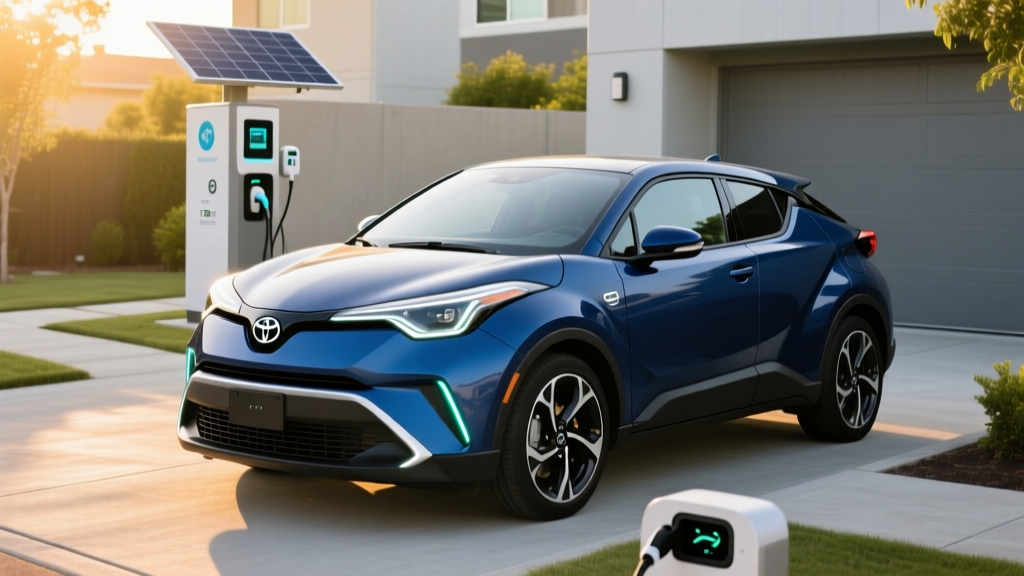
If you're searching for a compact electric crossover that slots below the bZ4X in Toyota's lineup, the Toyota C-HR Electric is the nameplate generating the most curiosity in 2026. Here is the direct answer: as of early 2026, Toyota has not released a battery-electric C-HR for the U.S. market. The C-HR was discontinued in North America after the 2022 model year, and the global "C-HR EV" shown in concept form remains unreleased and unpriced for American buyers. If you want a Toyota EV in this size class today, your real options are the bZ4X (EPA 252 mi, ~$37,070 base) or the hybrid Prius/Prius Prime. Below, we break down what a C-HR Electric would need to deliver to compete, what the actual Toyota EV lineup costs to own, and how to decide if an EV in this segment makes sense for you.
What the C-HR Electric Actually Is (and Isn't) in 2026
The original Toyota C-HR was a subcompact gas crossover sold in the U.S. from 2018 through 2022. Toyota retired it here in favor of the Corolla Cross. Overseas, a second-generation C-HR launched in Europe with hybrid and plug-in hybrid powertrains, and Toyota has teased electric SUV concepts in the compact segment. However, no production C-HR Electric with U.S. EPA certification, MSRP, or dealer availability exists as of this writing.
Closest Real Alternative: 2026 Toyota bZ4X Specs
Since the C-HR Electric isn't available, the bZ4X is Toyota's current electric offering and the most relevant comparison point. Here are the exact numbers from fueleconomy.gov and Toyota's U.S. spec sheets:
| Spec | Value |
|---|---|
| EPA Range | 252 miles |
| Battery (usable) | 71.4 kWh, NMC lithium-ion |
| Efficiency | 131 MPGe combined (25 kWh/100 mi) |
| Peak DC Fast Charge | 150 kW (CCS1) |
| 10–80% DC Fast Charge | ~30 minutes |
| Level 2 Charge Rate | 7.2 kW (~6.5 hours, 0–100%) |
| Motor Output | 201 hp / 196 lb-ft torque |
| 0–60 mph | 7.1 seconds |
| Base MSRP (XLE FWD) | $37,070 |
| Battery Warranty | 8 years / 100,000 miles |
EV vs Gas vs Hybrid: Real Cost Comparison
Buyers cross-shopping a theoretical C-HR Electric are often deciding between EV, hybrid, and gas. Here's a concrete 5-year cost comparison using the bZ4X (EV), Prius Prime (PHEV), and Corolla Cross (gas) as stand-ins, assuming 15,000 miles/year, $3.50/gallon gas, and $0.14/kWh home electricity:
| Vehicle | Purchase (MSRP) | Fuel/Energy | Maintenance | Est. Insurance (5yr) | Total 5-Yr |
|---|---|---|---|---|---|
| Toyota bZ4X XLE (EV) | $37,070 | $3,150 | $1,200 | $8,500 | $49,920 |
| Toyota Prius Prime SE (PHEV) | $33,445 | $3,800 | $1,800 | $7,200 | $46,245 |
| Toyota Corolla Cross XLE (Gas) | $30,290 | $7,875 | $2,500 | $7,000 | $47,665 |
The EV wins on energy and maintenance cost but loses ground on the higher purchase price and elevated insurance premiums (EV insurance averages 15–25% higher than equivalent gas models). If you qualify for the full federal tax credit, the bZ4X effective price drops, narrowing the gap substantially.
Federal Tax Credit: What Actually Applies
The IRS §30D Clean Vehicle Credit can reduce your federal tax liability by up to $7,500 — but eligibility depends on several rules that change frequently. As of 2026, key requirements include:
- MSRP Cap: SUVs/crossovers must be under $80,000; sedans under $55,000
- Buyer Income Cap: AGI ≤ $150,000 (single) / $300,000 (joint)
- Battery Sourcing: Critical minerals and battery components must meet phased-in percentages from U.S. or FTA-partner countries
- Point-of-Sale Transfer: You can apply the credit as a down-payment reduction at the dealer (effective 2024 onward)
The bZ4X's battery sourcing has historically limited its credit eligibility. Always verify current status on irs.gov or ask the dealer for the IRS-qualified vehicle listing before signing. Never assume a flat $7,500 — the actual credit could be $3,750, $7,500, or $0 depending on sourcing compliance and your income.
Real-World Ownership: What First-Time EV Buyers Miss
If you've never owned an EV, here are the practical realities that spec sheets don't highlight:
Home Charging Is Non-Negotiable for Most Owners
Over 80% of EV charging happens at home. A Level 2 home charger (240V, 32–48A) adds roughly 25–35 miles of range per hour and costs $500–$2,500 installed depending on your panel capacity and wiring run. If you live in an apartment without charging access or park on the street, EV ownership becomes significantly more inconvenient — public DC fast charging costs 2–3× more per kWh than home electricity.
Cold Weather Cuts Range 15–30%
The bZ4X does not include a heat pump on all trims (standard on AWD models). In sustained temperatures below 32°F, expect range to drop to 170–210 miles from a full charge. Preconditioning the battery while plugged in mitigates this but requires planning.
Charging Speed ≠ Peak kW
The bZ4X peaks at 150 kW but sustains that rate only briefly. The 10–80% charge takes ~30 minutes — slower than Hyundai/Kia's E-GMP platform (which does 10–80% in ~18 minutes at 240 kW peak). On road trips, this adds 10–15 minutes per stop.
Decision Framework: Should You Wait, Buy EV, or Go Hybrid?
- You have Level 2 home charging and drive <200 miles/day
- You qualify for the §30D credit, reducing effective price below $30,000
- You want zero tailpipe emissions and minimal maintenance
- You lack reliable home charging or frequently drive 300+ miles
- You want 44 miles of electric-only range for commuting plus gas flexibility
- You want lower upfront cost (~$33,445) with 48 MPG combined when the battery depletes
- You live in a charging desert or apartment without any charging access
- Your budget is strictly under $30,000 and you can't wait for credit eligibility
- You tow or carry heavy loads regularly (EV range drops sharply under load)
Common Misconceptions About Compact EVs
| Myth | Fact |
|---|---|
| "EV batteries need replacing every 5 years" | Modern NMC/LFP packs are warrantied for 8 years/100,000 miles with ≥70% capacity retention. Real-world degradation averages 10–15% over 8 years. |
| "Charging takes too long for road trips" | 10–80% in 30 minutes (bZ4X) or 18 minutes (Hyundai/Kia). Plan 2–3 stops on a 600-mile trip — comparable to rest stops on a gas drive. |
| "EVs cost more to own overall" | Over 5 years, EVs save $2,000–$4,000 in fuel/maintenance — but only if you charge at home. Public-only charging can erase savings. |
| "The C-HR Electric is available now" | No U.S.-spec C-HR EV exists. The nameplate was retired in North America in 2022; Toyota's current compact EV is the bZ4X. |
Frequently Asked Questions
Will Toyota ever sell a C-HR Electric in the U.S.?
Toyota has not announced a U.S.-spec C-HR EV. The brand is expanding its bZ series and has committed to multiple EV launches by 2028, but a subcompact electric crossover under the C-HR name remains unconfirmed. Monitor Toyota's U.S. newsroom for official announcements.
What's the cheapest Toyota EV I can buy today?
The 2026 Toyota bZ4X XLE FWD starts at $37,070 before incentives. After a potential $7,500 federal credit (if eligible), the effective price can drop to ~$29,570 — competitive with the gas Corolla Cross over 5 years of ownership.
Is a PHEV like the Prius Prime a better choice than a full EV?
It depends on your charging access and driving pattern. If you can charge at home nightly and drive under 44 miles/day, the Prius Prime runs on electricity almost exclusively. For road trips, you have the gas engine as backup with no range anxiety. The trade-off: you still need oil changes and have a more complex powertrain.
How much does it cost to charge a bZ4X at home?
A full 0–100% charge on a 71.4 kWh battery at $0.14/kWh costs approximately $10.00. That delivers ~252 EPA miles, or roughly $0.04 per mile — compared to $0.12–$0.15 per mile for a 30 MPG gas car at $3.50/gallon.
What should I check before buying any EV?
Verify: (1) your home electrical panel can support a 240V/40A circuit for Level 2 charging, (2) your daily and weekly driving patterns fit within 80% of the EPA range (leaving a cold-weather buffer), (3) current IRS §30D eligibility for the specific VIN you're purchasing, and (4) your insurance quote — EV premiums can be 15–25% higher.