Quick Verdict: Still the Performance Sedan Benchmark
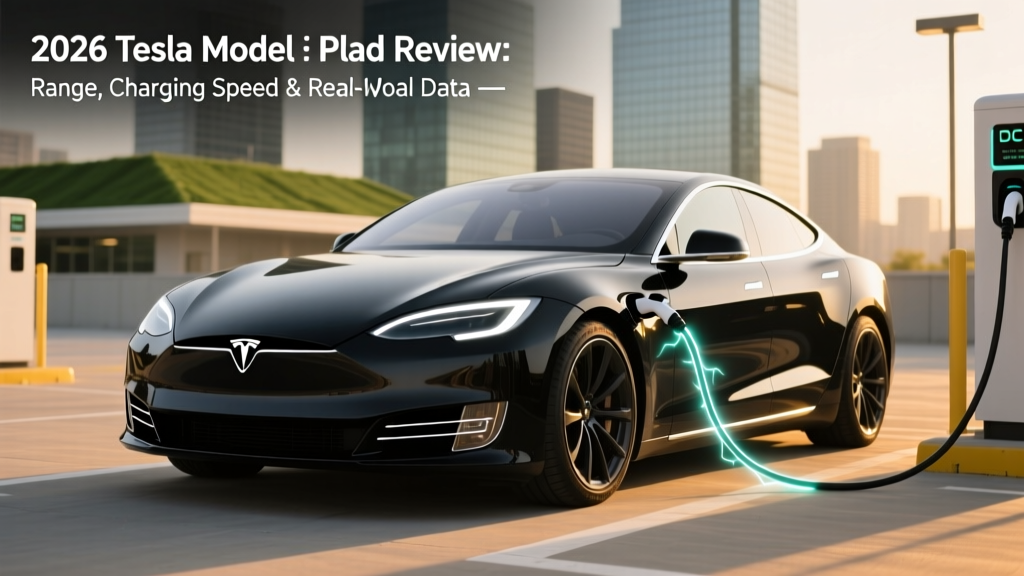
The 2026 Tesla Model S Plaid remains the fastest-accelerating production sedan you can buy, but its value proposition has shifted. With the Lucid Air Sapphire undercutting its luxury quotient and the Porsche Taycan Turbo GT matching its track credentials, the Plaid now competes on the strength of the Supercharger network, over-the-air updates, and a starting price that undercuts most rivals. For 2026, Tesla has refreshed the interior materials and bumped battery efficiency, but the tri-motor powertrain and 1,020-horsepower output carry over. The question isn't whether it's fast — it's whether the compromises in ride quality, panel fit, and service accessibility are worth the performance per dollar.
| Spec | 2026 Tesla Model S Plaid |
|---|---|
| EPA Range | 396 miles |
| Battery (Usable) | ~95 kWh, NMC (nickel-manganese-cobalt) |
| Drivetrain | Tri-motor AWD (1 front, 2 rear) |
| Horsepower | 1,020 hp |
| 0–60 mph | 1.99 seconds (with rollout subtracted) |
| Top Speed | 200 mph |
| Peak DC Fast Charge | 250 kW |
| 10–80% DC Time | ~27 minutes |
| Level 2 Home Charge | 11.5 kW (~41 mi/hr) |
| Efficiency | 120 MPGe combined (28 kWh/100 mi) |
| Cargo Volume | 28.0 cu ft (rear) + 3.1 cu ft (frunk) |
| Rear Legroom | 35.4 inches |
| Base MSRP | $89,990 (before destination) |
| Battery Warranty | 8 years / 150,000 miles (70% retention) |
Range and Efficiency: EPA vs. Reality
The EPA rates the 2026 Model S Plaid at 396 miles on a full charge. That's the combined cycle figure; expect slightly higher on the city loop thanks to aggressive regenerative braking and lower on highway runs where aerodynamic drag dominates at 75+ mph.
Real-World Range Expectations
- Highway (70 mph, mild weather): ~320–340 miles
- City/commute (stop-and-go, regen-heavy): ~370–390 miles
- Cold weather (below 32°F, highway): ~250–280 miles
- Cold weather with preconditioning: ~290–310 miles
The Plaid's tri-motor setup and performance tires (standard 21-inch Arachnids) add rolling resistance compared to the Long Range variant, which is rated at 402 miles. You're trading about 6 miles of range for 350+ additional horsepower.
Efficiency lands at 120 MPGe combined, or 28 kWh per 100 miles. That's competitive with the Lucid Air Grand Touring (131 MPGe) but trails the BMW i7 eDrive50 (134 MPGe). On a road trip, plan for a Supercharger stop every 250–280 miles if you want to keep the battery above 15% for longevity and avoid the slowest portion of the charge curve.
Charging Speed: Supercharger Network Advantage
Tesla's V3 Superchargers deliver a peak of 250 kW to the Model S Plaid. The 10–80% charge takes approximately 27 minutes under ideal thermal conditions — meaning the battery has been preconditioned via the navigation system routing you to the charger. Without preconditioning, especially in cold weather, expect that time to stretch to 35–40 minutes as the battery warms to optimal charging temperature.
| Charging Method | Power | Miles Added per Hour | Notes |
|---|---|---|---|
| Level 1 (120V outlet) | 1.4 kW | ~5 mi/hr | Emergency/trickle only |
| Level 2 (240V, 48A) | 11.5 kW | ~41 mi/hr | Full charge in ~9 hours |
| DC Fast (V3 Supercharger) | 250 kW peak | ~1,000 mi/hr at peak | 10–80% in ~27 min |
| DC Fast (CCS adapter, Electrify America) | Up to 150–250 kW | Varies by station | Requires $250 CCS adapter |
The charge curve tapers significantly above 80%. Going from 80% to 100% at a Supercharger can add another 25–30 minutes, making it impractical for road trips. Plan to charge to 80% and move on. For daily use, Tesla recommends setting the charge limit to 80% (or 90% for NMC chemistry to balance cell voltage periodically), reserving 100% charges for road trips.
Home charging with a Tesla Wall Connector (hardwired, 60A circuit) delivers the full 11.5 kW, adding roughly 41 miles of range per hour. A full overnight charge from 20% to 90% takes about 6 hours — more than adequate for daily use. Installation costs typically range from $500–$1,500 depending on panel proximity and local permit fees. A 200-amp panel is usually sufficient; older homes with 100-amp service may need an upgrade ($1,500–$3,000).
Performance: 1.99 Seconds Changes Your Perception of Physics
The tri-motor layout — one motor on the front axle, two on the rear — produces 1,020 horsepower and enables the claimed 1.99-second 0–60 mph time. Tesla's rollout-subtraction methodology (omitting the first 12 inches of movement, as drag racing timing does) inflates the figure slightly compared to some competitors' measurements, but independent testing by outlets like Motor Trend has confirmed sub-2.1-second runs consistently.
Beyond the headline number, the Plaid's torque vectoring across the rear axle provides exceptional corner-exit grip. The carbon-sleeved rotors (standard on 2025+ models) resist fade during repeated hard launches — a weakness of earlier Plaid builds. The yoke steering remains controversial; a round wheel is now a no-cost option, and most buyers should take it for daily driving comfort.
Track mode adjusts suspension damping, torque split, and stability control thresholds. On a road course, the Plaid is genuinely capable — but it's a heavy sedan (4,766 lbs), and tire wear during track use is aggressive. Budget for a set of Michelin Pilot Sport 4S tires ($1,600–$2,000 mounted) every 8,000–10,000 miles if you track regularly.
Interior, Tech, and Daily Livability
The 2026 refresh addresses longstanding complaints about interior material quality. Ventilated front seats, real aluminum trim, and improved sound deadening narrow the gap with the Mercedes EQS and Lucid Air. The 17-inch center touchscreen runs Tesla's latest UI, which is fast and feature-rich but still lacks Apple CarPlay and Android Auto — a dealbreaker for some buyers in this price range.
Cargo and passenger space: The liftback design yields 28.0 cubic feet behind the rear seats (expandable to 79.3 cu ft with seats folded) plus a 3.1 cu ft frunk. Rear legroom is 35.4 inches — adequate for adults on shorter trips but tight for six-footers on long hauls. The panoramic glass roof creates an airy feel but contributes to cabin heat in summer; the tint helps but doesn't eliminate the need for a sunshade in hot climates.
Driver assistance: Basic Autopilot (adaptive cruise, lane centering) is standard. Full Self-Driving (Supervised) is a $8,000 option or $99/month subscription. FSD remains an SAE Level 2 system — you must keep your hands on the wheel and eyes on the road. It handles highway interchanges and some city streets competently but is not autonomous. Tesla's camera-only vision stack occasionally struggles with construction zones, faded lane markings, and heavy rain.
Pricing, Tax Credits, and Total Cost
The 2026 Model S Plaid starts at $89,990 (plus $1,390 destination). Common options include:
- FSD (Supervised): $8,000 or $99/month
- Red Multi-Coat paint: $2,500
- 21-inch Arachnid wheels: included (no no-cost alternative currently offered)
- Yoke or round steering wheel: no-cost choice
A typical as-tested configuration — Plaid with FSD and premium paint — lands around $100,480.
Federal Tax Credit Eligibility (§30D)
| Requirement | 2026 Rule | Model S Plaid Status |
|---|---|---|
| MSRP Cap (sedans) | ≤ $55,000 | ❌ Exceeds cap ($89,990) |
| Buyer Income Cap (joint) | ≤ $300,000 AGI | N/A — MSRP disqualifies |
| Battery Component Sourcing | North America assembly | N/A — MSRP disqualifies |
| Critical Minerals Sourcing | FTA country or US | N/A — MSRP disqualifies |
Verdict: The Model S Plaid does not qualify for the $7,500 federal EV tax credit under IRS §30D rules. The $55,000 MSRP cap for sedans is the disqualifying factor. No state incentives are affected by this — check your local DMV or energy office for state-level rebates, which may still apply regardless of MSRP.
Five-year ownership cost estimate: Assuming 12,000 miles/year, $0.14/kWh home charging, and no major repairs under warranty, total fuel (electricity) cost is approximately $5,200 over five years. Compare that to a BMW M5 (~$18,500 in fuel at $3.70/gallon and 16 mpg combined). Insurance runs $3,200–$4,500/year depending on location and driving record — get quotes before purchasing. Depreciation is steeper than the Long Range variant; expect ~45–50% value retention at 5 years based on historical Plaid data.
Competitor Comparison: Plaid vs. Lucid Air Sapphire vs. Taycan Turbo GT
| Spec | 2026 Tesla Model S Plaid | 2026 Lucid Air Sapphire | 2026 Porsche Taycan Turbo GT |
|---|---|---|---|
| Price | $89,990 | $249,000 | $230,000 |
| Horsepower | 1,020 hp | 1,234 hp | 1,019 hp |
| 0–60 mph | 1.99 sec | 1.89 sec | 2.1 sec |
| EPA Range | 396 mi | 427 mi | 269 mi |
| DC Fast Charge Peak | 250 kW | 300 kW | 320 kW |
| Charging Network | Supercharger (NACS native) | CCS + NACS adapter | CCS + NACS adapter |
| Federal Tax Credit | ❌ | ❌ | ❌ |
The Plaid wins on price-to-performance ratio by a wide margin. The Sapphire is the better luxury car and the faster track weapon, but it costs nearly three times as much. The Taycan Turbo GT offers superior build quality and steering feel but sacrifices 127 miles of range. If your priority is straight-line performance per dollar and Supercharger access, the Plaid has no equal. If you want build quality and exclusivity, look to Porsche or Lucid.
Pros, Cons, and Who Should Buy
Pros
- Sub-2-second 0–60 with usable daily drivability
- Supercharger network access (native NACS, no adapter needed)
- Over-the-air updates continuously add features
- Class-leading range for a 1,000+ hp vehicle
- Liftback cargo practicality (28 cu ft + frunk)
- 8-year/150,000-mile battery warranty
Cons
- No federal tax credit (MSRP cap)
- 250 kW peak charge rate trails 800V competitors (300–320 kW)
- Yoke steering polarizing; round wheel now optional
- No Apple CarPlay or Android Auto
- Panel fit and service center wait times remain inconsistent
- High insurance premiums ($3,200–$4,500/yr)
- 21-inch performance tires wear quickly (~8,000–10,000 mi)
Best for: Performance enthusiasts who want supercar acceleration with sedan practicality, Supercharger road-trip capability, and a sub-$100K entry price. The Plaid works as a daily driver for commuters with home charging, a weekend track car, and a cross-country tourer — if you accept the service-network trade-offs.
Not ideal for: Buyers prioritizing interior luxury, quiet highway cruising, or maximum charging speed. If you regularly drive 400+ mile highway stretches in cold climates, the Lucid Air Grand Touring (427 mi EPA, 300 kW charging) is the better tool. If you want a traditional luxury dealership experience with white-glove service, Porsche or Mercedes will serve you better.
Frequently Asked Questions
What is the real-world range of the 2026 Tesla Model S Plaid?
Expect 320–340 miles on the highway in mild weather, 370–390 miles in city driving, and 250–280 miles in cold weather (below 32°F) on the highway. Preconditioning the battery via navigation routing recovers about 20–30 miles of cold-weather range.
How fast does the Model S Plaid charge at home and on the road?
At home on a 240V/48A Wall Connector, it charges at 11.5 kW, adding about 41 miles per hour (full charge in ~9 hours). On a V3 Supercharger, it peaks at 250 kW and charges 10–80% in approximately 27 minutes with preconditioning. Above 80%, the charge rate tapers significantly.
Does the 2026 Model S Plaid qualify for the federal EV tax credit?
No. Under IRS §30D, sedans must have an MSRP of $55,000 or less to qualify. The Plaid's $89,990 starting price disqualifies it regardless of battery sourcing or buyer income. Check your state for separate incentives that may not have MSRP caps.
Is the Plaid worth buying over the Lucid Air Sapphire or Porsche Taycan Turbo GT?
If price-to-performance is your priority, yes — the Plaid delivers 95% of the Sapphire's performance at 36% of the price. If you value luxury materials, build quality, or 300+ kW charging speeds, the Sapphire or Taycan are superior but cost $140K–$160K more.
How long will the Plaid's battery last, and what does replacement cost?
Tesla warranties the battery for 8 years or 150,000 miles, whichever comes first, with a minimum 70% capacity retention threshold. Real-world degradation data from older Model S packs suggests 10–15% loss over 100,000 miles. A full battery replacement out of warranty costs approximately $20,000–$25,000 at current Tesla service pricing, though individual module repairs can be less.
Is FSD (Supervised) worth the $8,000 option?
FSD handles highway driving, lane changes, and some city navigation competently, but it remains an SAE Level 2 system requiring constant driver supervision. It does not make the car autonomous. For most buyers, the $99/month subscription is a better way to evaluate it before committing $8,000. Basic Autopilot (included) covers adaptive cruise and lane centering adequately for highway commuting.