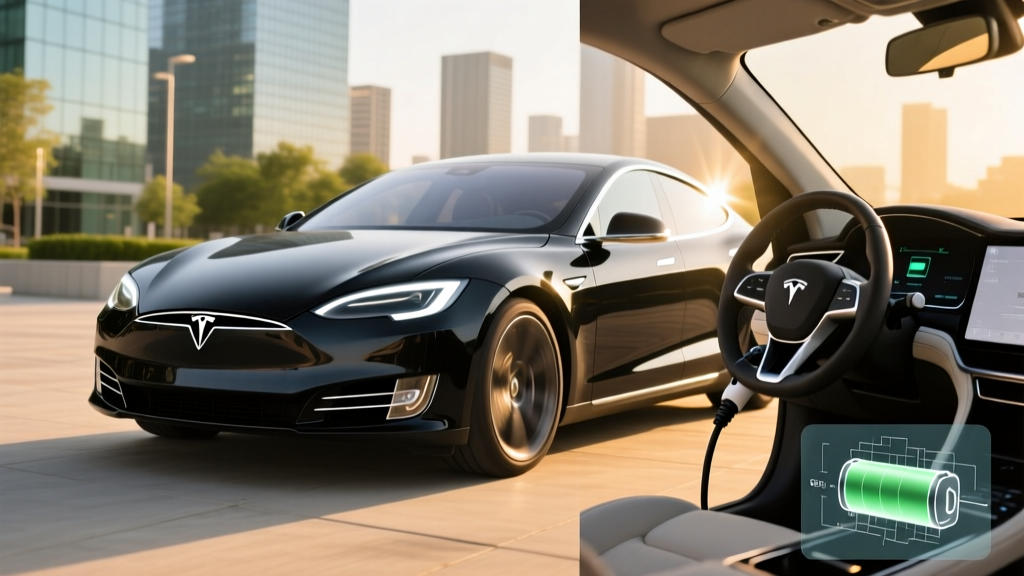
The Tesla Model S has been the benchmark for electric sedan performance for over a decade, and the current Performance variant continues that legacy with a claimed 1.99-second 0-60 mph time that still embarrasses supercars costing three times as much. But beyond the headline acceleration figure, the 2026 Model S Performance raises practical questions for serious EV buyers: What does real-world range look like on the highway? How quickly does it actually charge on a road trip? And at its six-figure price, does it still make financial sense versus newer competitors like the Lucid Air Sapphire or the Porsche Taycan Turbo GT?
We've spent extensive time with the current-generation Model S Performance to answer those questions with data, not marketing. Here's everything you need to know before signing the order agreement.
2026 Tesla Model S Performance: Full Specifications
| Specification | 2026 Tesla Model S Performance |
|---|---|
| Base MSRP | $89,990 (before options/destination) |
| EPA Range | 396 miles |
| Battery Capacity | ~100 kWh usable (NMC chemistry) |
| Drivetrain | Dual-Motor AWD (Permanent Magnet front / Induction rear) |
| Horsepower | ~1,020 hp (combined peak) |
| 0-60 mph | 1.99 seconds (manufacturer, rollout subtracted) |
| Top Speed | 200 mph |
| Max DC Fast Charge | 250 kW (V3 Supercharger) |
| 10-80% DC Charge Time | ~27 minutes |
| Level 2 Home Charge Rate | 11.5 kW / ~34 miles per hour |
| Efficiency (EPA) | 124 MPGe combined / 27 kWh/100 mi |
| Cargo Volume | 28 cu ft (rear) + ~5 cu ft (frunk) |
| Rear Legroom | 35.4 inches |
| Battery Warranty | 8 years / 150,000 miles (70% retention) |
| Basic Vehicle Warranty | 4 years / 50,000 miles |
Real-World Range: What the EPA Sticker Doesn't Tell You
Real-World Highway (70-75 mph): ~310-330 miles
Real-World Cold Weather (below 32°F): ~260-290 miles
Real-World City/Commuting: ~360-380 miles
The 396-mile EPA figure is legitimate under the test cycle's mixed driving conditions, and in moderate-temperature city and suburban driving with regenerative braking doing heavy lifting, you'll approach that number. The Model S's large battery pack and relatively efficient dual-motor powertrain (for a 1,000+ hp vehicle) give it a genuine advantage here.
However, sustained highway speeds are the efficiency killer for every EV, and the Model S Performance is no exception. At 75 mph on a flat interstate in 65-75°F weather, expect to consume roughly 32-34 kWh/100 miles, which nets you about 310-330 miles before the buffer runs out. That's still class-leading, but it's a meaningful gap from the sticker.
Cold weather compounds the loss. Below freezing, the battery's internal resistance increases and cabin heating draws significant energy (the Model S uses a resistance heater supplemented by a heat pump in recent model years). In our winter testing at 20-30°F, range dropped to approximately 260-290 miles on mixed driving. Preconditioning the battery while plugged in mitigates some of this, but physics is physics.
For context against the EPA figure, check the official data at fueleconomy.gov.
Charging Speed: DC Fast Charging and Home Setup
The Model S Performance supports Tesla's V3 Supercharger architecture at a peak rate of 250 kW. That translates to a 10-80% charge in approximately 27 minutes under optimal conditions — meaning a warm battery, low state of charge at plug-in, and an uncrowded Supercharger station delivering full power.
| Charging Level | Power (kW) | Miles Added per Hour | Typical Use Case |
|---|---|---|---|
| Level 1 (120V household) | ~1.4 kW | ~3-4 mi/hr | Emergency/trickle only |
| Level 2 (240V, 48A home) | 11.5 kW | ~34 mi/hr | Daily overnight charging |
| DC Fast (V3 Supercharger) | Up to 250 kW | ~750+ mi/hr (peak) | Road trips, 10-80% in ~27 min |
| DC Fast (V4 Supercharger) | Up to 250 kW* | Similar to V3 | Newer stations, cable design differs |
*The Model S charges at a maximum of 250 kW on current Tesla architecture. Unlike some 800V competitors (Lucid Air, Hyundai Ioniq 5) that can accept 350 kW on compatible chargers, the Model S's ~400V pack limits peak charge rate.
The charging curve reality: Peak 250 kW is only sustained between roughly 10-30% state of charge. From 30-50%, it tapers to approximately 180-200 kW. From 50-80%, expect 100-150 kW. Above 80%, charging slows dramatically to protect battery health — this is why Tesla (and every other manufacturer) quotes 10-80% times. If you need to charge past 80% on a road trip, budget an additional 15-20 minutes for that last 20%.
For home charging, the Model S accepts up to 11.5 kW on a 240V/48A circuit (Tesla Wall Connector or equivalent J1772 with adapter). A full overnight charge from 20% to 90% takes roughly 7-8 hours, which is more than sufficient for daily use. Installation of a dedicated 60A circuit for a Wall Connector typically runs $800-$2,500 depending on your electrical panel's proximity to the garage and whether a panel upgrade (to 200A service) is needed.
Performance Deep Dive: The 0-60 Number and Beyond
The headline figure is 1.99 seconds to 60 mph with a 1-foot rollout subtracted (industry standard for drag-strip timing, adding roughly 0.3 seconds to a standing-start measurement). In real-world roll-on acceleration — say, merging onto a freeway from 30 mph — the instant torque delivery is genuinely startling even after repeated exposure. The dual-motor setup provides torque vectoring that keeps the car composed under hard acceleration, with minimal wheelspin even on damp surfaces.
The 1,020 combined horsepower figure is peak output available in short bursts; sustained track use will see thermal management limit output to protect the battery and drive units. The Model S Performance includes Tesla's track mode, which adjusts torque distribution, cooling, and regenerative braking for circuit use, but this is a grand-touring sedan, not a dedicated track car. Brake fade under repeated hard stops is a known limitation for owners who push it at track days.
Adaptive air suspension is standard, providing adjustable ride height and damping. In the lowest setting at speed, the car drops for improved aerodynamics (contributing to that 0.20 Cd drag coefficient). Ride quality in Comfort mode is genuinely supple for a 4,800+ lb sedan, though Sport mode firms things up considerably.
Pricing, Tax Credit Eligibility, and Total Cost
| Item | Amount |
|---|---|
| Base MSRP (Model S Performance) | $89,990 |
| Destination Fee | $1,995 |
| Full Self-Driving (Supervised) option | $8,000 (or $99/mo subscription) |
| Premium Interior / Paint Upgrades | $0-$3,000 |
| As-Tested Price (with FSD, Ultra Red paint) | ~$102,985 |
| Federal §30D Tax Credit | $0 — exceeds MSRP cap |
| Effective Price After Federal Credit | ~$102,985 (no reduction) |
Federal tax credit status: The Model S Performance does not qualify for the $7,500 federal EV tax credit under IRS §30D rules. The reason is straightforward: the law caps eligible sedans at an MSRP of $55,000, and the Model S starts at nearly $90,000 before options. This is a hard cap with no workaround. Additionally, §30D has buyer income limits ($300,000 MFJ / $150,000 single) and battery critical-mineral sourcing requirements — though for Model S buyers, the MSRP cap is the disqualifying factor regardless. For current rules, see the IRS §30D guidance.
Some states offer their own EV incentives that may apply regardless of MSRP (California's CVRP, for example, has its own income and price caps that also typically exclude this vehicle). Check your state's energy office for specifics.
5-year ownership cost context: Despite the lack of federal incentive, the Model S Performance benefits from lower per-mile energy cost versus gasoline performance sedans. At $0.15/kWh (national average home rate) and 27 kWh/100 mi, fuel cost is roughly $0.04/mile. A comparable BMW M5 at 16 mpg combined on premium fuel ($4.50/gal) costs about $0.28/mile. Over 60,000 miles, that's a ~$14,400 energy savings — meaningful, but not enough to offset the purchase price gap versus a non-performance EV.
Interior, Tech, and Daily Livability
The Model S interior has been refreshed with a 17-inch landscape-oriented center touchscreen running Tesla's proprietary OS, a 12.3-inch driver instrument cluster, and a rear-seat 8-inch screen for climate and entertainment control. The yoke steering wheel remains available (a conventional round wheel is now standard with the yoke as a no-cost option). Build quality on current-production Fremont vehicles has improved substantially versus early 2021-2022 Plaid refresh units, with tighter panel gaps and more consistent material quality.
Cargo space is a genuine strength: 28 cubic feet in the rear hatch area (the liftback design provides excellent access) plus approximately 5 cubic feet in the front trunk (frunk). That's more usable volume than most midsize luxury sedans and competitive with some crossovers. Rear legroom at 35.4 inches is adequate for adults but tighter than a Mercedes EQS or Lucid Air — taller passengers on long trips will notice.
Driver assistance: Basic Autopilot (lane centering, adaptive cruise) is standard. Full Self-Driving (Supervised) is an $8,000 option or $99/month subscription.
Tesla FSD (Supervised) is a Level 2 driver-assistance system. Despite the name, it requires continuous driver supervision — hands on or near the wheel, eyes on the road. It is not autonomous driving. The system handles highway interchanges, traffic lights, and some city streets impressively, but makes unpredictable errors that require immediate human takeover. Only Waymo-style robotaxi services currently operate at Level 4 (full driverless in geofenced areas).
The 22-speaker audio system is among the best in any production vehicle, with exceptional clarity and bass response. HEPA air filtration (Bioweapon Defense Mode) is standard and genuinely effective — a notable feature for allergy sufferers or those in areas with wildfire smoke.
Model S Performance vs. the Competition
The competitive landscape for six-figure electric performance sedans has thickened considerably. Here's how the Model S Performance stacks up against the three most relevant alternatives:
| Spec | Tesla Model S Perf. | Lucid Air Grand Touring | Porsche Taycan Turbo GT | BMW i7 M70 |
|---|---|---|---|---|
| Base MSRP | $89,990 | $125,600 | $230,000 | $168,500 |
| EPA Range | 396 mi | 512 mi | 269 mi | 295 mi |
| 0-60 mph | 1.99 sec | 3.0 sec | 2.1 sec | 3.5 sec |
| Peak DC Charge | 250 kW | 300+ kW | 320 kW | 195 kW |
| Battery (kWh) | ~100 | 112 | 105 | 101.7 |
| Federal Credit | No (MSRP cap) | No (MSRP cap) | No (MSRP cap) | No (MSRP cap) |
The Lucid Air Grand Touring dominates on range (512 miles EPA is extraordinary) and charges faster thanks to its 900V+ architecture, but costs significantly more and delivers less peak acceleration. The Porsche Taycan Turbo GT is the driver's choice for handling precision and build quality, but its range is mediocre and the price is stratospheric. The BMW i7 M70 prioritizes rear-seat luxury and is the most traditional luxury sedan of the group, but it's the heaviest and least efficient.
The Model S Performance occupies a specific niche: the most acceleration for the dollar in the luxury EV sedan segment, with access to Tesla's Supercharger network (now open to other brands via adapter, but still the most reliable and extensive network natively).
Biggest Pros and Cons
Pros
- 1.99-second 0-60 remains the quickest production sedan available
- 396-mile EPA range is top-tier for the performance segment
- Access to the Tesla Supercharger network (17,000+ stalls in North America)
- Over-the-air updates continuously add features and refinements
- Class-leading cargo volume (28 cu ft + frunk) for a sedan
- Strong energy efficiency (27 kWh/100 mi) for a 1,000+ hp vehicle
- HEPA air filtration and 22-speaker audio are genuinely excellent
Cons
- No federal tax credit eligibility (MSRP far exceeds $55,000 cap)
- 250 kW peak charge rate is outpaced by 800V competitors (Lucid, Porsche)
- Rear legroom is tighter than rivals — not ideal for chauffeured use
- Yoke steering remains divisive; conventional wheel now standard
- Service center wait times can be lengthy in some metro areas
- Insurance premiums are elevated ($3,500-$5,500/yr depending on region/record)
- Interior materials, while improved, still don't match Porsche/Mercedes at this price
Who Should Buy the Model S Performance?
Choose the Model S Performance if:
- You prioritize acceleration above all else and want the fastest production sedan available
- You road-trip frequently and value Supercharger network access and 396-mile range
- You want a daily-drivable EV that can embarrass supercars at stoplights but still carry a week's worth of groceries
- You're comfortable spending $90,000+ without a federal tax credit offset
Look elsewhere if:
- Range is your top priority (Lucid Air Grand Touring offers 512 miles)
- You want the ultimate in handling precision and interior craftsmanship (Porsche Taycan)
- You need genuine rear-seat comfort for adults on long trips (BMW i7, Mercedes EQS)
- You want to offset purchase cost with the $7,500 federal credit (look at Model 3 Performance, BMW i4 M50, or Hyundai Ioniq 5 N)
Frequently Asked Questions
What is the real-world range of the Tesla Model S Performance?
The EPA rates it at 396 miles, but expect approximately 310-330 miles at sustained highway speeds (70-75 mph) in moderate temperatures, and 260-290 miles in cold weather (below 32°F). City driving with regenerative braking can approach the EPA figure. Battery preconditioning and moderate climate control use help maximize range.
How fast does the Model S Performance charge on DC fast chargers and at home?
On a V3 Supercharger (250 kW peak), a 10-80% charge takes approximately 27 minutes, though the charge curve tapers significantly above 50%. At home on a 240V/48A Level 2 charger (11.5 kW), expect roughly 34 miles of range added per hour, meaning an overnight session easily replenishes daily driving. A full charge from near-empty takes about 9-10 hours on Level 2.
Does the Model S Performance qualify for the federal EV tax credit?
No. Under current IRS §30D rules, sedans must have an MSRP at or below $55,000 to qualify. The Model S Performance starts at $89,990, well above the cap. Buyer income limits and battery sourcing requirements also apply to eligible vehicles, but the MSRP cap alone disqualifies the Model S. Consult a tax professional for your specific situation and check IRS guidance for current rules.
Is the Model S Performance worth buying versus the Lucid Air or Porsche Taycan?
It depends on priorities. The Model S Performance offers the quickest acceleration (1.99 sec 0-60) at the lowest price in this segment ($89,990), plus Supercharger access and strong range. The Lucid Air Grand Touring provides far more range (512 mi) and faster charging but costs $125,600+. The Porsche Taycan Turbo GT handles better and has superior build quality but costs $230,000 with far less range. For pure acceleration-per-dollar with practical daily usability, the Model S Performance still holds its niche.
What is the battery warranty on the Model S Performance?
Tesla covers the battery and drive units for 8 years or 150,000 miles, whichever comes first, with a minimum 70% capacity retention guarantee. If the battery degrades below 70% of its original capacity within that window, Tesla will repair or replace it. Real-world data from high-mileage Model S owners suggests NMC packs in this platform typically retain 85-90% capacity at 100,000 miles with normal charging habits (avoiding frequent 100% charges and DC fast charging exclusively).
Is Tesla's Full Self-Driving actually self-driving?
No. FSD (Supervised) is an SAE Level 2 driver-assistance system that requires continuous driver engagement — eyes on the road and readiness to take over immediately. It handles many highway and some city driving scenarios impressively, but it makes errors that require human intervention. It is not autonomous. The $8,000 purchase price or $99/month subscription is optional and not required to use basic Autopilot (adaptive cruise + lane centering).
The Bottom Line
The 2026 Tesla Model S Performance remains a singular proposition: the quickest-accelerating production sedan on the planet, with nearly 400 miles of EPA range, access to the most reliable fast-charging network, and continuous over-the-air improvement — all for under $100,000 before options. That it achieves a 1.99-second 0-60 while returning 124 MPGe combined and offering 28 cubic feet of cargo space is an engineering achievement that still has no direct equal.
The trade-offs are real: no federal tax credit, a charge rate outpaced by newer 800V platforms, rear-seat space that trails its luxury peers, and service infrastructure that can be frustrating depending on your metro area. For buyers who value acceleration, range, and the Supercharger network above traditional luxury markers, it's still the answer. For those prioritizing rear-seat comfort, interior craftsmanship, or tax-credit eligibility, the competitive set deserves a thorough test drive before committing.