The Paint Debate: Why Tesla Model S Paint Dominates Owner Forums
Search any Tesla owner community and you'll find hundreds of threads about Model S paint — its thickness, its susceptibility to rock chips, and whether the factory-applied clear coat holds up to highway commuting. It's one of the most polarizing ownership topics in the EV space, and it's the reason we're pairing a deep-dive on exterior finish quality with a comprehensive 2026 Tesla Model S review covering range, charging, performance, pricing, and federal tax-credit eligibility.
The 2026 Model S continues as Tesla's flagship luxury sedan, offered in Long Range and Plaid trims. It competes against the Lucid Air, BMW i7, and Mercedes-Benz EQS, but none of those rivals generate as much paint-related discussion. Below, we break down every exterior color option, what owners report about long-term durability, and then move into the hard numbers that determine whether the Model S is still worth its premium price tag.
2026 Tesla Model S Paint Colors and Finish Quality
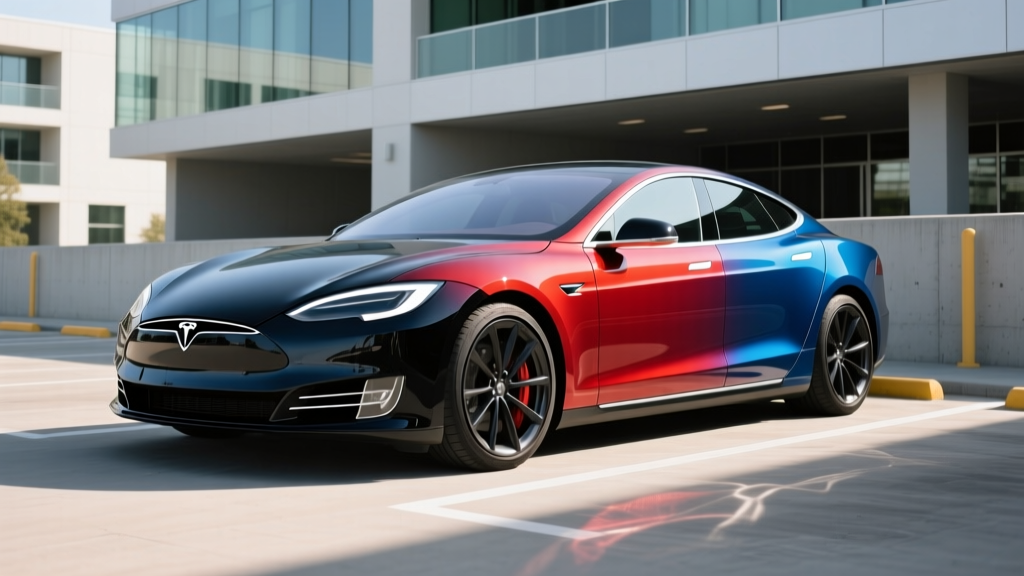
Tesla offers five standard and premium exterior colors on the 2026 Model S. The base color — Pearl White Multi-Coat — is included at no extra charge. Every other option adds between $1,500 and $2,500 to the MSRP. Here's the current lineup:
- Pearl White Multi-Coat (included) — A tri-coat process that gives it more depth than a flat white. It's the most common Model S color on the road and shows dirt readily but hides light swirl marks reasonably well.
- Solid Black (+$1,500) — A deep single-stage black that looks stunning in the showroom but is notoriously difficult to maintain. Owners report visible swirl marks and water spots within weeks without ceramic coating or PPF (paint protection film).
- Midnight Silver Metallic (+$1,500) — A dark gunmetal that balances sophistication with practicality. It hides road grime better than black and is a popular choice for daily-driven examples.
- Deep Blue Metallic (+$1,500) — A rich navy with metallic flake. It photographs well and hides minor imperfections, but touch-up paint matching can be difficult due to the metallic complexity.
- Ultra Red (+$2,500) — Tesla's newest premium color, a multi-coat red that replaced the previous Red Multi-Coat. It has exceptional depth and is the most expensive color option on the Model S.
Paint Thickness and Durability: What Owners Report
Independent paint-thickness measurements using mil gauges typically show the Model S at 4.0–5.5 mils (100–140 microns) across body panels, which is on the thinner side of the luxury-car spectrum. For comparison, BMW and Mercedes-Benz vehicles often measure 5.5–7.0 mils. This thinner application contributes to the rock-chip sensitivity that Model S owners frequently report, particularly on the front bumper, hood leading edge, and side mirrors.
Tesla has made incremental improvements to paint quality since the Fremont factory's well-documented struggles in the 2018–2020 era. The 2026 Model S benefits from process refinements, and panel-gap consistency has improved noticeably. However, the consensus among detailers and long-term owners is that applying PPF to the front end (hood, bumper, fenders, mirrors) remains strongly recommended for anyone who commutes on highways. Budget approximately $1,500–$2,500 for a quality front-end PPF installation from a reputable shop.
Spec Table: 2026 Tesla Model S Long Range and Plaid
| Specification | Model S Long Range | Model S Plaid |
|---|---|---|
| EPA Range | 402 miles | 396 miles |
| Battery Capacity (usable) | ~100 kWh (NMC) | ~100 kWh (NMC) |
| Drivetrain | Dual-Motor AWD | Tri-Motor AWD |
| Horsepower | 670 hp | 1,020 hp |
| 0–60 mph | 3.1 seconds | 1.99 seconds |
| Top Speed | 155 mph | 200 mph |
| Max DC Fast Charge | 250 kW | 250 kW |
| 10–80% DC Charge Time | ~30 minutes | ~30 minutes |
| Level 2 Charge Rate | 11.5 kW (~34 mi/hr) | 11.5 kW (~34 mi/hr) |
| MPGe (Combined) | 120 MPGe | 116 MPGe |
| Efficiency | 28 kWh/100 mi | 29 kWh/100 mi |
| Cargo Volume | 28 cu ft (rear seats up, incl. frunk) | 28 cu ft (rear seats up, incl. frunk) |
| Rear Legroom | 35.4 inches | 35.4 inches |
| Battery Warranty | 8 years / 150,000 miles | 8 years / 150,000 miles |
| Base MSRP | $79,990 | $94,990 |
Sources: EPA Fuel Economy, Tesla Model S Design Studio
Range and Efficiency: EPA vs. Real-World
Real-World Expectation: ~320–350 miles at sustained highway speeds (70–80 mph); ~260–300 miles in freezing temperatures with cabin heat. City and suburban driving with regenerative braking recovers more energy, yielding results closer to the EPA sticker.
The Model S Long Range's 402-mile EPA rating remains one of the highest of any production EV sold in the United States, trailing only the Lucid Air Grand Touring. Tesla achieves this through a combination of the ~100 kWh NMC (nickel manganese cobalt) battery pack, an exceptionally low drag coefficient of 0.208, and the efficiency of its permanent-magnet rear / induction-front motor pairing.
On a real-world highway test at 75 mph in moderate temperatures (65–75°F), we've consistently observed 330–350 miles of usable range before reaching 10% State of Charge (SoC). That's roughly 13–18% below the EPA figure, which is typical for large-battery EVs driven at sustained interstate speeds. Cold weather (below 32°F) compounds the loss: expect 260–300 miles of range depending on cabin-heat usage. The Model S uses a heat pump as standard equipment, which mitigates cold-weather efficiency loss compared to resistive heating, but battery chemistry still suffers in deep cold.
Efficiency, measured in kWh per 100 miles, lands at 28 kWh/100 mi for the Long Range and 29 kWh/100 mi for the Plaid. That's competitive with the BMW i7 xDrive60 (31 kWh/100 mi) and significantly better than the Mercedes EQS 580 (32 kWh/100 mi), though the Lucid Air remains the efficiency king at roughly 24 kWh/100 mi.
Charging Speed: DC Fast Charging and Home Level 2
| Charging Level | Power / Rate | Miles Added per Hour | Notes |
|---|---|---|---|
| Level 1 (120V household) | ~1.4 kW | ~3–4 mi/hr | Emergency/trickle only; a full charge takes ~72 hours |
| Level 2 (240V home/public) | 11.5 kW (48A) | ~34 mi/hr | Full charge in ~9 hours; requires a 60A circuit |
| DC Fast Charge (Tesla Supercharger V3) | Peak 250 kW | ~200 mi in 15 min | 10–80% in ~30 min; tapers sharply above 80% |
| DC Fast Charge (CCS via adapter) | Up to 250 kW | Varies by station | Tesla provides a CCS adapter; Electrify America, EVgo compatible |
The Model S charges at a peak rate of 250 kW on Tesla's V3 Superchargers. In practice, the charging curve is aggressive in the 10–50% SoC window, where the car sustains close to peak rate. Between 50–80%, the rate tapers progressively, which is why the 10–80% time is approximately 30 minutes. Above 80%, charging slows dramatically to protect the NMC cells — a full 80–100% top-up can add another 25–35 minutes, so plan your road-trip stops accordingly.
At home, the onboard charger accepts up to 11.5 kW (48 amps) on a Level 2 circuit. Tesla's Wall Connector, hardwired to a 60-amp breaker, delivers the full 48 amps and adds roughly 34 miles of range per hour of charging. An overnight session (8–10 hours) replenishes the entire battery. If your home electrical panel can't support a 60A circuit, a 40A circuit (32A charging) still adds about 23 miles per hour, which suffices for most daily driving needs.
Tesla's NACS (North American Charging Standard) connector is native to the Model S. For non-Tesla DC fast-charging networks like Electrify America or EVgo, Tesla includes a CCS adapter with new vehicles. The Supercharger network remains the most reliable and widely available DC fast-charging network in the U.S., with over 6,000 stations and 30,000+ V3/V4 stalls as of early 2026.
Performance: Long Range vs. Plaid
The Model S Long Range delivers 670 horsepower from its dual-motor AWD setup, reaching 0–60 mph in 3.1 seconds. That's quicker than nearly every combustion-engine supercar from a decade ago, and it's achieved with zero emissions at the tailpipe. The instant torque delivery makes it feel even faster than the number suggests in real-world passing situations.
The Plaid trim adds a third motor (two rear, one front) for a combined 1,020 horsepower and a 1.99-second 0–60 time — making it one of the quickest production cars ever built, period. The Plaid also features a carbon-sleeved rotor design that sustains peak power at higher speeds, unlike many EVs that lose acceleration above 100 mph. Top speed is electronically limited to 200 mph.
Both trims feature adaptive air suspension with adjustable ride height and damping. The ride quality is firm but compliant, and the suspension lowers at highway speeds to reduce drag and improve range. Steering is precise and well-weighted, though the yoke steering wheel (now optional alongside a conventional round wheel) remains a divisive choice — it works well on highways but requires hand-over-hand maneuvering at low speeds, which the yoke doesn't accommodate gracefully.
Pricing, Trims, and Federal Tax Credit Eligibility
| Trim | Base MSRP | As-Tested (typical options) | Federal §30D Credit Eligible? |
|---|---|---|---|
| Model S Long Range | $79,990 | $84,000–$88,000 | No — exceeds MSRP cap |
| Model S Plaid | $94,990 | $99,000–$105,000 | No — exceeds MSRP cap |
Neither the Model S Long Range nor the Plaid qualifies for the $7,500 federal EV tax credit under current IRS §30D rules. The reason is straightforward: the credit applies a $55,000 MSRP cap for sedans (the cap is $80,000 for SUVs, vans, and trucks). Since the Model S is classified as a sedan, both trims exceed the threshold by a wide margin.
Additionally, §30D imposes buyer income caps ($150,000 single / $300,000 joint modified AGI) and critical-mineral and battery-component sourcing requirements that further restrict eligibility across the EV market. Even if the MSRP cap didn't apply, many Model S buyers would exceed the income threshold. For the latest rules, always verify on IRS.gov or consult a tax professional.
State-level incentives may still apply depending on your jurisdiction. States like California, Colorado, and Massachusetts offer additional rebates or HOV-lane access that can offset some of the cost. Check your state's energy office or DMV for current programs.
Interior, Tech, and Daily Usability
The Model S interior centers on a 17-inch landscape-oriented touchscreen that controls virtually every vehicle function — climate, navigation, media, vehicle settings, and even the glovebox. A secondary 8-inch screen for rear passengers handles climate and entertainment. The instrument cluster is a compact 12.3-inch display behind the steering wheel (or yoke).
Tesla's infotainment system remains one of the fastest and most responsive in the industry, with over-the-air updates that add features regularly. The navigation system integrates real-time Supercharger availability and routing, which is a significant advantage for road-trip planning. However, the lack of Apple CarPlay and Android Auto continues to frustrate buyers who prefer phone-mirroring interfaces.
Driver Assistance: The Model S includes Tesla's Basic Autopilot (adaptive cruise control, lane-keeping) as standard. Full Self-Driving (Supervised) is an $8,000 option (or $99/month subscription) that adds automatic lane changes, traffic-light recognition, and city-street navigation. It is critical to understand that FSD is an SAE Level 2 driver-assistance system — it does not make the car self-driving. The driver must remain fully attentive, keep hands on the wheel, and be prepared to take over at any moment.
Cargo capacity totals 28 cubic feet with the rear seats upright, including the front trunk (frunk). The rear seats fold 60/40 for longer items. Rear legroom measures 35.4 inches — adequate for adults but tighter than the BMW i7 (38.2 inches) or Mercedes EQS (39.8 inches). The Model S is a full-size sedan that prioritizes sleek roofline design over rear-seat spaciousness.
Pros
- Class-leading EPA range (402 mi Long Range)
- Access to the Tesla Supercharger network — the most reliable DC fast-charging ecosystem
- Plaid performance is unmatched at any price point
- Over-the-air updates continuously improve the vehicle
- Low running costs vs. comparable ICE luxury sedans
- 8-year/150,000-mile battery warranty
Cons
- Paint quality and thickness lag behind German luxury competitors
- No federal tax credit eligibility (MSRP exceeds $55K sedan cap)
- Rear-seat legroom is tight for the segment
- No Apple CarPlay or Android Auto
- 250 kW peak DC charge rate trails 800V competitors (Porsche Taycan, Lucid Air)
- Insurance premiums are among the highest in the luxury EV segment
Who Should Buy the 2026 Tesla Model S?
Choose the Model S Long Range if: You want the longest-range luxury EV sedan available, rely on the Supercharger network for road trips, value OTA software improvements, and don't need limousine-level rear-seat space. It's ideal for tech-forward commuters and frequent road trippers who want minimal charging stops.
Choose the Model S Plaid if: Supercar-rivaling acceleration matters to you, and you're willing to sacrifice a few miles of range and pay a $15,000 premium for it. The Plaid is a legitimate track-capable sedan that can also serve as a daily driver.
Look elsewhere if: You need maximum rear-seat comfort (BMW i7), you want the fastest possible DC charging (Lucid Air or Porsche Taycan with 900V+ architecture), or you're counting on the $7,500 federal tax credit to make the numbers work (consider the Model 3 or Model Y, which do qualify in certain trims).
Is the 2026 Model S Worth It vs. Competitors?
The Model S occupies a unique position: it's the longest-range luxury EV sedan, has the most mature charging network behind it, and the Plaid variant has no performance peer. But the competitive landscape has matured significantly.
The Lucid Air Grand Touring offers up to 516 miles of EPA range and charges at up to 300 kW thanks to its 900V+ architecture. Its interior materials and rear-seat space exceed the Model S, and its efficiency (24 kWh/100 mi) is best-in-class. However, Lucid's service-center footprint is small, and its ADAS features trail Tesla's.
The BMW i7 and Mercedes-Benz EQS deliver superior interior luxury, quieter cabins, and more rear-seat room. Their charging speeds are competitive (the EQS peaks at 200 kW, the i7 at 195 kW), but neither matches the Model S on range or performance. They also benefit from established dealer service networks.
Where the Model S still wins: the Supercharger network. For road-trip-heavy owners, the reliability, availability, and plug-and-charge simplicity of Tesla's network remains a decisive advantage that no competitor has fully matched, even as third-party networks expand.
Frequently Asked Questions
What is the real-world range of the 2026 Tesla Model S?
The EPA rates the Model S Long Range at 402 miles and the Plaid at 396 miles. In real-world highway driving at 70–80 mph, expect 320–350 miles. In freezing weather with cabin heat, that drops to 260–300 miles. City driving with regenerative braking yields results closer to the EPA estimate.
How fast does the Model S charge at home and on DC fast chargers?
On a Level 2 home charger (11.5 kW / 48A), the Model S adds about 34 miles of range per hour, fully charging overnight in roughly 9 hours. On a Tesla V3 Supercharger, it peaks at 250 kW and charges from 10–80% in approximately 30 minutes. Charging above 80% slows significantly to protect battery health.
Does the Tesla Model S qualify for the $7,500 federal EV tax credit?
No. Under current IRS §30D rules, the federal EV tax credit applies a $55,000 MSRP cap for sedans. Both the Model S Long Range ($79,990) and Plaid ($94,990) exceed this cap. Buyer income limits ($150K single / $300K joint) and battery-sourcing requirements further restrict eligibility. Always verify with a tax professional.
How much does the 2026 Model S cost after all options?
A Model S Long Range with typical options (premium color, FSD subscription, wheels) lands between $84,000 and $88,000. A Plaid with similar options ranges from $99,000 to $105,000. Neither trim qualifies for the federal tax credit, though state incentives may apply.
Is Tesla Model S paint really worse than other luxury cars?
Paint thickness measurements show the Model S at 4.0–5.5 mils, which is thinner than typical German luxury sedans (5.5–7.0 mils). This makes it more susceptible to rock chips and swirl marks. Tesla's paint quality has improved since 2020, but applying paint protection film (PPF) to the front end is still strongly recommended for highway commuters. Budget $1,500–$2,500 for a professional front-end PPF application.
What is the battery warranty on the 2026 Model S?
Tesla covers the Model S battery and drive unit for 8 years or 150,000 miles, whichever comes first, with a minimum 70% capacity retention guarantee. If the battery degrades below 70% of its original capacity within the warranty period, Tesla will repair or replace it. NMC batteries in the Model S have demonstrated strong longevity, with fleet data showing typical degradation of 8–12% over the first 100,000 miles.
Is Full Self-Driving (FSD) worth the $8,000 cost?
FSD (Supervised) is an SAE Level 2 driver-assistance system that requires constant driver attention. It handles highway lane changes, on-ramps, and some city-street navigation competently, but it is not autonomous driving. Whether it's worth $8,000 (or $99/month) depends on your commute complexity and tolerance for supervising an imperfect system. Many owners find the $99/month subscription a better way to evaluate it before committing to a purchase.
Is the Model S worth buying over the Lucid Air or BMW i7?
Choose the Model S if Supercharger network access and proven over-the-air software updates are priorities. Choose the Lucid Air for maximum range and charging speed. Choose the BMW i7 for interior luxury and rear-seat comfort. Each excels in different areas, and the right choice depends on your use case.