The P100D in 2026: A Used Performance EV Benchmark
Tesla discontinued the Model S P100D after the 2020 model year, replacing it with the refreshed Plaid variant in 2021. Yet the P100D remains one of the most sought-after used electric vehicles on the market. Its combination of a 100 kWh battery pack, Ludicrous+ acceleration, and access to the Tesla Supercharger network continues to appeal to enthusiasts and daily drivers who want flagship performance without the six-figure new-car price tag.
This review evaluates the Model S P100D from a 2026 used-buyer perspective — covering real-world range, battery degradation expectations, charging speeds, ownership costs, and how it stacks up against newer EVs in the $40,000–$65,000 used market.
| Spec | Value |
|---|---|
| EPA Range (new) | 315 miles |
| Battery Capacity | 100 kWh (usable ~95 kWh), NMC chemistry |
| Drivetrain | Dual-Motor AWD |
| Horsepower | ~762 hp (Ludicrous+ mode) |
| 0–60 mph | 2.5 seconds (rollout subtracted) |
| Top Speed | 155 mph |
| MPGe (combined) | 98 MPGe |
| Energy Consumption | 34 kWh/100 mi |
| Max DC Fast Charge | ~150 kW (V2 Supercharger) |
| Level 2 Charge Rate | 11.5 kW (48A onboard charger) |
| Cargo Volume | 26.3 cu ft (rear) + 5.3 cu ft (frunk) |
| Rear Legroom | 35.4 inches |
| Curb Weight | 4,941 lbs |
| Battery Warranty (original) | 8 years / 150,000 miles |
| Original MSRP | ~$136,000 (before incentives) |
Real-World Range: What to Expect From a 5-Year-Old 100 kWh Pack
EPA Sticker: 315 miles (when new)
Real-World Expectation in 2026: 240–280 miles depending on battery State of Health (SoH), driving style, and ambient temperature.
The P100D's 100 kWh NMC (nickel-manganese-cobalt) battery pack was the largest Tesla offered in the Model S at the time. When new, it delivered an EPA-estimated 315 miles — a class-leading figure in 2019–2020.
For a 2026 used buyer, the critical question is degradation. NMC packs in the Model S typically lose 8–12% of total capacity over the first five years and 60,000–80,000 miles, according to long-term fleet data tracked by sources like Recurrent Auto. A P100D with 70,000 miles and a 90% SoH battery effectively has ~90 kWh of usable capacity, translating to roughly 270–285 miles in mixed driving.
Highway driving at 75+ mph reduces efficiency to approximately 36–38 kWh/100 mi, cutting range to around 240–255 miles on a full charge. Cold-weather performance is notably affected: at 20°F, expect a 20–30% range reduction due to battery resistance and cabin heating demands — potentially dropping effective range to 190–220 miles. The P100D does not have a heat pump (Tesla introduced those with the 2021 refresh), so it relies on resistive heating, which is more energy-intensive.
Buyer tip: Request a battery health report from Tesla or use the car's built-in energy graph to assess real-world SoH before purchasing. Cars that were frequently DC fast-charged or regularly charged to 100% may show slightly higher degradation.
Charging Speed: Supercharger V2 and Home Level 2
The P100D predates Tesla's V3 Supercharger architecture (250 kW), which debuted with the Model 3 and later Model S refresh. This means the P100D is limited to ~150 kW peak on V2 Superchargers, and on V3 stalls it will also cap at roughly 150 kW due to its older battery management system and pack configuration.
| Charging Method | Power (kW) | Speed (mi/hr) | 10–80% Time |
|---|---|---|---|
| DC Fast (V2 Supercharger) | ~150 kW peak | ~300 mi/hr (peak) | ~40–45 minutes |
| DC Fast (V3 Supercharger) | ~150 kW (capped) | ~300 mi/hr (peak) | ~40–45 minutes |
| Level 2 (Home, 48A/11.5 kW) | 11.5 kW | ~34 mi/hr | ~8–9 hours (full) |
| Level 2 (Public, 40A/9.6 kW) | 9.6 kW | ~28 mi/hr | ~10 hours (full) |
| Level 1 (120V, 12A) | 1.4 kW | ~4 mi/hr | Not practical for full charge |
The 10–80% DC fast-charge time of roughly 40–45 minutes is noticeably slower than modern EVs like the Hyundai Ioniq 5 (~18 minutes at 240 kW) or the refreshed Model S Plaid (~27 minutes at 250 kW). The P100D's charge curve tapers significantly above 60% SoC, dropping below 75 kW past 70% and below 30 kW past 90%. For road trips, plan on 35–45 minute stops at Superchargers to reach 80%.
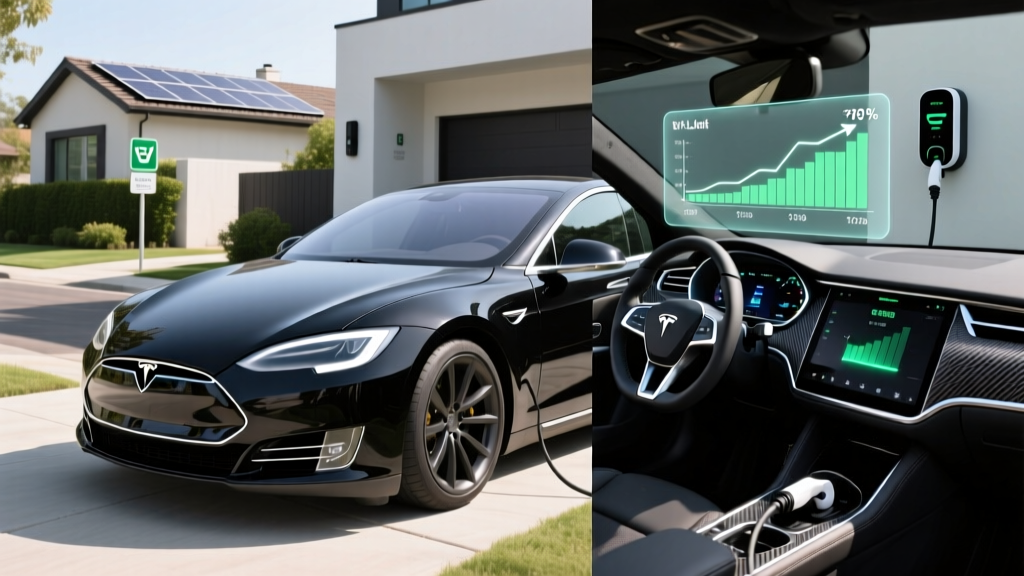
At home, the P100D's 48-amp onboard charger accepts up to 11.5 kW on a 60-amp circuit (NEMA 14-60 or hardwired Level 2). This adds roughly 34 miles of range per hour, meaning an overnight 8-hour session replenishes about 270 miles — more than enough for daily driving. Installation costs for a home Level 2 setup typically range from $1,200–$3,500 depending on panel capacity and wiring distance.
The P100D uses Tesla's proprietary connector (now designated NACS). With Tesla opening the Supercharger network to non-Tesla EVs via Magic Dock adapters, the P100D benefits from the largest and most reliable DC fast-charging network in North America — over 6,000 stations and 60,000+ stalls as of 2026.
Performance: Ludicrous Speeds, Daily-Drivable Comfort
The P100D's dual-motor all-wheel-drive powertrain produces approximately 762 horsepower in Ludicrous+ mode, delivering a 0–60 mph time of 2.5 seconds (with Tesla's 1-foot rollout subtracted, per their standard measurement). Independent testing by outlets like Motor Trend and Car and Driver consistently verified sub-2.7-second runs in real-world conditions.
This performance remains competitive with 2026 flagship EVs. The Lucid Air Sapphire (0–60 in 1.89 seconds) is quicker but starts at $250,000+. The Model S Plaid (1.99 seconds) is the natural in-family successor but commands $70,000+ on the used market. At $45,000–$60,000 used, the P100D offers supercar acceleration at a fraction of the original cost.
Beyond straight-line speed, the P100D features adaptive air suspension with adjustable ride height, torque-vectoring via independent front and rear motors, and a low center of gravity from the floor-mounted battery pack. The steering is precise, though not as sharp as a Porsche Taycan. Ride quality in Comfort mode is compliant enough for daily commuting, while Sport mode firms things up for canyon roads.
Autopilot and FSD: The P100D comes equipped with Tesla's Autopilot hardware (HW2.5 or HW3.0 depending on build date). Basic Autopilot includes Traffic-Aware Cruise Control and Autosteer. Full Self-Driving (FSD) capability was available as a $10,000 option. Note that FSD on the P100D is SAE Level 2 driver assistance — the driver must remain fully attentive, hands on the wheel, at all times. This is not autonomous driving.
Interior, Cargo, and Daily Livability
The pre-refresh Model S interior (2012–2020) is functional but shows its age compared to 2026 competitors. The 17-inch center touchscreen remains responsive and receives over-the-air software updates, but materials quality — particularly the synthetic leather (Tesla discontinued animal leather in 2017) and some plastic trim — falls short of what you'll find in a Mercedes EQS or Lucid Air.
Practical dimensions:
- Rear cargo: 26.3 cubic feet (with seats up), 58.1 cu ft (seats folded)
- Front trunk (frunk): 5.3 cubic feet
- Rear legroom: 35.4 inches
- Front headroom: 38.8 inches
- Seating: 5 passengers standard (optional rear-facing third-row jump seats were available for 7-passenger config in earlier years, discontinued by P100D era)
The hatchback liftgate is a major practicality advantage over traditional sedans. The combined 31.6 cu ft of cargo space (rear + frunk) easily accommodates four carry-on suitcases plus groceries. The flat floor and wide opening make loading bulky items straightforward.
Tech highlights include a 12.3-inch digital instrument cluster, premium 12-speaker audio with active noise cancellation, HEPA air filtration with Bioweapon Defense Mode, and full smartphone app integration for preconditioning, charging monitoring, and remote access.
Pricing, Tax Credits, and Ownership Economics
The Model S P100D is no longer sold new. On the used market in 2026, typical asking prices range from $42,000 to $62,000, depending on mileage, condition, battery SoH, and whether FSD was included in the original purchase.
| Factor | Details |
|---|---|
| Used Market Price Range (2026) | $42,000 – $62,000 |
| Federal Used EV Credit (§25E) | Up to $4,000 or 30% of sale price (whichever is lower) |
| §25E Price Cap | Sale price must be $25,000 or less — P100D does NOT qualify |
| New EV Credit (§30D) | Not applicable — vehicle is discontinued |
| Estimated Out-of-Pocket | $42,000 – $62,000 (no federal credit available) |
| Annual Insurance (est.) | $2,800 – $4,200 (varies by state, driver profile) |
| Estimated Annual Charging Cost | $600 – $1,100 (at 12,000 mi/yr, $0.14/kWh avg) |
Critical tax credit note: The IRS §25E Used Clean Vehicle Credit offers up to $4,000 for qualifying used EVs, but the vehicle's sale price must be $25,000 or less. The P100D's market value well exceeds this cap, making it ineligible for the federal used-EV credit. It also does not qualify for the §30D new-vehicle credit since it is no longer manufactured. Always consult a tax professional and verify current IRS rules before making purchase decisions based on incentive eligibility.
On the cost-of-ownership side, the P100D benefits from lower "fuel" costs compared to comparable gas performance sedans. At 34 kWh/100 mi and a national average electricity rate of ~$0.14/kWh, the P100D costs roughly $4.76 per 100 miles to charge at home. A BMW M5 getting 17 mpg combined at $3.50/gallon costs $20.59 per 100 miles. Over 12,000 miles annually, that's approximately $1,900 in annual fuel savings.
Maintenance costs are also lower than gas equivalents — no oil changes, spark plugs, or transmission fluid. However, budget for potential out-of-warranty repairs: air suspension struts ($1,500–$2,500 per corner), touchscreen replacement ($2,000–$3,000), and MCU upgrades are known expenses on higher-mileage examples.
Battery Warranty and Long-Term Degradation
Tesla's original battery and drive unit warranty for the P100D covers 8 years or 150,000 miles (whichever comes first), with a minimum 70% capacity retention threshold. For a 2019–2020 P100D, this warranty extends to 2027–2028, meaning most examples on the used market in 2026 still carry some factory battery coverage.
If the battery drops below 70% of its original capacity within the warranty period, Tesla will repair or replace it at no cost. Out-of-warranty battery replacement for the 100 kWh pack typically costs $15,000–$22,000 at Tesla Service Centers, though refurbished packs may be available at lower cost.
Long-term NMC degradation data suggests the P100D's pack should retain 80–85% capacity at 150,000 miles under normal use. Owners who followed best practices — charging to 80–90% daily, avoiding frequent DC fast charging, and preconditioning before Supercharging — typically report the lowest degradation rates.
Pros and Cons: The P100D Verdict
Pros
- Sub-2.7-second 0–60 mph remains elite in 2026
- 315-mile EPA range (new); 240–280 mi real-world with degradation
- Supercharger network access — largest and most reliable in North America
- Hatchback practicality with 31.6 cu ft total cargo space
- OTA software updates keep infotainment current
- Remaining battery warranty on most 2019–2020 examples
- Significantly lower cost per mile than gas performance sedans
Cons
- DC fast charging capped at ~150 kW — 40+ min for 10–80%
- No heat pump — cold-weather range loss of 20–30%
- Pre-refresh interior materials lag behind 2026 luxury competitors
- No federal tax credit eligibility (used price exceeds $25K cap)
- Insurance premiums 30–50% higher than non-performance EVs
- Potential out-of-warranty repair costs (air suspension, MCU)
- FSD is Level 2 only — not autonomous driving
Who Should Buy the Model S P100D?
Buy the P100D if:
- You want supercar acceleration (2.5s 0–60) for under $60,000
- You have home Level 2 charging and rarely need 40-minute road-trip stops to bother you
- You value Supercharger network reliability over peak charging speed
- You need a 5-passenger sedan with genuine hatchback cargo versatility
- You're buying a 2019–2020 example still under battery warranty
Look elsewhere if:
- You need the latest DC fast-charging speeds (consider a used Ioniq 5, EV6, or Model S Plaid)
- You live in a cold climate and need maximum winter range (the lack of a heat pump hurts)
- You want a modern interior with premium materials (look at a used Lucid Air Pure or Mercedes EQS)
- You're counting on a federal tax credit to reduce cost (the P100D doesn't qualify)
Frequently Asked Questions
What is the real-world range of the Tesla Model S P100D in 2026?
Expect 240–285 miles depending on battery health, driving style, and temperature. Highway driving at 75+ mph typically yields 240–255 miles. Cold weather (below 30°F) can drop range to 190–220 miles due to the lack of a heat pump and increased battery resistance.
How fast does the P100D charge at home and on DC fast chargers?
On DC fast chargers (Tesla V2/V3 Superchargers), the P100D peaks at approximately 150 kW, completing a 10–80% charge in roughly 40–45 minutes. At home on a Level 2 charger (11.5 kW / 48A), it adds about 34 miles of range per hour, fully charging in 8–9 hours overnight.
Does the Model S P100D qualify for any federal EV tax credit?
No. The §25E Used Clean Vehicle Credit requires a sale price of $25,000 or less, and the P100D trades well above that threshold. The §30D new-vehicle credit doesn't apply because the model is discontinued. Check IRS guidelines for the latest rules.
Is the P100D still worth buying vs. newer EVs?
For raw performance per dollar, yes — nothing else under $60,000 hits 2.5-second 0–60 times with 250+ miles of range and Supercharger access. However, if fast DC charging, modern interior quality, or cold-weather efficiency are priorities, newer alternatives like the Model S Plaid, Lucid Air Pure, or Hyundai Ioniq 5 N may serve you better.
What should I check before buying a used P100D?
Prioritize: (1) Battery State of Health — request a Tesla service report or check the energy graph. (2) Remaining battery/drive unit warranty (8yr/150K mi from original in-service date). (3) Air suspension condition — listen for compressor cycling and check for uneven ride height. (4) MCU version — HW3.0 is preferred for better Autopilot capability. (5) Service history for any drive unit or battery replacements under warranty.
What is the battery replacement cost if it fails out of warranty?
Out-of-warranty 100 kWh battery replacement runs $15,000–$22,000 at Tesla Service Centers. Refurbished packs may be available for $10,000–$14,000. Given this cost, buying an example with remaining warranty coverage is strongly recommended.