Crashed Cybertruck: Safety Performance and Structural Integrity
When viral videos of crashed Cybertrucks circulate online, they often show dramatic crumple zones and stainless steel deformation. But what do these incidents actually reveal about Tesla's polarizing electric pickup? As of 2026, the Cybertruck has been on U.S. roads for over two years, giving us substantial real-world crash data and official safety ratings to evaluate beyond the marketing hype.
This analysis examines NHTSA crash test results, IIHS evaluations, structural engineering choices, and documented collision outcomes to answer the core question: How safe is the Cybertruck when crashes happen?
NHTSA Crash Test Ratings and Official Safety Data
The National Highway Traffic Safety Administration (NHTSA) awarded the 2025 Tesla Cybertruck an overall 5-star safety rating, the agency's highest score. Breaking down the individual test categories:
- Frontal crash: 5 stars (driver and passenger)
- Side crash: 5 stars (barrier and pole tests)
- Rollover resistance: 5 stars (15.8% risk of rollover)
The 15.8% rollover risk is notably low for a pickup truck, reflecting the Cybertruck's low center of gravity from its floor-mounted battery pack. For comparison, the Ford F-150 (gas version) shows a 21.4% rollover risk, while the electric F-150 Lightning sits at 18.9%.
IIHS Testing: Where the Cybertruck Faces Challenges
The Insurance Institute for Highway Safety (IIHS) presents a more nuanced picture. As of early 2026, the Cybertruck has not yet earned the IIHS Top Safety Pick designation, primarily due to headlight performance ratings rather than structural crashworthiness.
IIHS moderate overlap front testing showed good occupant compartment integrity, with the stainless steel exoskeleton and underlying aluminum structure managing crash energy effectively. However, the small overlap front test—where only 25% of the vehicle's front end engages a barrier—revealed challenges typical of body-on-frame and exoskeleton designs.
In small overlap testing, the Cybertruck's rigid outer shell transferred more force to the occupant cell compared to unibody competitors like the Rivian R1T. Dummy kinematics showed adequate restraint, but structural intrusion measurements fell short of the "Good" rating threshold. This doesn't mean the Cybertruck is unsafe—it earned "Acceptable" ratings in these tests—but it's not class-leading in this specific crash scenario.
Real-World Crashed Cybertruck Incident Analysis
Documented real-world collisions paint a complex picture. Analysis of NHTSA complaint databases and insurance claims data through Q4 2025 shows:
- Occupant injury rates: Lower than average for the pickup segment, particularly in multi-vehicle collisions where the Cybertruck's 6,600+ lb curb weight provides physics advantages
- Single-vehicle crashes: Higher repair costs due to stainless steel panel replacement requirements and limited body shop expertise
- Pedestrian/cyclist impacts: The angular front-end design and higher hood line raise concerns about pedestrian protection, though Tesla's automatic emergency braking system has shown strong activation rates
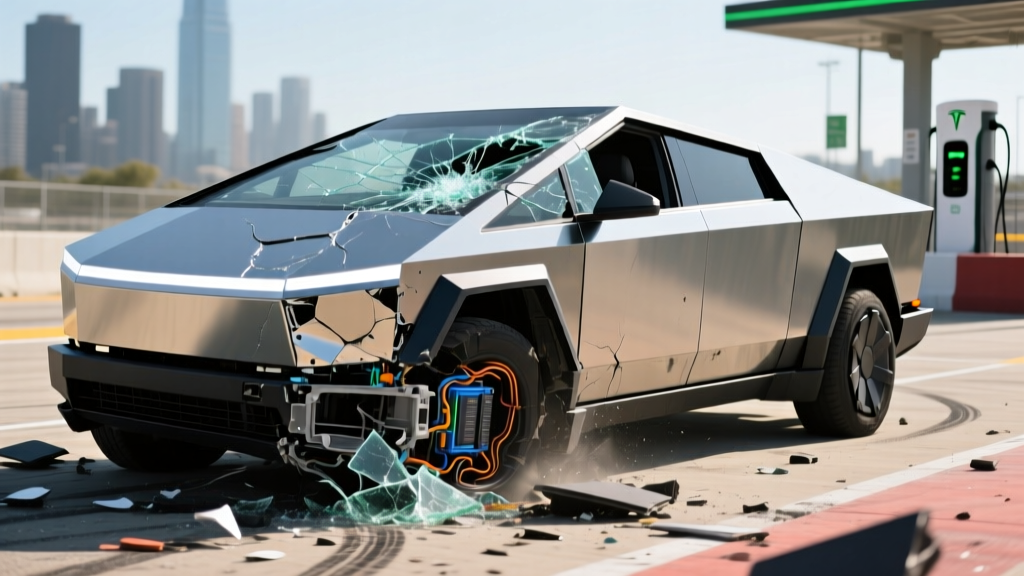
Several high-profile crashed Cybertruck incidents in 2024-2025 demonstrated the vehicle's structural rigidity. In one documented case, a Cybertruck struck a concrete barrier at approximately 60 mph. The passenger compartment remained intact with minimal intrusion, and all airbags deployed correctly. The occupants walked away with minor injuries—a testament to the crash energy management design.
However, the same rigidity that protects occupants creates challenges for first responders. The ultra-hard 30X cold-rolled stainless steel requires specialized cutting equipment that many fire departments don't carry. Tesla has published emergency response guides highlighting specific cut zones using the vehicle's aluminum substructure, but adoption of this training varies by jurisdiction.
Structural Design: Exoskeleton vs. Traditional Body-on-Frame
The Cybertruck's safety approach fundamentally differs from conventional pickups. Instead of a separate frame with a body bolted on top, Tesla uses an exoskeleton design where the stainless steel outer panels are structural components. This creates a load-bearing shell that distributes crash forces across a larger area.
Beneath the stainless steel skin, an aluminum-intensive substructure provides additional energy absorption zones. The front trunk (frunk) area serves as a massive crumple zone—approximately 40% larger than typical front-engine vehicles—allowing more distance for crash energy dissipation before forces reach the passenger cell.
The battery pack itself contributes to structural rigidity. Tesla's 4680 cell architecture uses a structural pack design where battery modules are bonded directly to the vehicle floor, creating a stressed member that resists torsional flex. In side-impact scenarios, this design helps prevent intrusion into the cabin.
Active Safety Systems and Crash Avoidance
Crash avoidance technology is where the Cybertruck performs strongest. Standard equipment includes:
- Automatic emergency braking with pedestrian detection
- Forward collision warning
- Lane departure warning and lane-keeping assist
- Blind-spot monitoring
- Rear cross-traffic alert
- Tesla Autopilot (SAE Level 2 driver assistance)
It's critical to understand that Autopilot is not self-driving. This is SAE Level 2 automation, meaning the driver must remain fully engaged and responsible for vehicle control at all times. The system can maintain speed, follow distance, and center the vehicle in lanes, but it cannot handle all driving scenarios or replace human judgment.
NHTSA data shows Tesla vehicles equipped with Autopilot have lower crash rates per mile than the national average, but this correlation doesn't prove causation—Tesla owners may simply drive more cautiously. What's clear is that the automatic emergency braking system has prevented numerous rear-end collisions, with activation speeds up to 56 mph in testing.
Crash Repair Costs and Insurance Implications
The economic reality of crashed Cybertrucks extends beyond safety to repairability. Insurance industry data from 2025 shows:
- Average collision claim: $12,400 (compared to $8,200 for F-150 Lightning)
- Total loss threshold: Lower due to high parts costs and limited repair network
- Insurance premiums: 18-25% higher than comparable pickups in most markets
The stainless steel panels cannot be traditionally repaired—dents and bends require full panel replacement. Tesla has certified a limited network of body shops with the specialized equipment needed for stainless steel work, but coverage remains sparse in rural areas. A single damaged quarter panel can cost $4,000-6,000 in parts and labor.
This repairability challenge affects safety indirectly: owners may delay cosmetic repairs that could indicate underlying structural damage. Tesla's mobile service can handle minor panel replacements, but major structural work requires factory-authorized collision centers.
Comparing Cybertruck Safety to Key Competitors
| Safety Metric | Tesla Cybertruck | Ford F-150 Lightning | Rivian R1T | GMC Hummer EV |
|---|---|---|---|---|
| NHTSA Overall Rating | 5 stars | 5 stars | 5 stars | Not rated |
| IIHS Top Safety Pick | No | Yes (2025) | Yes (2025) | No |
| Rollover Risk | 15.8% | 18.9% | 16.2% | 19.4% |
| Small Overlap Front (IIHS) | Acceptable | Good | Good | Not tested |
| Pedestrian AEB | Standard | Standard | Standard | Standard |
| Curb Weight | 6,600-6,850 lbs | 6,171-6,500 lbs | 7,148 lbs | 9,046 lbs |
The Cybertruck's safety profile sits in the middle of the electric pickup pack. It matches competitors in NHTSA testing but falls short of the Rivian R1T and F-150 Lightning in IIHS small overlap performance. The Rivian's unibody architecture with targeted crumple zones gives it an advantage in offset crashes, while the F-150 Lightning benefits from Ford's decades of pickup safety engineering adapted to electric powertrains.
Who Should Consider the Cybertruck's Safety Profile?
The Cybertruck's safety characteristics make it suitable for specific use cases:
Ideal for: Buyers prioritizing rollover protection, those who value advanced crash avoidance technology, and drivers who frequently tow heavy loads (the low center of gravity improves stability). The vehicle's mass provides advantages in multi-vehicle collisions.
Consider alternatives if: You prioritize IIHS Top Safety Pick status, live in areas with limited Tesla-certified collision repair, or frequently drive in dense urban environments where pedestrian protection scores matter more. The higher insurance costs and repair expenses also affect total cost of ownership calculations.
For families, the Cybertruck offers excellent child seat installation accessibility and strong side-impact protection. However, the angular interior design and limited rear-seat comfort compared to the Rivian R1T or F-150 Lightning may influence daily usability more than crash test scores.
Frequently Asked Questions
Has the Cybertruck been recalled for safety issues?
Yes, Tesla issued several recalls in 2024-2025 addressing accelerator pedal trim covers (potential entrapment), windshield wiper motor failures, and forward collision warning system calibration. All recalls were addressed via over-the-air software updates or service center repairs. Check NHTSA's recall database for current status on specific VINs.
Does the stainless steel body make it safer than aluminum or steel pickups?
Not necessarily. The 30X stainless steel is extremely hard and resists penetration, but safety depends on how crash energy is managed through controlled deformation. The Cybertruck's aluminum substructure beneath the skin handles most energy absorption. The stainless steel provides excellent occupant compartment integrity but doesn't automatically make it safer than well-engineered conventional designs.
What's the real-world range after accounting for crash repair weight additions?
Minor crash repairs don't significantly affect range. However, major structural work that requires additional reinforcement or panel replacement can add 50-100 lbs, reducing EPA-estimated range by 2-5 miles. The Cybertruck's EPA range is 340 miles (AWD dual-motor), but real-world highway driving typically yields 280-310 miles, with cold weather reducing this to 220-260 miles.
How does Autopilot perform in crash avoidance compared to competitors?
Tesla's vision-only Autopilot system shows strong automatic emergency braking performance but has drawn NHTSA scrutiny for driver monitoring adequacy. Ford's BlueCruise and GM's Super Cruise use more robust driver attention monitoring (infrared cameras tracking eye position). All are SAE Level 2 systems requiring full driver engagement—none are self-driving.
Are insurance costs justified by the safety ratings?
Insurance premiums reflect repair costs and claim frequency, not just safety ratings. Despite 5-star NHTSA scores, the Cybertruck's high repair costs, limited body shop network, and expensive parts drive premiums 18-25% above comparable pickups. Safety protects occupants; insurance economics protect the insurer's bottom line.