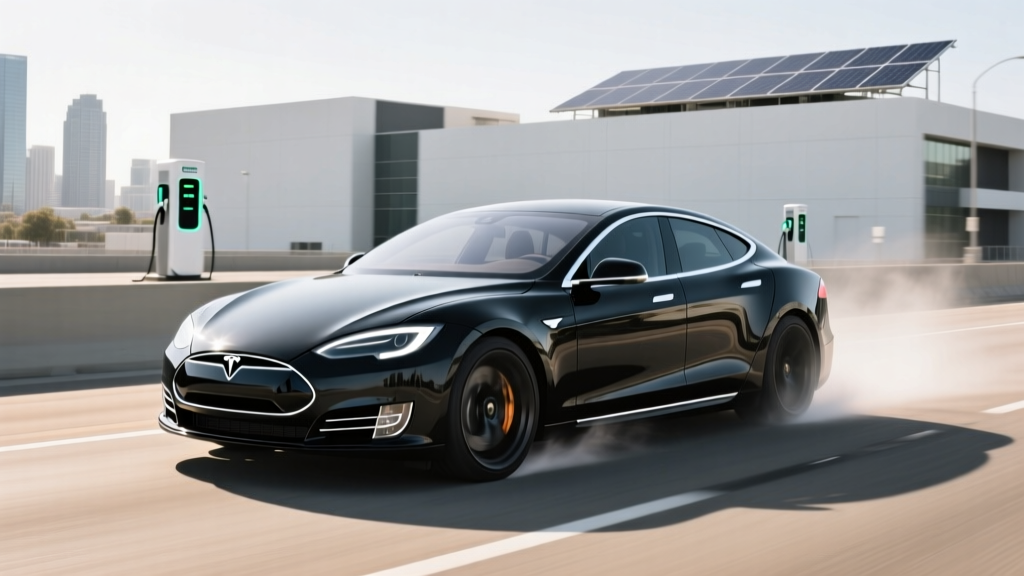
The Tesla Model S P100D with Ludicrous Mode was, for years, the quickest production sedan money could buy. Its headline 0-60 mph time of 2.5 seconds (2.3 seconds with rollout subtracted) rewrote expectations for what a four-door family car could do. But the EV landscape has shifted dramatically since the P100D's heyday. With the Model S now updated to dual-motor and tri-motor Plaid architectures, and competitors like the Lucid Air, Porsche Taycan, and BMW i7 closing the gap, where does the legendary P100D stand for buyers considering one on the used market in 2026?
This profile dissects the P100D variant — its real-world performance, range limitations, charging realities, and total ownership economics — so you can decide whether this acceleration icon still earns a spot in your garage.
Tesla Model S P100D: Core Specifications at a Glance
| Specification | Tesla Model S P100D (2016–2019) |
|---|---|
| 0-60 mph | 2.5 sec (2.3 sec w/ 1-ft rollout) |
| Horsepower | ~762 hp (combined, peak output) |
| Drivetrain | Dual-motor AWD |
| Battery Capacity | 100 kWh (usable ~98 kWh), NMC chemistry |
| EPA Range | 315 miles (2017+ rating) |
| Efficiency | 98 MPGe combined / 34 kWh/100mi |
| Max DC Fast Charge | ~145 kW peak (V2 Supercharger era) |
| 10–80% DC Charge Time | ~45–50 minutes |
| Level 2 Home Charging | 48 amps (11.5 kW) — ~34 mi/hr |
| Cargo Volume | 26.3 cu ft (rear seats up) / 58.1 cu ft (folded) |
| Frunk | 5.3 cu ft |
| Seating | 5 passengers (optional rear-facing 3rd row on earlier years) |
| Original MSRP | ~$134,500–$145,000 (depending on options) |
| 2026 Used Market Range | ~$32,000–$55,000 depending on mileage & condition |
| Battery Warranty | 8 years / 150,000 miles (70% minimum retention) |
Real-World Range: What the EPA Sticker Doesn't Tell You
Real-World Expectation: 240–270 miles at sustained highway speeds (70–80 mph); 220–250 miles in freezing temperatures; up to 290–310 miles in mild city/suburban driving with regen braking.
The P100D's 100 kWh NMC (nickel-manganese-cobalt) battery was the largest Tesla offered at the time, and its 315-mile EPA rating was class-leading. However, the Model S is a large, heavy sedan (approximately 4,941 lbs curb weight) with a performance-oriented powertrain. That mass works against efficiency at highway speeds.
On a 75 mph highway loop in moderate temperatures (65–75°F), expect consumption around 34–38 kWh/100mi, which translates to roughly 255–280 miles before needing to charge. Drop the ambient temperature below 32°F, and you'll lose an additional 15–25% of range due to battery resistance and cabin heating demands — the P100D lacks the heat pump found in newer Tesla models, relying instead on resistive heating, which is significantly less efficient.
For a 2026 buyer evaluating a used P100D, battery degradation is the critical variable. According to Tesla's own fleet data and independent tracking by sources like fueleconomy.gov, most 100 kWh packs experience 8–12% capacity loss in the first 100,000 miles, with degradation tapering afterward. A P100D with 80,000 miles might realistically deliver 270 miles of usable range on a full charge in ideal conditions — still respectable, but noticeably short of the sticker.
Charging Speed: The P100D's Biggest 2026 Limitation
This is where the P100D shows its age most clearly against the current EV market.
| Charging Method | Power (kW) | Rate | Notes |
|---|---|---|---|
| Level 1 (120V household) | ~1.4 kW | ~3–4 mi/hr | Emergency/trickle only |
| Level 2 (240V home, 48A) | 11.5 kW | ~34 mi/hr | Full charge in ~9 hours |
| DC Fast Charge (V2 Supercharger) | ~145 kW peak | ~170 mi in 30 min | Tapers significantly above 60% SoC |
| DC Fast Charge (V3 Supercharger) | ~145 kW (capped by car) | Same as V2 for this model | P100D cannot utilize V3's 250 kW capability |
The P100D's battery management system and charge architecture cap DC fast charging at approximately 145 kW. While newer Teslas (2021+ Model S Plaid, Model 3 Highland) can accept 250 kW on V3 Superchargers — achieving 10–80% in roughly 25–30 minutes — the P100D needs 45–50 minutes for the same session.
The charge curve is another factor. The P100D sustains its peak rate only between roughly 10–40% state of charge (SoC). Above 60%, charging speed drops sharply, and above 80% it becomes a trickle. This is a characteristic of the older NMC cell design and thermal management approach. For road trips, plan stops around the 50–60% mark rather than trying to charge to 80%+ at every stop — the time penalty is steep.
At home on a Level 2 Wall Connector (48 amps / 11.5 kW), a full charge from near-empty takes about 9 hours. This is adequate for overnight charging and remains the most practical and cost-effective way to own a P100D daily.
Performance: The 0-60 Time That Still Thrills
The headline number — 2.5 seconds to 60 mph (or 2.3 seconds using the 1-foot rollout convention common in drag racing) — remains genuinely supercar-territory. In 2026, only a handful of production vehicles are quicker: the Model S Plaid (1.99 sec), Lucid Air Sapphire (1.89 sec), Rimac Nevera (1.74 sec), and a few exotic hypercars.
The P100D achieves this via dual electric motors — one on each axle — delivering all-wheel drive and approximately 762 combined horsepower. Ludicrous Mode (standard on the P100D, not an add-on) unlocks maximum current delivery from the battery, enabled by a hardware fuse upgrade Tesla introduced with this variant.
In real-world driving, the instant torque delivery makes the P100D feel even faster than its numbers suggest. There's no transmission lag, no turbo spool, no power-band wait. Press the accelerator and you're pressed into the seat immediately. Quarter-mile times hover around 10.7–10.9 seconds at roughly 125 mph.
However, repeated hard launches cause the battery and motors to heat up, and the car will temporarily limit power output to protect itself — a thermal management constraint that newer Tesla models handle more gracefully with improved cooling loops. If you're buying for occasional thrill, the P100D delivers. If you're tracking it, expect power reduction after 2–3 consecutive launches.
Pricing, Tax Credits, and the Used-EV Credit Opportunity
The P100D originally stickered between roughly $134,500 and $145,000 depending on options (Enhanced Autopilot, premium interior, third-row seats). In 2026, used examples trade between approximately $32,000 and $55,000 depending on mileage, condition, battery health, and service history.
| Scenario | Approximate Cost |
|---|---|
| Used P100D (60,000–80,000 mi, good condition) | $38,000–$48,000 |
| Federal Used EV Tax Credit (§25E, up to $4,000) | −$4,000 (if eligible) |
| Effective Price After Credit | $34,000–$44,000 |
| Estimated Annual Insurance | $2,400–$3,800 |
Important tax credit note: The P100D does not qualify for the new-vehicle §30D federal tax credit ($7,500) because it is no longer sold new. However, it may qualify for the §25E Used Clean Vehicle Credit, which provides up to $4,000 (or 30% of the sale price, whichever is less) for qualifying used EVs sold for $25,000 or less through a licensed dealer. Given that most P100Ds sell above $25,000, eligibility is limited to higher-mileage or project-condition examples. Always verify current rules with a tax professional and the IRS before counting on this credit.
Income caps apply: modified adjusted gross income must not exceed $75,000 (single), $112,500 (head of household), or $150,000 (joint). The vehicle must also be at least two model years old and purchased from a dealer — private-party sales do not qualify.
Interior, Technology, and Daily Livability
The P100D-era Model S interior reflects Tesla's minimalist approach — a 17-inch center touchscreen controls nearly everything, including climate, media, navigation, and vehicle settings. There are minimal physical buttons. The digital instrument cluster is a 12.3-inch display behind the steering wheel.
Standout tech features:
- Over-the-air (OTA) software updates that added features post-purchase (improved Autopilot, UI refinements, efficiency tweaks)
- Autopilot hardware (HW2 or HW2.5 depending on build date) — capable of Traffic-Aware Cruise Control and Autosteer, but not the latest FSD computer (HW3/HW4)
- HEPA air filtration with Bioweapon Defense Mode
- Full glass panoramic roof
- Power-folding side mirrors, keyless entry via phone or fob
Notable drawbacks:
- Build quality inconsistency — panel gaps, rattles, and trim alignment varied significantly car-to-car in this era
- Older Autopilot hardware limits access to the latest FSD (Supervised) features; HW2.5 cannot run the current neural-net stack
- MCU1 (Media Control Unit) in early P100Ds is sluggish by 2026 standards; Tesla offered an MCU2 upgrade (~$1,500–$2,000) that many owners pursued
- No heat pump — cabin heating in winter significantly impacts range
- Touchscreen-only climate controls can be distracting while driving
Cargo and space: With 26.3 cubic feet behind the rear seats and 58.1 cubic feet with seats folded, the Model S liftback offers more practical cargo space than most sedans and rivals many crossovers. The 5.3 cu-ft frunk adds grocery-bag utility. Rear legroom is approximately 35.4 inches — adequate for adults but tighter than a BMW 5 Series or Mercedes E-Class.
Warranty and Long-Term Battery Outlook
Tesla's battery and drive unit warranty for the P100D covers 8 years or 150,000 miles, whichever comes first, with a minimum 70% capacity retention guarantee. For a 2017 model, that warranty window is closing or has already closed in 2025–2026 depending on the exact build date.
This is a critical consideration for used buyers. If the battery warranty has expired, a replacement 100 kWh pack costs approximately $18,000–$25,000 at a Tesla Service Center (including labor), though refurbished packs may be available for less. Third-party EV battery repair shops are increasingly offering module-level repairs for $5,000–$10,000, which can restore capacity without a full pack swap.
The drive units (motors) are generally robust, but earlier P100D examples have seen front drive unit replacements under 80,000 miles — listen for whining or grinding noises during a test drive. Suspension components (control arms, air springs if equipped) are wear items on any heavy vehicle at this mileage range.
How the P100D Compares in 2026
| Vehicle | 0-60 mph | EPA Range | Peak DC Charge | 2026 Price (Used/New) |
|---|---|---|---|---|
| Tesla Model S P100D (used) | 2.5 sec | 315 mi | ~145 kW | $32K–$55K (used) |
| Tesla Model S Plaid (new) | 1.99 sec | 396 mi | 250 kW | ~$89,990 (new) |
| Lucid Air Grand Touring | 3.0 sec | 516 mi | 300 kW | ~$138,000 (new) |
| Porsche Taycan Turbo S | 2.4 sec | 256 mi | 270 kW | $70K–$95K (used) / ~$190K (new) |
| BMW i7 xDrive60 | 4.5 sec | 318 mi | 195 kW | ~$95K–$110K (new) |
The P100D's value proposition in 2026 is straightforward: it delivers 95% of the Plaid's straight-line thrill for roughly 40–50% less money. Where it falls short is charging speed (a 145 kW peak vs. the Plaid's 250 kW), range (315 vs. 396 miles EPA), and access to the latest Autopilot/FSD hardware. If road-trip charging time and cutting-edge driver assist matter, the newer platforms win. If you want absurd acceleration and daily-driver practicality at a used-EV price, the P100D is hard to beat.
Pros
- 2.5-sec 0-60 remains supercar-quick in 2026
- Liftback cargo practicality (26.3 / 58.1 cu ft)
- OTA updates still add features post-purchase
- Supercharger network access (NACS native)
- Significant depreciation = strong used value
Cons
- 145 kW peak DC charge is slow by 2026 standards
- No heat pump — cold-weather range loss is significant
- Older Autopilot hardware limits FSD capability
- Battery warranty expiring on most examples
- Inconsistent build quality from this era
Who Should Buy the Tesla Model S P100D in 2026?
Best for: Enthusiasts who want hypercar acceleration at a fraction of hypercar cost, daily commuters with home Level 2 charging who rarely road-trip more than 250 miles one-way, and buyers who value Tesla's Supercharger network for occasional longer trips.
Skip it if: You regularly drive in sub-freezing climates (the range penalty and resistive heating are painful), you need the latest driver-assist technology, you road-trip frequently and can't tolerate 45–50 minute charge stops, or you want warranty peace of mind on a high-voltage battery.
Frequently Asked Questions
What is the real-world range of the Tesla Model S P100D?
The EPA rates it at 315 miles, but real-world highway driving at 70–80 mph yields roughly 255–280 miles in mild weather and 220–250 miles in freezing conditions. Battery degradation on used examples may reduce this further by 8–12%.
How fast does the P100D charge on DC fast chargers and at home?
On DC fast chargers (including V3 Superchargers), the P100D peaks at approximately 145 kW and takes 45–50 minutes for a 10–80% charge. At home on a Level 2 Wall Connector (48A / 11.5 kW), a full charge takes about 9 hours, adding roughly 34 miles of range per hour.
Does the Tesla Model S P100D qualify for any federal tax credit?
Not the new-vehicle §30D credit — it's no longer sold new. It may qualify for the §25E Used Clean Vehicle Credit (up to $4,000) if purchased for $25,000 or less from a licensed dealer and the buyer meets income caps ($75K single / $150K joint). Most P100Ds sell above the $25K price cap, limiting eligibility. Consult the IRS for current rules.
Is the P100D worth buying vs. a new Model S Plaid or competitors?
If acceleration thrills and value are your priorities, yes — the P100D delivers 2.5-sec 0-60 performance for $35K–$50K used, versus $90K+ for a new Plaid. If you need fast road-trip charging, the latest Autopilot hardware, and full warranty coverage, the Plaid or a Lucid Air is the better investment.
What is the Tesla P100D battery replacement cost?
A full 100 kWh battery replacement at a Tesla Service Center runs approximately $18,000–$25,000 including labor. Third-party module-level repairs may cost $5,000–$10,000. Most P100D battery warranties (8 yr / 150,000 mi) have expired or are expiring by 2026.
Is the P100D's Autopilot still competitive?
P100Ds shipped with HW2 or HW2.5 Autopilot computers. These support basic Autopilot (Traffic-Aware Cruise Control, Autosteer) but cannot run Tesla's current FSD (Supervised) neural-network stack, which requires HW3 or HW4. Tesla offered a paid HW3 upgrade for some vehicles — verify whether a specific example has been upgraded before purchase. Note that FSD (Supervised) is an SAE Level 2 driver-assist system — the driver must remain fully engaged at all times.