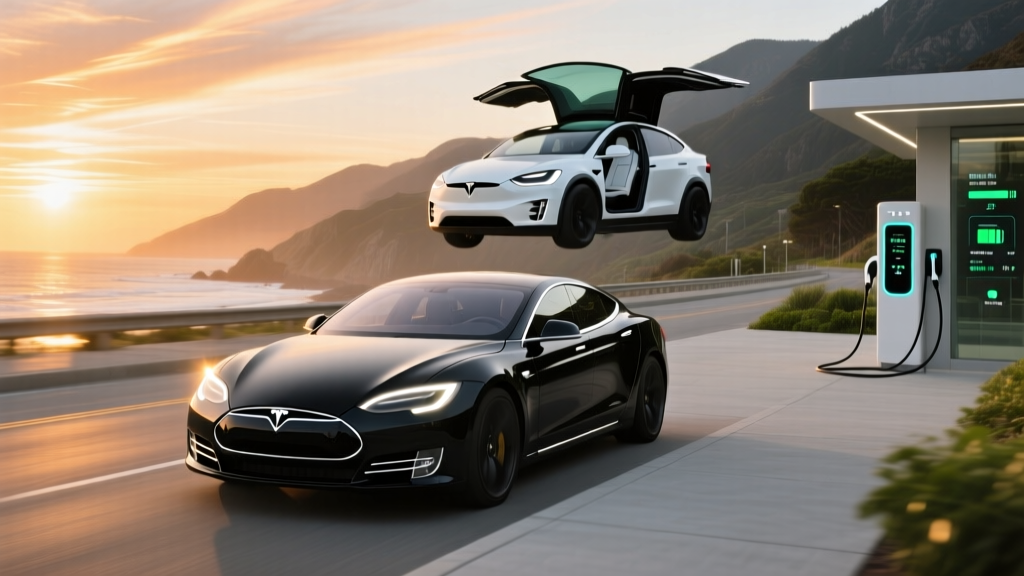
For over a decade, the Tesla Model S sedan and Model X SUV have served as the flagship benchmarks of the electric vehicle market. But persistent rumors and shifting production priorities have led many shoppers to ask: are the Tesla Model S and Model X discontinued? As of early 2026, Tesla has not issued a formal discontinuation announcement for either nameplate, but production volumes have dwindled significantly, and the company's strategic focus has pivoted heavily toward higher-volume, lower-cost platforms. Here is everything buyers and owners need to know about the current status, remaining specifications, and what the future holds for Tesla's original luxury EVs.
Current Status: Are the Model S and Model X Being Phased Out?
Tesla's Fremont factory continues to list the Model S and Model X on its production roster, but output has been deprioritized in favor of the Model Y, Cybertruck, and next-generation platforms. Order lead times on Tesla's website fluctuate between limited availability and extended waits, suggesting low-volume, build-to-order production rather than a full shutdown.
Industry analysts have noted that Tesla's investment in retooling Fremont for newer architectures signals a long-term phase-out trajectory. While you can still configure and order a 2026 Model S or Model X today, the writing is on the wall: these vehicles are entering their twilight years. For buyers, this raises real questions about long-term parts availability, resale value, and whether the premium pricing still justifies the purchase.
2026 Tesla Model S: Remaining Specifications & Pricing
The 2026 Model S continues in two primary trims: the Long Range and the Plaid. Both retain the 100 kWh (nominal) battery pack with NMC (nickel manganese cobalt) chemistry — Tesla has not transitioned these flagship models to LFP, which remains reserved for standard-range, lower-cost vehicles due to its lower energy density.
| Spec | Long Range | Plaid |
|---|---|---|
| EPA Range | 402 miles | 359 miles |
| Battery (usable) | ~95 kWh, NMC | ~95 kWh, NMC |
| Drivetrain | Dual-Motor AWD | Tri-Motor AWD |
| Horsepower | 670 hp | 1,020 hp |
| 0–60 mph | 3.1 seconds | 1.99 seconds |
| Top Speed | 155 mph | 200 mph |
| Max DC Fast Charge | 250 kW | 250 kW |
| 10–80% DC Charge | ~30 minutes | ~30 minutes |
| Level 2 Home Charge | 11.5 kW (~41 mi/hr) | 11.5 kW (~41 mi/hr) |
| EPA Efficiency | 124 MPGe (27 kWh/100mi) | 116 MPGe (29 kWh/100mi) |
| Cargo Volume | 28 cu ft (rear) + frunk | 28 cu ft (rear) + frunk |
| Base MSRP | $79,990 | $94,990 |
2026 Tesla Model X: Remaining Specifications & Pricing
The Model X also persists in Long Range and Plaid trims, sharing the same powertrain architecture as the Model S but in a heavier, three-row SUV body. The signature falcon-wing rear doors remain, along with a panoramic windshield and optional six-seat configuration.
| Spec | Long Range | Plaid |
|---|---|---|
| EPA Range | 335 miles | 326 miles |
| Battery (usable) | ~95 kWh, NMC | ~95 kWh, NMC |
| Drivetrain | Dual-Motor AWD | Tri-Motor AWD |
| Horsepower | 670 hp | 1,020 hp |
| 0–60 mph | 3.8 seconds | 2.5 seconds |
| Top Speed | 155 mph | 163 mph |
| Max DC Fast Charge | 250 kW | 250 kW |
| 10–80% DC Charge | ~31 minutes | ~31 minutes |
| Level 2 Home Charge | 11.5 kW (~34 mi/hr) | 11.5 kW (~34 mi/hr) |
| EPA Efficiency | 104 MPGe (32 kWh/100mi) | 100 MPGe (34 kWh/100mi) |
| Cargo (behind 3rd row) | 15.8 cu ft | 15.8 cu ft |
| Cargo (max, seats folded) | 88.1 cu ft | 88.1 cu ft |
| Towing Capacity | 5,000 lbs | 5,000 lbs |
| Base MSRP | $84,990 | $99,990 |
Charging Speed: What Owners Actually Experience
Both the Model S and Model X peak at 250 kW on V3 Tesla Superchargers. However, peak rate is not sustained rate. The charge curve tapers significantly above 60% state of charge (SoC). Here is what a typical session looks like:
| SoC Window | Average Power | Approx. Time | Miles Added |
|---|---|---|---|
| 10–30% | ~230 kW | ~6 min | ~100 mi |
| 30–60% | ~180 kW | ~10 min | ~130 mi |
| 60–80% | ~110 kW | ~14 min | ~100 mi |
| 80–100% | ~40 kW | ~25 min | ~60 mi |
At home on a Level 2 Wall Connector (48 amps / 11.5 kW), the Model S adds approximately 41 miles of range per hour, while the Model X adds about 34 miles per hour. A full overnight charge from 20% to 80% takes roughly 5–6 hours on Level 2. Both vehicles use the NACS (North American Charging Standard) connector natively — no adapter needed at Tesla Superchargers, and adapters are available for CCS networks.
Preconditioning matters: Navigate to a Supercharger using the built-in navigation, and the battery thermal management system will warm the pack for optimal charge acceptance. Skipping preconditioning in cold weather can add 10–15 minutes to a 10–80% session.
Federal Tax Credit Eligibility: What the §30D Rules Mean for Model S & X
This is where the 2026 reality gets complicated for Tesla's flagships. Under current IRS §30D rules, the federal EV tax credit has strict MSRP caps:
- Sedans (Model S): MSRP cap of $55,000
- SUVs (Model X): MSRP cap of $80,000
The Model S starts at $79,990 and the Model X at $84,990 — neither qualifies for the $7,500 federal tax credit under current rules. Both exceed their respective MSRP caps significantly. Additionally, buyer income limits apply ($150,000 single / $300,000 joint for modified AGI), and battery component and critical mineral sourcing requirements must be met — but the MSRP cap alone disqualifies both vehicles regardless of buyer income.
| Requirement | Model S | Model X | Status |
|---|---|---|---|
| MSRP Cap | $55,000 (sedan) | $80,000 (SUV) | ❌ Both exceed |
| Buyer Income Cap | $150K/$300K AGI | $150K/$300K AGI | Varies by buyer |
| Battery Sourcing | Partial compliance | Partial compliance | ⚠️ Moot — MSRP disqualifies |
| Point-of-Sale Transfer | N/A | N/A | N/A |
| Eligible for $7,500? | No | No | ❌ |
Some state-level incentives may still apply (check your state's energy office), and the used EV credit (up to $4,000 under §25E) may be available if purchasing a pre-owned Model S or X under $25,000 from a dealer — though finding one at that price point is increasingly rare.
Who Should Still Consider a Model S or Model X?
Despite the phase-out signals and tax-credit ineligibility, these vehicles retain genuine strengths for specific buyers:
Pros
- Class-leading range (402 mi EPA, Model S LR)
- Access to the full Tesla Supercharger network (17,000+ stalls in North America)
- Plaid performance remains unmatched in production sedans/SUVs
- Over-the-air updates continue as of 2026
- Model X offers genuine 3-row seating + 5,000-lb towing
- Strong build quality improvements post-2023 refresh
Cons
- No federal tax credit — full MSRP out of pocket
- Likely depreciation hit if discontinuation is confirmed
- Parts and service uncertainty long-term
- Aging interior design vs. newer luxury EV competitors
- 250 kW peak charge rate now trails 350 kW competitors (Hyundai/Kia E-GMP, Porsche Taycan)
- Model X falcon-wing doors prone to sensor and seal issues
Competitor Comparison: What to Buy Instead
If you're cross-shopping the Model S or Model X in 2026, several alternatives deserve serious consideration — many of which do qualify for the federal tax credit:
| Vehicle | EPA Range | 0–60 mph | Max DC kW | Base MSRP | Tax Credit? |
|---|---|---|---|---|---|
| Tesla Model S LR | 402 mi | 3.1s | 250 kW | $79,990 | No |
| Lucid Air Pure | 419 mi | 3.5s | 250 kW | $69,900 | No (MSRP) |
| BMW i7 xDrive60 | 318 mi | 4.5s | 195 kW | $105,700 | No (MSRP) |
| Mercedes EQS 450+ | 352 mi | 5.9s | 200 kW | $104,400 | No (MSRP) |
| Tesla Model X LR | 335 mi | 3.8s | 250 kW | $84,990 | No |
| Kia EV9 GT-Line AWD | 270 mi | 5.0s | 350 kW | $73,900 | Partial* |
| Rivian R1S (Dual) | 352 mi | 4.5s | 220 kW | $79,900 | Partial* |
*Credit eligibility depends on trim MSRP, buyer income, and battery sourcing. Verify at fueleconomy.gov before purchasing.
For sedan buyers prioritizing range, the Lucid Air Pure offers more EPA miles at a lower price — though its charging network access relies on CCS adapters and third-party networks. For three-row SUV buyers, the Kia EV9 and Rivian R1S present compelling alternatives with better tax-credit prospects and, in the EV9's case, significantly faster 350 kW DC charging capability.
Battery Longevity & Warranty Coverage
Tesla covers the Model S and Model X battery and drive unit with an 8-year / 150,000-mile warranty (whichever comes first), with a guaranteed minimum 70% capacity retention over that period. This is among the better warranty terms in the luxury EV segment.
Real-world degradation data from Tesla's fleet suggests NMC packs in the Model S/X typically lose 8–12% capacity over the first 100,000 miles, with the curve flattening significantly thereafter. Many 2017–2020 Model S vehicles with 150,000+ miles still report 82–88% state of health (SoH). The key longevity practices remain: avoid frequent 100% charges (set daily limit to 80%), minimize DC fast-charging when Level 2 is available, and use preconditioning in extreme temperatures.
A full battery replacement out of warranty costs approximately $15,000–$22,000 depending on the pack configuration, based on current service center estimates. This is a real long-term ownership cost to budget for if you plan to keep the vehicle beyond the warranty period.
Frequently Asked Questions
Are the Tesla Model S and Model X officially discontinued in 2026?
No. As of early 2026, Tesla has not formally discontinued either model. Both remain configurable and orderable on Tesla's website, though production volumes have been significantly reduced. Industry consensus expects a phase-out within the next 1–3 model years as Tesla prioritizes newer platforms.
What is the real-world range of the 2026 Model S Long Range?
The EPA rates it at 402 miles. In real-world highway driving at 70–80 mph, expect 320–340 miles. In cold weather (below freezing), plan for 280–320 miles. These figures assume moderate use of climate control and standard tire pressures.
How fast do the Model S and Model X charge at home and on the road?
On a V3 Supercharger, both peak at 250 kW and reach 10–80% in approximately 30 minutes. At home on a Level 2 Wall Connector (11.5 kW), the Model S adds ~41 miles per hour and the Model X adds ~34 miles per hour. A full overnight charge from 20–80% takes 5–6 hours.
Does either model qualify for the $7,500 federal EV tax credit?
No. Under IRS §30D rules, the Model S exceeds the $55,000 sedan MSRP cap and the Model X exceeds the $80,000 SUV cap. Neither is eligible regardless of buyer income. Consult a tax professional for state-specific incentives.
Is it worth buying a Model S or Model X if they may be discontinued?
It depends on your risk tolerance. Discontinuation typically accelerates depreciation and can complicate long-term parts availability. However, Tesla is contractually and legally obligated to support vehicles with safety recalls and software updates for years after production ends. If you can secure a favorable price and don't plan to sell within 2–3 years, the vehicles remain excellent performers. If resale value is a priority, consider a higher-volume competitor.
What's the biggest drawback of the Model X?
Beyond the price and tax-credit ineligibility, the falcon-wing rear doors remain the Model X's most polarizing feature. They require precise sensor calibration, can struggle in tight garages with low ceilings, and have historically been a source of water-seal and alignment issues. The 5,000-lb towing capacity also significantly reduces range when towing — expect a 40–50% range penalty with a loaded trailer.