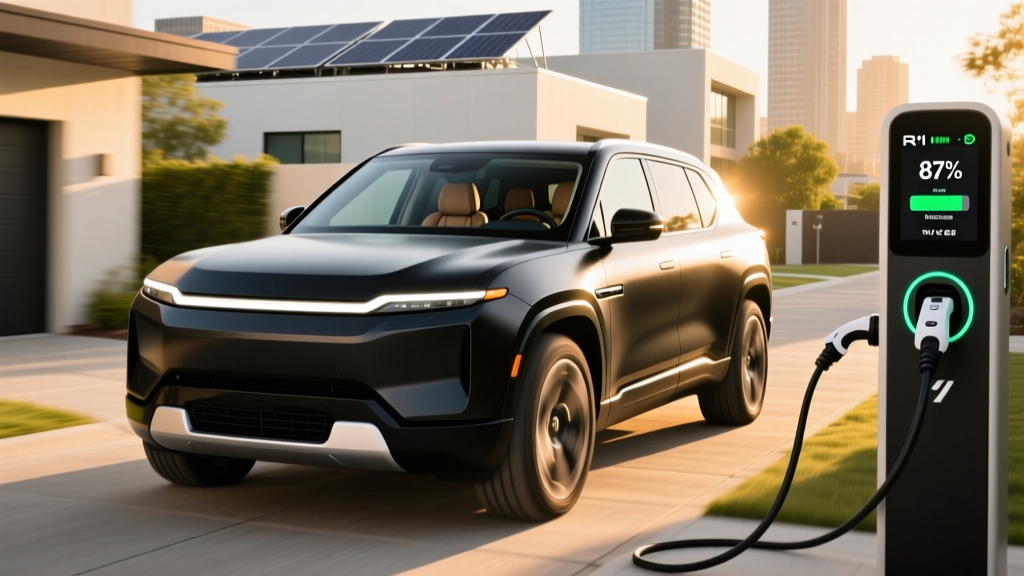
Rivian's production ramp through mid-2025 has put the automaker on firmer footing than ever. With Rivian Q2 2025 deliveries reaching approximately 13,700 vehicles — a roughly 12% year-over-year increase — the company demonstrated it could scale its Normal, Illinois factory while simultaneously launching its midsize R2 platform and fulfilling commercial van commitments. For buyers considering a Rivian in 2026, those delivery numbers matter: they signal improving build quality, shorter wait times, and a maturing service network.
But production volume alone doesn't answer the real question: Is the 2025 Rivian R1S — the three-row electric SUV that anchors the brand — the right EV for your household? We break down range, charging, pricing, tax credit eligibility, and real-world ownership to help you decide.
2025 Rivian R1S at a Glance: Core Specifications
| Spec | Dual-Motor (Standard) | Tri-Motor | Quad-Motor |
|---|---|---|---|
| EPA Range (Max Pack) | 410 mi | 390 mi | 350 mi |
| Battery (usable) | 149 kWh (Max, NMC) | 149 kWh (Max, NMC) | 149 kWh (Max, NMC) |
| Horsepower | 665 hp | 850 hp | 1,025 hp |
| 0-60 mph | 4.5 sec | 3.6 sec | 2.9 sec |
| Drivetrain | AWD (dual-motor) | AWD (tri-motor) | AWD (quad-motor) |
| Towing Capacity | 7,700 lbs | 7,700 lbs | 7,700 lbs |
| Peak DC Fast Charge | 220 kW | 220 kW | 220 kW |
| 10-80% DC Charge Time | ~30 min | ~30 min | ~30 min |
| Level 2 Home Charging | 11.5 kW (~30 mi/hr) | 11.5 kW (~30 mi/hr) | 11.5 kW (~30 mi/hr) |
| MPGe (combined) | 73 MPGe | 70 MPGe | 65 MPGe |
| Base MSRP | $79,900 | $99,900 | $105,900 |
Range: EPA Sticker vs. Real-World Expectations
Real-World Expectation: 330-360 miles highway at 70-75 mph; 280-310 miles in freezing temperatures with cabin heat; 370-390 miles mixed city/suburban driving.
The R1S Dual-Motor with the Max Pack achieves an EPA-estimated 410 miles — one of the highest figures in any production three-row SUV. That number is legitimate for mixed suburban driving at moderate speeds. However, the R1S is a 6,900-pound vehicle with the aerodynamic profile of a traditional SUV, and physics demands a toll at highway speeds.
In sustained 75-mph highway driving at 65°F, expect roughly 330-360 miles before needing to charge. Drop the ambient temperature to 25°F or below, engage the resistive cabin heater (the R1S uses a heat pump, which helps, but extreme cold still cuts into the pack), and that range can compress to 280-310 miles. The 20" All-Terrain wheel option shaves approximately 15-20 miles off any of these figures due to higher rolling resistance.
Rivian's battery management system reserves a top and bottom buffer — the 149 kWh usable figure already accounts for this, so you won't accidentally brick the pack by running it to zero. The Standard Pack (106 kWh usable) drops EPA range to roughly 270 miles for the Dual-Motor, which is more appropriate for buyers who charge at home nightly and rarely road-trip.
Charging Speed: DC Fast Charge and Home Level 2
The R1S peaks at 220 kW on a DC fast charger, which is competitive with the broader market but not class-leading. The charge curve is the more important detail: the R1S sustains roughly 200+ kW from 10% to about 45% state of charge (SoC), then tapers progressively. By 70% SoC, you're typically seeing 120-140 kW, and above 85%, the rate drops below 60 kW. This is standard behavior for large NMC packs, but it means the advertised 10-80% time of approximately 30 minutes assumes a charger capable of sustaining its rated output and a properly preconditioned battery.
| Charging Level | Power (kW) | Speed | Typical Use Case |
|---|---|---|---|
| Level 1 (120V) | ~1.4 kW | ~3-4 mi/hr | Emergency / trickle top-off |
| Level 2 (240V, 48A) | 11.5 kW | ~30 mi/hr | Home overnight charging (primary) |
| DC Fast Charge | Peak 220 kW | ~140 mi in 15 min (10-50% SoC) | Road trips, public stations |
Preconditioning matters. The R1S will warm or cool its battery pack automatically when you navigate to a DC fast charger in the infotainment system. Skip this step and your initial charge rate may be capped at 80-100 kW until the pack reaches optimal temperature — adding 10-15 minutes to your stop.
For home charging, the R1S accepts up to 11.5 kW on a Level 2 wall connector (48 amps on a 60-amp circuit). That translates to roughly 30 miles of range per hour of charging, or a full Standard Pack replenishment in about 9 hours and a Max Pack in approximately 13 hours. Most owners charging overnight from 20% to 80% will wake to a full-ready vehicle in 6-7 hours. A 200-amp electrical panel is typically sufficient, but a panel upgrade to 200A or higher may be needed for older homes — budget $1,500-$3,000 for that contingency.
Performance and Driving Dynamics
Even the "entry-level" Dual-Motor R1S produces 665 horsepower and hits 60 mph in 4.5 seconds. That's sports-sedan territory in a vehicle with three rows and 104.7 cubic feet of total cargo volume (with second and third rows folded). The Tri-Motor cuts that to 3.6 seconds, and the Quad-Motor — with independent motors at each wheel enabling torque vectoring — drops to a startling 2.9 seconds.
But straight-line speed isn't the R1S's defining characteristic. It's the air suspension and adaptive damping that make this 6,900-pound SUV handle with composure that defies its mass. The adjustable ride height offers 6.2 inches of travel, from a low "Park" mode for easier loading to a maximum 14.9 inches of ground clearance for off-road use. The R1S has completed the Rubicon Trail — a feat few production SUVs of any powertrain can claim.
The Quad-Motor's tank turn capability (rotating the vehicle in place by spinning left and right wheels in opposite directions) remains a party trick more than a daily feature, but it's genuinely useful in tight trail situations. The R1S's 7,700-pound towing capacity leads the electric SUV segment, though expect range to drop 40-50% when towing at highway speeds — a reality for all EVs.
Interior, Cargo, and Technology
The R1S seats up to seven passengers across three rows. Second-row legroom is a generous 38.9 inches, but the third row is best suited for children or short trips — 28.9 inches of legroom is tight for adults on longer drives. Cargo volume behind the third row is 10.4 cubic feet, expanding to 46.7 cu ft with the third row folded and 104.7 cu ft with both rear rows down. The front trunk (frunk) adds 11.0 cu ft of lockable, weather-sealed storage — ideal for charging cables, groceries, or gear you want separated from the cabin.
The 15.6-inch center touchscreen runs Rivian's proprietary infotainment software, which has improved substantially through over-the-air (OTA) updates since launch. Wireless Apple CarPlay and Android Auto are not supported — Rivian's native system is the only option. The interface is clean and responsive, but the lack of smartphone mirroring frustrates some buyers who prefer familiar maps and music apps. The 12.3-inch digital instrument cluster is clear and configurable, and a 6.8-inch rear touchscreen lets second-row passengers control climate and media.
The Rivian Driver+ system provides adaptive cruise control and lane-centering on divided highways. This is a SAE Level 2 driver-assistance system — meaning the driver must remain attentive with hands on or near the wheel at all times. It is not autonomous driving. The system performs competently on well-marked interstates but can struggle with faded lane lines and construction zones. A hands-free highway driving feature has been in development, but as of early 2026, Rivian's system still requires steering-wheel contact.
Pricing, Trims, and Federal Tax Credit Eligibility
| Trim | Base MSRP | As-Tested (Typical) | Federal Tax Credit (§30D) |
|---|---|---|---|
| Dual-Motor (Standard Pack) | $79,900 | $82,000-$85,000 | Up to $7,500* |
| Dual-Motor (Max Pack) | $87,900 | $90,000-$95,000 | Up to $7,500* |
| Tri-Motor (Max Pack) | $99,900 | $102,000-$108,000 | Up to $7,500* |
| Quad-Motor (Max Pack) | $105,900 | $110,000-$118,000 | Up to $7,500* |
*Federal tax credit eligibility requires meeting all IRS §30D conditions. As of 2025-2026 rules, the R1S qualifies as an SUV (MSRP cap: $80,000). This means the Dual-Motor Standard Pack at $79,900 base MSRP clears the cap, but optioned models and all higher trims exceed $80,000 and are ineligible for the new-vehicle credit. Buyer adjusted gross income must not exceed $300,000 (joint), $225,000 (head of household), or $150,000 (single). Additionally, battery components and critical minerals must meet escalating domestic-content and free-trade-agreement sourcing thresholds. Always verify current eligibility at IRS.gov and consult a tax professional before relying on the credit.
The point-of-sale transfer option, introduced in 2024, allows eligible buyers to apply the credit as an immediate price reduction at the dealer rather than waiting for a tax refund. This effectively lowers the out-of-pocket cost of the Dual-Motor Standard Pack to approximately $72,400 before destination and state fees — a compelling entry point for a 410-mile-range three-row SUV.
For buyers priced out of the new-vehicle credit, the used EV tax credit (up to $4,000 or 30% of the sale price, whichever is lower) applies to pre-owned R1S models sold for $25,000 or more through a licensed dealer, with lower income caps ($150,000 joint / $75,000 single). As more 2022-2023 R1S vehicles enter the used market, this becomes a viable path.
Pros and Cons
- Class-leading 410-mile EPA range (Dual-Motor Max Pack)
- Genuine off-road capability with air suspension and 14.9" ground clearance
- 7,700-lb towing capacity — highest among electric SUVs
- Spacious frunk (11.0 cu ft) and flexible cargo layout
- Regular OTA updates improving functionality post-purchase
- Strong build quality improvements reflected in Q2 2025 delivery volumes
- Only the base Dual-Motor Standard Pack qualifies for the $7,500 federal credit (MSRP cap)
- No Apple CarPlay or Android Auto — Rivian-native infotainment only
- Third-row seating is tight for adults (28.9" legroom)
- 220 kW peak DC charging is outpaced by Hyundai/Kia's 350 kW architecture
- Towing reduces range by 40-50% — plan charging stops accordingly
- Driver+ system requires hands-on-wheel; no hands-free highway mode yet
How the R1S Compares to Key Rivals
The R1S competes in a narrow but growing segment of three-row electric SUVs. The Tesla Model X starts at roughly $79,990 and offers similar range (348 mi EPA for the Long Range), faster Supercharger network access (250 kW peak), and a more mature software ecosystem, but its third row is comparably tight and its panel-gap quality remains inconsistent. The Kia EV9 undercuts significantly at $54,900 base (with the $7,500 credit available on multiple trims) but offers only 304 miles of range and less power. The BMW iX is a two-row competitor with a more luxurious interior but no third-row option.
For buyers who need three rows, genuine off-road capability, and maximum range, the R1S occupies a unique position. For budget-conscious families who prioritize tax credit access and can accept 300 miles of range, the Kia EV9 is a strong alternative worth cross-shopping.
Who Should Buy the 2025 Rivian R1S?
Look elsewhere if: Your budget is under $60,000, you primarily drive in the city with nightly home charging (a smaller-battery EV or PHEV suffices), you need adult-friendly third-row seating for daily use, or you require Apple CarPlay/Android Auto integration.
Frequently Asked Questions
What is the real-world range of the Rivian R1S?
The EPA rates the Dual-Motor Max Pack at 410 miles. In real-world highway driving at 70-75 mph, expect 330-360 miles. In sub-freezing temperatures, plan for 280-310 miles. The Standard Pack delivers roughly 270 miles EPA and 220-240 miles real-world highway.
How fast does the R1S charge at home and on the road?
On a DC fast charger, the R1S peaks at 220 kW and charges from 10-80% in approximately 30 minutes with proper preconditioning. At home on a Level 2 (240V, 48A) charger, it adds roughly 30 miles of range per hour, fully replenishing the Standard Pack overnight in about 9 hours.
Does the Rivian R1S qualify for the $7,500 federal EV tax credit?
Only the Dual-Motor Standard Pack at its $79,900 base MSRP falls under the $80,000 SUV cap for the §30D new-vehicle credit. All other trims and optioned configurations exceed the cap and are ineligible. Buyer income limits and battery-sourcing requirements also apply. Verify at IRS.gov.
What did Rivian Q2 2025 delivery numbers look like?
Rivian delivered approximately 13,700 vehicles in Q2 2025, a roughly 12% increase year-over-year. This included both R1 consumer vehicles and Amazon EDV commercial vans. The rising delivery cadence signals improved production efficiency and shorter customer wait times heading into 2026.
Is the Rivian R1S worth buying over the Tesla Model X or Kia EV9?
If you prioritize range (410 mi), off-road capability, and towing (7,700 lbs), the R1S has no direct equal. If budget and tax credit access are paramount, the Kia EV9 offers strong value at $54,900 with credit eligibility across multiple trims. The Model X wins on charging infrastructure (Supercharger network) but lags on interior quality and third-row space.
What is the battery warranty on the Rivian R1S?
Rivian covers the R1S battery and drive unit for 8 years or 175,000 miles, whichever comes first, with a capacity retention threshold of 70%. The limited vehicle warranty is 5 years or 60,000 miles.