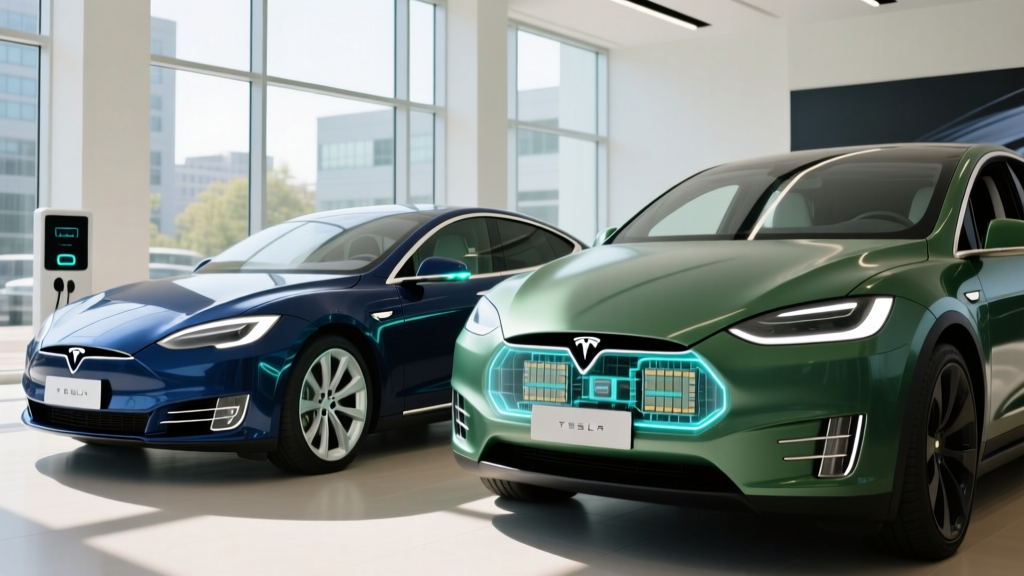
The 2026 Tesla Model S and Model X: Still the Benchmark?
Tesla's flagship sedan and SUV entered 2026 with incremental but meaningful refinements. The latest Tesla Model S and Model X update brings revised battery management software, a slightly larger usable battery buffer, updated interior materials, and expanded Supercharger network compatibility following the industry-wide NACS adoption. For buyers researching these vehicles, the core appeal remains: class-leading range, access to the most reliable DC fast-charging network in North America, and performance figures that embarrass sports cars costing twice as much.
But the competitive landscape has shifted dramatically since these vehicles launched. The Lucid Air, BMW iX, Mercedes EQS, and Rivian R1S now challenge Tesla's dominance in the premium EV space. This review breaks down exactly what the 2026 Model S and Model X deliver — with real-world numbers, not marketing claims — so you can decide if they're still the right choice.
Specs at a Glance: Model S vs. Model X (2026)
| Spec | Model S Long Range | Model S Plaid | Model X Long Range | Model X Plaid |
|---|---|---|---|---|
| EPA Range | 402 mi | 359 mi | 348 mi | 326 mi |
| Battery (usable) | ~100 kWh (NMC) | ~100 kWh (NMC) | ~100 kWh (NMC) | ~100 kWh (NMC) |
| Drivetrain | Dual-Motor AWD | Tri-Motor AWD | Dual-Motor AWD | Tri-Motor AWD |
| Horsepower | 670 hp | 1,020 hp | 670 hp | 1,020 hp |
| 0–60 mph | 3.1 sec | 1.99 sec | 3.8 sec | 2.5 sec |
| MPGe (combined) | 120 MPGe | 116 MPGe | 109 MPGe | 105 MPGe |
| Efficiency | 28 kWh/100 mi | 29 kWh/100 mi | 31 kWh/100 mi | 32 kWh/100 mi |
| Max DC Fast Charge | 250 kW | 250 kW | 250 kW | 250 kW |
| 10–80% DC Charge | ~30 min | ~30 min | ~32 min | ~32 min |
| Level 2 Home Charge | 11.5 kW (~41 mi/hr) | 11.5 kW (~41 mi/hr) | 11.5 kW (~36 mi/hr) | 11.5 kW (~36 mi/hr) |
| Cargo Volume | 28 cu ft (rear) + frunk | 28 cu ft (rear) + frunk | 88.1 cu ft (max) + frunk | 88.1 cu ft (max) + frunk |
| Seating | 5 passengers | 5 passengers | 5, 6, or 7 passengers | 5, 6, or 7 passengers |
| Base MSRP | $74,990 | $89,990 | $79,990 | $94,990 |
Source: fueleconomy.gov and Tesla official specifications. Prices exclude destination fee.
Real-World Range: What the EPA Number Doesn't Tell You
Model S Long Range: EPA 402 mi — Expect ~330–350 mi highway at 75 mph; ~270–300 mi in freezing temps.
Model X Long Range: EPA 348 mi — Expect ~280–310 mi highway at 75 mph; ~230–260 mi in freezing temps.
Plaid trims: Subtract ~10–15% from the figures above due to higher energy draw from tri-motor powertrain.
The Model S Long Range's 402-mile EPA rating remains one of the highest of any production EV sold in the US. But EPA range is a blended cycle that includes low-speed city driving where regenerative braking recovers significant energy. On a sustained 75 mph highway run — the scenario that matters for road trips — expect to use roughly 300–330 Wh/mile in the Model S, which translates to about 330–350 real miles before the battery is depleted.
Cold weather compounds this. At 20°F, lithium-ion cells experience higher internal resistance, and cabin heating draws heavily from the pack despite Tesla's heat pump system. Plan for 15–25% range reduction in sustained freezing conditions. The Model X, with its larger frontal area and heavier curb weight (~5,100 lbs vs. ~4,560 lbs for the Model S), loses proportionally more range at highway speeds and in cold weather.
One advantage Tesla retains: the navigation system's range prediction is among the most accurate in the industry. When you enter a Supercharger destination, the car preconditions the battery for optimal charge speed and displays a remarkably precise arrival state-of-charge estimate. This reduces the psychological burden of range planning on road trips.
Charging Speed: 250 kW Peak, but Read the Fine Print
| Charging Level | Power / Rate | Miles Added per Hour | Notes |
|---|---|---|---|
| Level 1 (120V household) | ~1.4 kW | ~4–5 mi/hr | Emergency/trickle only |
| Level 2 (240V home) | 11.5 kW (48A) | ~36–41 mi/hr | Full charge overnight (~10 hrs) |
| DC Fast Charge (V3 Supercharger) | Peak 250 kW | ~170 mi in 15 min | 10–80% in ~30 min |
| DC Fast Charge (CCS/NACS third-party) | Up to 250 kW | Varies by station | Now compatible via NACS standard |
Tesla's V3 Superchargers deliver a peak of 250 kW, but — and this is critical for trip planning — that peak only holds between roughly 10% and 30% state of charge. Above 50% SoC, the charge rate tapers significantly. By 80%, you're pulling closer to 60–80 kW. This charge-curve taper is why Tesla quotes 10–80% in about 30 minutes, not 0–100%.
The Model S and Model X still use a 400-volt architecture, unlike the 800V systems in the Lucid Air, Hyundai Ioniq 5, and Porsche Taycan, which sustain peak charge rates longer. In practice, a Model S at a V3 Supercharger will add approximately 200 miles in 15 minutes when starting at a low state of charge — impressive, but not class-leading anymore.
For home charging, the onboard charger accepts up to 11.5 kW (48 amps) on a Level 2 circuit. This requires a 60-amp dedicated circuit and a hardwired Tesla Wall Connector or NACS-compatible Level 2 unit. Expect a full overnight charge from 10% to 100% in roughly 10 hours. Most owners who plug in nightly never need to think about charging logistics for daily driving.
With the 2026 model year, Tesla has fully transitioned to the NACS (North American Charging Standard) connector, which is now the native plug. The broader Supercharger network — over 6,500 stalls in North America — remains Tesla's strongest competitive moat. Reliability and uptime at Superchargers consistently outperform Electrify America, EVgo, and other third-party networks, according to J.D. Power EV Experience Index data.
Performance: From Quick to Absurd
The Long Range dual-motor powertrain produces 670 horsepower and delivers a 3.1-second 0–60 mph time in the Model S. That's supercar territory from a five-passenger sedan with a 28-cubic-foot trunk. The Model X Long Range hits 60 mph in 3.8 seconds — remarkable for a three-row SUV weighing over 5,100 pounds.
The Plaid trims are engineering showcases: three electric motors (one front, two rear) producing 1,020 horsepower. The Model S Plaid's claimed 1.99-second 0–60 mph time (with rollout subtracted) makes it one of the quickest production cars ever built. The Model X Plaid manages 2.5 seconds — a physics-defying number for a vehicle that can seat seven people.
But here's what spec sheets don't convey: instant torque delivery means these cars feel even faster than their 0–60 numbers suggest in real-world driving. There's no transmission kickdown, no turbo lag, no rev build. You press the accelerator and the car simply goes — immediately and violently. The Plaid's carbon-sleeved rotors in the rear motors allow sustained high-RPM operation without the power fade that affects some competing EVs during repeated hard acceleration.
Pricing, Trims, and the Federal Tax Credit Question
| Trim | Base MSRP | As-Tested (typical) | §30D Credit Eligible? |
|---|---|---|---|
| Model S Long Range | $74,990 | $78,000–$82,000 | No — exceeds $55,000 sedan MSRP cap |
| Model S Plaid | $89,990 | $93,000–$98,000 | No — exceeds $55,000 sedan MSRP cap |
| Model X Long Range | $79,990 | $83,000–$88,000 | No — exceeds $80,000 SUV MSRP cap |
| Model X Plaid | $94,990 | $98,000–$103,000 | No — exceeds $80,000 SUV MSRP cap |
This is where the news turns disappointing for bargain-seeking buyers. Under current IRS §30D rules, the federal EV tax credit phases out for sedans with an MSRP above $55,000 and SUVs/pickups/vans above $80,000. Additionally, buyer income caps apply ($150,000 single / $300,000 joint MAGI), and the vehicle must meet critical-mineral and battery-component sourcing requirements. See the full rules at IRS.gov §30D.
Neither the Model S nor the Model X qualifies for the $7,500 federal tax credit in 2026. The Model S trims exceed the $55,000 sedan cap, and both Model X trims exceed the $80,000 SUV cap. Buyers should not expect a point-of-sale credit transfer at the dealership for these vehicles.
Some states offer additional incentives that may partially offset the purchase price — check your state's energy office or the Alternative Fuels Data Center for current local programs. Consult a tax professional for eligibility specifics.
Interior, Tech, and Daily Livability
Tesla's minimalist interior philosophy remains polarizing. The 2026 Model S and Model X feature a 17-inch center touchscreen (now with improved resolution and faster processing), a 12.3-inch driver instrument cluster (reintroduced after early complaints about its omission), and a rear-seat 8-inch screen for climate and entertainment controls.
What works well:
- The glass roof provides an airy, open cabin feel and excellent outward visibility
- Over-the-air updates continue to add features years after purchase
- The HEPA air filtration system ("Bioweapon Defense Mode") is genuinely effective — among the best cabin air filtration in any vehicle
- The front trunk (frunk) adds practical cargo space: ~5.3 cu ft in both models
- Wireless phone charging, ventilated front seats, and heated rear seats are standard
Notable drawbacks:
- No physical stalks for turn signals or gear selection — everything is via touchscreen or steering-wheel buttons, which remains frustrating for many drivers
- Build quality, while improved from earlier years, still doesn't match the panel-gap consistency of BMW or Mercedes at this price point
- The yoke steering wheel (optional) is controversial and can be impractical for low-speed maneuvers and parking
- Rear-seat comfort in the Model S is adequate but not luxurious for the price — competitors like the Lucid Air and Mercedes EQS offer more rear-seat legroom and amenities
Cargo and passenger space: The Model S offers 28 cu ft behind the rear seats and ~5.3 cu ft in the frunk. The Model X is far more versatile: up to 88.1 cu ft with rear seats folded, plus the frunk, and available six- or seven-passenger seating. For families needing three rows, the Model X is one of very few EVs offering this configuration.
Driver Assistance: Autopilot and FSD (Supervised)
Tesla Autopilot and Full Self-Driving (Supervised) are SAE Level 2 driver-assistance systems. The driver must remain fully attentive, keep hands on the wheel, and be prepared to take over at any moment. These systems do not make the vehicle autonomous. Only Level 4 services like Waymo operate without a human driver in defined areas.
Every Model S and Model X comes standard with Tesla's Basic Autopilot, which includes adaptive cruise control, lane-centering, and automatic emergency braking. The optional FSD (Supervised) package — currently priced at $8,000 or $99/month — adds automatic lane changes, navigation-guided on/off-ramp handling, traffic-light and stop-sign recognition, and enhanced parking features.
In practice, FSD (Supervised) handles most highway driving competently but still requires regular driver intervention for construction zones, faded lane markings, and complex intersections. City-street performance has improved substantially through neural-network updates, but the system still makes occasional puzzling decisions that demand driver vigilance. It is a convenience feature, not a replacement for an attentive driver.
Warranty, Battery Longevity, and Ownership Costs
Tesla covers the Model S and Model X with:
- Basic vehicle warranty: 4 years / 50,000 miles
- Battery and drive unit warranty: 8 years / 150,000 miles (Long Range) with a minimum 70% capacity retention threshold
- Plaid battery/drive unit: 8 years / 150,000 miles, 70% retention
Tesla uses NMC (nickel-manganese-cobalt) chemistry in both vehicles. NMC offers higher energy density than LFP (lithium iron phosphate), enabling the long range figures, but it degrades slightly faster over time and benefits from being kept between 20–80% SoC for daily use. Tesla's battery management system is among the most sophisticated in the industry, and real-world data from high-mileage owners suggests 10–15% degradation over the first 150,000 miles is typical.
Battery replacement, should it be needed out of warranty, is estimated at $12,000–$20,000 depending on the pack configuration. However, Tesla's track record shows that complete pack failures are rare; most degradation is gradual capacity loss rather than catastrophic failure.
Insurance costs tend to be higher than comparable ICE vehicles — expect $2,500–$4,000 annually depending on your profile and state. Tesla's own insurance product is available in many states and may offer competitive rates based on real-time driving behavior.
✅ Pros
- Class-leading EPA range (402 mi, Model S LR)
- Access to the Supercharger network — most reliable in North America
- Exceptional performance across all trims
- Continuous OTA software updates add value post-purchase
- Model X offers rare 3-row EV seating
- Best-in-class navigation range prediction
❌ Cons
- No federal tax credit eligibility (MSRP cap)
- 400V architecture limits sustained DC fast-charge rate
- Interior quality still lags German competitors at this price
- No physical turn-signal stalks or gear selector
- FSD (Supervised) requires constant driver attention despite the name
- Higher insurance costs than ICE equivalents
Who Should Buy the 2026 Model S or Model X?
Choose the Model S Long Range if: You want the longest-range EV sedan available, frequently road-trip, value Supercharger access, and prioritize acceleration and tech over traditional luxury interior appointments.
Choose the Model X if: You need three-row seating in an EV, want a large cargo area with a power liftgate, and your family's daily driving plus weekend trips fall within the 280–310 mile real-world highway range envelope.
Look elsewhere if: You need the federal tax credit (consider the Model 3 or Model Y), you want a traditional luxury interior (BMW iX, Mercedes EQS), or you prioritize the fastest possible DC charging (Lucid Air, Hyundai Ioniq 5 with 800V architecture).
Frequently Asked Questions
What is the real-world range of the 2026 Tesla Model S?
The Model S Long Range carries a 402-mile EPA rating. In real-world highway driving at 75 mph, expect approximately 330–350 miles. In freezing temperatures, that drops to roughly 270–300 miles. The Plaid trim's higher energy consumption reduces these figures by about 10–15%.
How fast does the Model S or Model X charge at home and on the road?
On a Level 2 home charger (11.5 kW / 48A), the Model S adds about 41 miles of range per hour, fully charging overnight in ~10 hours. On a V3 Supercharger, DC fast charging peaks at 250 kW, achieving 10–80% in approximately 30 minutes — though the charge rate tapers substantially above 50% SoC.
Does the 2026 Model S or Model X qualify for the $7,500 federal EV tax credit?
No. Under current IRS §30D rules, the Model S exceeds the $55,000 MSRP cap for sedans, and the Model X exceeds the $80,000 cap for SUVs. Neither vehicle qualifies for the federal new clean vehicle credit. State-level incentives may still apply — check the Alternative Fuels Data Center for your state.
Is the Model S worth buying over the Lucid Air or Mercedes EQS?
The Model S wins on range (402 vs. Lucid Air's ~390 mi on certain trims, and significantly more than the EQS), Supercharger network access, and performance-per-dollar. The Lucid Air offers a more luxurious interior and faster 800V charging. The Mercedes EQS prioritizes ride comfort and traditional luxury. Your priority — tech/network vs. interior luxury vs. charging architecture — should drive the decision.
How long will the Tesla Model S battery last?
Tesla warranties the battery for 8 years or 150,000 miles with a minimum 70% capacity retention. Real-world data from high-mileage owners suggests NMC packs in Teslas lose approximately 10–15% capacity over 150,000 miles. With proper care (avoiding frequent 100% charges, using daily charge limits of 80–90%), the pack should remain functional well beyond 200,000 miles.
Can the Model X tow?
Yes. The 2026 Model X is rated to tow up to 5,000 pounds when properly equipped with the factory tow package. Expect range to decrease by 30–50% when towing at highway speeds, depending on trailer weight and aerodynamics.