Quick Verdict: Is the 2026 Tesla Model S Lunar Silver Still a Luxury EV Benchmark?
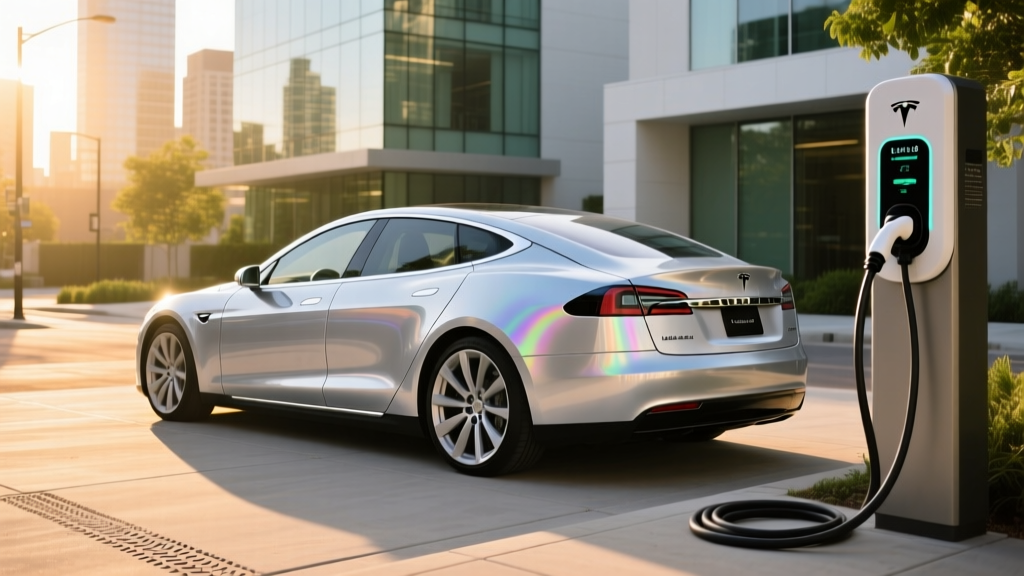
The 2026 Tesla Model S in Lunar Silver remains one of the longest-range, fastest-charging luxury sedans on the market. With an EPA-estimated 402 miles in the Long Range trim and a 250 kW DC fast-charging peak, it continues to set the bar for road-trip capability. The Lunar Silver exterior — a premium multi-coat paint option that replaced Quicksilver in recent model years — adds a striking, cool-toned metallic finish that pairs well with Tesla's minimalist interior.
But the Model S faces stiffer competition than ever. The Lucid Air, Mercedes EQS, and BMW i7 all offer compelling alternatives with varying trade-offs in range, luxury, and price. This review breaks down every spec that matters — from real-world range and charging curves to tax credit eligibility — so you can decide if the Model S Lunar Silver is the right luxury EV for your garage.
| Spec | Value |
|---|---|
| EPA Range | 402 miles |
| Battery (usable) | ~100 kWh (NMC) |
| Drivetrain | Dual-Motor AWD |
| Horsepower | 670 hp |
| 0–60 mph | 3.1 seconds |
| Peak DC Fast Charge | 250 kW |
| 10–80% DC Charge | ~30 minutes |
| Level 2 Home Charge | 11.5 kW (~44 mi/hr) |
| MPGe (combined) | 120 MPGe |
| Efficiency | 28 kWh/100 mi |
| Cargo Volume | 28 cu ft (rear) + frunk |
| Rear Legroom | 35.4 inches |
| Battery Warranty | 8 years / 150,000 miles |
| Base MSRP | $79,990 |
Real-World Range: What 402 EPA Miles Actually Looks Like
EPA Estimate: 402 miles (Long Range AWD)
Real-World Expectation: ~320–350 miles highway (70–80 mph); ~260–290 miles in cold weather (below 32°F); ~370+ miles city/mixed driving with regen.
The Model S Long Range's 402-mile EPA sticker is among the highest of any production EV sold in the US. According to fueleconomy.gov, the combined efficiency rating is 120 MPGe (28 kWh/100 mi), which is respectable for a 4,800-lb luxury sedan with 670 hp.
In practice, highway range drops noticeably. At sustained 75–80 mph speeds, expect 320–350 miles before needing a charge stop. Cold weather (below freezing) further reduces usable range by 20–30%, putting real winter range around 260–290 miles. Tesla's heat pump helps mitigate cabin heating draw, but battery chemistry still loses efficiency in the cold.
City and suburban driving with frequent regenerative braking opportunities gets you closest to — or occasionally above — the EPA number. Tesla's one-pedal driving mode and strong regen make stop-and-go traffic an efficiency advantage rather than a penalty.
Charging Speed: Supercharger Network Advantage
| Charging Level | Power | Miles Added per Hour | Notes |
|---|---|---|---|
| Level 1 (120V) | ~1.4 kW | ~3–4 mi/hr | Emergency/trickle only |
| Level 2 (240V, 48A) | 11.5 kW | ~44 mi/hr | Home Wall Connector; full charge in ~10 hrs |
| DC Fast Charge (V3 Supercharger) | 250 kW peak | ~200 mi in 15 min | 10–80% in ~30 min; tapers above 80% |
| DC Fast Charge (V4 Supercharger) | Up to 250 kW | Similar to V3 | Newer stalls; CCS adapter not needed |
The Model S peaks at 250 kW on Tesla's V3 and V4 Superchargers using its native NACS connector. A 10–80% session takes approximately 30 minutes, though the charge curve is not flat. You'll see peak rates (230–250 kW) between roughly 10–40% State of Charge, after which the rate tapers to ~150 kW by 60% and drops further above 80%. This is standard lithium-ion behavior — the battery management system restricts current to protect cell longevity.
Preconditioning matters. Navigate to a Supercharger using the built-in navigation and the car will warm or cool the battery to optimal temperature before you arrive. Skipping preconditioning (e.g., pulling into a charger without navigation routing) can add 5–10 minutes to your session, especially in cold weather.
For home charging, Tesla's Wall Connector at 48 amps delivers 11.5 kW, adding roughly 44 miles of range per hour. An overnight charge (8–10 hours) easily replenishes a full battery. Installation typically requires a 60-amp dedicated circuit; budget $500–$2,000 for electrician work depending on panel proximity and local permit requirements.
One key advantage: Tesla's NACS connector gives Model S owners native access to the Supercharger network — over 50,000 stalls globally — without adapters. As of 2026, many non-Tesla chargers (Electrify America, EVgo) also support NACS, though CCS1 remains common at older stations.
Performance and Driving Dynamics
The 2026 Model S Long Range delivers 670 horsepower through its dual-motor all-wheel-drive powertrain. The 0–60 mph sprint takes 3.1 seconds — quicker than most sports cars and dramatically faster than any combustion luxury sedan in its price bracket.
The Plaid trim (1,020 hp, 0–60 in 1.99 seconds) is available for those who want hypercar acceleration, starting at $94,990. However, the Long Range strikes a better balance for most buyers: it's still brutally fast while offering the full 402-mile range (Plaid drops to ~359 miles EPA).
Ride quality has improved with Tesla's adaptive air suspension, which adjusts damping and ride height based on speed and road conditions. The cabin is noticeably quieter than earlier Model S generations, though panel-gap consistency and some interior material choices still lag behind Mercedes and BMW at this price point.
Interior, Cargo, and Technology
The Model S interior centers on a 17-inch touchscreen that controls virtually every vehicle function — climate, media, navigation, vehicle settings, and even the glovebox. A 12.3-inch digital instrument cluster sits behind the yoke-style steering wheel (a conventional round wheel is available as a no-cost option).
Rear passengers get 35.4 inches of legroom — adequate for adults but less generous than the BMW i7 (40.2 in) or Mercedes EQS (42.0 in). The rear seat is best suited for two adults; the center position is tight. A small rear touchscreen provides climate and media controls for back-seat riders.
Cargo space is a standout: 28 cubic feet behind the rear seats (hatchback-style liftgate) plus a front trunk (frunk) for additional storage. Fold the rear seats and you get over 64 cu ft — far more than any sedan competitor. This practicality is a genuine advantage for families and road trippers.
Driver Assistance: Tesla's Autopilot comes standard and includes adaptive cruise control, lane centering, and automatic emergency braking. Full Self-Driving (Supervised) is a $8,000 add-on that enables automated lane changes, navigation-based on/off-ramp handling, and city-street driving.
Important: Both Autopilot and FSD (Supervised) are SAE Level 2 driver-assistance systems. The driver must remain attentive, keep hands on the wheel, and be prepared to take over at any moment. These are not "self-driving" systems. Only Level 4 services like Waymo operate without a human driver in defined areas.
Pricing, Tax Credits, and Ownership Cost
| Trim | Base MSRP | Lunar Silver Paint | FSD Add-On | Est. As-Tested |
|---|---|---|---|---|
| Long Range | $79,990 | +$2,500 | +$8,000 | $90,490 |
| Plaid | $94,990 | +$2,500 | +$8,000 | $105,490 |
Does the Model S Qualify for the Federal EV Tax Credit?
No — the Model S does not qualify for the §30D federal tax credit in 2026. The IRS imposes an MSRP cap of $55,000 for sedans (and $80,000 for SUVs/pickups/vans). Since the Model S starts at $79,990 and is classified as a sedan, it exceeds the cap regardless of battery sourcing or buyer income.
§30D Federal Tax Credit Requirements (2026):
- MSRP Cap: ≤$55,000 for sedans; ≤$80,000 for SUVs/trucks/vans — Model S fails (sedan at $79,990+)
- Buyer Income Cap: AGI ≤$150,000 (single) / ≤$300,000 (joint) — must also be met
- Battery Sourcing: Critical minerals and battery components must meet phased-in domestic/FTEA sourcing thresholds
- Point-of-Sale Transfer: Eligible credits can be transferred to the dealer at purchase for an immediate price reduction
Some states offer additional incentives (California's CVRP, Colorado's tax credit, etc.) that may partially offset the cost. Check your state's energy office or DMV for current programs — these vary widely and change frequently.
Total cost of ownership still favors the Model S over comparable gas luxury sedans (BMW 5 Series, Mercedes E-Class) when you factor in fuel savings (~$1,500–$2,500/year less in electricity vs. premium gas), minimal maintenance (no oil changes, fewer brake replacements thanks to regen), and strong resale value. However, insurance premiums tend to run 15–30% higher than equivalent ICE vehicles — get quotes before purchasing.
Warranty and Battery Longevity
Tesla covers the Model S battery and drive unit for 8 years or 150,000 miles, whichever comes first, with a guaranteed minimum 70% capacity retention over that period. The basic vehicle warranty is 4 years / 50,000 miles.
The Model S uses NMC (nickel manganese cobalt) battery chemistry, which offers high energy density (enabling the 402-mile range) but degrades slightly faster than LFP (lithium iron phosphate) over thousands of cycles. Real-world data from high-mileage Tesla owners shows typical degradation of 8–12% over the first 100,000 miles, after which the curve flattens considerably.
Best practices for NMC longevity:
- Set daily charge limit to 80% (use the car's built-in charge-limit slider)
- Charge to 100% only when needed for long trips
- Avoid leaving the car at very low SoC (below 10%) for extended periods
- Use preconditioning for DC fast charging to reduce thermal stress
Pros, Cons, and Who Should Buy
Pros
- Class-leading 402-mile EPA range
- 250 kW Supercharger access with native NACS — best road-trip network
- 3.1-second 0–60 mph (Long Range); Plaid offers 1.99s
- 28 cu ft hatchback cargo + frunk — far more practical than sedan rivals
- Continuous OTA software updates add features over time
- Strong resale value relative to luxury EV competitors
Cons
- Does not qualify for $7,500 federal tax credit (MSRP cap)
- Rear legroom (35.4 in) trails BMW i7 and Mercedes EQS
- Interior materials and panel gaps still lag German luxury rivals
- Yoke steering takes significant adaptation; not ideal for all drivers
- FSD (Supervised) is expensive ($8,000) and remains Level 2
- Insurance premiums higher than ICE equivalents
Choose the Model S Lunar Silver if: You prioritize maximum range, Supercharger network access, and hatchback practicality. You want the longest road-trip EV available and value performance.
Consider the Lucid Air if: You want even more range (516 mi Grand Touring) and a more luxurious, spacious rear seat — and can accept a smaller charging network.
Consider the BMW i7 if: Traditional luxury, ride comfort, and rear-seat space matter more than maximum range. You're willing to trade ~100 miles of range for a more premium cabin.
2026 Model S Lunar Silver FAQ
What is the real-world range of the 2026 Tesla Model S?
The EPA rates the Model S Long Range at 402 miles. In real-world highway driving at 70–80 mph, expect 320–350 miles. Cold weather (below freezing) reduces this to roughly 260–290 miles. City driving with regenerative braking can approach or slightly exceed the EPA figure.
How fast does the Model S charge at home and on the road?
On a Tesla V3/V4 Supercharger (250 kW peak), a 10–80% charge takes approximately 30 minutes, adding up to 200 miles in 15 minutes. At home on a Level 2 Wall Connector (11.5 kW), you'll add about 44 miles per hour — a full overnight charge covers even a depleted battery.
Does the 2026 Model S qualify for the $7,500 federal EV tax credit?
No. Under IRS §30D rules, sedans must have an MSRP at or below $55,000 to qualify. The Model S starts at $79,990, disqualifying it regardless of battery sourcing or buyer income. Check your state for additional incentives that may apply.
What paint is Lunar Silver, and how much does it cost?
Lunar Silver is a premium multi-coat metallic exterior color available on the Model S. It costs $2,500 extra over the no-cost Pearl White Multi-Coat. It features a cool, silver-blue metallic tone that shifts subtly in different lighting conditions.
Is the Model S worth buying over the Lucid Air or Mercedes EQS?
The Model S wins on charging infrastructure (Supercharger network), cargo practicality (hatchback), and performance-per-dollar. The Lucid Air offers more range and a more spacious rear seat. The Mercedes EQS and BMW i7 deliver superior luxury materials and ride refinement. Your choice depends on which attributes you prioritize.
How long will the Model S battery last?
Tesla warranties the battery for 8 years / 150,000 miles with a minimum 70% capacity retention guarantee. Real-world data from the Tesla fleet suggests NMC batteries typically lose 8–12% capacity over the first 100,000 miles, with slower degradation thereafter. Many Model S vehicles have exceeded 200,000 miles on the original battery pack.
Is Autopilot or FSD self-driving?
No. Both Autopilot and Full Self-Driving (Supervised) are SAE Level 2 driver-assistance systems. You must remain alert, keep your hands on the wheel, and be ready to take control at any time. Tesla's FSD handles more scenarios (city streets, intersections) than basic Autopilot, but it is not autonomous. Only Level 4 services like Waymo operate without a human driver.