BYD Shark Precio: What You Need to Know About BYD's Plug-In Hybrid Pickup
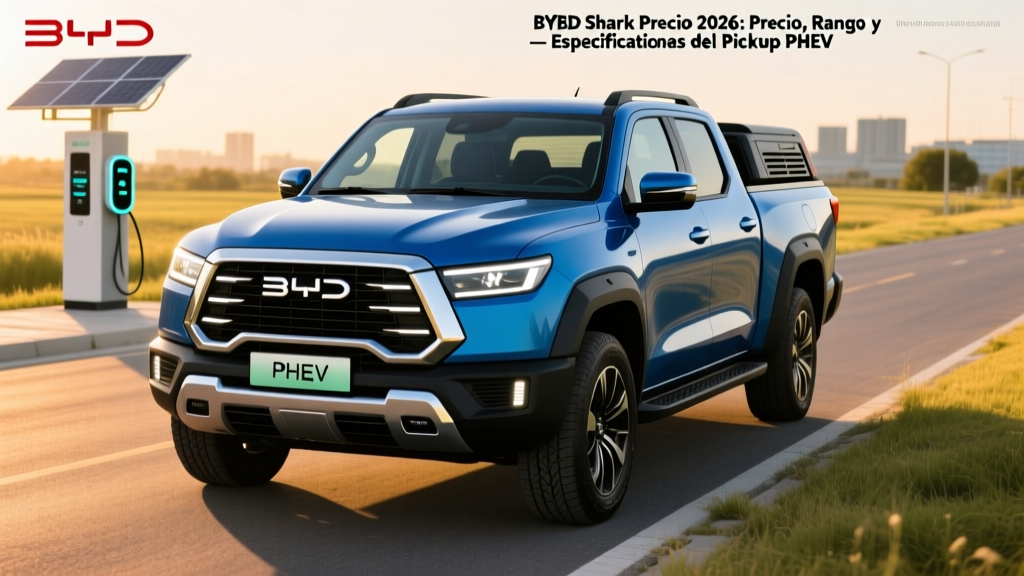
The BYD Shark 6 is the Chinese automaker's first foray into the global pickup truck segment, and the search term "BYD Shark precio" reflects growing curiosity about whether this plug-in hybrid (PHEV) truck will land in the U.S. market — and at what price. As of early 2026, the BYD Shark is not sold in the United States and has no confirmed U.S. launch date. It is currently available in select markets including Mexico, Australia, and parts of South America. This review breaks down everything known about the Shark 6's specs, pricing in international markets, powertrain details, and what a hypothetical U.S. launch would mean for buyers comparing it against the Ford Maverick PHEV, Toyota Tacoma, and Chevrolet Colorado.
BYD Shark 6 Powertrain, Battery, and Electric Range
The BYD Shark 6 uses BYD's proprietary DMO (Dual Mode Off-Road) super hybrid platform — the same architecture underpinning the Leopard 5 SUV. This is not a simple parallel hybrid; it's a series-parallel system that can operate in pure EV mode, series hybrid mode (engine generates electricity for the motors), or parallel mode (engine and motors drive the wheels simultaneously).
Battery Chemistry and Capacity
The Shark 6 is equipped with a 26.7 kWh BYD Blade battery using LFP (lithium iron phosphate) chemistry. LFP cells are known for their thermal stability, longer cycle life, and lower cost compared to NMC (nickel manganese cobalt) packs, though they carry a slight energy-density penalty. The Blade form factor — long, thin prismatic cells arranged in a structural array — also serves as a chassis stiffening element.
| Spec | Value |
|---|---|
| Engine | 1.5L turbocharged inline-4 |
| Electric Motors | Dual (front + rear), AWD |
| Combined Output | 430 HP / 479 lb-ft torque |
| Battery | 26.7 kWh, LFP (BYD Blade) |
| EV-Only Range (NEDC) | ~62 mi / 100 km |
| EV-Only Range (EPA est.) | ~48–52 mi (estimated) |
| Total Range | 500+ mi (combined gas + electric) |
| 0–100 km/h (0–62 mph) | 5.7 seconds |
| Drivetrain | AWD (dual-motor electric + ICE) |
| Fuel Tank | ~18.5 gal (70 L) |
Charging: DC Fast Charge and Level 2 Home Charging
PHEV charging speeds are typically an afterthought, but the Shark 6's relatively large 26.7 kWh pack makes charging speed a legitimate consideration. Here's what the specs look like based on international-market data:
| Charge Level | Power (kW) | Time / Rate |
|---|---|---|
| Level 1 (120V household) | ~1.4 kW | ~18–20 hours (0–100%) |
| Level 2 (240V, 32A) | ~6.6 kW | ~4 hours (0–100%) |
| DC Fast Charge (CCS) | ~40–50 kW peak | ~30 min (10–80%) |
The DC fast-charging capability is modest compared to full BEVs — a 40–50 kW peak rate is typical for PHEVs with smaller battery packs. You won't see the Shark 6 at a 350 kW Electrify America station pulling anywhere near its theoretical maximum. However, for a PHEV, the ability to add ~30 miles of EV range in 15 minutes on a DC charger is practical for topping up during errands.
For home charging, a standard Level 2 wallbox (240V, 32A) will refill the pack from empty in roughly four hours — meaning an overnight charge is more than sufficient for daily commuting on electric power alone. The 6.6 kW onboard charger is the limiting factor, not the wallbox.
BYD Shark Precio: International Pricing and U.S. Tax Credit Outlook
The "BYD Shark precio" search trend is driven primarily by buyers in Mexico, where the truck launched in late 2024, and Australian buyers, where it arrived in 2025. Here's a breakdown of known pricing:
| Market | Trim | Price (local) | Price (USD est.) |
|---|---|---|---|
| Mexico | Base | ~899,900 MXN | ~$45,000 |
| Australia | Base | ~AUD $57,900 | ~$38,000 |
| Brazil | Base | ~R$ 289,900 | ~$50,000 |
| U.S. (hypothetical) | Estimated | N/A | ~$40,000–$48,000 |
Would the BYD Shark Qualify for the U.S. Federal EV Tax Credit?
This is where things get complicated — and likely unfavorable for BYD. Under the current IRS §30D clean vehicle credit rules:
- MSRP cap: Trucks, SUVs, and vans must have an MSRP at or below $80,000. The Shark 6 would likely clear this bar.
- Income cap: Buyer AGI must not exceed $150,000 (single) / $300,000 (joint).
- Battery sourcing requirement: A percentage of critical minerals and battery components must be sourced from the U.S. or free-trade-agreement countries. This percentage increases annually.
- FEOC exclusion: Vehicles with battery components manufactured by a "foreign entity of concern" (FEOC) — which includes Chinese companies like BYD — are disqualified from the credit entirely as of 2024 (components) and 2025 (critical minerals).
Because BYD manufactures its own Blade batteries in China, the Shark 6 would almost certainly be classified as containing FEOC battery components, making it ineligible for the $7,500 federal tax credit regardless of where the vehicle is assembled. This is a significant competitive disadvantage against U.S.-assembled PHEVs like the Ford Maverick (if a PHEV variant launches) or the Jeep Wrangler 4xe.
Performance, Towing, and Off-Road Capability
The dual-motor AWD layout gives the Shark 6 a 5.7-second 0–62 mph time — genuinely quick for a midsize pickup and comparable to a Toyota Tacoma TRD Sport. The 430 combined horsepower figure comes from the front motor (~200 HP), rear motor (~230 HP), and the 1.5L turbo engine (~190 HP), though peak combined output is limited by the power electronics rather than simple addition.
Key capability figures:
- Towing capacity: ~2,500 kg (5,500 lbs) braked — competitive with a V6 Tacoma
- Payload: ~800 kg (1,760 lbs)
- Ground clearance: ~220 mm (8.7 inches)
- Wading depth: ~600 mm (23.6 inches)
- Drive modes: Sand, Mud, Snow, Sport, Eco, Normal, plus an EV-priority mode
The DMO platform's series-hybrid mode is particularly useful off-road, where the engine can act as a generator to maintain battery charge while the electric motors deliver instant torque at low speeds. This is similar to the approach used in the Hummer EV's range-extended mode, though at a lower power level.
Interior, Technology, and Driver Assistance
The Shark 6 interior follows BYD's recent design language with a large, rotating central touchscreen (15.6 inches) and a 10.25-inch digital instrument cluster. The center screen can pivot between landscape and portrait orientation — a BYD signature that's more gimmick than utility, but it does allow full-screen navigation in portrait mode.
Infotainment and Connectivity
- 15.6-inch rotating touchscreen with wireless Apple CarPlay and Android Auto
- Wireless phone charging pad (15W)
- 360-degree camera system with transparent chassis view
- OTA (over-the-air) software updates
- V2L (Vehicle-to-Load) capability — can power external devices up to ~3.3 kW via the charge port or bed outlet
ADAS / Driver Assistance (SAE Level 2)
The BYD Shark 6's driver-assistance suite is a Level 2 system — it provides combined steering and acceleration/braking assistance, but the driver must remain fully engaged with hands on the wheel and eyes on the road at all times. This is not autonomous or "self-driving" capability.
Standard ADAS features include:
- Adaptive cruise control with stop-and-go
- Lane-keeping assist and lane-departure warning
- Automatic emergency braking (front and rear)
- Blind-spot monitoring with rear cross-traffic alert
- Traffic sign recognition
The ADAS suite is competent but not class-leading. It lacks the hands-free highway driving capability of GM's Super Cruise or Ford's BlueCruise, which are available on the Silverado and F-150 respectively.
Cargo Space, Dimensions, and Practicality
As a midsize pickup, the Shark 6 slots between the compact Ford Maverick and the full-size Ford F-150 in terms of exterior dimensions. It's closest in size to the Toyota Tacoma and Chevrolet Colorado.
| Dimension | Measurement |
|---|---|
| Overall Length | ~212 in (5,380 mm) |
| Wheelbase | ~126 in (3,200 mm) |
| Bed Length | ~60 in (1,520 mm) |
| Bed Width (between wheel wells) | ~44 in (1,120 mm) |
| Rear Legroom | ~37 in (estimated) |
| Seating | 5 passengers (crew cab) |
The bed is slightly shorter than a Tacoma's 5-foot bed, and the between-the-wells width won't accommodate a standard 4x8 sheet of plywood flat. For buyers who need maximum bed utility, this is a limitation. The crew cab rear seat is adult-friendly for shorter trips but doesn't match the Colorado's rear legroom.
Warranty and Long-Term Ownership Considerations
In international markets, BYD offers a 6-year / 150,000 km (~93,000 mile) vehicle warranty and an 8-year / 160,000 km (~100,000 mile) battery warranty with a capacity retention threshold of 70%. If the Shark 6 were to launch in the U.S., BYD would likely need to match or exceed the 8-year/100,000-mile battery warranty standard set by competitors to gain buyer confidence.
The LFP Blade battery is a long-term durability positive. LFP chemistry typically withstands 3,000+ full charge cycles before reaching 80% capacity — roughly double the cycle life of NMC cells. For a PHEV with a 26.7 kWh pack that's frequently cycled between 20% and 100%, this translates to well over 150,000 miles of daily EV-mode use before meaningful degradation occurs.
However, BYD's lack of a U.S. dealer network and parts infrastructure is a serious ownership risk. Even if the truck launches stateside, early adopters should expect limited service centers and potentially long wait times for collision or drivetrain parts.
BYD Shark 6 vs. Key Competitors: Is It Worth Buying?
✓ Pros
- Strong 430 HP output with 5.7s 0–60
- ~50 mi EV-only range covers most commutes
- LFP Blade battery offers excellent longevity
- V2L capability for job-site or camping power
- Competitive international pricing (~$38K–$45K)
- Standard AWD with legitimate off-road modes
✗ Cons
- Not available in the U.S. (no confirmed launch)
- Would NOT qualify for $7,500 federal tax credit (FEOC battery rules)
- No U.S. dealer or parts network
- Modest 40–50 kW DC fast-charge speed
- Bed shorter than Tacoma/Colorado competitors
- No hands-free highway driving (Level 2 only)
If BYD were to bring the Shark 6 to the U.S., it would face an uphill battle. The FEOC battery sourcing exclusion effectively adds $7,500 to its effective price compared to qualifying competitors. A U.S.-spec Shark 6 at ~$45,000 without the credit competes against the Toyota Tacoma i-FORCE MAX hybrid (which also doesn't qualify for the credit but has an established dealer network) and the Ford Maverick Hybrid (significantly cheaper, though less powerful and FWD-only).
Consider the BYD Shark 6 if: You live in Mexico, Australia, or South America where it's sold; you want a PHEV pickup for daily EV commuting with weekend towing; you value LFP battery longevity and V2L capability.
Look elsewhere if: You're a U.S. buyer (it's not available and the tax credit wouldn't apply anyway); you need a full-size bed for work; you want hands-free highway driving; you prioritize dealer support and parts availability.
Frequently Asked Questions
What is the real-world electric range of the BYD Shark 6?
BYD claims 100 km (62 mi) on the NEDC cycle. Real-world EPA-equivalent range is estimated at 48–52 miles in mild weather. In cold conditions (below 40°F), expect 35–40 miles of EV-only driving before the gasoline engine activates. Once the battery is depleted, the 1.5L turbo engine takes over, providing 500+ total miles of range.
How fast does the BYD Shark charge at home and on DC fast chargers?
On a Level 2 home charger (240V, 6.6 kW), the 26.7 kWh battery charges from empty in approximately 4 hours. On a DC fast charger, it peaks at around 40–50 kW, reaching 10–80% in roughly 30 minutes. These speeds are typical for PHEVs — adequate for daily use but not comparable to full BEV fast-charging.
How much would the BYD Shark cost in the U.S.?
There is no confirmed U.S. pricing because the Shark 6 is not sold in the United States. Based on international pricing, a U.S. launch would likely start around $40,000–$48,000 MSRP. However, the truck would almost certainly not qualify for the $7,500 federal EV tax credit due to BYD's Chinese-manufactured battery triggering FEOC exclusions under IRS §30D rules.
Does the BYD Shark qualify for the federal EV tax credit?
No — if it were sold in the U.S., the BYD Shark 6 would be ineligible for the §30D clean vehicle credit. The IRS excludes vehicles with battery components from "foreign entities of concern" (FEOC), and BYD manufactures its Blade batteries in China. This applies regardless of where the vehicle is assembled or the buyer's income level.
Is the BYD Shark better than the Ford Maverick Hybrid or Toyota Tacoma Hybrid?
It depends on the use case. The Shark 6 offers more power (430 HP vs. Maverick's 191 HP) and genuine AWD with off-road capability. However, the Maverick Hybrid starts under $30,000 and achieves 42 MPG combined. The Tacoma i-FORCE MAX offers superior dealer support, a larger bed, and proven reliability. For U.S. buyers, both established alternatives make more sense until BYD builds a domestic infrastructure.
What is the BYD Shark's towing capacity?
The Shark 6 is rated to tow approximately 2,500 kg (5,500 lbs) with a braked trailer — competitive with V6 midsize trucks. The electric motors provide strong low-end torque for trailer launches, though sustained highway towing will deplete the battery quickly and rely primarily on the gasoline engine.
Sources: IRS §30D Clean Vehicle Credit Rules, EPA Fuel Economy, BYD official international press materials.