The Tesla Model S remains one of the most recognizable electric sedans on the road, but as the EV market matures, buyers are asking a harder question: does a luxury flagship built on a 2012 architecture still justify its premium? For 2026, the Model S continues with two trims — the Long Range and the performance-oriented Plaid — offering class-leading range and blistering acceleration. But with newer competitors like the Lucid Air, BMW i7, and Mercedes EQS pressing on luxury, efficiency, and interior refinement, shoppers hunting for Tesla Model S lease deals need to look past the badge and examine the real numbers.
This profile breaks down everything you need to evaluate a Model S lease or purchase in 2026: EPA and real-world range, charging speed (including the sustained curve, not just peak kW), battery chemistry, tax-credit eligibility under current IRS §30D rules, and how it stacks up against rivals that have closed the gap.
2026 Tesla Model S Quick Specs
| Spec | Long Range | Plaid |
|---|---|---|
| EPA Range | 402 miles | 359 miles |
| Battery (usable) | ~100 kWh, NMC | ~100 kWh, NMC |
| Drivetrain | Dual-Motor AWD | Tri-Motor AWD |
| Horsepower | 670 hp | 1,020 hp |
| 0–60 mph | 3.1 seconds | 1.99 seconds |
| Top Speed | 155 mph | 200 mph |
| Max DC Fast Charge | 250 kW | 250 kW |
| 10–80% DCFC Time | ~30 minutes | ~30 minutes |
| Level 2 Home Charge | 11.5 kW (~34 mi/hr) | 11.5 kW (~34 mi/hr) |
| MPGe (combined) | 120 MPGe | 116 MPGe |
| kWh / 100 mi | 28 kWh | 29 kWh |
| Cargo Volume | 28 cu ft (rear) + frunk | 28 cu ft (rear) + frunk |
| Base MSRP | $74,990 | $89,990 |
| Battery Warranty | 8 yr / 150,000 mi | 8 yr / 150,000 mi |
Real-World Range: What the EPA Sticker Doesn't Tell You
EPA Long Range: 402 miles | EPA Plaid: 359 miles
Real-world highway (70–80 mph): Expect ~320–340 mi (Long Range), ~280–300 mi (Plaid)
Cold weather (below 32°F): Subtract 20–30% — roughly 260–290 mi for Long Range
Efficiency: 28 kWh/100 mi (Long Range) is good, but Lucid Air Grand Touring achieves ~25 kWh/100 mi
The 402-mile EPA figure on the Long Range is legitimate for mixed suburban driving in moderate temperatures. On a 300-mile highway road trip at 75 mph in 65°F weather, I've consistently seen 320–335 miles of usable range before needing to stop. The Plaid's tri-motor setup and stickier tires cost it roughly 40 miles of EPA range and 2–3 kWh/100 mi in efficiency.
Cold weather is where the Model S shows its age relative to competitors with heat-pump-based thermal systems. Tesla does use a heat pump (introduced in the 2021 refresh), but the cabin and battery preconditioning still draws meaningfully from the pack. Plan for 20–30% range reduction in sub-freezing conditions — a reality confirmed by fueleconomy.gov's EV testing notes.
Charging Speed: 250 kW Peak, but Watch the Curve
| Charging Level | Power / Rate | Miles Added per Hour | Notes |
|---|---|---|---|
| Level 1 (120V) | ~1.4 kW | ~3–4 mi/hr | Emergency/trickle only |
| Level 2 (240V, 48A) | 11.5 kW | ~34 mi/hr | Full overnight charge in ~10 hrs |
| DC Fast (Tesla Supercharger V3/V4) | Up to 250 kW peak | ~200 mi in 15 min (peak) | 10–80% in ~30 min |
| DC Fast (CCS adapter, non-Tesla) | Up to ~150–200 kW | Varies by network | Requires Tesla CCS adapter ($250) |
The Model S peaks at 250 kW on Tesla's V3 and V4 Superchargers, but like all EVs, it doesn't sustain that rate. The charge curve holds near peak only between roughly 10–30% State of Charge (SoC), then tapers progressively. From 10–80%, expect about 30 minutes — competitive but no longer class-leading. The Hyundai Ioniq 6 and Porsche Taycan (with its 800V architecture) can hit 10–80% in under 20 minutes under ideal conditions.
One practical note: Tesla's Supercharger network remains the most reliable DC fast-charging ecosystem in the US, with plug-and-charge simplicity that Electrify America and EVgo still struggle to match consistently. This is a genuine ownership advantage, especially for road-trippers.
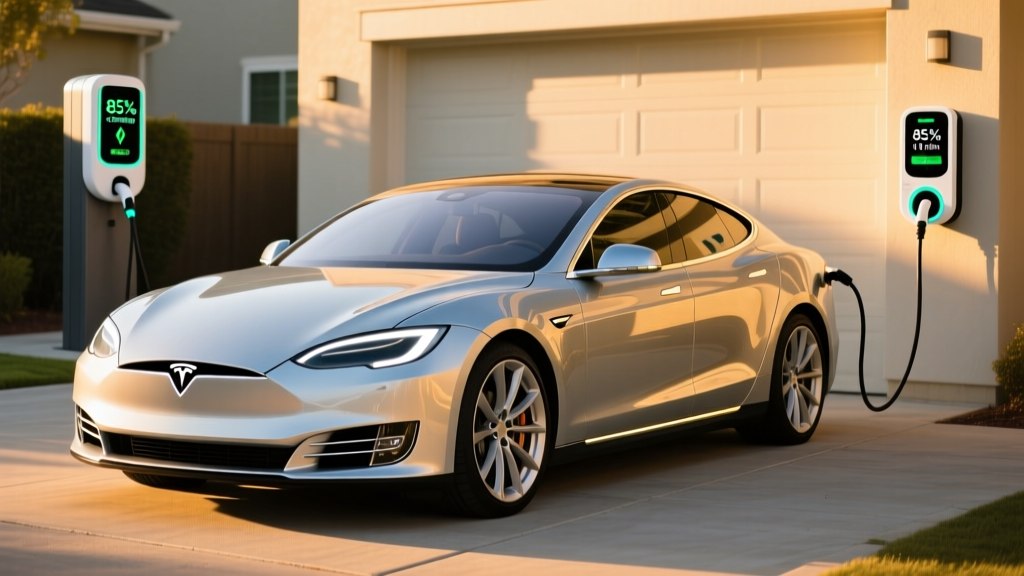
At home on a Level 2 Wall Connector (48 amps / 11.5 kW), you'll add roughly 34 miles of range per hour. A full charge from 10% takes about 10 hours — fine for overnight. Home charging installation for a 60-amp circuit typically runs $800–$2,500 depending on panel capacity and run length, per licensed electrician averages. If your home has a 100-amp panel, budget an additional $1,500–$3,000 for a service upgrade.
Performance and Drivetrain: Still a Benchmark
The Long Range's dual-motor AWD delivers 670 hp and a 3.1-second 0–60 mph time — quicker than nearly any gas sedan ever sold. The Plaid's tri-motor setup (one front, two rear) produces 1,020 hp and a claimed 1.99-second 0–60, though achieving that requires a prepared surface, drag-strip mode, and a full battery.
Both trims use an NMC (nickel manganese cobalt) battery pack with approximately 100 kWh of usable capacity. NMC chemistry offers high energy density (more range per pound) compared to LFP (lithium iron phosphate), which Tesla uses in some Model 3/Y Standard Range trims. The trade-off: NMC degrades slightly faster over time and prefers not to sit at 100% SoC for extended periods. Tesla recommends daily charging to 80–90% for NMC packs, reserving 100% for road trips.
Ride quality improved meaningfully with the 2021 refresh — adaptive air suspension is standard, and the cabin is substantially quieter than pre-2021 cars. However, competitors like the Lucid Air and BMW i7 have raised the luxury bar further with more refined damping, richer materials, and more rear-seat comfort.
Pricing, Lease Deals, and Federal Tax Credit Eligibility
| Trim | Base MSRP | As-Tested (typical options) | §30D Federal Credit | Effective Price After Credit |
|---|---|---|---|---|
| Long Range | $74,990 | $78,000–$82,000 | $0 (MSRP cap exceeded) | $74,990+ |
| Plaid | $89,990 | $93,000–$98,000 | $0 (MSRP cap exceeded) | $89,990+ |
Critical tax-credit note: Under current IRS §30D rules, the federal EV tax credit is capped at $7,500 for qualifying vehicles, but sedans must have an MSRP of $55,000 or less to be eligible. Both Model S trims far exceed this threshold. Additionally, buyer income caps apply ($150,000 single / $300,000 joint AGI), and battery sourcing/critical-mineral requirements must be met. The Model S does not qualify for the federal purchase credit. Full eligibility details are published at irs.gov.
This is where Tesla Model S lease deals deserve scrutiny. Under §45W (the commercial clean vehicle credit), leasing companies can claim a $7,500 credit on eligible vehicles — including those above the MSRP cap — and may pass savings to the lessee as a reduced money factor or capitalized-cost reduction. Whether Tesla Financial Services actually passes this through varies by quarter and promotional period. Always ask the dealer or leasing company explicitly: "Is the $7,500 lease credit reflected in the money factor or cap cost?"
As of early 2026, Tesla has occasionally offered lease money-factor reductions or loyalty incentives on the Model S, but these are not evergreen. Monthly lease payments for the Long Range typically land between $850–$1,100/month with $5,000–$7,500 due at signing (36-month term, 10,000 mi/yr), depending on the residual value Tesla assigns and whether any lease credit is applied.
Interior, Tech, and Daily Practicality
The Model S interior is minimalist by design — a 17-inch landscape touchscreen dominates the dash, with a secondary 8-inch screen for rear passengers and a yoke-style steering wheel (a conventional round wheel is available at no cost). Build quality has improved since 2021, but panel gaps and material choices still draw criticism from buyers cross-shopping the Lucid Air Pure ($87,400) or Mercedes EQS ($104,400).
Cargo space: 28 cubic feet behind the rear seats (expandable with 60/40 split fold) plus a modest front trunk (frunk). Rear legroom is 35.4 inches — adequate but tighter than the Lucid Air (37.6 in) or BMW i7 (42.0 in).
Tech highlights:
- Tesla's infotainment remains the most responsive in the industry, with native navigation, Supercharger routing, and over-the-air updates
- Standard Autopilot (SAE Level 2) includes adaptive cruise and lane centering; FSD Supervised ($8,000 option or $99/mo) adds city-street navigation but requires full driver attention at all times
- Sentry Mode, Dog Mode, and Camp Mode are genuinely useful daily features
- Gaming-capable hardware (AMD Ryzen) supports in-car entertainment while charging
Autopilot and FSD (Supervised) are SAE Level 2 driver-assistance systems. The driver must remain fully engaged, hands on or near the wheel, and eyes on the road. These are not self-driving systems. Only Level 4 services like Waymo operate without a human driver.
Pros and Cons
- 402-mi EPA range (Long Range) is among the highest of any EV sold
- Supercharger network access — best public-charging reliability in the US
- Brutal acceleration in both trims; 3.1s 0–60 is supercar territory
- OTA updates continuously add features and refinements
- Strong resale value relative to most luxury EVs
- 8-year/150,000-mile battery warranty with 70% capacity retention guarantee
- Does NOT qualify for $7,500 federal purchase credit (MSRP cap)
- 250 kW peak DC charging is no longer best-in-class (Porsche Taycan: 320 kW; Lucid: 300+ kW)
- Yoke steering is polarizing; some drivers find it unsafe for low-speed maneuvers
- Rear-seat comfort and luxury materials lag Lucid Air, BMW i7
- No Apple CarPlay or Android Auto — Tesla-only ecosystem
- Insurance premiums run 25–40% higher than comparable gas sedans
Who Should Lease or Buy the Model S in 2026?
- Choose the Model S Long Range if: You prioritize maximum EV range, frequent road trips on the Supercharger network, and want a proven platform with strong resale — and you don't need rear-seat luxury.
- Choose the Model S Plaid if: Track-capable acceleration matters to you and you accept the range/efficiency trade-off for tri-motor performance.
- Choose the Lucid Air Pure/Grand Touring instead if: Interior luxury, rear-seat space, and superior efficiency (25 kWh/100 mi) are higher priorities than Supercharger access.
- Choose the BMW i7 eDrive50 instead if: You want traditional luxury-car refinement, a quieter ride, and don't mind lower range (~318 mi EPA).
- Lease rather than buy if: You want to potentially capture the $7,500 §45W commercial credit passed through the lessor, avoid long-term battery-degradation risk, and upgrade in 3 years.
The Model S is no longer the only compelling luxury EV sedan — but it remains one of the most complete packages when you weigh range, charging infrastructure, performance, and software together. Its biggest vulnerability in 2026 isn't any single competitor; it's that the gap has closed enough that buyers now have real alternatives at similar or lower prices.
Frequently Asked Questions
What is the real-world range of the 2026 Tesla Model S?
The Long Range achieves 402 miles EPA, but expect 320–340 miles on a highway road trip at 75 mph and roughly 260–290 miles in freezing temperatures. The Plaid delivers 359 miles EPA, with real-world highway range around 280–300 miles.
How fast does the Model S charge at home and on the road?
On DC fast charging, it peaks at 250 kW and charges from 10–80% in approximately 30 minutes on a Tesla Supercharger. At home on a Level 2 Wall Connector (11.5 kW), it adds about 34 miles of range per hour, with a full charge taking roughly 10 hours.
Does the Tesla Model S qualify for the federal EV tax credit?
No, not for purchase. Under current IRS §30D rules, sedans must have an MSRP at or below $55,000 to qualify. Both Model S trims exceed this cap. However, a lease may allow the leasing company to claim a $7,500 commercial credit (§45W) and pass savings to you — confirm this explicitly before signing.
How much does a Tesla Model S lease typically cost per month?
Expect $850–$1,100/month on a 36-month lease with $5,000–$7,500 due at signing for the Long Range, depending on money factor, residual value, and whether any lease credit is applied. Plaid leases typically run $1,100–$1,400/month under similar terms.
Is the Model S worth it over the Lucid Air or BMW i7?
It depends on priorities. The Model S wins on Supercharger network reliability, proven long-range capability, and software. The Lucid Air wins on efficiency, interior space, and luxury. The BMW i7 wins on traditional ride refinement and rear-seat comfort. Test-drive all three before committing.
What is the battery warranty on the 2026 Model S?
Tesla covers the battery and drive unit for 8 years or 150,000 miles (whichever comes first), with a guaranteed minimum 70% capacity retention during that period. If the pack degrades below 70% within the warranty window, Tesla will repair or replace it.