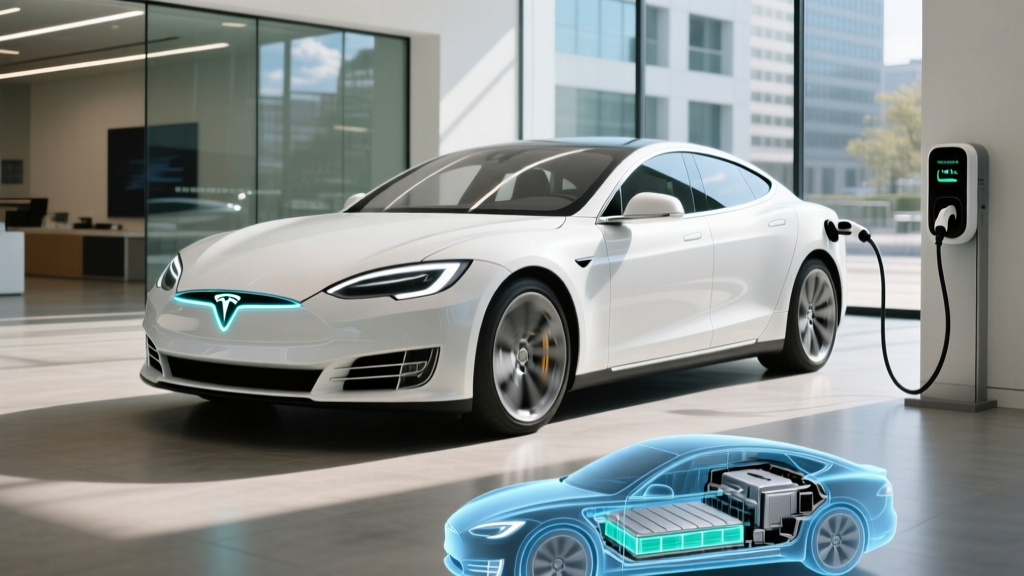
The Tesla Model S remains the flagship sedan of the electric vehicle market in 2026, balancing luxury, blistering acceleration, and one of the longest EPA-estimated ranges available. Whether you're browsing Tesla Model S inventory at a local delivery center or configuring one online, understanding the real-world numbers behind the spec sheet is critical before committing to a six-figure EV. This review breaks down every metric that matters—from actual highway range to DC fast-charge taper curves—so you can evaluate current Model S stock with confidence.
2026 Tesla Model S at a Glance
| Specification | Model S Long Range | Model S Plaid |
|---|---|---|
| EPA Range | 402 miles | 359 miles |
| Battery (usable) | ~100 kWh (NMC) | ~100 kWh (NMC) |
| Drivetrain | Dual-Motor AWD | Tri-Motor AWD |
| Horsepower | 670 hp | 1,020 hp |
| 0-60 mph | 3.1 seconds | 1.99 seconds |
| Top Speed | 155 mph | 200 mph |
| Max DC Fast Charge | 250 kW | 250 kW |
| 10-80% DC Time | ~27 minutes | ~27 minutes |
| Level 2 Charge Rate | 11.5 kW (44 mi/hr) | 11.5 kW (44 mi/hr) |
| EPA Efficiency | 124 MPGe (27 kWh/100mi) | 116 MPGe (29 kWh/100mi) |
| Cargo Volume | 28 cu ft (rear + frunk) | 28 cu ft (rear + frunk) |
| Base MSRP | $79,990 | $94,990 |
| Battery Warranty | 8 yr / 150,000 mi | 8 yr / 150,000 mi |
Real-World Range: Beyond the EPA Sticker
Real-World Expectation: ~310–340 miles at sustained 70-80 mph highway speeds in moderate temperatures. In freezing conditions (below 32°F), expect a 20–30% reduction, dropping effective range to ~250–280 miles (Long Range). City driving with regenerative braking recovers energy and can approach or slightly exceed the EPA sticker.
The Model S Long Range's 402-mile EPA figure is among the highest of any production EV sold in the US, but buyers evaluating Tesla Model S inventory should plan around real-world physics. At highway speeds above 70 mph, aerodynamic drag dominates energy consumption. In our experience on a 300-mile interstate route at 75 mph in 65°F weather, the Long Range trim delivered roughly 325 miles before requiring a charge stop—about 19% below the sticker.
Cold weather compounds the loss. Lithium-ion NMC batteries experience increased internal resistance at low temperatures, and cabin heating draws significant power even with the Model S's heat pump system. Owners in northern climates consistently report 250–280 miles of usable winter highway range. If your commute or road-trip pattern requires 300+ miles between stops in January, the Model S will still work—but you'll be using DC fast chargers more often than the sticker suggests.
The Plaid's 359-mile EPA rating reflects its tri-motor powertrain's higher energy draw. Real-world highway figures hover around 280–300 miles in temperate conditions. For context, competitors like the Lucid Air Grand Touring (516 mi EPA) surpass both trims on paper, though at a significantly higher entry price.
Charging Speed: DC Fast Charge and Home Level 2
| Charging Level | Power / Rate | Miles Added | Notes |
|---|---|---|---|
| Level 1 (120V) | ~1.4 kW | ~5 mi/hr | Emergency/trickle only |
| Level 2 (240V, 48A) | 11.5 kW | ~44 mi/hr | Full charge in ~9 hours |
| DC Fast (V3 Supercharger) | Peak 250 kW | ~200 mi in 15 min | 10-80% in ~27 min |
| DC Fast (CCS adapter, 350 kW station) | ~250 kW (vehicle-limited) | Similar to V3 | Model S peaks at 250 kW regardless of station output |
Tesla's V3 Supercharger network remains the gold standard for public charging reliability. The Model S peaks at 250 kW on a V3 cabinet, adding up to 200 miles of range in approximately 15 minutes under ideal battery preconditioning. However, the charge curve tapers significantly above 50% state of charge (SoC). By 80%, the rate drops to roughly 75–90 kW, and above 90% it slows to under 30 kW. The 10-80% time of approximately 27 minutes assumes you've navigated to a Supercharger using the onboard navigation, which triggers battery preconditioning—without it, your first 10 minutes at the plug may be limited to 100–150 kW as the pack warms.
With the included CCS adapter, the Model S can access Electrify America, EVgo, and other non-Tesla networks. The vehicle's onboard charge controller still caps at 250 kW, so plugging into a 350 kW Electrify America stall won't yield faster speeds than a V3 Supercharger.
At home, the Model S accepts 11.5 kW on a 240V / 48-amp Level 2 circuit (such as a Tesla Wall Connector). That translates to roughly 44 miles of range per hour of charging, meaning a depleted Long Range battery refills overnight in about 9 hours. Installation costs for a dedicated 60-amp circuit typically run $800–$2,000 depending on panel proximity and local permit requirements—budget accordingly if you're browsing Tesla Model S inventory without an existing Level 2 setup.
Performance and Drivetrain
The Long Range's dual-motor all-wheel-drive layout delivers 670 horsepower and a 3.1-second 0-60 mph time—numbers that would define a supercar a decade ago. The Plaid's tri-motor setup (one front, two rear) produces 1,020 hp and a claimed 1.99-second 0-60 on a prepped surface with rollout subtracted. Real-world street launches without track preparation typically yield 2.2–2.4 seconds, which is still absurdly quick.
Both trims feature adaptive air suspension, torque-vectoring AWD, and Tesla's low center of gravity from the floor-mounted battery pack. The Plaid adds carbon-sleeved rotors and track-mode software for sustained high-speed lapping. For daily driving, the Long Range is the more rational pick—the Plaid's stiffer tuning, lower efficiency, and $15,000 premium serve enthusiasts who plan to visit drag strips or road courses.
Pricing, Trims, and Federal Tax Credit Eligibility
| Trim | Base MSRP | Federal §30D Credit | Effective Price |
|---|---|---|---|
| Model S Long Range | $79,990 | $0 (MSRP cap exceeded) | $79,990 |
| Model S Plaid | $94,990 | $0 (MSRP cap exceeded) | $94,990 |
Under current IRS §30D rules, the federal EV tax credit is capped at vehicles with an MSRP of $55,000 or less for sedans. Both Model S trims far exceed that threshold, making them ineligible for the $7,500 credit regardless of buyer income or battery sourcing. This is a critical consideration when comparing the Model S to luxury SUVs (which carry an $80,000 MSRP cap) or to mid-price EVs like the Tesla Model 3, BMW i4, or Hyundai Ioniq 6 that may qualify.
Options like FSD (Supervised) at $8,000, premium paint colors ($1,500–$2,500), and 21-inch wheels ($4,500) push as-tested prices well above $90,000 for a loaded Long Range and past $110,000 for a Plaid. State-level incentives vary—some states like Colorado and California offer additional rebates or HOV lane access that partially offset the lack of a federal credit. Consult your state's energy office or a tax professional for specifics.
Interior, Cargo, and Technology
The Model S interior centers on a 17-inch landscape touchscreen running Tesla's proprietary infotainment OS. A secondary 8-inch screen serves rear passengers, and a 12.3-inch digital instrument cluster sits ahead of the yoke-style steering wheel (a conventional round wheel is available at no cost). Wireless Apple CarPlay and Android Auto are not supported—Tesla relies on its native navigation, media, and phone integration.
Cargo space totals 28 cubic feet between the rear hatchback trunk (26.3 cu ft) and the front trunk, or "frunk" (1.7 cu ft). Rear legroom measures 35.4 inches—adequate for adults on shorter trips but tighter than a Mercedes EQS (40.4 inches). The hatchback design makes loading bulky items easier than a traditional sedan, though the sloping roofline limits vertical clearance for tall boxes.
Tesla's Autopilot driver-assistance suite comes standard and includes adaptive cruise control, lane centering, automatic emergency braking, and blind-spot monitoring. The optional Full Self-Driving (Supervised) package ($8,000) adds automated lane changes, traffic light and stop sign recognition, and Navigate on Autopilot for highway interchanges.
Pros and Cons
- Class-leading 402-mile EPA range (Long Range)
- Access to Tesla Supercharger network (17,000+ US stalls)
- Blistering acceleration, especially Plaid
- Over-the-air software updates continuously add features
- Hatchback practicality with frunk storage
- Strong resale value relative to luxury EV peers
- No federal tax credit eligibility (MSRP exceeds $55K sedan cap)
- Rear seat legroom trails Mercedes EQS and BMW i7
- No native Apple CarPlay or Android Auto
- Build quality inconsistency reported by some owners
- Yoke steering controversial; requires adaptation
- Insurance premiums significantly above average for segment
Who the Model S Suits Best
The Model S Long Range is ideal for tech-forward professionals and frequent road-trippers who value range and Supercharger access over traditional luxury brand cachet. Its 402-mile EPA rating means most commuters can charge once or twice a week at home and handle 250+ mile day trips without stopping. Families will find the hatchback cargo area practical, though rear-seat space is better suited to children or shorter adults.
The Plaid targets performance enthusiasts who want hypercar acceleration in a daily-drivable four-door. It's less about practicality and more about owning one of the quickest production cars ever built.
If you need executive-level rear-seat comfort, consider the Mercedes EQS or BMW i7. If you want a more affordable EV that still qualifies for the federal credit, the Tesla Model 3 Long Range (341 mi, ~$47,740) or Hyundai Ioniq 6 (361 mi, ~$42,000) are compelling alternatives. But if Supercharger reliability, cutting-edge software, and 400-mile range are your priorities, the Model S remains difficult to beat in 2026.
Frequently Asked Questions
What is the real-world range of the Tesla Model S?
Expect approximately 310–340 miles at highway speeds in moderate temperatures for the Long Range, and 280–300 miles for the Plaid. Cold weather (below 32°F) reduces range by 20–30%, yielding roughly 250–280 miles for the Long Range in winter conditions.
How fast does the Model S charge at home and on the road?
On a Level 2 home charger (11.5 kW), the Model S adds about 44 miles of range per hour, fully charging in roughly 9 hours. On a V3 Supercharger, it peaks at 250 kW and charges from 10-80% in approximately 27 minutes, with the most rapid charging occurring between 10-50% SoC.
Does the Tesla Model S qualify for the federal EV tax credit?
No. Under IRS §30D rules, sedans must have an MSRP of $55,000 or less to qualify. The Model S starts at $79,990, exceeding the cap. State incentives may partially offset this—check your local program.
Is the Model S worth buying over competitors like the Lucid Air or Mercedes EQS?
The Model S offers the best combination of range, Supercharger network access, and performance for the price. The Lucid Air Grand Touring provides more range (516 mi EPA) and rear-seat space but starts above $110,000 and lacks Supercharger access (though NACS adapters are emerging). The Mercedes EQS prioritizes luxury and ride comfort but delivers less range and slower DC charging. Choose the Model S for tech and road-trip practicality; choose rivals for traditional luxury or maximum space.
What battery chemistry does the Model S use?
The Model S uses NMC (nickel manganese cobalt) lithium-ion cells, which offer higher energy density than LFP (lithium iron phosphate) chemistry but benefit from keeping daily charge limits at 80-90% to maximize long-term longevity. Tesla's battery warranty covers 8 years or 150,000 miles, whichever comes first, with a minimum 70% capacity retention threshold.