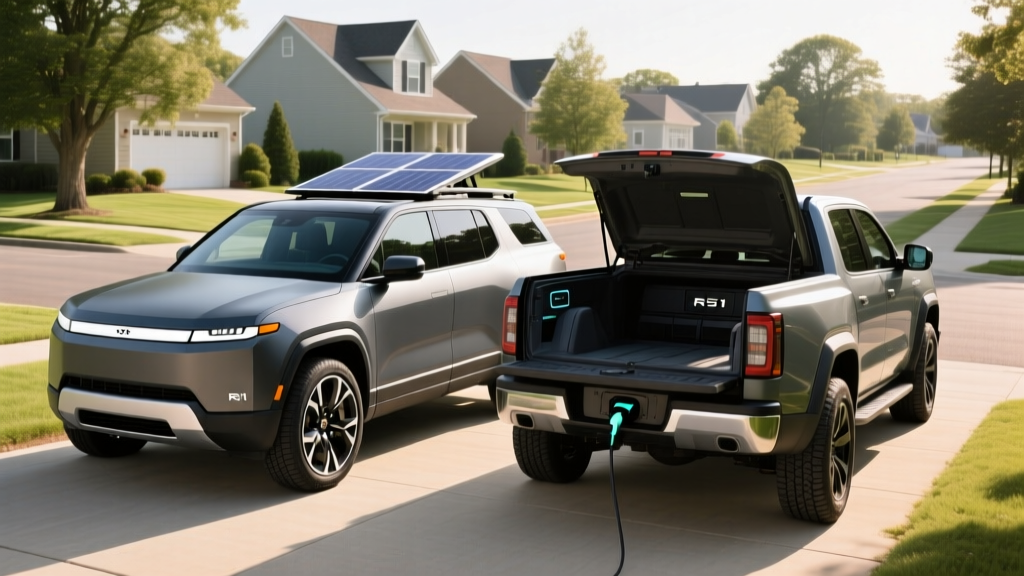
If you've been searching for a Rivian in Woodbridge, NJ, you're not alone. Central Jersey's mix of suburban commuting, shore-bound road trips, and genuine winter weather makes it one of the more demanding environments for any electric vehicle. The 2026 Rivian R1S (three-row SUV) and R1T (pickup truck) are compelling choices — but how they perform on the Garden State Parkway in February matters more than any spec sheet alone.
This review covers both models with a specific lens for Woodbridge-area buyers: real-world range in New Jersey winters, charging infrastructure along the Route 1 and Route 9 corridors, federal tax credit eligibility under current IRS §30D rules, and whether Rivian's adventure platform actually works as a daily driver in the Northeast.
2026 Rivian R1S and R1T: Quick Verdict
Rivian's second-generation R1S and R1T (refreshed for the 2025 model year and carried forward into 2026 with minor updates) represent the most capable dual-motor and quad-motor electric platforms on the market for buyers who need genuine off-road capability, serious towing, and family-hauling space. The move to Rivian's in-house Gen 2 drive units and a new 4680-type battery option (on Max pack trims) has improved efficiency and charging speeds substantially over the original 2022-2024 models.
For Woodbridge, NJ residents, the R1S Dual-Motor with the Standard battery is the value sweet spot — enough range for NYC commutes, eligible for the full federal tax credit, and practical for three-row family duty. The R1T appeals to a narrower buyer but remains the only electric pickup that blends genuine trail capability with daily-driver refinement.
| Spec | R1S Dual-Motor (Standard) | R1S Dual-Motor (Max) | R1T Dual-Motor (Standard) | R1T Quad-Motor (Max) |
|---|---|---|---|---|
| EPA Range | 270 mi | 410 mi | 270 mi | 415 mi |
| Battery (usable) | ~92 kWh (LFP) | ~141 kWh (NMC) | ~92 kWh (LFP) | ~141 kWh (NMC) |
| Horsepower | 533 hp | 533 hp | 533 hp | 1,025 hp |
| 0-60 mph | 4.5 sec | 4.5 sec | 4.5 sec | 2.6 sec |
| Max DC Fast Charge | 200 kW | 220 kW | 200 kW | 220 kW |
| 10-80% DC Time | ~30 min | ~42 min | ~30 min | ~42 min |
| Level 2 (11.5 kW) | ~16 mi/hr | ~25 mi/hr | ~16 mi/hr | ~25 mi/hr |
| Towing Capacity | 7,700 lb | 7,700 lb | 11,000 lb | 11,000 lb |
| Base MSRP | $75,900 | $89,900 | $69,900 | $99,900 |
Real-World Range: What to Expect on New Jersey Roads
EPA Estimated: 270 mi (Standard) / 410 mi (Max, R1S)
Real-World Expectation: Plan for 220-240 mi highway (Standard) and 330-360 mi highway (Max) in mild conditions. In New Jersey winters (30°F and below), expect a 20-30% reduction — roughly 170-200 mi for the Standard pack and 260-300 mi for the Max pack. Rivian's heat pump helps mitigate cold-weather losses compared to resistive heating, but physics is physics.
The R1S and R1T are large, heavy vehicles with the aerodynamic profile of, well, an SUV and a pickup. At 70-80 mph on the Turnpike, efficiency drops noticeably compared to the EPA combined cycle, which blends city and highway driving. According to fueleconomy.gov, the R1S Dual-Motor Standard achieves 73 MPGe combined (46 kWh/100 mi), while the Max pack variant reaches 78 MPGe combined (43 kWh/100 mi).
For Woodbridge commuters heading into Manhattan via the Lincoln or Holland Tunnel, a Standard-pack R1S with ~220 real-world miles is more than adequate for a week of round-trip driving (~60 miles/day). If your routine includes regular runs to the Jersey Shore (roughly 80 miles one-way from Woodbridge) or trips to the Poconos, the Max pack's 330+ real-world highway miles provides a meaningful buffer — especially when you factor in winter losses and the desire to avoid charging stops on short trips.
Charging Speed and Infrastructure: NJ Coverage
Rivian's 2026 lineup charges via the NACS (Tesla-style) connector natively — a significant upgrade from early models that required adapters. This means direct access to Tesla Supercharger stalls (now open to Rivian vehicles) in addition to the Rivian Adventure Network and third-party CCS stations via adapter.
| Charging Level | Power | Standard Pack (mi/hr) | Max Pack (mi/hr) |
|---|---|---|---|
| Level 1 (120V) | 1.4 kW | ~3 mi/hr | ~3 mi/hr |
| Level 2 (240V, 48A) | 11.5 kW | ~16 mi/hr | ~25 mi/hr |
| DC Fast (peak) | 200-220 kW | ~140 mi in 30 min | ~200 mi in 30 min |
At home in Woodbridge, a Level 2 wall connector on a 60-amp circuit (48 amps continuous) will fully replenish a Standard pack overnight in about 6-7 hours. The Max pack needs roughly 12-14 hours from near-empty — fine for overnight top-ups, but worth noting if you arrive home at 15% and need a full battery by morning.
On DC fast chargers, the Standard pack's LFP chemistry allows it to sustain peak charge rates longer than the NMC Max pack, which tapers more aggressively above 80%. In practice, both packs deliver their 10-80% charges in competitive times, but that last 20% on the Max pack can add 15-20 minutes. Preconditioning the battery (via the Rivian app or nav-routed charging) is essential for hitting peak rates — skip it, and your 200 kW peak might show up as 120 kW on a cold January morning.
For Woodbridge-area public charging, Electrify America stations along Route 1 and the Garden State Parkway provide reliable 150-350 kW DC options. The Tesla Supercharger network adds substantial coverage across New Jersey, including stalls in Edison, East Brunswick, and Secaucus.
Performance: Dual-Motor vs. Quad-Motor
The 2026 Rivian lineup offers two powertrain configurations, both featuring Rivian's in-house Gen 2 drive units:
Dual-Motor (AWD): 533 horsepower and 610 lb-ft of torque. The 0-60 mph time of 4.5 seconds makes both the R1S and R1T quicker than most sports sedans from a decade ago. This is the volume configuration and the one most Woodbridge buyers should consider — it's lighter, more efficient, and substantially less expensive.
Quad-Motor (AWD, R1T only on Max pack): 1,025 horsepower and a 2.6-second 0-60 mph time. This is supercar acceleration in a pickup truck, and it's genuinely thrilling. But it also costs $30,000 more, reduces efficiency, and adds weight. Unless you need the ultimate trail-crawling torque vectoring or simply want the fastest truck ever built, the Dual-Motor is the rational choice.
Both configurations feature Rivian's air suspension with adjustable ride height (up to 14.9 inches of ground clearance), a locking rear differential (standard), and a wading depth of over 3 feet. The R1T's unique gear tunnel — a lockable, full-width storage compartment between the cab and bed — remains one of the most clever pieces of vehicle packaging in production.
Pricing, Trims, and Federal Tax Credit Eligibility
| Model / Trim | Base MSRP | Federal Credit (§30D) | Effective Price |
|---|---|---|---|
| R1T Dual-Motor Standard | $69,900 | Up to $7,500* | ~$62,400 |
| R1S Dual-Motor Standard | $75,900 | Up to $7,500* | ~$68,400 |
| R1S Dual-Motor Max | $89,900 | Up to $7,500* | ~$82,400 |
| R1T Quad-Motor Max | $99,900 | Up to $7,500* | ~$92,400 |
*Federal tax credit eligibility is not automatic. Under IRS §30D rules, the $7,500 credit requires:
- MSRP caps: Vans/SUVs/pickups must have an MSRP at or below $80,000. This means the R1S Standard ($75,900) and R1T Standard ($69,900) qualify, but the R1S Max ($89,900) and R1T Quad-Motor Max ($99,900) exceed the cap and are ineligible for the federal credit.
- Buyer income limits: Modified AGI must not exceed $150,000 (single), $225,000 (head of household), or $300,000 (joint filers).
- Battery sourcing requirements: A portion of critical minerals and battery components must be sourced from the U.S. or free-trade-agreement countries. These thresholds tighten annually. Rivian has worked to qualify its Standard (LFP) battery supply chain, but confirm current-year eligibility at fueleconomy.gov before purchasing.
- Point-of-sale transfer: As of 2024, buyers can transfer the credit to the dealer at purchase, reducing the purchase price upfront rather than waiting for a tax refund. Rivian supports this at its delivery centers.
For Woodbridge buyers, this means the R1S Dual-Motor Standard at ~$68,400 (after credit) is a legitimate value proposition against three-row luxury SUVs from BMW, Mercedes, and Volvo — many of which start higher and don't offer electric drivetrains with this much range and capability.
Interior, Tech, and Daily Livability
The R1S seats up to seven (with second-row captain's chairs reducing that to six). Cargo space behind the third row is 10.8 cu ft, expanding to 57.1 cu ft behind the second row and 104.7 cu ft with both rear rows folded. Legroom is generous in the first two rows (41.3 inches front, 38.5 inches second), though the third row is best suited for children on longer trips.
The R1T's 4.5-foot bed (extending to ~6 feet with the tailgate down) and the aforementioned gear tunnel give it cargo flexibility no conventional pickup matches. The bed features built-in tie-downs, a powered tonneau cover, and integrated camp kitchen options.
Rivian's 15.6-inch center touchscreen runs a proprietary operating system that has matured considerably since launch. The interface is responsive, over-the-air updates are regular and substantive, and the vehicle's phone-as-key system works reliably. Apple CarPlay and Android Auto are not supported — Rivian's stance is that its native system is purpose-built for EV features. Most owners adapt quickly, but if smartphone mirroring is non-negotiable, this is a genuine drawback.
The Driver+ assistance suite (adaptive cruise, lane centering, highway assist) is a solid Level 2 system. It is not autonomous driving — you must keep your hands on the wheel and eyes on the road. It performs comparably to Ford's BlueCruise on highways, though it doesn't yet offer hands-free operation on mapped roads the way GM's Super Cruise does.
Ownership Costs, Warranty, and Long-Term Outlook
Rivian covers the R1S and R1T with a 5-year/60,000-mile bumper-to-bumper warranty and an 8-year/175,000-mile battery and drive unit warranty. That battery warranty is among the most generous in the industry, and the 175,000-mile threshold reflects confidence in both the LFP chemistry (Standard pack, known for exceptional cycle life) and the NMC chemistry (Max pack, with robust thermal management).
Insurance costs for Rivians run higher than average — expect $2,400-$3,600 annually in New Jersey depending on your driving record, age, and coverage level. This reflects the vehicle's repair costs (aluminum body panels, specialized drive units) and its performance capability.
Charging at home on New Jersey's average residential rate (~$0.17/kWh) costs roughly $15.60 for a full Standard pack charge and $24 for a full Max pack — translating to about $0.07-$0.08 per mile. Compare that to a comparable gas SUV at 20 MPG and $3.50/gallon: $0.175 per mile. Over 15,000 miles per year, home charging saves roughly $1,500-$1,600 annually.
Pros
- Genuine off-road capability with air suspension and locking differentials
- Class-leading towing (11,000 lb R1T) for an electric vehicle
- LFP Standard pack offers exceptional longevity and daily-charge-to-100% flexibility
- NACS native charging opens full Tesla Supercharger network
- R1T gear tunnel is uniquely practical
- Strong federal tax credit eligibility on Standard trims
- Over-the-air updates continuously improve the vehicle
Cons
- Max and Quad-Motor trims exceed $80K MSRP cap, losing federal credit
- No Apple CarPlay or Android Auto
- Third-row space in R1S is tight for adults
- Insurance premiums are above average
- Service center network is still growing — nearest to Woodbridge may require a drive
- Quad-Motor is thrilling but difficult to justify on cost and efficiency
Who Should Buy a Rivian in Woodbridge, NJ?
Best for: Active families who need three rows (R1S) or a pickup bed (R1T), regularly take road trips to the Poconos, Adirondacks, or New England, and have home charging access. The Standard pack is ideal for daily commuting along the Route 1/Route 9 corridor with weekend adventures, while the Max pack suits those who regularly drive 300+ miles between charges.
Consider alternatives if: You primarily need a commuter car (the Rivian platform is large and heavy for stop-and-go I-95 traffic), you don't have reliable home charging, or your budget is below $65,000. In those cases, the Hyundai Ioniq 5, Tesla Model Y, or a plug-in hybrid like the Toyota RAV4 Prime may serve you better at a lower cost.
Key competitors: The Tesla Model X offers more range and Supercharger convenience but lacks off-road credibility and costs significantly more. The BMW iX is more refined on-road but smaller and less capable off-pavement. The Ford F-150 Lightning competes directly with the R1T on towing and utility but doesn't match Rivian's build quality or driving dynamics. The Kia EV9 is the closest three-row competitor at a lower price point, but it offers less range, no off-road chops, and no pickup variant.
Frequently Asked Questions
What is the real-world range of the Rivian R1S and R1T?
The EPA rates the Standard pack at 270 miles and the Max pack at 410 miles (R1S). In real-world New Jersey driving — highway speeds, four-season weather — expect 220-240 miles from the Standard and 330-360 from the Max in mild conditions. In winter, subtract 20-30%.
How fast does a Rivian charge at home and on the road?
On a home Level 2 charger (11.5 kW), the Standard pack gains about 16 miles per hour and the Max pack about 25 miles per hour. On DC fast chargers, both reach 10-80% in 30-42 minutes, with the Standard pack's LFP chemistry sustaining peak rates longer.
Does the Rivian R1S or R1T qualify for the $7,500 federal tax credit?
The Standard pack trims (R1S at $75,900 and R1T at $69,900) fall under the $80,000 MSRP cap and can qualify for the full $7,500, subject to buyer income limits and battery-sourcing rules. Max and Quad-Motor trims exceed the cap and do not qualify. Always verify current eligibility on IRS.gov.
Is Rivian reliable enough for a daily driver in New Jersey?
Rivian's second-generation platform (2025+) has shown substantial improvements in build quality and software stability over early 2022-2023 models. The 8-year/175,000-mile battery warranty is industry-leading. However, service center density in New Jersey is still limited compared to legacy brands — check Rivian's service locator for the nearest facility before committing.
Can I charge a Rivian at Tesla Superchargers?
Yes. 2026 Rivian vehicles come with a native NACS port, meaning they can plug directly into Tesla Supercharger stalls without an adapter. This dramatically expands your fast-charging options across New Jersey and the entire East Coast.
How does the Rivian handle New Jersey winters?
Well. The dual-motor AWD system provides excellent traction, the air suspension can raise the vehicle for snow clearance, and the heat pump efficiently warms the cabin without the range penalty of resistive heating. Expect 20-30% range loss in sustained sub-freezing temperatures — plan accordingly on longer trips.