The Tesla Model S in 2026: Still the Benchmark?
The Tesla Model S has been on sale for well over a decade, yet it remains one of the most talked-about luxury electric sedans on the market. For 2026, Tesla continues to offer the Model S in Long Range and Plaid trims, with incremental updates to software, battery management, and interior materials. While newer competitors like the Lucid Air, BMW i7, and Mercedes-Benz EQS have closed the gap in comfort and build quality, the Model S still delivers an unmatched combination of range, Supercharger network access, and over-the-air evolution.
This review focuses heavily on what buyers are searching for: the Tesla Model S interior, real-world range versus EPA estimates, charging speeds, pricing, and whether the federal §30D tax credit applies. If you're cross-shopping luxury EV sedans, the details below will help you decide whether the Model S still earns its premium price tag.
Tesla Model S Interior: Cabin Quality, Space, and Tech
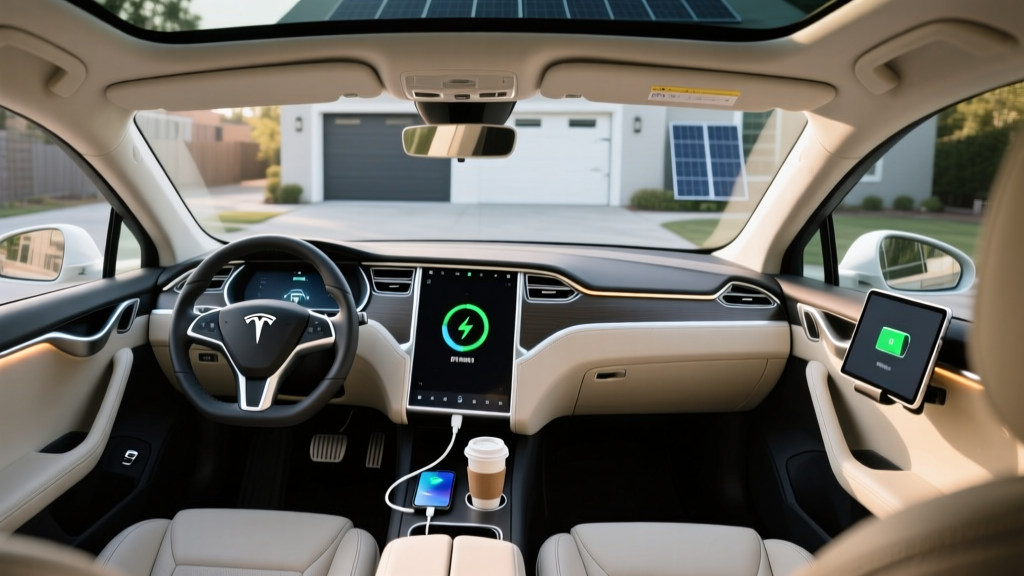
The Model S interior has improved meaningfully since the 2021 refresh, though it still draws polarized reactions. The cabin centers around a 17-inch landscape-oriented touchscreen that controls nearly every vehicle function — climate, navigation, media, and vehicle settings. A secondary 8-inch screen for rear passengers handles climate and entertainment. Tesla has moved to a yoke-style steering wheel as standard, with a conventional round wheel available as a no-cost option.
Materials and Build Quality
For 2026, Tesla uses vegan leather upholstery across all trims, with a choice of black, cream, or black-and-white two-tone. Soft-touch materials cover the dashboard and door uppers, and the fit-and-finish gap between Tesla and legacy luxury automakers has narrowed — though panel consistency still varies car-to-car. The minimalist aesthetic means no physical buttons for climate or volume; everything routes through the touchscreen or steering-wheel controls.
Passenger and Cargo Dimensions
The Model S seats five adults, though the rear middle position is best suited for children on longer trips. Cargo space remains a strong point thanks to the hatchback design and front trunk (frunk).
| Measurement | Specification |
|---|---|
| Front headroom | 38.8 in |
| Rear headroom | 35.4 in |
| Front legroom | 42.7 in |
| Rear legroom | 35.4 in |
| Cargo volume (rear seats up) | 28 cu ft |
| Cargo volume (rear seats folded) | 63 cu ft |
| Frunk volume | 5.3 cu ft |
The 28 cu ft of cargo space behind the rear seats beats most luxury sedans and rivals mid-size SUVs. Fold the 60/40 split rear seats and you get 63 cu ft — enough for a full set of luggage for a family road trip. The 5.3 cu ft frunk handles charging cables or a small carry-on.
Infotainment and Standout Features
The 2026 Model S runs Tesla's latest software, which includes a full in-car gaming suite (Steam integration), theater mode for the main display while parked, and a 22-speaker audio system with active noise cancellation. Navigation routes through Superchargers automatically, preconditioning the battery for optimal DC fast-charging speeds upon arrival. The panoramic glass roof floods the cabin with light but lacks a retractable shade — a notable drawback in hot climates where solar heat gain is significant.
Range, Efficiency, and Real-World Expectations
The 2026 Model S Long Range carries an EPA-estimated 405 miles of range. The Plaid variant, with its tri-motor setup and stickier tires, drops to an EPA-estimated 396 miles. Both trims use a ~100 kWh battery pack (approximately 95 kWh usable) with NMC (nickel-manganese-cobalt) chemistry, chosen for its higher energy density versus LFP — a trade-off that favors maximum range over cycle-life longevity.
EPA estimate: 405 mi (Long Range) / 396 mi (Plaid)
Expect ~330–360 mi on highway-only road trips at 70–80 mph.
In freezing temperatures (below 32°F), plan for 25–35% range reduction, yielding roughly 260–300 mi before needing a charge.
City driving with regenerative braking can match or slightly exceed the EPA sticker.
| Spec | Long Range | Plaid |
|---|---|---|
| EPA Range | 405 mi | 396 mi |
| Battery (usable) | ~95 kWh (NMC) | ~95 kWh (NMC) |
| MPGe (combined) | 120 MPGe | 116 MPGe |
| Energy consumption | 28 kWh/100 mi | 29 kWh/100 mi |
| Drivetrain | Dual-motor AWD | Tri-motor AWD |
| Horsepower | 670 hp | 1,020 hp |
| 0–60 mph | 3.1 sec | 1.99 sec |
| Top speed | 155 mph | 200 mph |
Efficiency of 28–29 kWh/100 mi is competitive for a large luxury sedan. For context, the Lucid Air Grand Touring achieves roughly 26 kWh/100 mi, while the BMW i7 xDrive60 consumes around 35 kWh/100 mi. Tesla's heat pump and thermal management system contribute significantly to this efficiency advantage, particularly in moderate climates.
Charging Speed: DC Fast, Level 2, and Supercharger Access
Charging speed remains one of the Model S's strongest selling points, particularly given access to the Tesla Supercharger network — now the largest and most reliable DC fast-charging network in North America. The Model S uses the NACS (North American Charging Standard) connector natively.
| Charging Level | Power / Rate | Time or Miles Added |
|---|---|---|
| Level 1 (120V) | ~1.4 kW | ~3–4 mi/hr |
| Level 2 (240V, 48A) | 11.5 kW | ~34 mi/hr |
| DC Fast Charge (peak) | 250 kW | 10–80% in ~28 min |
| DC Fast Charge (sustained avg) | ~175 kW | ~200 mi in 15 min |
A critical nuance: the 250 kW peak charge rate is not sustained across the full 10–80% window. The charge curve tapers significantly above 50% state of charge (SoC), and especially above 80%. In practice, you'll see 250 kW only briefly at low SoC if the battery is properly preconditioned — which the navigation system does automatically when a Supercharger is set as your destination. Arriving at a charger with a cold battery can reduce peak rates by 40–60%.
For home charging, a Tesla Wall Connector on a 60-amp circuit delivers up to 11.5 kW, adding roughly 34 miles of range per hour. A full overnight charge (8–10 hours) easily replenishes the pack from near-empty. Most owners who charge at home rarely visit a public charger except on road trips.
Pricing, Trims, and Federal Tax Credit Eligibility
The 2026 Tesla Model S is offered in two trims. Pricing reflects Tesla's most recent MSRP as of early 2026:
| Trim | Base MSRP | As-Tested (typical options) |
|---|---|---|
| Long Range | $74,990 | $78,000–$82,000 |
| Plaid | $89,990 | $93,000–$98,000 |
Options that push the as-tested price higher include Ultra Red premium paint ($2,500), 21-inch Arachnid wheels ($4,500), and Full Self-Driving (Supervised) capability ($8,000). Tesla's destination fee adds approximately $1,390.
Does the Model S Qualify for the Federal EV Tax Credit?
This is where the news turns negative for most buyers. The IRS §30D Clean Vehicle Credit imposes an MSRP cap of $55,000 for sedans. Because the Model S starts at $74,990, it does not qualify for the $7,500 federal tax credit, regardless of your income level or the battery's critical-mineral sourcing.
- Vehicle MSRP must not exceed $55,000 (sedans) or $80,000 (SUVs/pickups)
- Buyer modified adjusted gross income: ≤$150,000 (single), ≤$225,000 (head of household), ≤$300,000 (joint)
- Battery critical minerals and components must meet phased-in sourcing thresholds
- Vehicle must be assembled in North America
- Credit can be transferred to the dealer at point of sale as a purchase discount
Some states offer their own EV rebates or tax credits that may partially offset the cost. Check your state energy office or the AFDC state incentives database for current programs, as these vary widely by jurisdiction and frequently change.
Warranty, Ownership Costs, and Long-Term Outlook
Tesla covers the 2026 Model S with the following warranty:
| Component | Coverage |
|---|---|
| Basic vehicle | 4 years / 50,000 miles |
| Battery & drive unit | 8 years / 150,000 miles |
| Battery capacity retention | ≥70% over warranty period |
The 8-year/150,000-mile battery warranty is competitive with other luxury EV makers. Tesla guarantees at least 70% capacity retention during that period. Based on fleet data from older Model S vehicles, NMC packs typically lose 10–15% capacity over 100,000 miles, with the most rapid degradation occurring in the first 15,000–20,000 miles before leveling off. A full battery replacement out of warranty currently runs between $13,000 and $18,000 depending on the pack and labor.
Insurance premiums for the Model S remain elevated compared to mainstream EVs — expect $2,800–$4,200 annually depending on your profile, location, and coverage level. The high repair cost of aluminum body panels and integrated battery structure contributes to these premiums. Get quotes before purchasing to avoid surprises.
Driver Assistance: Autopilot and FSD (Supervised)
Every 2026 Model S comes standard with Tesla's Basic Autopilot, which includes traffic-aware cruise control and lane-centering on highways. Full Self-Driving (Supervised) is an $8,000 add-on that enables automatic lane changes, navigation-guided on/off-ramp transitions, and limited city-street steering.
Both Autopilot and FSD (Supervised) are SAE Level 2 driver-assistance systems. The driver must remain fully attentive, keep hands on the steering wheel (or yoke), and be prepared to take over at any moment. These systems do NOT make the vehicle self-driving. Tesla's "Full Self-Driving" name is a product label, not a description of capability.
In practice, FSD (Supervised) handles most highway scenarios competently and has improved in urban environments, but it still struggles with construction zones, unprotected left turns in heavy traffic, and adverse weather. For pure highway cruising, it reduces fatigue significantly. For full autonomy, you'd need a Level 4 robotaxi like Waymo — available only in select metro areas.
Pros, Cons, and the Competition
- 405-mile EPA range — among the longest of any production EV sedan
- Native Supercharger network access (17,000+ stalls in North America)
- Class-leading acceleration, especially Plaid (1,020 hp, 1.99s 0–60)
- Practical hatchback cargo area (28/63 cu ft) + frunk
- Continuous OTA software updates add features post-purchase
- Excellent efficiency (28 kWh/100 mi) for the segment
- No federal tax credit eligibility (MSRP exceeds $55K sedan cap)
- Interior still trails Lucid, Mercedes, and BMW in perceived luxury
- Yoke steering is divisive; no physical buttons for climate/audio
- Glass roof lacks a shade — hot in summer, cold radiant effect in winter
- Insurance premiums significantly above segment average
- 250 kW peak DC charge rate trails 800V competitors (Hyundai Ioniq 5 at 350 kW, Lucid Air at 300+ kW)
- You prioritize maximum range and Supercharger convenience for frequent road trips
- You want a hatchback sedan with genuine cargo versatility
- You value OTA updates and a tech-forward software experience
- Acceleration and performance are important (Plaid especially)
- Interior luxury and ride refinement are your top priorities → Lucid Air, Mercedes EQS
- You want faster DC charging speeds → Hyundai Ioniq 5/6, Kia EV6 (800V architecture)
- You need a vehicle under $55K to qualify for the federal tax credit → Tesla Model 3, Hyundai Ioniq 6
Frequently Asked Questions
What is the real-world range of the 2026 Tesla Model S?
The EPA rates the Long Range at 405 miles and the Plaid at 396 miles. In real-world highway driving at 75 mph in moderate temperatures, expect 330–360 miles. In freezing weather, plan for 260–300 miles. City driving with regenerative braking can match or slightly exceed the EPA figure.
How fast does the Model S charge at home and on the road?
At home on a Level 2 Tesla Wall Connector (11.5 kW), the Model S adds about 34 miles of range per hour, reaching a full charge overnight in 8–10 hours. On DC fast chargers, it peaks at 250 kW and charges from 10–80% in approximately 28 minutes, though the sustained average is closer to 175 kW due to charge-curve tapering above 50% SoC.
Does the 2026 Model S qualify for the $7,500 federal EV tax credit?
No. The §30D credit caps sedan MSRP at $55,000, and the Model S starts at $74,990. It is ineligible regardless of buyer income or battery sourcing. State-level incentives may partially offset cost — check your local programs.
Is the Tesla Model S interior better than the Lucid Air's?
The Lucid Air's interior is generally regarded as more luxurious, with higher-quality materials, a more traditional control layout (physical buttons plus screens), and a more spacious rear seat. The Model S counters with a more practical hatchback cargo area, a larger infotainment ecosystem (gaming, streaming), and the advantage of native Supercharger integration.
Is the Model S Plaid worth the premium over Long Range?
The Plaid adds 350 hp, a third motor, and a 1.99-second 0–60 time for roughly $15,000 more. For most buyers, the Long Range is the smarter choice — it's still blisteringly quick at 3.1 seconds, gets 9 more miles of EPA range, and costs less to insure. The Plaid is a halo performance car; buy it only if you'll regularly use the extra performance.
How long will the Model S battery last?
Tesla warranties the battery for 8 years or 150,000 miles with a 70% capacity-retention guarantee. Historical fleet data suggests NMC packs in the Model S lose approximately 10–15% capacity over 100,000 miles. With proper care (avoiding frequent 100% charges, minimizing DC fast-charging in extreme heat), many Model S batteries are projected to last 200,000+ miles before falling below 80% capacity.
Sources: fueleconomy.gov (EPA range and efficiency data), IRS §30D Clean Vehicle Credit, Tesla.com official specifications.