The Tesla Model S has been the benchmark luxury electric sedan for over a decade, and the 2026 model year continues that legacy with incremental updates to its battery management, Supercharger compatibility, and interior refinement. But for shoppers weighing a six-figure EV purchase, the practical questions come down to daily usability: how far can it really go, and how long does it take to charge at home and on the road?
This review answers those questions with exact numbers — EPA range, battery chemistry, peak and sustained charge rates, and real-world adjustments for highway driving and cold weather — alongside the full ownership picture: pricing, federal tax credit eligibility, cargo space, and how the Model S stacks up against rivals like the Lucid Air and Porsche Taycan.
2026 Tesla Model S: Core Specifications at a Glance
| Spec | Model S Long Range | Model S Plaid |
|---|---|---|
| Base MSRP | $74,990 | $89,990 |
| EPA Range | 402 miles | 396 miles |
| Battery (usable) | ~100 kWh (NMC) | ~100 kWh (NMC) |
| Drivetrain | Dual-Motor AWD | Tri-Motor AWD |
| Horsepower | 670 hp | 1,020 hp |
| 0–60 mph | 3.1 seconds | 1.99 seconds |
| Top Speed | 155 mph | 200 mph |
| MPGe (combined) | 120 MPGe | 116 MPGe |
| Efficiency | 28 kWh/100 mi | 29 kWh/100 mi |
| Max DC Fast Charge | 250 kW | 250 kW |
| 10–80% DC Charge | ~30 minutes | ~30 minutes |
| Level 2 Home Charge | 11.5 kW (~41 mi/hr) | 11.5 kW (~41 mi/hr) |
| Battery Warranty | 8 yr / 150,000 mi | 8 yr / 150,000 mi |
| Cargo (rear + frunk) | 28 cu ft + 3.1 cu ft | 28 cu ft + 3.1 cu ft |
How Long Does It Take to Charge a Tesla Model S?
This is the question most prospective buyers search for, and the answer depends entirely on which charging method you use. The Model S supports three charging tiers, and understanding the difference between kW (power — how fast energy flows) and kWh (energy — how much the battery holds) is essential for interpreting these numbers.
| Charging Level | Power (kW) | Miles of Range Added per Hour | Typical Use Case |
|---|---|---|---|
| Level 1 (120V household outlet) | ~1.3 kW | ~3–4 mi/hr | Emergency trickle; not practical for daily use |
| Level 2 (240V home Wall Connector) | 11.5 kW | ~41 mi/hr | Daily home charging; full charge in ~9–10 hours |
| DC Fast Charge (Tesla Supercharger V3) | Up to 250 kW peak | Up to ~200 mi in 15 min | Road trips; 10–80% in ~30 minutes |
DC Fast Charging: The Real-World Curve
Tesla rates the Model S at a peak 250 kW on V3 Superchargers. However, that peak rate only holds at a low state of charge (roughly 10–25% SoC). As the battery fills, the charge rate tapers — a physics-driven reality of lithium-ion cells managing heat and lithium plating risk. Expect the following approximate timeline:
- 10–50% SoC: Sustained ~200–250 kW; roughly 15 minutes
- 50–80% SoC: Tapers from ~150 kW down to ~60 kW; roughly 15 additional minutes
- 80–100% SoC: Slow taper from ~40 kW to under 10 kW; can add 20+ minutes
The 10–80% charge takes approximately 30 minutes under ideal conditions (battery preconditioned via in-car navigation to a Supercharger, moderate ambient temperature). In cold weather (below 32°F / 0°C), add 5–10 minutes to this estimate if the battery hasn't been preconditioned — cold cells accept charge more slowly until they warm up.
Level 2 Home Charging: The Daily Routine
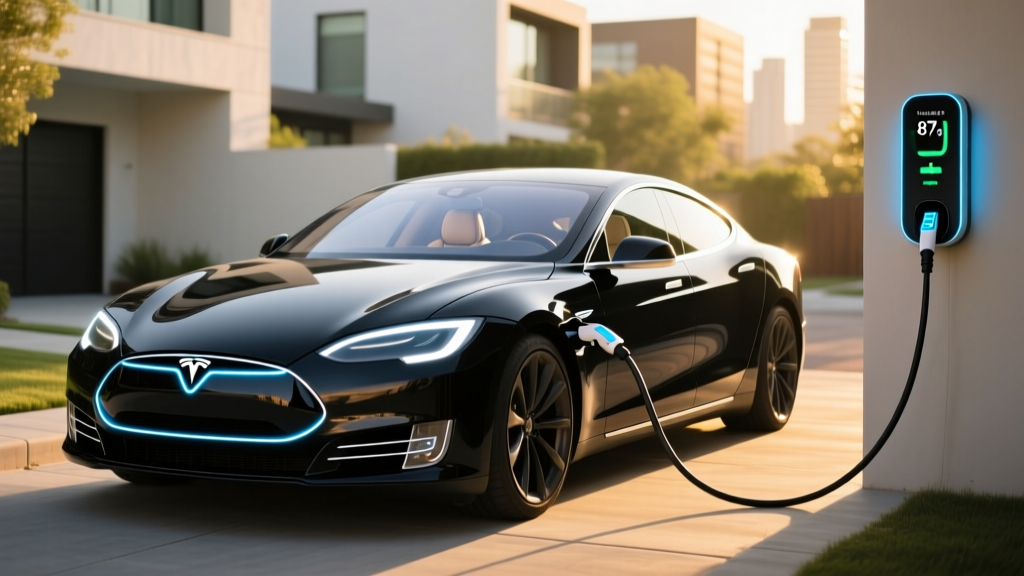
Tesla's Wall Connector, installed on a 60-amp circuit, delivers up to 11.5 kW (48 amps continuous). With the Model S's ~100 kWh battery, a full 0–100% charge takes roughly 9–10 hours. In practice, most owners charge between 20% and 80% daily, which takes about 5 hours — easily accomplished overnight.
At 41 miles of range added per hour, a typical overnight session (8 hours) replenishes roughly 328 miles — more than enough for virtually any daily commute. Home charging cost varies by electricity rate; at the U.S. average of ~$0.17/kWh, a full charge costs approximately $17, or about $0.04 per mile driven.
Model S Long Range: EPA-rated 402 miles. Real-world highway driving at 70–75 mph typically yields 320–360 miles depending on temperature, terrain, and driving style. In cold weather (below freezing), expect a 15–25% reduction, bringing usable range to approximately 280–320 miles on a full charge.
Model S Plaid: EPA-rated 396 miles. Real-world highway: 310–350 miles; cold weather: 270–310 miles. Aggressive driving in the Plaid can drop efficiency significantly below the 29 kWh/100 mi EPA figure.
Source: fueleconomy.gov
Range, Efficiency, and Battery Chemistry
The 2026 Model S uses a nickel-manganese-cobalt (NMC) lithium-ion battery pack with approximately 100 kWh of usable capacity. NMC chemistry is chosen here for its high energy density — critical for packing 400+ miles of range into a sedan form factor. The trade-off versus LFP (lithium iron phosphate) chemistry is that NMC batteries are more sensitive to sustained 100% SoC storage and extreme heat, though Tesla's thermal management system actively mitigates degradation.
Tesla recommends daily charging to 80–90% for NMC packs and reserving 100% charges for road trips. The battery management system includes a buffer (typically 2–5 kWh below the cell-level total) that protects against deep discharge, which is why the "usable" figure differs from the raw cell capacity.
Efficiency is a strong suit. At 28 kWh per 100 miles (Long Range), the Model S is competitive with luxury EVs in its class, though the lighter Lucid Air Grand Touring edges it out at roughly 26 kWh/100 mi. The Model S achieves 120 MPGe combined — a metric that equates electrical energy to the energy content of a gallon of gasoline for comparison purposes (fueleconomy.gov MPGe explainer).
Performance and Driving Dynamics
The Model S Long Range delivers 670 horsepower from its dual-motor all-wheel-drive powertrain, launching to 60 mph in 3.1 seconds — a figure that would have been supercar territory a decade ago. The Plaid variant's tri-motor setup produces 1,020 horsepower and a claimed 1.99-second 0–60 time (on a prepared surface with rollout subtracted), making it one of the quickest production cars ever built.
Beyond straight-line speed, the Model S features adaptive air suspension that adjusts ride height based on speed and GPS-remembered locations (useful for steep driveways). The yoke steering wheel remains standard, though a conventional round wheel is available as a no-cost option. Regenerative braking is strong and consistent, enabling one-pedal driving in most scenarios, though Tesla removed the adjustable regen setting — it's fixed at maximum.
Interior, Cargo, and Technology
The Model S interior centers on a 17-inch landscape-oriented touchscreen that handles virtually all vehicle functions — climate, media, navigation, and vehicle settings. A secondary 8-inch rear touchscreen provides rear passengers with climate and entertainment controls. The instrument cluster is a compact digital display behind the yoke/wheel.
Cargo capacity is generous for a sedan: 28 cubic feet behind the rear seats (including the under-floor trunk area), plus a 3.1-cubic-foot front trunk (frunk). With the rear seats folded (60/40 split), cargo space expands substantially, making the Model S practical for bulkier items that wouldn't fit in a traditional sedan trunk.
Passenger space includes 42.7 inches of front legroom and 35.4 inches of rear legroom — adequate for adults on shorter trips, though the sloping roofline limits rear headroom for taller passengers. The cabin materials have improved in recent years with ventilated front seats, premium audio (22 speakers), and ambient lighting, though some reviewers still note panel-gap inconsistencies that Tesla has been working to address.
Driver Assistance and Autonomy
The Model S comes standard with Tesla's Basic Autopilot (adaptive cruise control, lane-keeping assist, automatic emergency braking). The optional Full Self-Driving (Supervised) package ($8,000 as of 2026) adds automated lane changes, Navigate on Autopilot, traffic light and stop sign recognition, and the Autopark feature.
Despite the "Full Self-Driving" name, Tesla's FSD (Supervised) is an SAE Level 2 driver-assistance system. The driver must remain fully attentive, keep hands on the yoke/wheel, and be prepared to take over at any moment. It is not a self-driving system. Only Level 4 services like Waymo operate without a human driver — and only in geofenced areas.
Pricing, Trims, and Federal Tax Credit Eligibility
| Trim | Base MSRP | Destination | Federal §30D Credit | Effective Price (if eligible) |
|---|---|---|---|---|
| Model S Long Range | $74,990 | $1,390 | Not eligible (MSRP cap) | $76,380 |
| Model S Plaid | $89,990 | $1,390 | Not eligible (MSRP cap) | $91,380 |
The 2026 Model S does not qualify for the federal §30D new clean vehicle tax credit. The reason: IRS rules cap eligible sedans at an MSRP of $55,000 (irs.gov §30D rules). Both Model S trims exceed this cap significantly. Additionally, buyers must meet income thresholds (modified AGI ≤ $150,000 single / $300,000 joint) and the vehicle must meet critical mineral and battery component sourcing requirements — but the MSRP cap alone disqualifies the Model S regardless of other factors.
Some states offer additional incentives that may apply regardless of MSRP; check your state's energy office or Alternative Fuels Data Center for local programs.
Pros, Cons, and Who Should Buy
Pros
- Class-leading 402-mile EPA range (Long Range)
- Extensive Tesla Supercharger network — most reliable DC fast-charging infrastructure in the U.S.
- Over-the-air updates continuously add features
- Exceptional performance even in base Long Range trim
- Spacious cargo area for a sedan (28 cu ft + frunk)
- Strong battery warranty: 8 years / 150,000 miles with 70% minimum capacity retention
Cons
- No federal tax credit eligibility (MSRP exceeds $55K sedan cap)
- 250 kW peak DC charge rate trails 800V rivals (Hyundai Ioniq 5, Porsche Taycan at 350 kW)
- Yoke steering divisive; limited physical controls
- Rear seat headroom compromised by roofline
- FSD (Supervised) remains Level 2 despite $8,000 price tag
- No NACS advantage over competitors now that NACS is the industry standard
Who the Model S Is For
Choose the Model S if: You want a proven luxury EV sedan with best-in-class range, access to the Supercharger network for road trips, strong performance, and you don't need the federal tax credit to justify the purchase.
Consider alternatives if: You want 800V ultra-fast charging (Porsche Taycan, Lucid Air), a more traditional luxury interior (Mercedes EQS), or need a vehicle that qualifies for the $7,500 federal credit (look at the Tesla Model 3 or Model Y instead).
How the Model S Compares to Key Rivals
The luxury electric sedan segment has matured considerably. Here's how the Model S stacks up on the metrics that matter:
| Metric | Tesla Model S LR | Lucid Air Grand Touring | Porsche Taycan 4S | Mercedes EQS 450+ |
|---|---|---|---|---|
| EPA Range | 402 mi | 516 mi | 288 mi | 390 mi |
| Battery | ~100 kWh NMC | 112 kWh NMC | 93.4 kWh NMC | 107.8 kWh NMC |
| Max DC Charge | 250 kW | 300 kW | 270 kW | 200 kW |
| 10–80% Time | ~30 min | ~25 min | ~23 min | ~35 min |
| 0–60 mph | 3.1 sec | 3.0 sec | 3.8 sec | 5.9 sec |
| Base MSRP | $74,990 | $125,600 | $103,800 | $104,400 |
| Federal Credit | No (MSRP cap) | No (MSRP cap) | No (MSRP cap) | No (MSRP cap) |
The Lucid Air Grand Touring dominates on range and charging speed but costs nearly $50,000 more. The Porsche Taycan charges faster thanks to its 800V architecture but sacrifices range. The Mercedes EQS offers a more traditionally luxurious cabin but trails on efficiency and performance. The Model S occupies a value position in this segment — delivering 400+ miles and supercar acceleration at a price $30,000–$50,000 below its most direct competitors.
Frequently Asked Questions
What is the real-world range of the Tesla Model S?
The EPA rates the Long Range at 402 miles and the Plaid at 396 miles. In real-world highway driving at 70–75 mph, expect 320–360 miles (Long Range) and 310–350 miles (Plaid). Cold weather below freezing reduces range by 15–25%, bringing the Long Range down to roughly 280–320 miles on a full charge. City driving with regenerative braking tends to be closer to EPA figures.
How fast does the Tesla Model S charge at home and on the road?
On a Tesla V3 Supercharger (DC fast charge), the Model S peaks at 250 kW and charges from 10–80% in approximately 30 minutes with a preconditioned battery. At home on a Level 2 Wall Connector (11.5 kW / 48A), it adds about 41 miles of range per hour, fully charging overnight in 9–10 hours. On a standard 120V outlet (Level 1), expect only 3–4 miles per hour — suitable only for emergencies.
Does the 2026 Tesla Model S qualify for the federal EV tax credit?
No. The IRS §30D tax credit caps eligible sedans at $55,000 MSRP. The Model S starts at $74,990, which disqualifies it regardless of buyer income or battery sourcing. Check your state's incentive programs for possible local credits that may not have MSRP caps.
Is the Tesla Model S worth buying versus the Lucid Air or Porsche Taycan?
If value and proven reliability matter most, the Model S Long Range at ~$76,000 (out the door) delivers 402 miles of range and 3.1-second 0–60 times at a fraction of the Lucid Air's price. The Lucid wins on range (516 mi EPA) and charge speed (300 kW) but costs $50K+ more. The Taycan wins on charging speed (800V architecture) and driving dynamics but gives up significant range. The Model S is the segment's value play.
How long will the Model S battery last?
Tesla warranties the battery for 8 years or 150,000 miles (whichever comes first), guaranteeing a minimum 70% capacity retention. Real-world data from Tesla's fleet suggests NMC packs typically retain 85–90% capacity at 150,000 miles when charged primarily to 80–90% daily. A full battery replacement outside of warranty currently costs between $12,000 and $20,000 depending on the pack and labor.
Can I use non-Tesla chargers with the Model S?
Yes. The 2026 Model S comes with the NACS (North American Charging Standard) connector natively — the same connector Tesla has used since 2012 and which most major automakers are adopting through 2025–2026. For CCS-based chargers ( Electrify America, EVgo CCS stalls), you'll need a NACS-to-CCS adapter, which Tesla sells or includes depending on model year. CHAdeMO chargers are increasingly rare and not recommended for new purchases.