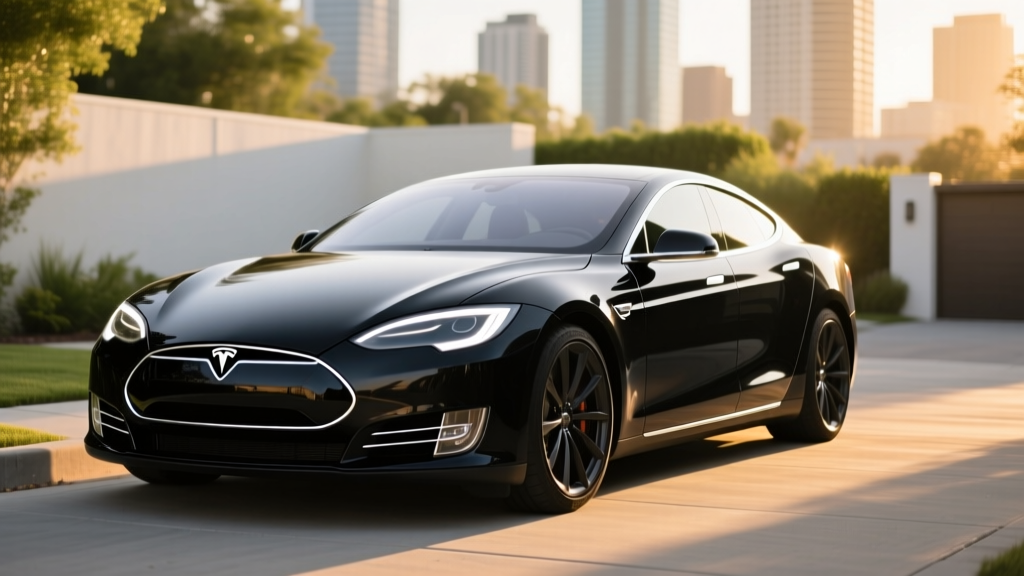
The Tesla Model S has been the benchmark luxury electric sedan since 2012, but its resale trajectory tells a more complicated story than its 0-60 times ever could. If you're researching Tesla Model S depreciation, you're likely weighing whether the flagship sedan's steep entry price holds up over three, five, or seven years of ownership — or whether rivals like the Lucid Air, Porsche Taycan, and Mercedes EQS offer better long-term value retention.
This review examines the 2026 Tesla Model S through the lens of depreciation while covering every spec a buyer needs: real-world range, charging speed, battery chemistry, pricing, tax credit eligibility, and how it stacks up against key competitors in the luxury EV sedan segment.
2026 Tesla Model S Core Specifications
| Spec | Model S Long Range | Model S Plaid |
|---|---|---|
| Base MSRP | $84,990 | $99,990 |
| EPA Range | 402 miles | 396 miles |
| Battery (usable) | ~100 kWh (NMC) | ~100 kWh (NMC) |
| Drivetrain | Dual-Motor AWD | Tri-Motor AWD |
| Horsepower | 670 hp | 1,020 hp |
| 0-60 mph | 3.1 sec | 1.99 sec |
| MPGe (combined) | 120 MPGe | 116 MPGe |
| Max DC Fast Charge | 250 kW | 250 kW |
| 10-80% DCFC Time | ~30 min | ~30 min |
| Level 2 Rate (48A) | ~11.5 kW / 44 mi/hr | ~11.5 kW / 44 mi/hr |
| Battery Warranty | 8 yr / 150,000 mi | 8 yr / 150,000 mi |
| Cargo Volume | 28 cu ft (rear + frunk) | 28 cu ft (rear + frunk) |
Depreciation Reality: What the Numbers Show
Luxury sedans historically depreciate faster than SUVs and trucks, and high-end EVs carry additional headwinds: rapid technology iteration, battery health concerns among second-hand buyers, and Tesla's frequent price adjustments on new models that instantly reset used-market expectations.
Based on historical resale data and industry depreciation models from sources like Kelley Blue Book and iSeeCars, the Model S has exhibited the following approximate value retention pattern:
- Year 1: ~15-20% depreciation off MSRP (destination, fees, and initial market adjustment)
- Year 3: ~40-48% cumulative depreciation
- Year 5: ~55-63% cumulative depreciation
- Year 7: ~65-72% cumulative depreciation
For a $84,990 Model S Long Range, that translates to roughly $46,000-$53,000 in value lost over five years — or approximately $9,200-$10,600 per year in depreciation alone. The Plaid, starting at $99,990, faces even steeper dollar losses due to its higher entry point and niche buyer pool on the used market.
Several factors uniquely accelerate Tesla Model S depreciation:
- Price volatility: Tesla has adjusted Model S pricing multiple times since 2020, often cutting MSRP. Each cut immediately depresses used values of existing cars.
- Tech iteration: Hardware generations (HW3 to HW4, new interior refreshes) make older models feel dated faster than traditional luxury sedans.
- Battery uncertainty: While Tesla's NMC packs have proven durable (most showing 85-90% capacity retention at 100,000 miles), second-hand buyers discount for worst-case replacement scenarios costing $15,000-$22,000.
- Segment shift: Luxury buyers increasingly prefer SUVs (Model X, BMW iX, Porsche Cayenne EV), reducing demand for used luxury sedans.
Real-World Range and Efficiency
Real-World Highway (70 mph, mild weather): ~320-350 miles
Real-World Cold Weather (below 32°F, mixed driving): ~260-300 miles
Efficiency: 120 MPGe combined (Long Range) — approximately 28 kWh/100 miles
The Model S Long Range's 402-mile EPA rating remains among the highest of any production EV sold in the U.S. However, the EPA cycle includes substantial low-speed and city driving where regenerative braking recovers energy. At sustained highway speeds of 70-80 mph, expect to use 30-32 kWh/100 miles, yielding an effective range closer to 320-350 miles from the ~100 kWh usable battery pack.
In cold weather, the NMC (nickel manganese cobalt) chemistry loses some efficiency to internal resistance and cabin heating demands. Tesla's heat pump system mitigates this better than resistive heating, but owners in northern climates should plan for 25-30% range reduction in winter conditions. According to fueleconomy.gov, the Long Range achieves 124 MPGe city / 116 MPGe highway.
Charging Speed: Home and DC Fast Charging
| Charging Level | Power | Speed (miles/hr) | Notes |
|---|---|---|---|
| Level 1 (120V) | ~1.4 kW | ~5 mi/hr | Emergency/trickle only |
| Level 2 (240V, 48A) | 11.5 kW | ~44 mi/hr | Full charge in ~9 hrs |
| Level 2 (240V, 60A) | 14.4 kW | ~52 mi/hr | Requires Wall Connector + 60A circuit |
| DC Fast Charge (V3 Supercharger) | Peak 250 kW | ~75 mi in 15 min | 10-80% in ~30 min |
| DC Fast Charge (V4 Supercharger) | Peak 250 kW* | Similar to V3 | *Model S limited to 250 kW architecture |
The Model S charges at a peak rate of 250 kW on Tesla V3 and V4 Superchargers. However, that peak rate is sustained only between roughly 10-30% state of charge. The charge curve tapers significantly above 50% SoC, and charging from 80-100% is very slow — this is typical of NMC lithium-ion chemistry, which requires careful current management at high states of charge to protect cell longevity.
At home on a 48-amp Level 2 circuit (the most common residential installation using a Tesla Wall Connector on a 60-amp breaker), the Model S adds approximately 44 miles of range per hour. A full overnight charge from 10% to 100% takes about 9 hours. For most owners charging nightly from 30-80%, that's a 4-5 hour session — easily accomplished while sleeping.
One depreciation-relevant note: the Model S uses Tesla's proprietary connector (now standardized as NACS). As of 2026, virtually all new EVs sold in North America have adopted NACS, meaning the Model S has native access to the largest fast-charging network without adapters — a factor that supports its resale value relative to CCS-equipped competitors.
Pricing, Tax Credits, and the Depreciation Equation
| Trim | Base MSRP | Destination | Federal §30D Credit | Effective Price |
|---|---|---|---|---|
| Long Range | $84,990 | $1,995 | $0 (MSRP cap exceeded) | $86,985 |
| Plaid | $99,990 | $1,995 | $0 (MSRP cap exceeded) | $101,985 |
This is critical for depreciation calculations: the Tesla Model S does not qualify for the federal §30D EV tax credit. Under current IRS rules, sedans must have an MSRP at or below $55,000 to be eligible. Both Model S trims far exceed that cap, meaning buyers pay full sticker with no federal offset.
Additionally, the §30D credit has income caps ($150,000 single / $300,000 joint modified AGI) and critical-mineral/battery-sourcing requirements. But even if a buyer met all other criteria, the MSRP cap alone disqualifies the Model S.
This lack of credit has two depreciation implications: (1) the buyer absorbs the full MSRP cost with no government subsidy cushion, and (2) the used-market buyer also cannot claim the credit on a new purchase, reducing the incentive to buy new vs. used — which paradoxically provides some floor to resale values.
Some states offer their own incentives that are not subject to the federal MSRP cap. Check your state's energy office or DMV for current programs, as these vary widely by jurisdiction and change frequently.
Interior, Cargo, and Technology
The Model S interior was refreshed in 2021 and carries forward into 2026 with a minimalist design anchored by a 17-inch center touchscreen (landscape orientation) and a 12.3-inch driver instrument cluster. A rear-seat 8-inch touchscreen controls climate and media for passengers.
Cargo and dimensions:
- Rear cargo (behind second row): 26.3 cu ft
- Front trunk (frunk): 2.8 cu ft
- Total cargo: ~28 cu ft (with seats up)
- Rear legroom: 40.9 inches
- Front headroom: 39.3 inches
- Curb weight: ~4,561 lbs (Long Range)
The liftback design provides a wider cargo opening than traditional sedans, making the Model S more practical for bulky items than competitors like the Porsche Taycan (which uses a conventional trunk lid).
Standout tech features:
- Autopilot standard (SAE Level 2 driver assist — requires active driver supervision at all times)
- Full Self-Driving (Supervised) available as a $8,000 option or $99/month subscription — still SAE Level 2 despite the name
- Over-the-air updates continuously add features
- Sentry Mode (cameras record around the vehicle when parked)
- Gaming-capable infotainment (AMD Ryzen processor)
- Yoke steering wheel standard (conventional round wheel available at no cost)
Notable drawbacks:
- No Apple CarPlay or Android Auto — Tesla's proprietary infotainment only
- Build quality has improved but still draws criticism for panel-gap consistency vs. German luxury competitors
- Yoke steering can be unintuitive for low-speed maneuvers and three-point turns
- Minimalist interior lacks physical buttons — all climate/media controls are touchscreen
- No heads-up display
Model S vs. Key Competitors: Depreciation and Value
| Attribute | Tesla Model S LR | Lucid Air Pure | Porsche Taycan 4S | Mercedes EQS 450+ |
|---|---|---|---|---|
| Base MSRP | $84,990 | $74,990 | $99,900 | $105,550 |
| EPA Range | 402 mi | 419 mi | 277 mi | 390 mi |
| Battery (kWh) | ~100 (NMC) | ~88 (NMC) | ~83.7 (NMC) | ~108.4 (NMC) |
| Peak DCFC (kW) | 250 | 220 | 270 | 200 |
| 0-60 mph | 3.1 sec | 5.2 sec | 3.8 sec | 5.9 sec |
| Federal Credit | No (MSRP cap) | No (MSRP cap) | No (MSRP cap) | No (MSRP cap) |
| Est. 5-Yr Depreciation | ~55-63% | ~58-65% | ~50-58% | ~55-63% |
Who Should Buy the Model S (and Who Shouldn't)
Choose the Tesla Model S if:
- You prioritize maximum range and Supercharger network access for frequent long-distance road trips
- You want supercar-level acceleration (especially the Plaid at 1,020 hp) in a practical four-door sedan
- You value over-the-air updates and a tech-forward ownership experience
- You plan to own for 5+ years and can absorb the depreciation hit
Consider alternatives if:
- Depreciation minimization is a top priority — consider leasing or buying CPO (certified pre-owned) to let the first owner absorb the steepest loss
- You want Apple CarPlay/Android Auto or a more traditional luxury interior (look at the EQS or Taycan)
- You need more cargo space — the Model X, BMW iX, or Rivian R1S offer SUV practicality
- Your budget is under $75,000 — the Lucid Air Pure offers competitive range at a lower entry point
Pros and Cons
- Class-leading 402-mile EPA range
- Access to 20,000+ Tesla Superchargers natively (NACS)
- Brutal acceleration — 3.1 sec (LR) or 1.99 sec (Plaid) 0-60
- Spacious liftback cargo area for a sedan (28 cu ft)
- Continuous OTA updates add features over time
- Strong battery warranty: 8 yr / 150,000 mi with 70% retention threshold
- Steep depreciation: ~55-63% value loss over 5 years
- No federal tax credit — MSRP exceeds the $55,000 sedan cap
- No Apple CarPlay or Android Auto
- 250 kW peak DCFC is now mid-pack; rivals charge at 270-350 kW
- Build quality perception trails Porsche, Mercedes
- Yoke steering polarizing; round wheel should be standard
Battery Warranty and Long-Term Degradation
Tesla covers the Model S battery and drive unit for 8 years or 150,000 miles, whichever comes first, with a minimum 70% capacity retention guarantee. This is among the more generous mileage limits in the luxury EV segment — Porsche covers the Taycan battery for 8 years / 100,000 miles, and Mercedes covers the EQS for 10 years / 155,000 miles.
Real-world degradation data from Tesla's fleet indicates the NMC battery packs in the Model S retain approximately 88-92% of original capacity at 100,000 miles, with degradation slowing significantly after the initial 10-15% loss in the first 20,000-30,000 miles. This suggests most owners will not approach the 70% warranty threshold under normal use.
Out-of-warranty battery replacement for the Model S currently ranges from $15,000 to $22,000 depending on the service center and whether a refurbished pack is available. This figure weighs heavily on used-market pricing as vehicles approach the 8-year / 150,000-mile mark.
Frequently Asked Questions
What is the real-world range of the 2026 Tesla Model S?
The EPA rates the Long Range at 402 miles and the Plaid at 396 miles. In real-world highway driving at 70-80 mph in mild weather, expect 320-350 miles. In cold weather (below freezing), plan for 260-300 miles. These are achievable numbers, but the EPA figure assumes a mix of city and highway driving at moderate speeds.
How fast does the Model S charge at home and on the road?
On a 48-amp Level 2 home charger (240V), the Model S charges at 11.5 kW, adding about 44 miles of range per hour — a full overnight session covers most daily needs. On a Tesla V3 Supercharger, it peaks at 250 kW and charges from 10-80% in approximately 30 minutes. Note that the 250 kW peak is only sustained at low states of charge; the rate tapers progressively above 50% SoC.
Does the Tesla Model S qualify for the federal EV tax credit?
No. Under current IRS §30D rules, sedans must have an MSRP of $55,000 or less. The Model S starts at $84,990 (Long Range), well above the cap. Buyers also need to meet income limits ($150K single / $300K joint) and battery sourcing requirements — but the MSRP cap alone disqualifies the Model S regardless of income.
How much does the Tesla Model S depreciate over 5 years?
Based on historical resale data, the Model S loses approximately 55-63% of its MSRP over five years. On an $84,990 Long Range, that's roughly $46,000-$53,000 in value loss. Key drivers include Tesla's new-car price volatility, technology iteration, and the general luxury-sedan depreciation curve. Buying certified pre-owned or leasing can mitigate this exposure.
Is the Model S worth buying vs. the Lucid Air or Porsche Taycan?
It depends on your priorities. The Model S wins on range (402 mi), acceleration (3.1 sec LR / 1.99 sec Plaid), and Supercharger network access. The Lucid Air Pure offers more range (419 mi) at a lower price ($74,990). The Porsche Taycan holds value slightly better and delivers a more engaging driving experience, but sacrifices range (277 mi for the 4S). If road-trip charging infrastructure matters most, Tesla's Supercharger advantage remains significant in 2026, though competitors now have NACS access to the same network.
What are the biggest pros and cons of the Model S in 2026?
Top pros: class-leading range, Supercharger access, extreme acceleration, spacious liftback design, and strong OTA update cadence. Top cons: steep depreciation, no federal tax credit, 250 kW peak charging now trails some rivals, no smartphone integration (CarPlay/Android Auto), and build-quality perception still trails German luxury brands.
Sources: EPA fueleconomy.gov, Tesla Model S specifications, IRS §30D Clean Vehicle Credits.