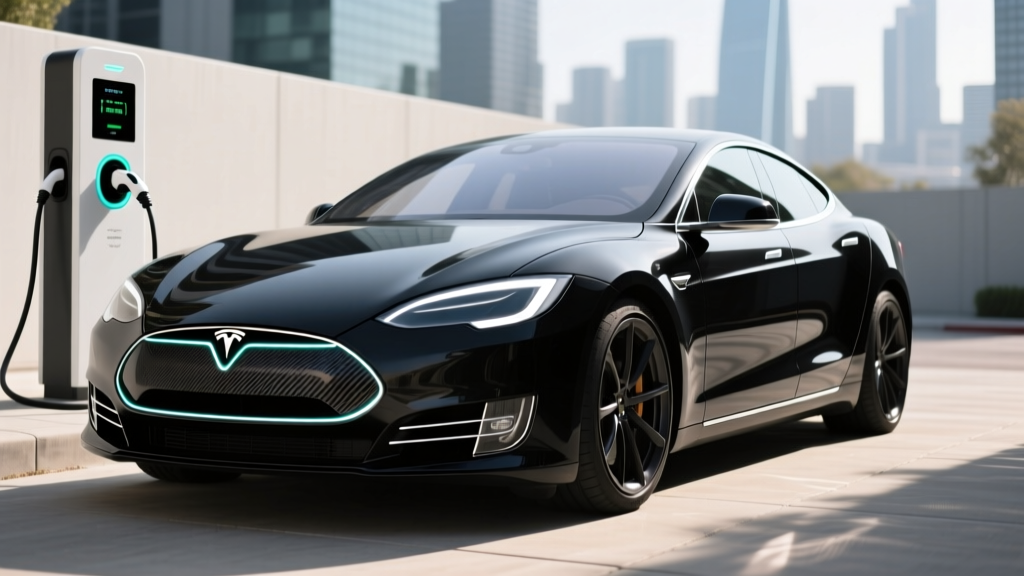
The Tesla Model S remains one of the longest-running nameplates in the premium electric sedan segment, and for 2026, it continues to anchor Tesla's flagship lineup. While Tesla doesn't offer a standalone "Black Edition" trim, the Tesla Model S in Solid Black (a $1,500 paint option) is among the most searched configurations — and for good reason. The blacked-out aesthetic pairs with the Stealth Wrap-compatible body lines and the available 21-inch Arachnid wheels to create what is arguably the most understated-luxury execution in the EV market.
But beyond the paint code, the 2026 Model S Long Range and Plaid variants carry serious engineering credentials: a 100 kWh battery pack, up to 402 miles of EPA-rated range, 250 kW DC fast charging, and dual-motor all-wheel drive as standard. This review breaks down every spec, real-world range figure, charging curve, and ownership cost you need before signing the order sheet.
2026 Tesla Model S: Core Specifications at a Glance
| Specification | Model S Long Range | Model S Plaid |
|---|---|---|
| EPA Range | 402 miles | 396 miles |
| Battery (usable) | ~100 kWh (NMC) | ~100 kWh (NMC) |
| Drivetrain | Dual-Motor AWD | Tri-Motor AWD |
| Horsepower | 670 hp | 1,020 hp |
| 0–60 mph | 3.1 seconds | 1.99 seconds |
| Top Speed | 155 mph | 200 mph |
| Max DC Fast Charge | 250 kW | 250 kW |
| 10–80% DC Charge | ~28 minutes | ~28 minutes |
| Level 2 Charge Rate | 11.5 kW (~44 mi/hr) | 11.5 kW (~44 mi/hr) |
| MPGe (combined) | 120 MPGe | 116 MPGe |
| Efficiency | 28 kWh/100 mi | 29 kWh/100 mi |
| Cargo Volume | 28 cu ft (rear) + frunk | 28 cu ft (rear) + frunk |
| Base MSRP | $74,990 | $89,990 |
| Battery Warranty | 8 yr / 150,000 mi | 8 yr / 150,000 mi |
Source: Tesla Model S Design Studio and fueleconomy.gov.
Real-World Range: What the EPA Sticker Doesn't Tell You
Real-World Highway (70 mph, 72°F): ~320–340 miles
Real-World Highway (32°F, winter): ~260–290 miles
City / Mixed Commute: ~360–380 miles (regen-heavy routes recover more energy)
The 402-mile EPA figure on the Long Range is legitimate in moderate-temperature mixed driving, but real-world conditions compress that number. At sustained highway speeds of 70–80 mph, aerodynamic drag dominates and efficiency drops to roughly 30–32 kWh/100 mi, yielding 320–340 miles of practical range.
Cold weather is the bigger variable. In sub-freezing temperatures, the battery's internal resistance increases and cabin heating draws significant power (the Model S uses a heat pump, which helps, but resistive loads still add up). Expect a 25–35% range reduction in winter highway driving — roughly 260–290 miles from a full charge. Preconditioning the battery while plugged in mitigates some of this loss and is critical before DC fast charging in cold weather.
The Plaid's tri-motor setup adds weight and parasitic losses from the third motor, trimming range to 396 miles EPA and roughly 310–330 miles real-world highway. For most buyers, the Long Range's range advantage and $15,000 lower price make it the pragmatic pick unless track performance is a priority.
Charging Speed: DC Fast, Level 2, and the Charge Curve Reality
| Charging Level | Power / Rate | Miles Added per Hour | Typical Use Case |
|---|---|---|---|
| Level 1 (120V) | ~1.4 kW | ~3–5 mi/hr | Emergency / trickle top-off |
| Level 2 (240V, 48A) | 11.5 kW | ~44 mi/hr | Home overnight charging |
| DC Fast (V3 Supercharger) | Peak 250 kW | ~200 mi in 15 min | Road trips |
| DC Fast (above 80% SoC) | Tapers to ~40–60 kW | Varies | Topping off (slow) |
Tesla's V3 Supercharger network delivers a peak of 250 kW to the Model S, and the car's battery thermal management system is among the best in the industry at sustaining high charge rates. In ideal conditions (battery preconditioned, 10–50% SoC), you'll see sustained rates of 200–240 kW. The 10–80% charge typically completes in about 28 minutes.
However, the charge curve tapers significantly above 80%. Charging from 80–100% can take as long as the 10–80% session. For road trips, the optimal strategy is short, frequent stops charging to 70–80% rather than waiting for a full battery. Tesla's navigation system automatically routes through Superchargers and preconditions the battery when a charger is set as the destination — use this feature to avoid arriving at a cold battery that charges at half speed.
At home, the Model S accepts 11.5 kW on Level 2 (48 amps on a 60-amp circuit, requiring a NEMA 14-60 outlet or hardwired Tesla Wall Connector). A full charge from 10% takes roughly 8.5 hours — easily achievable overnight. If your home electrical panel supports only a 40-amp circuit (32 amps), charge rate drops to ~7.7 kW (~30 mi/hr), which still covers most daily needs but extends full-charge time to ~12 hours.
Performance and Driving Dynamics
The Long Range's dual-motor AWD system produces 670 horsepower and launches the Model S to 60 mph in 3.1 seconds — faster than most sports sedans costing twice as much. The Plaid's tri-motor configuration (one front, two rear) generates 1,020 hp and a 1.99-second 0–60 time, making it one of the quickest production cars ever built.
Both variants feature adaptive air suspension that adjusts ride height based on speed and terrain. At highway speeds, the car lowers automatically to reduce drag and improve range. The steering is precise but light — this is a grand tourer, not a corner-carving sports sedan. The Plaid adds carbon-ceramic brakes (optional, $15,000 package) for track use, but the standard steel brakes on the Long Range are more than adequate for road use.
Regenerative braking offers two modes: Standard (strong one-pedal driving feel) and Low (coasting-friendly). Unlike some competitors, Tesla does not offer adjustable regen levels beyond these two presets. The Standard mode is aggressive enough for most drivers to use one-pedal driving in city traffic.
Interior, Tech, and Cargo
The Model S interior centers on a 17-inch landscape-oriented touchscreen running Tesla's proprietary infotainment OS. The yoke steering wheel is standard (a round wheel is available at no cost). Build quality has improved significantly since the 2021 refresh — panel gaps are tighter, and materials include ventilated front seats, a panoramic glass roof, and a 22-speaker audio system.
Passenger space: Front legroom is generous at 42.7 inches, but rear legroom (35.4 inches) is tighter than rivals like the Mercedes EQS or Lucid Air. The rear seat comfortably fits two adults but feels cramped for three across on long trips.
Cargo: The hatchback-style trunk provides 28 cubic feet of rear cargo space (seats folded: ~63 cu ft), plus a front trunk (frunk) that accommodates a carry-on bag. The hatch design is more practical than a traditional sedan trunk, but the high load floor and sloping roofline limit tall-item utility.
Autopilot and FSD: Basic Autopilot (Traffic-Aware Cruise Control + Autosteer) is standard. Full Self-Driving (Supervised) is a $8,000 add-on. FSD operates at SAE Level 2 — the driver must remain fully engaged, hands on wheel (or torque applied with the yoke), eyes on road. It handles highway merges, stoplights, and some city streets impressively, but it is not autonomous driving and requires constant supervision.
Pricing, Trims, and Federal Tax Credit Eligibility
| Trim | Base MSRP | As-Tested (Black + common options) | Federal Tax Credit (§30D) |
|---|---|---|---|
| Model S Long Range | $74,990 | $82,490 (Black paint, FSD, 21" wheels) | Not eligible (MSRP > $55K sedan cap) |
| Model S Plaid | $89,990 | $104,490 (Black paint, FSD, carbon-ceramic brakes) | Not eligible (MSRP > $55K sedan cap) |
The 2026 Tesla Model S does not qualify for the federal §30D new EV tax credit. Under current IRS rules, sedans with an MSRP above $55,000 are excluded from the credit, regardless of battery sourcing or buyer income. The Model S Long Range starts at $74,990 — well above the threshold. This is a firm disqualifier, not a gray area.
Buyers seeking tax incentives should investigate state-level rebates (California's CVRP, Colorado's Innovative Motor Vehicle Credit, and others may offer $2,000–$5,000 depending on income). Some states also offer reduced electricity rates for EV charging or HOV lane access, which add non-monetary value. Always consult the IRS §30D guidance and a tax professional for your specific situation.
The Solid Black paint adds $1,500 to any configuration. Other paint options include Pearl White (standard), Midnight Silver ($1,500), Deep Blue ($1,500), and Ultra Red ($2,500). The Stealth PPF wrap popular among black Model S owners typically adds $5,000–$8,000 from third-party installers.
Warranty and Long-Term Ownership
Tesla covers the Model S battery and drive units for 8 years or 150,000 miles, whichever comes first, with a minimum 70% capacity retention guarantee. The basic vehicle warranty is 4 years / 50,000 miles. This battery warranty is competitive with the industry standard (most automakers offer 8 yr / 100,000 mi), and Tesla's 150,000-mile threshold is among the most generous.
The NMC (nickel manganese cobalt) chemistry in the Model S pack has demonstrated strong longevity in fleet data. Independent analyses from sources like Recurrent Auto show Tesla batteries retaining 88–92% of original capacity after 100,000 miles. Degradation is most pronounced in the first 20,000 miles (2–4% loss), then flattens to roughly 1% per year or per 10,000 additional miles.
For owners who charge primarily at home on Level 2 and keep daily SoC between 20–80% (using the car's built-in charge limit feature), long-term degradation is minimal. Frequent DC fast charging and regularly charging to 100% accelerate wear, but the battery management system's thermal controls mitigate much of this risk.
Who Should Buy the Tesla Model S in Black?
- You want the longest-range sedan in Tesla's lineup for cross-country road trips
- You need a practical daily driver with strong Supercharger network access
- You prioritize tech-forward features and OTA updates over traditional luxury branding
- Sub-2-second 0–60 performance is a priority and budget allows $90K+
- You plan to use track mode and value tri-motor torque vectoring
- You need maximum rear-seat space (consider the Lucid Air or Mercedes EQS)
- Federal tax credit eligibility is essential to your purchase math (consider the Model 3 or Model Y)
- You prefer traditional luxury dealership service experiences
The Model S in black is a stealth-luxury statement — it flies under the radar at valet stands while delivering performance that embarrasses supercars at stoplights. But its strongest selling point remains Tesla's Supercharger network: over 17,000 V3/V4 stalls across North America with unmatched reliability and seamless plug-and-charge integration. For frequent road trippers, this ecosystem advantage is difficult to quantify but impossible to ignore.
Pros and Cons
- 402-mile EPA range is class-leading for a performance sedan
- 250 kW DC charging with excellent sustained charge curve
- Supercharger network access (NACS connector, native — no adapter needed)
- 670 hp Long Range at $74,990 is strong value per horsepower
- OTA software updates continuously add features post-purchase
- 8 yr / 150,000 mi battery warranty (150K is above industry norm)
- No federal tax credit eligibility (sedan MSRP cap is $55K)
- Rear seat legroom is tighter than Lucid Air and Mercedes EQS
- Yoke steering wheel is polarizing and takes adaptation
- No Apple CarPlay or Android Auto integration
- Service center availability varies by region; mobile service can't fix everything
- Insurance premiums are significantly above segment average
Frequently Asked Questions
Is there a specific "Tesla Model S Black Edition" trim?
No. Tesla does not produce a "Black Edition" trim. "Tesla Model S Black" refers to the Solid Black multi-coat paint option ($1,500 upgrade) available on both Long Range and Plaid trims. Some owners pair black paint with the available 21-inch Arachnid wheels and delete chrome trim for a full blacked-out appearance.
What is the real-world range of the 2026 Tesla Model S?
Expect approximately 320–340 miles on the highway in moderate temperatures, and 260–290 miles in freezing winter conditions. The 402-mile EPA figure reflects mixed city/highway driving at moderate speeds. City-heavy commutes with frequent regenerative braking can approach 370–380 miles.
How fast does the Model S charge at home and on the road?
On a Level 2 home charger (240V, 48A), the Model S charges at 11.5 kW, adding roughly 44 miles of range per hour — a full overnight charge. On a V3 Supercharger, it peaks at 250 kW and charges from 10–80% in approximately 28 minutes when the battery is preconditioned.
Does the Tesla Model S qualify for the $7,500 federal EV tax credit?
No. Under IRS §30D rules, sedans must have an MSRP at or below $55,000 to qualify. The Model S starts at $74,990, making it ineligible regardless of buyer income or battery component sourcing. Check state-level incentives as an alternative.
How does the Model S compare to the Lucid Air and Mercedes EQS?
The Lucid Air Grand Touring offers more range (516 mi EPA) and more rear-seat space but at a higher starting price ($125,600) and with a less mature charging network. The Mercedes EQS 450+ provides a more traditional luxury interior and dealer service experience but lower range (390 mi EPA) and slower DC charging (200 kW peak). The Model S wins on Supercharger access, software, and value at its price point.
Is the Tesla Model S a good car for road trips?
Yes — it's one of the best EVs for long-distance travel thanks to 402-mile range, 250 kW charging, and exclusive access to the Supercharger network. Plan stops every 250–300 miles (charging to ~80% in 20–25 minutes) and use the built-in navigation for automatic battery preconditioning at each stop.