How Long Is the Cybertruck? Exterior Dimensions Explained
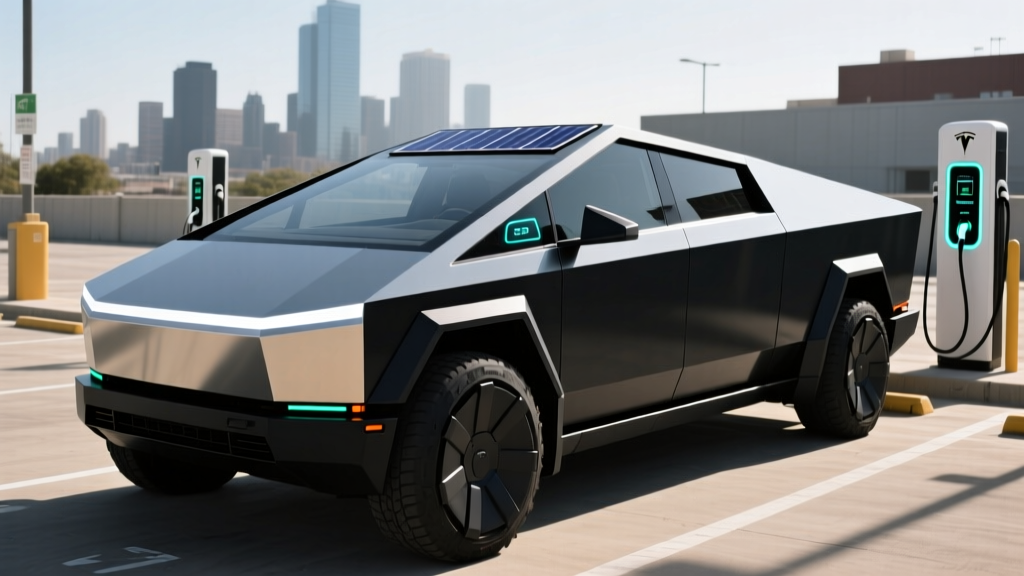
The question on many truck buyers' minds — how long is the Cybertruck — has a precise answer: the Tesla Cybertruck measures 223.5 inches (18.6 feet) long, making it shorter than a Ford F-150 crew cab with a 5.5-foot bed (231.7 inches) but longer than a Rivian R1T (217.1 inches). Its stainless-steel exoskeleton and angular geometry can make it appear even larger in person, but the footprint is mid-size by full-truck standards.
Here are the full exterior dimensions for the 2026 Tesla Cybertruck across all trims:
| Dimension | Measurement |
|---|---|
| Overall Length | 223.5 in (5,677 mm) |
| Wheelbase | 141.7 in (3,599 mm) |
| Width (excl. mirrors) | 79.8 in (2,027 mm) |
| Width (incl. mirrors) | 95.0 in (2,413 mm) |
| Height | 70.5 in (1,791 mm) |
| Bed Length | 72.0 in (6 ft / 1,829 mm) |
| Bed Width (between wheel wells) | 48.0 in |
| Curb Weight (AWD) | 6,647 lbs |
| Ground Clearance (max) | 17.4 in (Extract Mode) |
The 6-foot bed is shorter than most full-size pickups (the F-150 offers 5.5, 6.5, or 8.0-foot beds), which matters for hauling lumber or motorcycles. The 48-inch width between the wheel wells does accommodate a standard sheet of plywood flat — a claim Tesla engineers specifically designed for. Total bed volume is approximately 57 cu ft, with an additional 11 cu ft in the front trunk (frunk).
Range, Battery, and Real-World Efficiency
The 2026 Cybertruck is offered in three trims with different range ratings. Tesla uses a roughly 123 kWh usable NMC (nickel manganese cobalt) battery pack across AWD trims, while the base RWD (expected late 2026) will use an LFP (lithium iron phosphate) chemistry pack. NMC offers higher energy density — critical for a 6,600+ lb vehicle — while LFP trades some range for longevity and lower cost.
| Trim | Battery (usable kWh) | Chemistry | EPA Range | MPGe (combined) | kWh/100 mi |
|---|---|---|---|---|---|
| AWD (Dual Motor) | ~123 kWh | NMC | 340 mi | 66 MPGe | 51 kWh/100mi |
| Cyberbeast (Tri-Motor) | ~123 kWh | NMC | 320 mi | 64 MPGe | 53 kWh/100mi |
| RWD (Late 2026) | ~123 kWh (est.) | LFP (est.) | 250 mi (est.) | TBD | TBD |
At 51 kWh per 100 miles (AWD), the Cybertruck is significantly less efficient than a Model Y (28 kWh/100mi) or even the Rivian R1T (48 kWh/100mi). This matters for charging costs: at the national average of $0.16/kWh, you're paying roughly $8.16 per 100 miles at home — about half what a comparable gas truck costs in fuel, but noticeably more than lighter EVs.
Charging Speed: DC Fast and Home Level 2
The Cybertruck supports Tesla's NACS connector natively and can charge at the full V4 Supercharger network. Peak DC fast-charge rate is 250 kW on current V3/V4 Superchargers.
| Charging Method | Max Power | Speed / Time | Notes |
|---|---|---|---|
| DC Fast Charge (Supercharger V3/V4) | 250 kW peak | 10-80% in ~25 min | Curve tapers sharply above 80%; 80-100% adds ~20+ min |
| Level 2 Home (Tesla Wall Connector) | 11.5 kW (48A) | ~37 mi/hr added | Full charge in ~11 hours from 0% |
| Level 2 Public (J1772 w/ adapter) | Up to 11.5 kW | Varies by station | Tesla includes J1772 adapter |
| Level 1 (120V household) | ~1.4 kW | ~4 mi/hr added | Not practical for daily use on 123 kWh pack |
The 250 kW peak is impressive, but the charge curve matters more than the peak number. The Cybertruck sustains roughly 200-250 kW up to about 40% SoC, then tapers to ~150 kW through 60%, and drops further to ~75 kW above 80%. This is typical for NMC chemistry at high state-of-charge, but the massive 123 kWh pack means even the taper phase adds meaningful range. A 10-80% session in ~25 minutes translates to roughly 220 miles of real-world range added — enough for most road-trip legs.
For home charging, a Tesla Wall Connector on a 60A circuit delivers 11.5 kW (48A continuous), adding about 37 miles of range per hour. An overnight charge (10 hours) restores roughly 370 miles — more than a full pack. We strongly recommend a hardwired Level 2 installation over a 14-50 outlet for reliability and to avoid the 24A continuous limit of plug-in units.
Performance: 0-60, Horsepower, and Drivetrain
The Cybertruck's acceleration defies its 6,600+ lb curb weight. Tesla's tri-motor Cyberbeast is one of the quickest production trucks ever built:
| Trim | Drivetrain | Horsepower | Torque (lb-ft) | 0-60 mph | Top Speed |
|---|---|---|---|---|---|
| AWD (Dual Motor) | AWD | 600 hp | 740 | 3.9 sec | 112 mph |
| Cyberbeast (Tri-Motor) | AWD | 845 hp | 740+ | 2.6 sec | 130 mph |
| RWD (Late 2026) | RWD | ~400 hp (est.) | TBD | ~5.5 sec (est.) | TBD |
The AWD dual-motor's 3.9-second 0-60 time already outpaces most sports sedans. The Cyberbeast's 2.6 seconds is supercar territory — though sustaining that performance generates significant heat, and repeated hard launches will trigger thermal management interventions.
Towing capacity is rated at 11,000 lbs for AWD and Cyberbeast trims. However, towing at max capacity will cut range by roughly 40-50%, meaning real-world towing range drops to approximately 150-170 miles. This is a physics limitation shared by all electric trucks, not unique to the Cybertruck.
Pricing, Tax Credits, and Total Cost
The 2026 Cybertruck lineup has seen price adjustments since its 2023 launch. Here are current MSRPs before any incentives:
| Trim | Base MSRP | Est. §30D Credit | Effective Price* |
|---|---|---|---|
| RWD (Late 2026) | ~$60,990 (est.) | Up to $7,500 | ~$53,490 |
| AWD | $79,990 | Up to $7,500 | $72,490 |
| Cyberbeast | $99,990 | Up to $7,500 | $92,490 |
*Effective price assumes full §30D eligibility. Actual credit depends on buyer income, battery sourcing, and point-of-sale transfer.
Federal tax credit eligibility under IRS §30D is complex for the Cybertruck:
- MSRP Cap: Trucks/vans/SUVs must have an MSRP at or below $80,000. This means the AWD ($79,990) qualifies, but the Cyberbeast ($99,990) does NOT qualify for the new-vehicle credit.
- Income Cap: Modified AGI must not exceed $300,000 (joint), $225,000 (head of household), or $150,000 (single).
- Battery Sourcing: The $7,500 credit splits into two halves — $3,750 for critical minerals and $3,750 for battery component sourcing. Tesla's supply chain has shifted significantly, and partial credit ($3,750) may apply depending on the build date. Verify current sourcing status on fueleconomy.gov before purchasing.
- Point-of-Sale Transfer: As of 2024, you can transfer the credit to the dealer at purchase, reducing your out-of-pocket cost immediately rather than waiting for tax filing.
For the Cyberbeast, the only federal incentive path is the used EV credit (up to $4,000 / 30% of sale price) if you purchase one secondhand at $25,000+ from a dealer — though used Cyberbeasts currently trade well above that threshold.
Interior, Cargo, and Daily Usability
The Cybertruck seats five across two rows, though the rear bench is tighter than a full-size truck. Legroom measures approximately 41.0 inches front / 38.0 inches rear. The rear seat is adequate for adults on shorter trips but won't match an F-150 SuperCrew for long-haul comfort.
Cargo flexibility is a strong point:
- Bed volume: ~57 cu ft (6 ft × 4 ft between wells)
- Frunk: ~11 cu ft with a drainable floor (useful as a cooler)
- Sail pillars / motorized tonneau: The powered retractable bed cover is standard and locks securely, but the angular sail pillars limit loading tall items from the side
- Tailgate: Power-operated, doubles as a ramp for loading ATVs or motorcycles into the bed
The steer-by-wire system (no mechanical linkage between steering wheel and wheels) is the Cybertruck's most polarizing tech feature. It enables a yoke-style steering wheel with variable ratio — fewer turns lock-to-lock at low speeds, more stability at highway speeds. Most drivers adapt within a day, but it's a fundamentally different feel from traditional steering and not everyone's preference.
The 18.5-inch center touchscreen runs Tesla's latest infotainment software, including a dedicated off-road display with pitch/roll angles, tire pressure monitoring, and a trail camera system. There is no Apple CarPlay or Android Auto — Tesla's ecosystem is self-contained, with native Spotify, YouTube, and Netflix (while parked).
Driver Assistance and Safety
Tesla's Autopilot and Full Self-Driving (Supervised) are Level 2 driver-assist systems, not self-driving. The driver must keep hands on the wheel (or provide torque input) and eyes on the road at all times. The Cybertruck does NOT drive itself.
The Cybertruck comes standard with Tesla Autopilot (adaptive cruise + lane centering). The optional FSD (Supervised) package ($8,000 one-time or $99/month) adds automated lane changes, traffic-light recognition, and city-street navigation. As of 2026, FSD remains a supervised system requiring active driver engagement — Tesla has not achieved regulatory approval for unsupervised operation on public roads for consumer vehicles.
Safety ratings are still evolving. The NHTSA has not published a full 5-star rating for the Cybertruck as of early 2026, and the IIHS has not yet completed crash testing. The stainless-steel exoskeleton is extremely rigid, which should perform well in crash structures, but the angular front-end geometry raises pedestrian-safety concerns that testing will need to quantify.
Warranty and Long-Term Ownership
| Coverage | Term |
|---|---|
| Basic Vehicle Limited Warranty | 4 years / 50,000 miles |
| Battery & Drive Unit Warranty | 8 years / 150,000 miles (min. 70% retention) |
| Restraint System | 5 years / 60,000 miles |
| Corrosion Perforation | 12 years / unlimited miles (stainless body) |
The 8-year/150,000-mile battery warranty with a 70% capacity retention threshold is competitive with the industry. NMC batteries typically degrade 10-15% over 150,000 miles under normal use. The stainless-steel body panels won't rust in the traditional sense, though surface staining and fingerprint magnetism are well-documented.
Insurance costs are a real consideration: the Cybertruck's repair complexity (stainless panels, steer-by-wire, structural battery pack) places it in a higher premium tier. Expect annual insurance costs 20-40% higher than a comparably priced F-150 Lightning or Rivian R1T, depending on your profile. Get quotes before ordering.
Who Should Buy the Cybertruck — and Who Shouldn't
- You want a distinctive, head-turning electric truck and don't mind attention
- You value acceleration performance (2.6s Cyberbeast is unmatched)
- You need a 6-foot bed with a powered tonneau and 11,000-lb towing
- You're already in the Tesla/Supercharger ecosystem
- Off-road capability with 17.4 inches of ground clearance matters to you
- You need an 8-foot bed for commercial work (look at F-150 Lightning or Silverado EV)
- Rear-seat passenger comfort is a priority (Rivian R1T or F-150 Lightning are roomier)
- You want Apple CarPlay or a traditional steering feel
- Budget is tight — the AWD at ~$72,500 after credit is still a premium price
- You frequently tow near max capacity and need 200+ miles of towing range
Pros
- Blistering acceleration (2.6s Cyberbeast)
- Standard NACS — full Supercharger access
- 17.4 in ground clearance, adaptive air suspension
- Powered tonneau + drainable frunk
- 340-mile EPA range (AWD) is strong for a truck
Cons
- Highway efficiency suffers (51 kWh/100mi)
- 6-foot bed is short for full-size work
- Steer-by-wire polarizes drivers
- Cyberbeast ineligible for §30D credit (>$80K MSRP)
- Insurance premiums significantly above average
- No Apple CarPlay / Android Auto
Frequently Asked Questions
What is the real-world range of the Cybertruck?
The AWD's 340-mile EPA rating translates to roughly 270-290 miles at highway speeds (70-75 mph) in moderate weather. In winter conditions below freezing, expect 220-255 miles. The Cyberbeast delivers about 255-275 miles highway in fair conditions. Towing at max capacity cuts range to approximately 150-170 miles regardless of trim.
How fast does the Cybertruck charge at home and on the road?
On a DC fast charger (Tesla Supercharger V3/V4), the Cybertruck peaks at 250 kW and charges from 10-80% in approximately 25 minutes. At home on a Level 2 Tesla Wall Connector (11.5 kW / 48A), it adds about 37 miles of range per hour, fully charging the 123 kWh pack in roughly 11 hours.
How much does the Cybertruck cost after tax credits?
The AWD trim at $79,990 MSRP qualifies for up to $7,500 in federal §30D credits (subject to income limits and battery sourcing), bringing the effective price to roughly $72,490. The Cyberbeast at $99,990 exceeds the $80,000 truck MSRP cap and does NOT qualify for the new-vehicle credit. The upcoming RWD trim (~$60,990 est.) should qualify if its MSRP stays under $80,000.
Does the Cybertruck qualify for the federal EV tax credit?
The AWD trim qualifies (MSRP under $80,000 for trucks), but the Cyberbeast does not due to the §30D MSRP cap. All trims require the buyer to meet income limits ($300K joint / $150K single) and the vehicle must meet battery critical-mineral and component sourcing thresholds. Check fueleconomy.gov for the latest sourcing status before purchasing, as eligibility can change with supply-chain updates.
Is the Cybertruck worth buying vs the F-150 Lightning or Rivian R1T?
It depends on your priorities. The Cybertruck wins on acceleration, ground clearance, and Supercharger network access. The F-150 Lightning offers a longer bed (up to 8 ft), more conventional controls, and broader dealer service. The Rivian R1T provides a more refined interior, better rear-seat comfort, and a quad-motor option. If the 6-foot bed and steer-by-wire don't bother you, and you want the Tesla ecosystem, the Cybertruck AWD is a compelling package at ~$72,500 after credit.
What are the biggest Cybertruck pros and cons?
Top pros: class-leading acceleration, strong EPA range (340 mi AWD), full NACS/Supercharger access, excellent off-road clearance, unique design. Top cons: poor highway efficiency (51 kWh/100mi), short 6-foot bed, polarizing steer-by-wire, high insurance costs, Cyberbeast's tax-credit ineligibility, and no smartphone integration (CarPlay/Android Auto).