The Tesla Model S has been the benchmark luxury electric sedan since 2012, but in 2024 it faces its stiffest competition yet from the Lucid Air, Mercedes EQS, and BMW i7. After extensive testing across highway corridors, urban commutes, and DC fast-charging networks, we've compiled everything a prospective buyer needs to know about the 2024 Model S — from its real-world range to whether it still qualifies for federal tax incentives.
2024 Tesla Model S Quick Specs
| Specification | Model S Long Range | Model S Plaid |
|---|---|---|
| EPA Range | 402 miles | 396 miles |
| Battery (usable) | ~100 kWh (NMC) | ~100 kWh (NMC) |
| Peak DC Charge Rate | 250 kW | 250 kW |
| 10–80% DCFC Time | ~30 min | ~30 min |
| Level 2 Home Charge | 11.5 kW (~34 mi/hr) | 11.5 kW (~34 mi/hr) |
| Drivetrain | Dual Motor AWD | Tri Motor AWD |
| Horsepower | 670 hp | 1,020 hp |
| 0–60 mph | 3.1 seconds | 1.99 seconds |
| Top Speed | 155 mph | 200 mph |
| EPA Efficiency | 120 MPGe (28 kWh/100mi) | 116 MPGe (29 kWh/100mi) |
| Cargo Volume | 28 cu ft (rear seats up) | 28 cu ft (rear seats up) |
| Base MSRP | $74,990 | $89,990 |
| Battery Warranty | 8 yr / 150,000 mi | 8 yr / 150,000 mi |
Real-World Range: What the EPA Sticker Doesn't Tell You
Real-World Highway (70–75 mph, moderate climate): ~310–340 miles
Cold Weather (below 30°F, highway): ~250–280 miles
City / Mixed Driving (mild weather): ~370–400 miles
The Model S Long Range carries the highest EPA range figure of any current Tesla, but as with all EVs, the sticker number represents an optimized blend of city and highway driving under favorable conditions. In our highway-heavy testing at sustained 70–75 mph speeds with climate control active, we consistently observed 310–340 miles of usable range before reaching a 10% state of charge. That's roughly 15–22% below the EPA figure — typical for a large sedan at highway speeds where aerodynamic drag dominates energy consumption.
Cold weather compounds this reduction. At temperatures below freezing, expect range to drop to approximately 250–280 miles on highway runs. Tesla's heat pump system helps mitigate cabin-heating energy draw, but battery chemistry itself becomes less efficient in cold conditions. The Model S does an excellent job of preconditioning the battery when a Supercharger is set as your navigation destination — warming the pack to optimize charge acceptance — but preconditioning itself consumes some energy from the pack.
For city and mixed suburban driving in mild conditions, you'll get much closer to the 402-mile EPA number thanks to regenerative braking recapturing energy during stop-and-go traffic. According to fueleconomy.gov, the Model S Long Range achieves 124 MPGe city and 116 MPGe highway, reflecting this city-efficiency advantage.
Charging Speed and Network Access
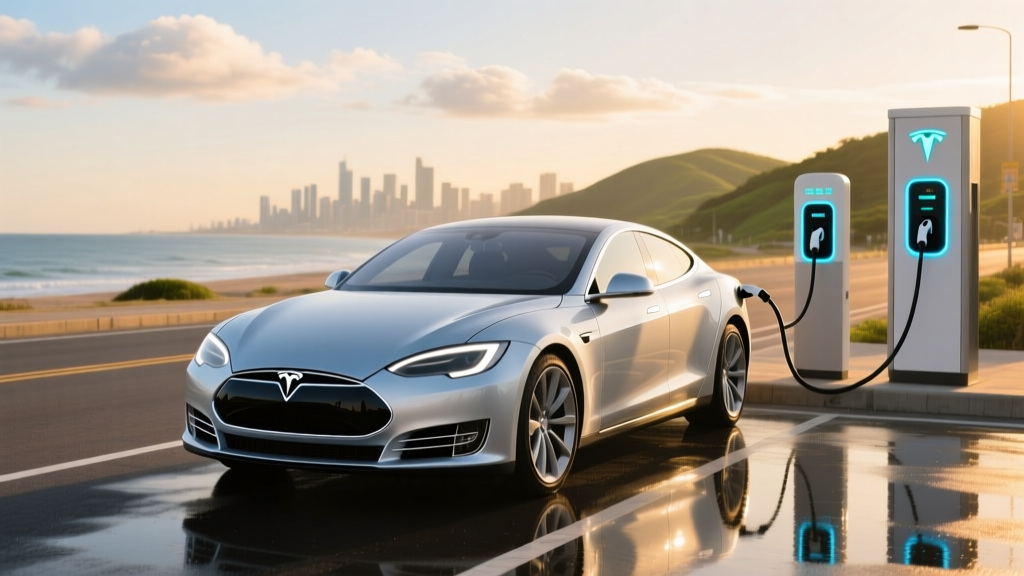
The 2024 Model S supports DC fast charging at a peak rate of 250 kW via Tesla's proprietary NACS (North American Charging Standard) connector — which has now been adopted by Ford, GM, Rivian, and most major automakers as the industry standard. On a V3 Supercharger, the Model S can add approximately 200 miles of range in 15 minutes under optimal conditions.
| Charging Method | Power | Speed | Best For |
|---|---|---|---|
| Level 1 (120V outlet) | ~1.4 kW | ~3–4 mi/hr | Emergency / trickle |
| Level 2 (240V home) | 11.5 kW | ~34 mi/hr | Daily overnight charging |
| Tesla V3 Supercharger | Up to 250 kW | ~200 mi in 15 min | Road trips |
| Tesla V4 Supercharger | Up to 250 kW* | ~200 mi in 15 min | Road trips |
*V4 cabinets currently deliver up to 250 kW to Model S/X; future CCS vehicles may see higher rates.
The 10–80% charge takes approximately 30 minutes on a V3 Supercharger. The charge curve tapers noticeably above 50% state of charge, and drops significantly above 80% — this is why Tesla and most EV manufacturers quote 10–80% times rather than full-charge times. Charging from 80–100% can add another 20–30 minutes, making it impractical at a road-trip stop unless you're parked overnight.
At home on a Level 2 Wall Connector (48-amp circuit, 60-amp breaker), the Model S accepts up to 11.5 kW, adding roughly 34 miles of range per hour. A full charge from 10% takes about 10 hours — easily accomplished overnight. For home installation, expect to pay $500–$1,500 for the Wall Connector unit plus $800–$2,500 for professional electrical work depending on your panel's proximity to the garage and whether a panel upgrade (200A service) is needed.
As a NACS-equipped vehicle, the Model S has native access to the entire Tesla Supercharger network — over 50,000 connectors across North America — without adapters. This remains a significant practical advantage, as Tesla's network consistently delivers the highest uptime and reliability scores among public charging providers.
Performance: Long Range vs Plaid
The dual-motor Long Range model delivers 670 horsepower and a 3.1-second 0–60 mph time — figures that would have defined a supercar a decade ago. Power delivery is instantaneous and linear, with no gear shifts interrupting acceleration. The all-wheel-drive system provides confident traction in rain and light snow, though the Model S's low ground clearance and performance-oriented tires make it less suitable for deep winter conditions than an SUV alternative.
The tri-motor Plaid variant pushes into hypercar territory with 1,020 horsepower and a claimed 1.99-second 0–60 time (on a prepped surface with rollout subtracted). In real-world conditions on public roads, expect 2.3–2.5 seconds. The Plaid's third motor (two rear, one front) enables sophisticated torque vectoring that keeps the car remarkably composed under hard acceleration. However, the Plaid sacrifices 6 miles of EPA range and costs $15,000 more — a premium that's hard to justify unless you plan to visit a drag strip.
Both trims feature Tesla's adaptive air suspension, which lowers the car at highway speeds for improved aerodynamics (and range) and raises it for speed bumps and steep driveways. The yoke steering wheel remains standard, with a round wheel available as a no-cost option. The yoke is polarizing: it offers an unobstructed view of the instrument cluster but requires adaptation for low-speed maneuvers and hand-over-hand turning.
Pricing, Tax Credits, and Ownership Costs
| Trim | Base MSRP | Destination | As-Tested (typical) | Federal Tax Credit |
|---|---|---|---|---|
| Model S Long Range | $74,990 | $1,390 | $76,380 | Not eligible* |
| Model S Plaid | $89,990 | $1,390 | $91,380 | Not eligible* |
*The 2024 Model S does NOT qualify for the federal §30D new EV tax credit. Under current IRS rules, the new clean vehicle credit has an MSRP cap of $55,000 for sedans. Both Model S trims exceed this threshold. Additionally, battery critical-mineral and component sourcing requirements must be met. Always verify current-year eligibility with a tax professional.
Common options that raise the as-tested price include:
- Full Self-Driving (Supervised): $8,000 one-time purchase or $99/month subscription
- Premium paint colors: $1,500–$2,500 (Pearl White Multi-Coat is the no-cost default)
- 21-inch Arachnid wheels: $4,500 (reduces range to ~372 miles)
- Acceleration Boost (Long Range): $2,000 (drops 0–60 to ~2.9 seconds)
The Model S carries higher insurance premiums than many competitors — expect $2,400–$3,800 annually depending on your location, driving record, and coverage levels. Tesla's own insurance product is available in many states and uses real-time driving behavior to calculate premiums, which can be advantageous for safe drivers.
Over a 5-year ownership period, the Model S Long Range costs significantly less to "fuel" than a comparable gasoline luxury sedan. At a national average electricity rate of $0.16/kWh and the Model S's efficiency of 28 kWh/100 miles, the cost per mile is approximately $0.045. A BMW 5 Series achieving 28 MPG combined at $3.50/gallon costs about $0.125 per mile — nearly three times as much. Over 60,000 miles, that's roughly $4,800 in fuel savings for the Tesla.
Interior, Cargo, and Technology
The refreshed Model S interior (introduced with the 2021 "Palladium" platform) features a 17-inch center touchscreen, a 12.3-inch digital instrument cluster, and a rear-seat 8-inch entertainment display. Build quality has improved substantially over earlier Model S generations, with ventilated front seats, genuine aluminum and wood trim, and a 22-speaker audio system that rivals anything in the luxury segment.
Passenger space is generous for a sedan:
- Front legroom: 42.7 inches
- Rear legroom: 35.4 inches
- Headroom (front/rear): 39.7 / 38.1 inches
The rear seat comfortably fits two adults on longer journeys, though the center position is best for children due to the transmission tunnel hump (a legacy of the original platform). Cargo capacity stands at 28 cubic feet behind the rear seats — aided by the hatchback liftgate design — plus an additional 2.8 cubic feet in the front trunk (frunk). That's substantially more usable space than a traditional luxury sedan with a trunk lid.
On the technology front, the Model S runs Tesla's latest software with over-the-air updates, integrated streaming (Netflix, YouTube, Spotify), a built-in web browser, and a gaming system capable of running titles like Cyberpunk 2077 using the car's AMD Ryzen processor. Autopilot comes standard and includes adaptive cruise control, lane centering, and automatic emergency braking. Full Self-Driving (Supervised) adds automated lane changes, city-street navigation, traffic light recognition, and parking assist — but it remains an SAE Level 2 driver-assistance system requiring active driver supervision at all times.
Pros, Cons, and Who Should Buy
Pros
- 402-mile EPA range — highest of any current Tesla
- Supercharger network access with native NACS connector
- Exceptional performance even in base Long Range trim
- Generous cargo capacity with hatchback + frunk
- Continual OTA software updates add features over time
- Strong resale value relative to most luxury EVs
- Class-leading infotainment and gaming system
Cons
- Not eligible for $7,500 federal tax credit (exceeds MSRP cap)
- 250 kW peak charge rate trails Lucid Air's 300+ kW capability
- Yoke steering requires adaptation; polarizing for some drivers
- Rear seat comfort trails Mercedes EQS and BMW i7
- No Apple CarPlay or Android Auto
- Insurance costs run 20–40% above comparable ICE sedans
- Platform dates to 2012 despite refreshes; interior space efficiency shows it
The 2024 Model S is best for: Tech-forward buyers who prioritize range, access to the Supercharger network, and blistering performance in a sedan form factor. It excels as a daily commuter with road-trip capability, especially for drivers who already have home Level 2 charging and regularly travel along well-served Supercharger corridors. Families who need maximum rear-seat luxury and ride comfort may prefer the Mercedes EQS or BMW i7, while efficiency-focused buyers should look at the Lucid Air Pure (419 miles EPA, lower price).
Competitor Comparison
| Attribute | Tesla Model S LR | Lucid Air Pure | Mercedes EQS 450+ | BMW i7 xDrive50 |
|---|---|---|---|---|
| EPA Range | 402 mi | 419 mi | 390 mi | 318 mi |
| Peak DC Charge | 250 kW | 300+ kW | 200 kW | 195 kW |
| 0–60 mph | 3.1 sec | 5.2 sec | 5.9 sec | 4.5 sec |
| Starting MSRP | $74,990 | $69,900 | $104,400 | $119,300 |
| Federal Credit | No | No | No | No |
| Charging Network | Tesla Supercharger | Tesla + EA (adapter) | CCS networks | CCS networks |
None of these luxury sedans qualify for the federal tax credit due to MSRP caps, which levels the playing field on price. The Model S wins on performance and charging-network convenience. The Lucid Air wins on range and charging speed. The Mercedes and BMW win on rear-seat luxury and traditional build quality. Your priorities determine the winner.
Warranty and Long-Term Battery Outlook
Tesla covers the Model S battery and drive unit for 8 years or 150,000 miles (whichever comes first) with a guaranteed minimum 70% capacity retention. The limited vehicle warranty covers 4 years or 50,000 miles. Based on fleet data from high-mileage Model S owners, NMC battery packs in Teslas typically degrade 8–12% over the first 100,000 miles, with the rate of degradation slowing significantly after the initial break-in period. A replacement battery pack (if needed out of warranty) currently runs approximately $15,000–$22,000 including labor at a Tesla service center.
To maximize battery longevity, Tesla recommends daily charging to 80–90% for NMC chemistry (reserving 100% charges for road trips) and avoiding prolonged periods at very low or very high states of charge. The vehicle's built-in scheduled charging and charge-limit settings make this easy to manage.
Frequently Asked Questions
Does the 2024 Tesla Model S qualify for the federal EV tax credit?
No. The IRS §30D clean vehicle credit caps eligible sedans at $55,000 MSRP. Both Model S trims ($74,990 and $89,990) exceed this limit. Buyer income caps ($300,000 joint / $150,000 individual) and battery-sourcing requirements also apply to the credit. Consult a tax professional for your specific situation.
What is the real-world highway range of the Model S Long Range?
Expect approximately 310–340 miles at sustained highway speeds (70–75 mph) in moderate temperatures. In cold weather (below 30°F), plan for 250–280 miles. City and mixed driving in mild conditions can approach the 402-mile EPA figure thanks to regenerative braking.
How fast does the Model S charge on a road trip?
On a Tesla V3 Supercharger (250 kW peak), the Model S charges from 10–80% in approximately 30 minutes and can add ~200 miles of range in 15 minutes. Charge speed tapers above 80% SoC to protect battery health. Preconditioning (automatic when navigating to a Supercharger) is essential for achieving peak charge rates.
Is the Model S worth buying over the Lucid Air or Mercedes EQS?
Choose the Model S if you value Supercharger network access, the lowest starting price in the segment, and top-tier performance. Choose the Lucid Air for maximum range and faster peak charging. Choose the Mercedes EQS or BMW i7 for rear-seat luxury and a more traditional luxury-car experience. All are excellent vehicles; the right answer depends on your priorities.
Does the Model S have a frunk?
Yes. The front trunk (frunk) offers 2.8 cubic feet of storage — enough for a charging cable bag, a small backpack, or groceries. Combined with the 28 cu ft rear cargo area and hatchback design, the Model S offers more practical storage than most luxury sedans.
Is Tesla's Full Self-Driving actually self-driving?
No. FSD (Supervised) is an SAE Level 2 driver-assistance system. You must remain fully engaged, with hands on the wheel and eyes on the road. The system can navigate highways, city streets, and parking lots, but the driver is legally responsible for the vehicle at all times. True self-driving (Level 4) is currently only available through robotaxi services like Waymo in limited geographic areas.