Quick Verdict: The 2023 Model S in White Still Sets the Luxury EV Sedan Benchmark
If you're searching for a tesla model s 2023 white interior configuration on the used or certified pre-owned market in 2026, you're looking at one of the most accomplished electric sedans ever built — now available at a meaningful discount from its original MSRP. The 2023 Model S Long Range pairs a 100 kWh battery pack with a dual-motor all-wheel-drive system, delivering an EPA-estimated 405 miles of range, a 3.1-second 0-60 mph sprint, and access to Tesla's Supercharger network. The all-white premium interior ($2,000 option when new) remains one of the most striking cabin treatments in the EV space, though it demands commitment to upkeep.
This review covers the 2023 Model S Long Range and Plaid trims with real-world range data, charging curves, current used-market pricing, federal tax credit considerations for pre-owned purchases, and how the white interior holds up after years of daily use.
Range, Battery & Efficiency: 405 EPA Miles, But What's Real?
The 2023 Tesla Model S Long Range carries a 100 kWh battery pack (approximately 95 kWh usable) using NMC (nickel manganese cobalt) chemistry. Tesla does not publish exact cell-level chemistry specs, but teardown analysis and supplier data confirm NMC for the Model S/X platform — chosen for its high energy density, which is critical for a sedan chasing 400+ miles of range.
| Condition | Estimated Range |
|---|---|
| EPA Combined | 405 miles |
| Highway (70-75 mph, moderate temps) | ~330-355 miles |
| City / Mixed Commuting | ~370-395 miles |
| Cold Weather (below 32°F, highway) | ~260-300 miles |
| Plaid Trim (EPA) | 396 miles |
The Model S benefits from a heat pump (standard since the 2021 refresh), which reduces cold-weather cabin-heating energy draw significantly compared to resistive heaters. Still, expect 20-30% range loss in sustained sub-freezing highway driving. At 75 mph on a flat interstate in 70°F weather, owners consistently report 330-355 miles before hitting 0% SoC — excellent for a 5,300-lb luxury sedan.
Efficiency lands at 120 MPGe combined (Long Range), translating to roughly 28 kWh per 100 miles — competitive with the Lucid Air Grand Touring (131 MPGe) and significantly better than the Mercedes EQS 450+ (97 MPGe). The Model S's low drag coefficient (0.208 Cd) is a major contributor.
| Spec | Long Range | Plaid |
|---|---|---|
| EPA Range | 405 mi | 396 mi |
| Battery (Usable) | ~95 kWh (NMC) | ~95 kWh (NMC) |
| Drivetrain | Dual-Motor AWD | Tri-Motor AWD |
| Horsepower | 670 hp | 1,020 hp |
| 0-60 mph | 3.1 sec | 1.99 sec |
| Top Speed | 155 mph | 200 mph |
| MPGe (Combined) | 120 MPGe | 116 MPGe |
| Cargo (Trunk + Frunk) | 28.0 cu ft (25.0 + 3.0) | 28.0 cu ft |
| Rear Legroom | 35.4 in | 35.4 in |
| Curb Weight | 4,766 lbs | 4,961 lbs |
Charging Speed: 250 kW Peak, Supercharger Access Included
The 2023 Model S supports up to 250 kW DC fast charging on Tesla V3 Superchargers. In controlled testing, the charge curve peaks near 250 kW at low state-of-charge (SoC) and tapers progressively — a 10-80% charge takes approximately 27-30 minutes. Above 80%, charging slows dramatically to protect the NMC cells; plan to unplug at 80% on road trips unless you need the final stretch.
| Charging Method | Power / Rate | Time or Miles Added |
|---|---|---|
| Tesla V3 Supercharger (DC) | 250 kW peak | 10-80% in ~27-30 min |
| Tesla V4 Supercharger (DC) | 250 kW peak (CCS adapter not needed) | Similar to V3 |
| CCS DC Fast Charger (with adapter) | Up to ~175 kW (adapter-limited) | 10-80% in ~40 min |
| Level 2 Home (Tesla Wall Connector, 48A) | 11.5 kW | ~44 miles per hour of charge |
| Level 2 Home (32A generic J1772 w/ adapter) | 7.7 kW | ~30 miles per hour |
| Level 1 (120V household outlet) | ~1.4 kW | ~4-5 miles per hour |
Home charging with a Tesla Wall Connector on a 60A circuit (48A continuous) adds roughly 44 miles of range per hour — enough to fully replenish a daily commute overnight. Installation typically costs $800-$2,000 depending on panel proximity and local permit fees, per Tesla's certified installer network.
A key advantage of the 2023 Model S: it uses the native Tesla connector (now standardized as NACS), meaning full access to over 25,000 Supercharger stalls across North America with no adapter required. Tesla also sells a CCS adapter (~$250) for use on Electrify America and other non-Tesla DC networks, though peak speeds are limited to roughly 175 kW through the adapter.
The White Interior: Aesthetics, Durability & Daily Ownership
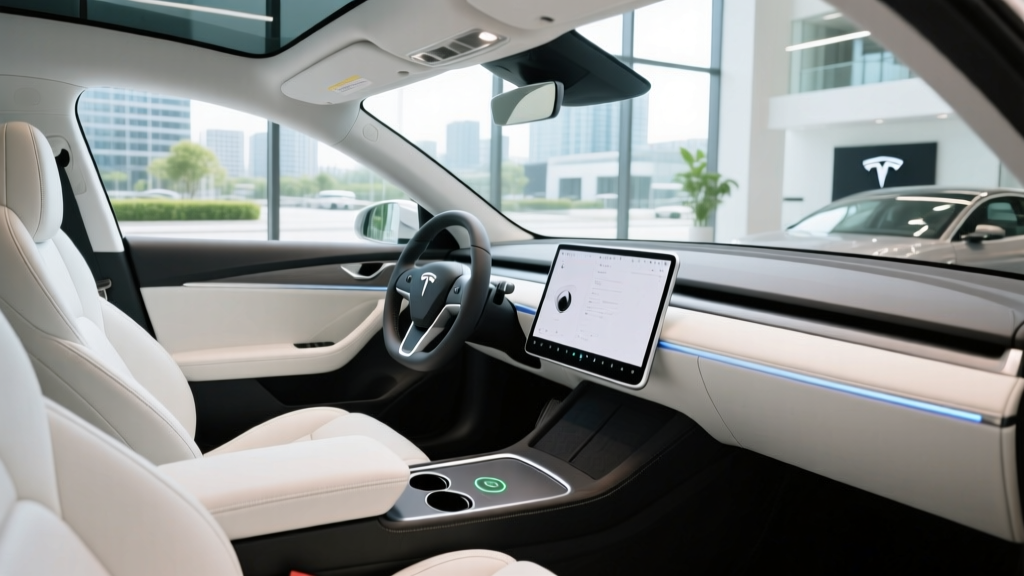
The all-white premium interior was a $2,000 upgrade on the 2023 Model S and remains one of the most photographed and debated options Tesla offers. Here's what ownership actually looks like after several years:
Material composition: Tesla uses a synthetic vegan leather (polyurethane-based) for seats, door panels, and the dashboard. The white material is more resistant to staining than natural leather, and most surface marks from denim or spills wipe clean with a damp microfiber cloth. However, the white steering wheel shows hand oils and grime faster than black — many owners treat it with a ceramic coating or use a steering wheel cover for daily commuting.
Long-term wear: After 2-3 years of daily use, white seats can develop a slight grayish patina on the bolsters and seat cushions, particularly from dark denim jeans. Regular cleaning (weekly wipe-downs recommended) prevents permanent dye transfer. The white dashboard and door card inserts hold up better since they see less direct contact.
The visual payoff: There's no denying the white interior transforms the Model S cabin. It amplifies the sense of space, reflects sunlight (reducing cabin heat soak in summer), and photographs dramatically against the black exterior or any dark paint. On the used market in 2026, a white-interior Model S typically commands a $1,000-$2,000 premium over equivalent black-interior examples.
Notable interior drawbacks: The 2023 Model S still uses a yoke-style steering wheel as standard (a conventional round wheel became a no-cost option in mid-2023). The 17-inch center touchscreen handles nearly all vehicle controls, including HVAC and glovebox release — no physical buttons for critical functions. Rear passengers get a dedicated 8-inch touchscreen for climate and entertainment. Build quality improved significantly with the 2021+ refresh, but some owners report minor panel-gap inconsistencies that Tesla service centers address under warranty.
Pricing, Tax Credits & 2026 Used-Market Value
When new, the 2023 Model S Long Range carried a base MSRP of approximately $89,990 (before delivery fees), while the Plaid started at $108,490. The white interior added $2,000; Full Self-Driving (Supervised) capability was a $15,000 add-on.
| Item | Long Range | Plaid |
|---|---|---|
| Original MSRP (2023) | ~$89,990 | ~$108,490 |
| White Interior Option | +$2,000 | +$2,000 |
| Estimated Used Price (2026, ~30k mi) | $58,000-$67,000 | $72,000-$82,000 |
| Federal §30D New-Vehicle Credit | NOT eligible (exceeds $55,000 sedan MSRP cap; buyer income limits apply) | |
| Federal §25E Used-EV Credit (2026) | Up to $4,000 or 30% of sale price (whichever is lower), if dealer-registered & buyer income qualifies | |
Federal tax credit reality: The 2023 Model S never qualified for the $7,500 new-vehicle §30D federal tax credit because its MSRP exceeds the $55,000 cap for sedans. Additionally, buyer income caps ($150,000 single / $300,000 joint MAGI) and battery critical-mineral sourcing requirements apply. However, buying a used 2023 Model S from a licensed dealer in 2026 may qualify you for the §25E used clean vehicle credit — up to $4,000 or 30% of the sale price, whichever is lower. Income caps for §25E are $75,000 single / $150,000 joint. Confirm eligibility with a tax professional and verify the dealer has registered the sale with the IRS energy credits portal.
Performance & Driving Dynamics: 670 hp (or 1,020 hp) Meets Adaptive Air Suspension
The 2023 Model S Long Range produces 670 horsepower from its dual-motor AWD setup (one permanent-magnet motor front, one induction motor rear). The 0-60 mph time of 3.1 seconds is supercar territory from a five-passenger sedan. The Plaid's tri-motor configuration (one front, two rear) pushes output to 1,020 hp and drops 0-60 to an absurd 1.99 seconds — making it the quickest production sedan ever measured by multiple independent testers.
Beyond straight-line speed, the 2023 refresh brought a fully adaptive air suspension that adjusts ride height and damping in real time. The result is a sedan that can lower itself for highway efficiency, raise for driveway clearance, and stiffen through canyon roads with minimal body roll. Steering feel has improved over pre-2021 models, though it remains somewhat numb compared to a Porsche Taycan's rack. Regenerative braking offers strong one-pedal driving capability, though Tesla removed the user-adjustable regen strength setting — it defaults to strong and cannot be softened via the menu.
Tech, Driver Assistance & Safety
The 2023 Model S runs Tesla's current infotainment software on a 17-inch landscape touchscreen with an AMD Ryzen processor — interface response is tablet-fast. Wireless phone mirroring is notably absent; Tesla relies on its native apps (Spotify, Apple Music, YouTube, Netflix when parked, and a full web browser). A 22-speaker audio system with active noise cancellation is standard and ranks among the best factory car audio setups available.
Tesla Autopilot (standard) and Full Self-Driving Supervised ($15,000 option or $199/month subscription) are SAE Level 2 driver-assistance systems. The driver must remain fully engaged, hands on the wheel (or torque-applied with the yoke), and eyes on the road at all times. FSD Supervised handles highway on-ramps, lane changes, and some city intersections, but it is not autonomous driving. Only Level 4 robotaxi services (Waymo, Zoox) operate without driver supervision in geofenced areas.
Safety ratings from NHTSA awarded the 2023 Model S a 5-star overall rating. The IIHS has not crash-tested the refreshed Model S as of early 2026. Standard active safety includes automatic emergency braking, blind-spot monitoring, lane departure warning, and rear cross-traffic alert.
Warranty & Long-Term Battery Outlook
Tesla covers the 2023 Model S with a 4-year/50,000-mile basic vehicle warranty and an 8-year/150,000-mile battery and drive unit warranty. The battery warranty guarantees retention of at least 70% of original capacity over the coverage period. NMC chemistry in Tesla's large-pack applications has demonstrated approximately 8-12% degradation over the first 100,000 miles based on fleet data, with the curve flattening significantly thereafter. A full battery replacement outside warranty currently costs approximately $15,000-$22,000 at Tesla service centers.
Who Should Buy the 2023 Model S (and Who Shouldn't)
- You want 400+ miles of EPA range with access to the largest fast-charging network
- You value supercar-rivaling acceleration in a practical five-seat sedan
- You regularly take road trips and need reliable, widespread DC charging infrastructure
- You prefer a minimalist, screen-forward cabin with over-the-air software updates
- White interior aesthetics matter to you and you're willing to maintain them
- You want physical buttons for HVAC, volume, or wipers (consider the BMW i7 or Mercedes EQS)
- You need a Level 4 autonomous experience (no production car offers this today)
- You want the longest warranty in the luxury EV segment (Hyundai/Kia offer 10yr/100k)
- Your budget is below $55,000 (consider the used Model 3 or Hyundai Ioniq 6)
- 405-mile EPA range — among the longest of any EV sedan
- 250 kW Supercharger access with 25,000+ stalls nationwide
- 670 hp standard; 1,020 hp Plaid is the quickest sedan ever built
- Adaptive air suspension balances comfort and sport handling
- Heat pump standard for efficient cold-weather operation
- Strong used-market value retention relative to German luxury EVs
- Over-the-air updates continue to add features post-purchase
- No physical buttons — all controls routed through touchscreen
- White interior requires regular cleaning to prevent dye transfer
- Yoke steering wheel polarizing (round wheel now a no-cost option)
- FSD Supervised remains Level 2 despite the "Full Self-Driving" name
- Regen braking strength not user-adjustable
- No Apple CarPlay or Android Auto
- Insurance premiums run 20-40% above comparable ICE sedans
Frequently Asked Questions
What is the real-world range of the 2023 Tesla Model S?
The EPA rates the Long Range at 405 miles. In real-world highway driving at 70-75 mph, expect 330-355 miles. In cold weather (below freezing), highway range drops to approximately 260-300 miles. City driving with regenerative braking can approach or slightly exceed the EPA figure.
How fast does the 2023 Model S charge?
On a Tesla V3 Supercharger, it peaks at 250 kW and charges from 10-80% in approximately 27-30 minutes. At home on a 48A Level 2 Wall Connector, it adds about 44 miles of range per hour (11.5 kW). On non-Tesla DC chargers with a CCS adapter, peak speeds are roughly 175 kW.
Does the 2023 Tesla Model S qualify for the federal EV tax credit?
Not as a new vehicle — its MSRP exceeds the §30D sedan cap of $55,000, and buyer income limits plus battery-sourcing rules further restrict eligibility. However, purchasing a used 2023 Model S from a licensed dealer in 2026 may qualify for the §25E used-EV credit of up to $4,000, subject to income caps ($75k single / $150k joint). Verify with a tax professional and the IRS §25E guidelines.
Is the white interior worth it on a used Model S?
Aesthetically, yes — it's the most visually striking interior option and commands a resale premium. Practically, it requires weekly wipe-downs to prevent denim dye transfer, and the steering wheel shows grime quickly. Most owners find the synthetic leather material durable and stain-resistant with basic care. If you prefer a low-maintenance cabin, black is the safer choice.
How does the 2023 Model S compare to the Lucid Air and Mercedes EQS?
The Lucid Air Grand Touring offers more range (516 mi EPA) and a more traditional luxury interior, but has a smaller service network and higher starting price. The Mercedes EQS 450+ is quieter and more plush but delivers only 350 miles of range and significantly lower efficiency (97 MPGe). The Model S wins on charging infrastructure, acceleration, software, and used-market value retention.
What is the battery warranty on the 2023 Model S?
Tesla covers the battery and drive unit for 8 years or 150,000 miles, whichever comes first, with a guaranteed minimum 70% capacity retention. Real-world fleet data suggests NMC packs in the Model S lose approximately 8-12% capacity over the first 100,000 miles, with degradation slowing substantially afterward.