The Kia EV6 GT sits at the apex of Hyundai Motor Group's E-GMP platform, pairing 576 horsepower with a cabin that punches above its price class in material quality and technology. But the EV6 GT isn't just a straight-line dragster — it's a grand-touring electric crossover with real daily-driver credentials, provided you understand where its 77.4 kWh NMC battery delivers and where it falls short. This review breaks down the 2026 Kia EV6 GT interior, real-world range, charging behavior, ownership costs, and how it stacks up against the Tesla Model Y Performance and Ford Mustang Mach-E GT.
2026 Kia EV6 GT Spec Sheet at a Glance
| Spec | Value |
|---|---|
| EPA Range | 206 miles (GT AWD); 310 miles (GT-Line RWD Long Range) |
| Battery (usable) | 77.4 kWh, NMC (nickel-manganese-cobalt) |
| Drivetrain | Dual-motor AWD (GT); RWD available on GT-Line |
| Horsepower / Torque | 576 hp / 545 lb-ft (GT) |
| 0–60 mph | 3.4 seconds (GT) |
| DC Fast-Charge Peak | 244 kW (10–80% in ~18 min) |
| Level 2 Home Charge | 10.9 kW (~32 miles/hr) |
| MPGe (combined) | 85 MPGe (GT AWD) |
| Efficiency | 39 kWh/100 mi (GT AWD) |
| Cargo (rear seats up / down) | 24.4 cu ft / 50.2 cu ft |
| Base MSRP (GT) | $63,090 (incl. destination) |
| Battery Warranty | 10 years / 100,000 miles |
Kia EV6 GT Interior: Materials, Layout, and Livability
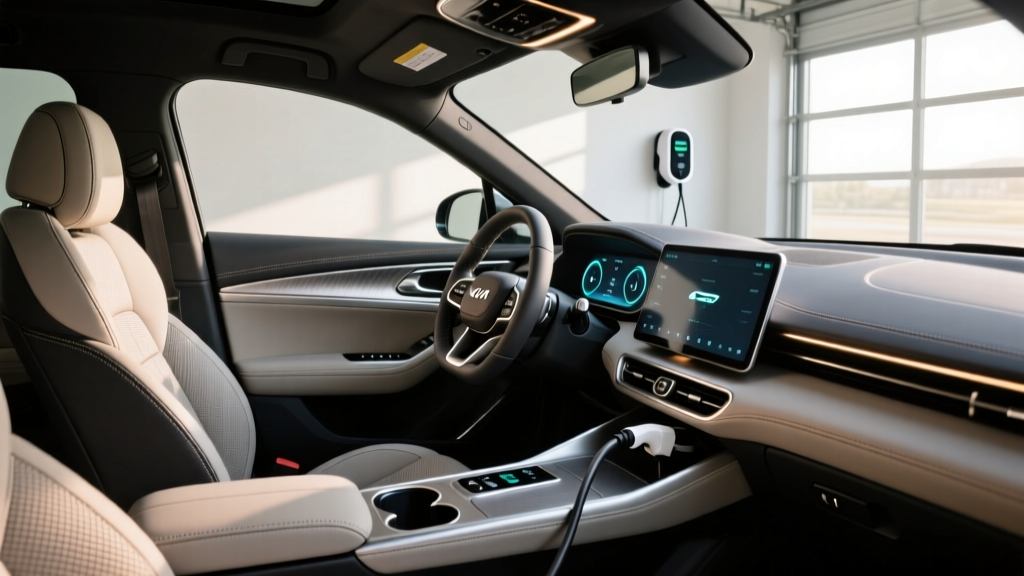
The search for the Kia EV6 GT interior usually comes from buyers trying to decide whether the GT's premium over the GT-Line is justified. Inside, the GT gets unique suede-and-vegan-leather sport buckets with GT badging, a flattened-bottom steering wheel with neon-green stitching, and a dedicated GT drive-mode selector on the wheel. The dual 12.3-inch curved display cluster (instrument + infotainment) is standard across all EV6 trims, but the GT adds an augmented-reality head-up display that overlays navigation arrows and speed onto the windshield.
Material quality is a highlight. Soft-touch surfaces cover the dash top and door uppers, and the ambient lighting strip that sweeps across the dash and doors gives the cabin a modernist, almost Scandinavian feel. Physical climate controls sit below the main touchscreen — a welcome decision that avoids the touchscreen-only frustration found in some competitors. The rotary shift dial on the center console frees up storage space underneath.
Front legroom is generous at 41.7 inches, and the flat floor (a benefit of the E-GMP skateboard) makes the rear middle seat genuinely usable for adults. Rear legroom measures 37.8 inches — adequate for six-footers, though the sloping roofline cuts headroom for taller passengers compared to the boxier Hyundai Ioniq 5. Cargo volume is 24.4 cubic feet behind the second row and 50.2 cu ft with the 60/40 split folded. The front trunk (frunk) on AWD models is a shallow 0.7 cu ft — essentially a charging-cable cubby, not real luggage space.
Real-World Range: What to Expect Beyond the EPA Sticker
EPA: 206 miles (GT AWD) / 310 miles (GT-Line RWD Long Range)
Real-world highway (70 mph, 72°F): ~175–185 miles (GT); ~265–280 miles (GT-Line RWD)
Cold weather (20°F, highway): ~140–155 miles (GT); ~210–225 miles (GT-Line RWD)
The GT's performance tuning, stickier tires, and AWD drivetrain exact a real efficiency penalty. If range is your priority, the GT-Line RWD Long Range is the pragmatic choice.
The EV6 GT's 206-mile EPA rating is the trade-off for its 576 hp and dual-motor grip. In mixed suburban-and-highway driving during mild weather, expect around 185–195 miles before hitting 10% State of Charge. Sustained 75–80 mph interstate driving drops that to roughly 175 miles. Cold weather is the bigger equalizer: at 20°F without preconditioning, range can fall to 140–155 miles because the battery management system restricts regen and diverts energy to cabin and pack heating. The available heat pump (standard on GT trims) mitigates this somewhat compared to resistive heating, but physics still wins.
Per fueleconomy.gov, the EV6 GT AWD achieves 85 MPGe combined (39 kWh/100 mi), which trails the GT-Line RWD Long Range's 134 MPGe combined. That's a meaningful difference in operating cost: at the national average electricity price of $0.17/kWh, the GT costs roughly $6.63 per 100 miles to fuel at home, while the GT-Line RWD costs about $4.15.
Charging Speed: 244 kW Peak, but Mind the Curve
The EV6's 800-volt E-GMP architecture remains one of the best fast-charging setups on the market. On a 350 kW-capable DC fast charger (like Electrify America's latest stalls), the EV6 GT peaks at approximately 244 kW and sustains above 200 kW through roughly 55% State of Charge. A 10–80% session takes about 18 minutes under ideal thermal conditions — meaning the pack is preconditioned via navigation routing to the charger.
| Charging Level | Power | Speed / Notes |
|---|---|---|
| Level 1 (120V household) | ~1.4 kW | ~4 miles/hr — emergency only |
| Level 2 (240V home, 48A) | 10.9 kW | ~32 miles/hr; 0–100% in ~7.5 hours |
| DC Fast Charge (350 kW stall) | Peak 244 kW | 10–80% in ~18 min |
| DC Fast Charge (150 kW stall) | Peak ~130 kW | 10–80% in ~32 min |
The charge curve is where real-world ownership separates from spec sheets. Above 80% SoC, charging tapers sharply — Kia's battery management system protects the NMC cells by reducing current. Going from 80% to 100% on DC can take nearly as long as 10–80%. For road trips, plan to leave chargers at 80% and stop more frequently; it's faster overall than waiting for the last 20%.
For home charging, a Level 2 wallbox at 48 amps (like the ChargePoint Home Flex or Emporia Vue) delivers 10.9 kW, replenishing the full 77.4 kWh pack overnight in about 7.5 hours. Installation typically runs $800–$2,000 depending on panel proximity and whether your home's electrical panel needs a 200-amp upgrade. The EV6 ships with NACS (Tesla-style) charge port compatibility on 2025+ models, with a CCS adapter included for legacy networks.
Performance: 576 Horsepower With Daily-Driver Manners
The GT's dual-motor AWD powertrain produces 576 hp and 545 lb-ft of torque, rocketing the 4,796-lb crossover to 60 mph in 3.4 seconds. That's supercar-adjacent acceleration in a vehicle with a usable back seat and cargo hatch. The GT mode sharpens throttle mapping, firms the adaptive dampers, and opens an electronic limited-slip differential on the rear axle that enables a drift mode (best left to closed courses).
But the GT isn't one-dimensional. In Normal or Eco mode, the ride is compliant and highway-quiet, and the regen levels are adjustable via steering-wheel paddles — from aggressive one-pedal-style braking (i-Pedal mode, which can bring the car to a full stop) to near-freewheeling coasting. The steering is precise if slightly light on center feel, and body control is excellent for a vehicle this heavy.
The trade-off is efficiency and tire wear. The GT's 21-inch Michelin Pilot Sport EV tires provide exceptional grip but cost roughly $350 per corner and wear faster under the car's 4,800-lb mass and instant torque. Budget-conscious buyers should factor in a $1,400 tire replacement every 20,000–30,000 miles.
Pricing, Trims, and Federal Tax Credit Eligibility
The 2026 EV6 lineup spans three main trims:
| Trim | Drivetrain | MSRP (incl. destination) |
|---|---|---|
| Light Long Range | RWD | $44,090 |
| GT-Line Long Range | RWD or AWD | $49,590–$53,090 |
| GT | AWD (dual-motor) | $63,090 |
Federal tax credit eligibility under IRS §30D is nuanced. The EV6 qualifies for up to $3,750 (the critical-minerals half of the credit) as of early 2026, because its battery sourcing meets partial but not full critical-minerals and battery-component requirements. The full $7,500 credit is not available because the EV6's battery components do not fully satisfy the domestic-manufacturing threshold that increases in stringency each year.
Additionally, buyers must meet income caps ($150,000 single / $300,000 joint MAGI) and the vehicle's MSRP must not exceed $80,000 for SUVs/crossovers — the EV6 clears both hurdles. The credit can now be transferred to the dealer as a point-of-sale discount, reducing your out-of-pocket cost at purchase rather than waiting until tax filing. Always verify current-year rules with a tax professional, as sourcing requirements tighten annually.
Tech, Safety, and Driver Assistance
The EV6 comes equipped with Kia's Highway Driving Assist 2 (HDA2), a SAE Level 2 driver-assistance system that combines adaptive cruise control with lane-centering and automated lane changes when you tap the turn signal. This is a hands-on-wheel, eyes-on-road system — it does not make the EV6 self-driving, and you must remain engaged at all times. HDA2 is competitive with Toyota Safety Sense and Honda Sensing but doesn't reach the hands-off capability of GM's Super Cruise or Ford's BlueCruise on mapped highways.
Highway Driving Assist 2 is SAE Level 2 — the driver must supervise at all times. It does not handle construction zones, unmapped roads, or complex urban intersections. Hands-off-wheel alerts trigger after approximately 30 seconds of no torque input on the steering wheel.
The infotainment system runs Kia's latest ccNC (Connected car Navigation Cockpit) software on the 12.3-inch touchscreen, with wireless Apple CarPlay and Android Auto, over-the-air updates, and a digital key that lets you unlock and start the car via smartphone NFC. The GT adds a Meridian premium audio system, a fingerprint-authenticated driver profile, and Vehicle-to-Load (V2L) capability — a 120V outlet that can power up to 3.6 kW of external devices, useful for camping or emergency backup power.
The EV6 earned the IIHS Top Safety Pick+ rating and a 5-star overall NHTSA rating, with standard automatic emergency braking, blind-spot monitoring, rear cross-traffic alert, and safe-exit assist (which prevents rear doors from opening if a cyclist or car is approaching).
EV6 GT vs. the Competition
| Kia EV6 GT | Tesla Model Y Performance | Ford Mustang Mach-E GT | |
|---|---|---|---|
| Price | $63,090 | ~$55,490 | ~$56,995 |
| EPA Range | 206 mi | 277 mi | 260 mi |
| 0–60 mph | 3.4 sec | 3.5 sec | 3.5 sec |
| Peak DC Charge | 244 kW | 250 kW | 150 kW |
| 10–80% DC Time | ~18 min | ~20 min | ~38 min |
| Cargo (rear up) | 24.4 cu ft | 30.2 cu ft | 29.7 cu ft |
| Battery Warranty | 10 yr / 100k mi | 8 yr / 120k mi | 8 yr / 100k mi |
The EV6 GT trades range and cargo volume for superior charging speed, a more premium interior, and a longer battery warranty. The Model Y Performance wins on efficiency, cargo, and Supercharger network access (though the EV6's NACS compatibility now opens Superchargers to Kia owners via adapter). The Mach-E GT offers the most interior space but lags significantly on charging speed — a painful gap on road trips.
- 244 kW peak DC charging — among the fastest in its class
- 3.4-second 0–60 with usable back seat and cargo hatch
- 10-year / 100,000-mile battery warranty
- Premium interior with physical climate controls
- V2L capability for off-grid or emergency power
- NACS compatibility opens Tesla Supercharger network
- 206-mile EPA range is low for the price point
- Cold-weather range drops to ~140–155 mi without preconditioning
- Frunk is nearly useless on AWD models (0.7 cu ft)
- 21-inch performance tires wear fast and cost ~$350 each
- HDA2 requires hands-on-wheel — no hands-free highway mode
- Federal tax credit limited to $3,750 (not full $7,500)
Who Should Buy the Kia EV6 GT?
Buy the GT-Line RWD Long Range instead if: Range is your priority. At 310 miles EPA and 134 MPGe, it covers most commutes and road trips with fewer stops, costs $10,000+ less, and still delivers brisk acceleration.
Look at the Model Y Performance if: You need maximum cargo space, best-in-class efficiency, and seamless Supercharger access without adapters.
Frequently Asked Questions
What is the real-world range of the 2026 Kia EV6 GT?
The EPA rates the EV6 GT AWD at 206 miles. In real-world highway driving at 70 mph in mild weather, expect approximately 175–185 miles. In cold weather (below 30°F), range drops to roughly 140–155 miles. The GT-Line RWD Long Range is significantly better at 310 miles EPA and ~265–280 miles real-world highway.
How fast does the EV6 GT charge at home and on DC fast chargers?
On a 350 kW DC fast charger, the EV6 GT peaks at 244 kW and charges from 10–80% in approximately 18 minutes. At home on a Level 2 wallbox (48A / 10.9 kW), a full charge takes about 7.5 hours, adding roughly 32 miles of range per hour of charging.
Does the 2026 Kia EV6 GT qualify for the federal EV tax credit?
As of early 2026, the EV6 qualifies for up to $3,750 of the $7,500 federal credit under IRS §30D — it meets the critical-minerals requirement but not the full battery-component domestic-sourcing threshold. Buyers must also meet income caps ($150K single / $300K joint). The credit can be applied as a point-of-sale rebate at the dealer. Consult a tax professional and check IRS.gov for the latest rules.
Is the Kia EV6 GT worth it over the Tesla Model Y Performance?
If you value interior quality, charging speed, and a 10-year battery warranty, the EV6 GT is compelling. If you prioritize range (277 vs. 206 miles EPA), cargo space (30.2 vs. 24.4 cu ft), and lower pricing, the Model Y Performance is the more practical choice. Both are legitimately quick — the gap is 0.1 seconds to 60 mph.
What is the Kia EV6 battery warranty?
Kia covers the EV6's high-voltage battery for 10 years or 100,000 miles (whichever comes first), guaranteeing it will retain at least 70% of its original capacity. This is among the longest battery warranties in the EV market, exceeding Tesla's 8-year/120,000-mile coverage and Ford's 8-year/100,000-mile policy.
How does the Kia EV6 GT interior compare to rivals?
The EV6 GT interior stands out for its physical climate controls, dual curved displays, augmented-reality HUD, and suede sport seats with GT-specific stitching. Compared to the Model Y's minimalist single-screen cabin, the EV6 feels more traditionally premium. The Mach-E GT's interior is roomier but uses more hard plastics in lower-touch areas.