If you own or are shopping for a Tesla Model 3 or Model Y, you've likely run into a frustrating limitation: the limited number of USB-C ports available for everything you need to power and connect. Between dashcam recording, phone charging, passenger devices, and gaming controllers, the stock port layout falls short. A quality Tesla Model 3/Y USB hub solves this — but choosing the right one requires understanding the car's electrical architecture. This review covers the full EV profile alongside a practical USB hub guide so you can optimize your Tesla's connectivity without compromising its systems.
Tesla Model 3 and Model Y: 2026 Lineup Overview
The 2026 Tesla Model 3 (Highland refresh) and Model 3/Y (Juniper refresh) represent the most popular EVs on American roads. Both ride on Tesla's mature platform with industry-leading efficiency, access to the Supercharger network, and over-the-air updates that keep aging hardware relevant. The Model 3 sedan targets commuters and driving enthusiasts; the Model Y crossover serves families needing cargo versatility.
Both vehicles share similar powertrain options — a base Rear-Wheel Drive (RWD) with LFP battery chemistry, and Long Range / Performance variants using NMC chemistry with dual-motor All-Wheel Drive (AWD). Understanding which battery chemistry your trim carries matters for daily charging habits, longevity, and usable capacity.
Spec Table: 2026 Model 3 vs Model Y at a Glance
| Specification | Model 3 RWD | Model 3 Long Range AWD | Model Y RWD | Model Y Long Range AWD |
|---|---|---|---|---|
| EPA Range | 272 mi | 363 mi | 320 mi | 330 mi |
| Battery (usable) | ~57 kWh (LFP) | ~75 kWh (NMC) | ~57 kWh (LFP) | ~75 kWh (NMC) |
| Motor / Drivetrain | Single / RWD | Dual / AWD | Single / RWD | Dual / AWD |
| Horsepower | 271 hp | 346 hp | 295 hp | 384 hp |
| 0–60 mph | 5.8 sec | 4.2 sec | 6.5 sec | 4.8 sec |
| Efficiency | 132 MPGe / 25 kWh/100mi | 134 MPGe / 25 kWh/100mi | 123 MPGe / 27 kWh/100mi | 122 MPGe / 28 kWh/100mi |
| Max DC Fast Charge | 170 kW | 250 kW | 170 kW | 250 kW |
| 10–80% DCFC Time | ~25 min | ~18 min | ~25 min | ~20 min |
| Level 2 (11.5 kW) | ~44 mi/hr | ~44 mi/hr | ~44 mi/hr | ~44 mi/hr |
| Cargo Volume | 23 cu ft (trunk+frunk) | 23 cu ft | 72 cu ft (rear folded+frunk) | 72 cu ft |
| Base MSRP | $38,990 | $47,740 | $44,990 | $48,990 |
Sources: fueleconomy.gov, Tesla Specifications. Pricing reflects 2026 MSRP before destination fees and incentives.
Real-World Range: What the EPA Number Doesn't Tell You
EPA Sticker: Model 3 LR AWD — 363 miles | Model Y LR AWD — 330 miles
Real-World Highway (70 mph, mild weather): Expect ~280–310 mi (Model 3) and ~260–285 mi (Model Y)
Cold-Weather (below 30°F): Lose 20–30% range — plan for ~210–250 mi (Model 3) and ~200–230 mi (Model Y)
City / Stop-and-Go: Often exceeds EPA thanks to regenerative braking — 330+ mi achievable in Model 3 LR
The Model 3 and Model Y are among the most efficient EVs sold, but EPA combined-cycle testing blends city and highway driving under moderate temperatures. Highway driving at sustained 70–80 mph is the real test, and aerodynamic drag punishes the taller Model Y more than the sleek Model 3. In our experience, a Model 3 Long Range driven at 75 mph in 65°F weather delivers roughly 290–310 miles before needing a charge stop — a meaningful drop from the 363-mile sticker, but still class-leading.
Cold weather compounds range loss. LFP batteries in the RWD trims are particularly sensitive to low temperatures, losing more range and accepting charge more slowly until preconditioned. Tesla's heat pump (standard on all 2026 trims) helps, but plan conservatively in winter: a 272-mile Model 3 RWD may deliver only 190–210 miles on a frigid highway commute.
Charging Speed: Supercharger, Level 2, and Home Setup
Tesla's Supercharger network remains the gold standard for DC fast charging reliability. The Long Range and Performance trims peak at 250 kW on V3 and V4 Superchargers, while RWD trims cap at 170 kW due to the smaller LFP pack's charge-rate limits.
| Charging Level | Power | Speed (Model 3 LR / Model Y LR) | Speed (RWD Trims) |
|---|---|---|---|
| Level 1 (120V) | ~1.4 kW | ~3–4 mi/hr | ~3–4 mi/hr |
| Level 2 (240V, 48A) | 11.5 kW | ~44 mi/hr | ~44 mi/hr |
| DC Fast (V3 Supercharger) | Up to 250 kW (LR) / 170 kW (RWD) | 10–80% in ~18–20 min | 10–80% in ~25 min |
| Non-Tesla DCFC (CCS via adapter) | Up to 250 kW (LR) | Varies by station; ~20–25 min 10–80% | ~25–30 min 10–80% |
Charge-curve reality: The 250 kW peak only holds from roughly 10–30% State of Charge (SoC). Above 50%, speeds taper significantly — by 80% you're typically at 40–60 kW. This is normal lithium-ion behavior, but it means the advertised 10–80% time is the useful metric, not peak kW alone. For RWD LFP owners, Tesla recommends periodic charging to 100% to maintain battery calibration — an advantage LFP holds over NMC, which prefers daily limits of 80–90% for longevity.
Home Level 2 charging on a 48-amp circuit (60-amp breaker) adds roughly 44 miles per hour of charging, fully replenishing either model overnight. Installation typically costs $800–$2,000 depending on panel proximity and whether a 200-amp service upgrade is needed.
The USB Hub Problem: Why Tesla Owners Need One
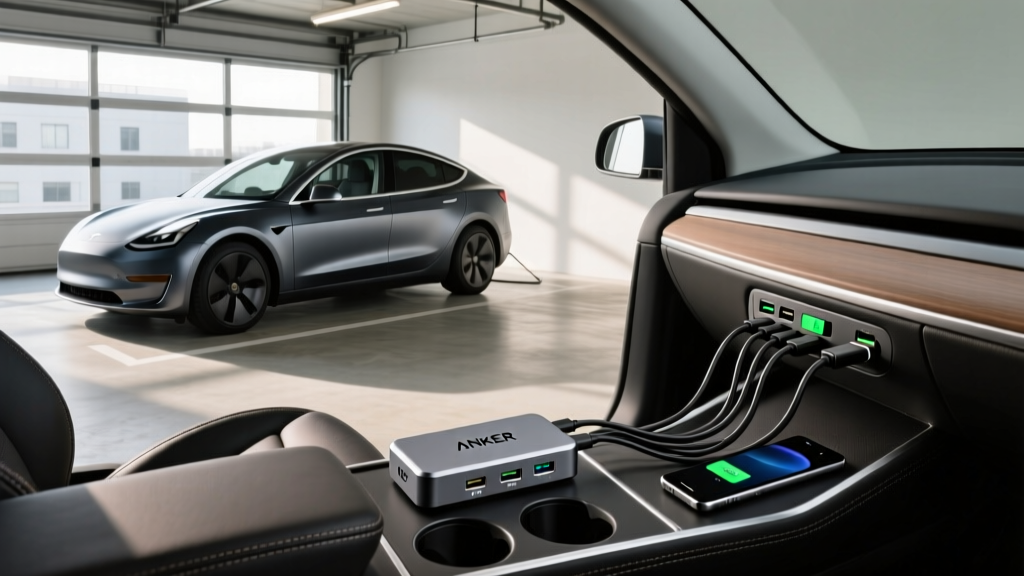
The 2026 Model 3 Highland and Model Y Juniper feature USB-C ports in the front center console and rear passenger area. However, the front ports serve dual duties: data (for dashcam/Sentry Mode USB drive access) and power delivery. This creates a bottleneck when you simultaneously need:
- A USB drive connected for dashcam and Sentry Mode recording
- Phone charging for the driver
- Phone charging for the passenger
- Power for accessories (wireless controller, portable fan, etc.)
The Tesla infotainment system requires the dashcam USB drive to occupy a data-capable port — typically the front USB-C port closest to the driver side or the port inside the center console (varies by model year). Plugging a simple power hub into that data port can disable dashcam recording entirely.
Choosing the Right USB Hub for Model 3/Y
Not all USB hubs work safely in a Tesla. Here's what matters:
- Pass-through data + power: The hub must support data pass-through on at least one port so the dashcam USB drive remains visible to the car's computer. Hubs that split power-only will break Sentry Mode.
- Power Delivery (PD) rating: Tesla's front USB-C ports output up to 27W (pre-2023) or 65W (2024+ Highland/Juniper). A hub that draws too much standby power or poorly negotiates PD can trigger port shutdowns or error messages.
- Form factor: Slim, angled hubs that sit flush inside the center console or behind the screen minimize cable clutter and avoid interference with the wireless charging pad.
- Powered vs. unpowered: Unpowered hubs (bus-powered from the car's port) are simpler but limit total wattage across connected devices. For multiple fast-charging phones, a powered hub with its own connection to a 12V accessory outlet may be necessary — though this adds cable routing complexity.
Popular hub configurations for Tesla Model 3/Y:
- Minimalist (1 data + 2 power): A compact USB-C hub with one data pass-through port for the dashcam drive and two power-only ports for phones. Brands like Jeda, Baseus, and Spigen offer Tesla-specific form factors.
- Expanded (1 data + 3–4 power): Larger hubs for families running rear-seat tablets plus front-seat devices. Ensure total draw stays under the port's PD budget.
- Glovebox USB hub: Some owners route a longer USB-C cable to the glovebox, mounting a hub there to keep the console clean. This works but requires the car's data port to reach — test cable length before committing.
Pricing, Trims, and Federal Tax Credit Eligibility
| Trim | 2026 MSRP | Est. Federal Credit (§30D) | Effective Price (if eligible) |
|---|---|---|---|
| Model 3 RWD | $38,990 | Up to $7,500 (point-of-sale) | ~$31,490 |
| Model 3 Long Range AWD | $47,740 | Up to $7,500 (point-of-sale) | ~$40,240 |
| Model 3 Performance | $52,990 | Up to $7,500 (point-of-sale) | ~$45,490 |
| Model Y RWD | $44,990 | Up to $7,500 (point-of-sale) | ~$37,490 |
| Model Y Long Range AWD | $48,990 | Up to $7,500 (point-of-sale) | ~$41,490 |
| Model Y Performance | $52,490 | Up to $7,500 (point-of-sale) | ~$44,990 |
§30D Tax Credit Rules (2026): The federal EV tax credit under IRS §30D offers up to $7,500, split between critical minerals ($3,750) and battery component sourcing ($3,750). Eligibility depends on:
- MSRP cap: Sedans (Model 3) must be under $55,000; SUVs/trucks (Model Y) under $80,000. All current trims qualify.
- Buyer income cap: Modified AGI ≤ $150,000 (single) or ≤ $300,000 (joint filing).
- Battery sourcing: Critical minerals and battery components must meet escalating domestic/free-trade-partner thresholds. Tesla's shifting supply chain means eligibility can change mid-year — always verify on the IRS qualified vehicles list before purchase.
- Point-of-sale transfer: Since 2024, buyers can transfer the credit to the dealer for an immediate price reduction rather than waiting for tax filing.
Consult a tax professional for your specific situation. Credit rules are subject to legislative change and supply-chain compliance updates.
Pros and Cons: Model 3 and Model Y
- Class-leading efficiency (kWh/100mi) means lower charging costs
- Supercharger network reliability — best public charging experience
- OTA updates add features post-purchase
- Strong resale value relative to EV market
- Excellent safety ratings (NHTSA 5-Star, IIHS Top Safety Pick)
- Minimal maintenance — no oil changes, brake pads last 100k+ miles
- Highland/Juniper refresh improved ride quality and cabin noise
- USB-C port layout forces hub workarounds for dashcam + charging
- No physical instrument cluster — all info on center screen
- FSD (Supervised) is Level 2 only — not self-driving, requires full attention
- Insurance premiums 15–30% higher than comparable ICE vehicles
- RWD LFP range drops sharply in cold weather
- Service center wait times remain long in some regions
- Phantom braking complaints persist with basic Autopilot
Who Should Buy the Model 3 vs Model Y?
Choose the Model 3 if: You prioritize driving dynamics, maximum range per dollar, and a lower starting price. The Model 3 Long Range at 363 EPA miles is the efficiency king for commuters covering 40–80 miles daily who want to charge only at home and rarely stop on road trips.
Choose the Model Y if: You need cargo flexibility (72 cu ft with rear seats folded), easier ingress/egress from the higher seating position, or plan to carry rear-facing child seats. The Model Y Long Range sacrifices ~33 miles of range for substantially more utility.
Choose RWD (LFP battery) if: Budget is the priority, you live in a mild climate, and you can charge at home daily. LFP batteries tolerate regular 100% charging and show slower long-term degradation — ideal for high-mileage commuters.
Choose Long Range AWD (NMC battery) if: You face cold winters, need maximum range for road trips, or want dual-motor traction in snow. Charge daily to 80–90% and only hit 100% before long drives.
Frequently Asked Questions
What is the real-world range of the Tesla Model 3 and Model Y?
The Model 3 Long Range AWD delivers roughly 280–310 real-world highway miles (EPA: 363 mi), while the Model Y Long Range AWD delivers 260–285 miles (EPA: 330 mi). Cold weather below freezing reduces these figures by 20–30%. City driving with regenerative braking can match or exceed EPA estimates.
How fast does the Model 3/Y charge at home and on DC fast chargers?
At home on a 48-amp Level 2 charger (11.5 kW), both vehicles add approximately 44 miles of range per hour — a full overnight charge from empty. On Tesla V3/V4 Superchargers, Long Range models peak at 250 kW and charge 10–80% in roughly 18–20 minutes. RWD trims peak at 170 kW, taking about 25 minutes for 10–80%.
How much does a Tesla Model 3 or Model Y cost after the federal tax credit?
If you meet all IRS §30D requirements (income caps, battery sourcing compliance), the Model 3 RWD drops from $38,990 to approximately $31,490, and the Model Y Long Range AWD drops from $48,990 to about $41,490. The credit can now be applied at point-of-sale as an immediate price reduction. Always verify current eligibility on the IRS qualified vehicles list, as battery-sourcing compliance can change.
Is the Tesla Model 3/Y worth buying vs competitors like the Hyundai Ioniq 6 or Ford Mustang Mach-E?
The Model 3 wins on efficiency and Supercharger access; the Ioniq 6 offers comparable range with faster 800V charging architecture (10–80% in ~18 min on 350 kW chargers) and a more traditional interior layout. The Mach-E competes with the Model Y on space but trails on range and charging speed. If Supercharger reliability and software ecosystem matter most, Tesla retains an edge. If you prefer dealer service, physical controls, or faster non-Tesla DCFC capability, competitors deserve a close look.
Does the Tesla Model 3 or Model Y qualify for the $7,500 federal EV tax credit?
Both the Model 3 and Model Y currently qualify for up to $7,500 under §30D, provided the buyer meets income thresholds ($150K single / $300K joint MAGI) and the specific VIN's battery meets critical-mineral and component-sourcing requirements. All trims fall under the MSRP caps ($55K sedan / $80K SUV). Confirm eligibility for your exact configuration at irs.gov before purchasing.
What USB hub works best for Tesla dashcam and phone charging simultaneously?
Look for a USB-C hub with explicit data pass-through on one port (for the dashcam drive) and power delivery on remaining ports. Tesla-specific hubs from Jeda, Baseus, or Spigen are designed to fit the center console geometry and negotiate the car's PD protocol correctly. Avoid generic PC hubs — they may not handle automotive temperature ranges or the car's specific power negotiation.
What's the battery warranty on the Model 3 and Model Y?
Tesla covers the battery and drive unit for 8 years or 100,000 miles (RWD trims) and 8 years or 120,000 miles (Long Range / Performance), whichever comes first. The warranty guarantees at least 70% capacity retention over that period. Real-world data from high-mileage Tesla owners shows most NMC packs retain 85–90% capacity at 100,000 miles; LFP packs show comparable or slightly better retention due to their chemistry's inherent cycle-life advantage.