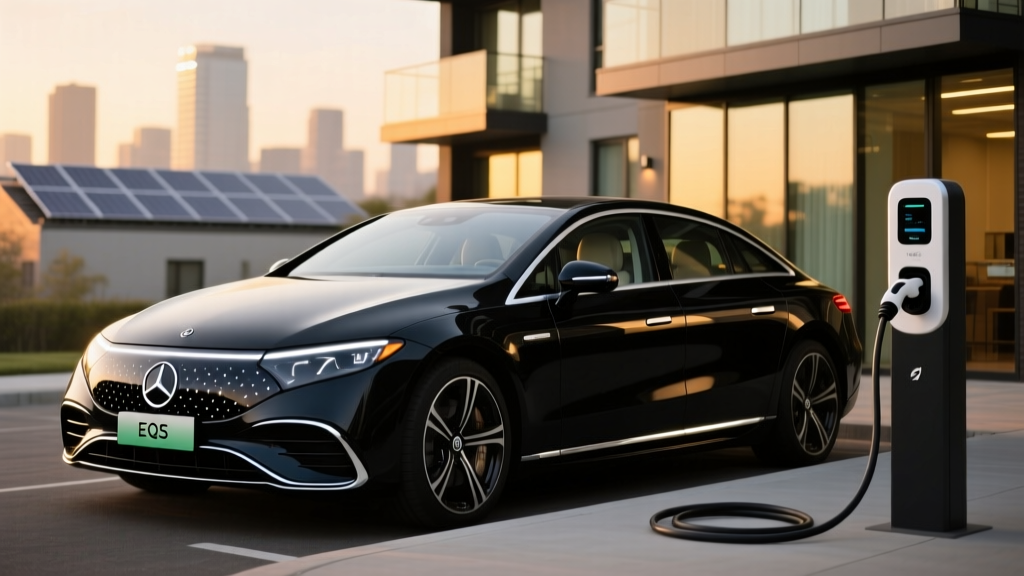
The 2025 Mercedes-Benz EQS sedan represents the brand's flagship electric luxury statement — a vehicle engineered to deliver S-Class refinement with zero tailpipe emissions. But at a starting price exceeding $75,000, buyers need more than prestige; they need concrete data on range, charging speed, and total ownership value. This review breaks down the 2025 EQS lineup with exact figures, real-world expectations, and the tax-credit realities that affect your wallet.
Quick Verdict: Who the 2025 Mercedes EQS Actually Serves
The 2025 EQS targets luxury sedan buyers who prioritize cabin isolation, highway comfort, and long-range cruising over sporty dynamics. It excels as a daily commuter and cross-country tourer for executives and families who can charge at home. If you need a third row, want a performance bargain, or can't access Level 2 charging, competitors like the Lucid Air or BMW i7 may serve you better.
Range and Efficiency: EPA Numbers vs Real-World Reality
The 2025 EQS lineup offers multiple configurations, each with distinct range profiles:
| Trim | Drivetrain | EPA Range | MPGe (Combined) | kWh/100mi |
|---|---|---|---|---|
| EQS 450+ Sedan | RWD | 390 miles | 97 MPGe | 34 kWh/100mi |
| EQS 450 4MATIC | AWD | 371 miles | 92 MPGe | 36 kWh/100mi |
| EQS 580 4MATIC | AWD | 371 miles | 90 MPGe | 37 kWh/100mi |
| AMG EQS | AWD | 330 miles | 79 MPGe | 42 kWh/100mi |
Real-World Range Reality: The EPA's 390-mile estimate for the EQS 450+ assumes mixed driving at moderate temperatures. On sustained highway trips at 75 mph, expect 320-340 miles before needing a charge. In freezing weather (below 32°F), range drops to 280-310 miles due to battery resistance and cabin heating demands. The EQS's standard heat pump mitigates some cold-weather loss, but physics still wins.
The 2025 EQS uses a 107.8 kWh usable battery (120 kWh gross) with NMC (nickel manganese cobalt) chemistry, chosen for its energy density and cold-weather performance. This is not an LFP battery — Mercedes prioritized range over cycle-life longevity, though the 8-year/100,000-mile warranty provides coverage if degradation exceeds 30%.
Charging Speed: DC Fast Charging and Home Setup
Charging speed determines road-trip viability and daily convenience. The 2025 EQS supports:
| Charging Level | Power | Speed (miles added) | Time/Notes |
|---|---|---|---|
| Level 1 (120V) | 1.4 kW | ~4 miles/hour | Emergency/trickle only |
| Level 2 (240V, 48A) | 11 kW | ~32 miles/hour | Full charge in ~11 hours |
| DC Fast Charge | Peak 200 kW | ~180 miles in 15 min | 10-80% in ~31 minutes |
The EQS's 200 kW peak DC charge rate is competitive but not class-leading — the Lucid Air peaks at 300 kW, and the Porsche Taycan at 270 kW. More critically, the EQS sustains 200 kW only between 10-40% state of charge, then tapers to ~120 kW through 80%. On a road trip from Los Angeles to San Francisco, you'll spend 35-40 minutes at each DC stop, not the "15 minutes for 180 miles" that peak-rate marketing implies.
Home charging reality: A full Level 2 installation (240V, 60A circuit with a 48A charger like the ChargePoint Home Flex) costs $1,200-$2,500 including electrician labor and permits, assuming your electrical panel has capacity. Panel upgrades can add $1,500-$3,000. Budget accordingly — the EQS's 107.8 kWh battery is too large for Level 1 convenience.
Performance: 0-60 Times and Powertrain Specs
| Trim | Horsepower | Torque (lb-ft) | 0-60 mph | Top Speed |
|---|---|---|---|---|
| EQS 450+ | 355 hp | 419 | 5.9 seconds | 130 mph |
| EQS 450 4MATIC | 355 hp | 590 | 5.3 seconds | 130 mph |
| EQS 580 4MATIC | 536 hp | 633 | 4.1 seconds | 130 mph |
| AMG EQS | 649 hp (751 w/boost) | 700 (828 w/boost) | 3.4 seconds | 155 mph |
The base EQS 450+ delivers adequate acceleration for luxury cruising, but the 580 4MATIC's 4.1-second sprint matches sports-sedan territory. The AMG variant is brutally quick but sacrifices 60 miles of range and costs $40,000 more. All trims use dual-motor AWD except the 450+, which is rear-wheel drive — a trade-off for efficiency over all-weather traction.
Pricing, Trims, and Federal Tax Credit Eligibility
| Trim | Base MSRP | As-Tested (Typical) | Federal §30D Credit | Effective Price |
|---|---|---|---|---|
| EQS 450+ Sedan | $75,900 | $82,000 | $0 (MSRP cap) | $82,000 |
| EQS 450 4MATIC | $78,900 | $86,000 | $0 (MSRP cap) | $86,000 |
| EQS 580 4MATIC | $98,900 | $108,000 | $0 (MSRP cap) | $108,000 |
| AMG EQS | $147,900 | $160,000+ | $0 (MSRP cap) | $160,000+ |
Federal Tax Credit Reality (2025-2026): The 2025 Mercedes EQS does not qualify for the $7,500 IRS §30D federal EV tax credit. The credit applies only to sedans with MSRP under $55,000 (per IRS rules). Every EQS trim exceeds this cap. Additionally, the credit requires buyer income below $150,000 (single) or $300,000 (joint), and battery components must meet critical-mineral and North American sourcing thresholds. Always consult a tax professional before purchase.
Without federal incentives, the EQS competes on luxury merit alone. State-level rebates (California's $2,000 CVRP, for example) may apply, but these vary by jurisdiction and income — check your local air district or energy office.
Interior Space, Cargo, and Technology
Passenger space: The EQS sedan offers 41.7 inches of front legroom and 38.2 inches rear — competitive with the BMW i7 and slightly less than the Lucid Air's 41.0 inches rear. The cabin seats four comfortably (five in a pinch), with available rear-seat recline and massage functions on higher trims.
Cargo volume: 22 cubic feet trunk (sedan), expanding to 63 cu ft with rear seats folded. The EQS SUV variant offers 28 cu ft behind the second row and 74 cu ft max — better for families hauling gear.
Technology highlights:
- MBUX Hyperscreen: 56-inch curved glass dashboard spanning driver to passenger, with OLED displays and haptic feedback
- Driver assistance: Active Distance Assist DISTRONIC (adaptive cruise), Active Steering Assist (lane centering), and Active Lane Change Assist — all SAE Level 2 (driver must remain engaged)
- Over-the-air updates: Mercedes delivers firmware improvements remotely, including efficiency optimizations and feature unlocks
- ENERGIZING comfort: Coordinated seat massage, ambient lighting, and fragrance systems tied to drive modes
Notable drawbacks: The Hyperscreen's touch-only climate controls frustrate some drivers; the sloping roofline compromises rear headroom for tall passengers; and the EQS's 5,800-pound curb weight produces noticeable body roll in corners compared to the Porsche Taycan.
Warranty and Long-Term Ownership
| Coverage | Years | Miles |
|---|---|---|
| Basic Vehicle | 4 | 50,000 |
| Powertrain | 4 | 50,000 |
| High-Voltage Battery | 8 | 100,000 |
| Corrosion Perforation | 6 | Unlimited |
The battery warranty guarantees the pack will retain at least 70% of original capacity over 8 years/100,000 miles. Real-world NMC degradation data from EPA testing and owner forums suggests 8-12% loss over 100,000 miles under normal use — well within warranty thresholds. Replacement cost for a full EQS battery pack: $20,000-$28,000 out of warranty, though individual module repairs are cheaper.
2025 Mercedes EQS vs Competitors: Is It Worth Buying?
Pros
- Class-leading 390-mile EPA range (450+ trim)
- Exceptional cabin quietness and ride comfort
- MBUX Hyperscreen tech integration
- Strong highway efficiency (34 kWh/100mi)
- Comprehensive 8-year battery warranty
Cons
- No federal tax credit (MSRP exceeds $55k cap)
- 200 kW peak charge rate lags Lucid Air (300 kW) and Taycan (270 kW)
- Heavy curb weight affects handling dynamics
- Touch-only climate controls on Hyperscreen
- High starting price vs BMW i7 and Lucid Air
Choose the 2025 EQS if: You prioritize S-Class luxury, long highway range, and Mercedes brand cachet over sporty handling or tax-credit savings. It's ideal for executives with home charging and frequent long-distance travel.
Consider alternatives if:
- Lucid Air Pure ($87,400): 419-mile range, 300 kW charging, more rear legroom
- BMW i7 xDrive50 ($119,300): 318-mile range, more traditional luxury sedan styling, better handling
- Tesla Model S ($74,990): 405-mile range, Supercharger network access, but dated interior
Frequently Asked Questions
What is the real-world range of the 2025 Mercedes EQS?
The EQS 450+ achieves an EPA-estimated 390 miles, but real-world highway driving at 75 mph yields 320-340 miles. In freezing temperatures, expect 280-310 miles. The heat pump helps, but cold weather and high speeds always reduce range.
How fast does the 2025 EQS charge at home and on the road?
At home on Level 2 (240V, 48A), the EQS charges at 11 kW, adding ~32 miles per hour — a full charge takes 11 hours. On DC fast chargers, it peaks at 200 kW, achieving 10-80% in ~31 minutes, but the charge curve tapers significantly above 40% state of charge.
Does the 2025 Mercedes EQS qualify for the federal EV tax credit?
No. The IRS §30D credit applies only to sedans with MSRP under $55,000. The cheapest EQS trim starts at $75,900, disqualifying it entirely. State incentives may apply — check your local programs.
Is the EQS worth buying over the Lucid Air or BMW i7?
The EQS wins on cabin tech and highway efficiency but loses on charging speed and tax-credit eligibility. The Lucid Air offers more range (419 mi) and faster charging (300 kW); the BMW i7 delivers sharper handling. Test-drive all three before deciding.
What's the biggest drawback of the 2025 EQS?
The lack of federal tax credit eligibility is the most significant financial drawback, adding $7,500 to the effective cost vs credit-eligible competitors. The 200 kW charge rate also lags rivals, adding time to road trips.
Sources: EPA Fuel Economy, IRS §30D Tax Credit Rules, Mercedes-Benz USA EQS Specs