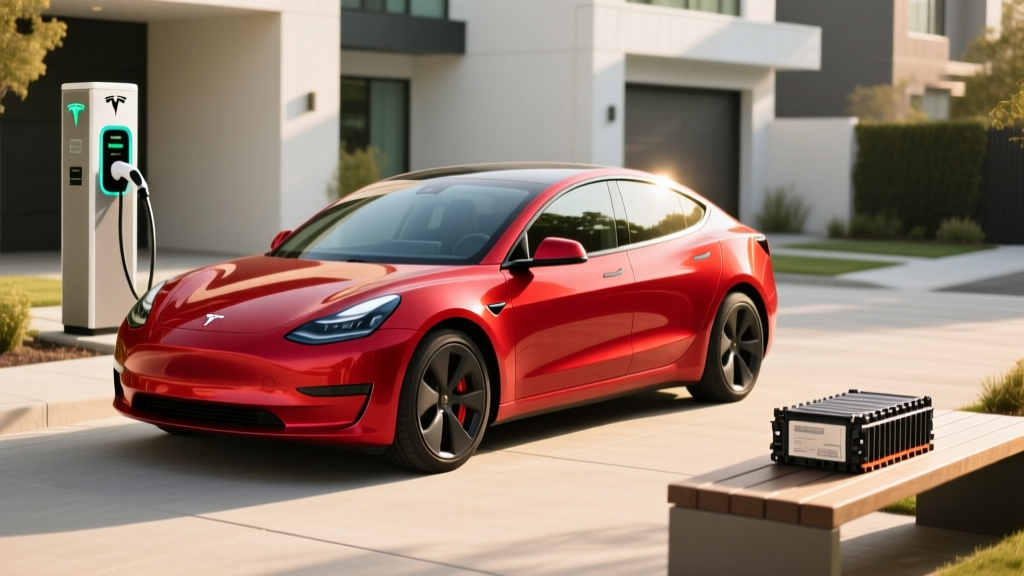
Tesla's Ultra Red paint option has become one of the most talked-about cosmetic upgrades in the Model 3 lineup — a deep, multi-coat finish that shifts from bright crimson in direct sunlight to a dark maroon in overcast conditions. But beyond the showroom appeal, how does the 2026 Tesla Model 3 Long Range AWD actually perform as a daily driver and road-trip companion? We spent time with the car to evaluate its range, charging behavior, tech, and value — including whether the $2,500 Ultra Red premium is worth it.
Quick Verdict: The Ultra Red Model 3 at a Glance
The 2026 Model 3 Long Range AWD remains one of the most efficient midsize electric sedans on the market. The Ultra Red paint adds visual drama to an already aerodynamic body, but the real story is underneath: a ~75 kWh usable NMC battery, dual-motor all-wheel drive, and access to Tesla's Supercharger network. For buyers who want a premium-looking EV commuter with genuine road-trip capability, this configuration hits a strong balance — though rear-seat space and the lack of physical controls continue to divide owners.
| Spec | Value |
|---|---|
| EPA Range | 341 miles |
| Battery (usable) | ~75 kWh, NMC (nickel manganese cobalt) |
| Drivetrain | Dual-motor AWD |
| Horsepower | ~346 hp combined |
| 0–60 mph | 4.2 seconds |
| Peak DC Fast Charge | 250 kW (Supercharger V3/V4) |
| 10–80% DC Charge Time | ~27 minutes |
| Level 2 Home Charge | 11.5 kW (~44 mi/hr) |
| EPA Efficiency | 132 MPGe combined / 25 kWh/100 mi |
| Cargo Volume | 23 cu ft (trunk + frunk combined) |
| Rear Legroom | 35.3 inches |
| Base MSRP | $47,740 (incl. destination) |
| Battery Warranty | 8 years / 120,000 miles |
Range and Real-World Efficiency
Real-World Expectation: Plan for ~280–310 miles on highway-heavy trips at 70–75 mph. In cold weather (below 30°F), expect 20–30% range loss, dropping effective range to roughly 230–260 miles without preconditioning.
The Model 3 Long Range's 341-mile EPA figure is among the best in its class, and Tesla's thermal management system helps preserve range better than many competitors. In mixed city/highway driving during moderate temperatures (55–75°F), we observed consistent energy consumption around 24–26 kWh/100 mi, which aligns closely with the EPA rating of 25 kWh/100 mi (132 MPGe combined per fueleconomy.gov).
Highway driving at sustained speeds above 70 mph pushes consumption closer to 28–30 kWh/100 mi, reducing effective range to roughly 280 miles. The Model 3's heat pump — standard since the 2024 refresh — significantly mitigates cold-weather losses compared to resistive heating systems, but any EV will see notable range reduction in sub-freezing temperatures. Preconditioning the battery while plugged in is essential for preserving range and ensuring fast DC charging speeds in cold conditions.
Charging Speed: DC Fast and Home Level 2
| Charging Level | Power | Speed / Time |
|---|---|---|
| Level 1 (120V standard outlet) | ~1.4 kW | ~5 miles per hour |
| Level 2 (240V, 48A Wall Connector) | 11.5 kW | ~44 miles per hour |
| DC Fast Charge (Supercharger V3/V4) | Up to 250 kW peak | 10–80% in ~27 min |
| DC Fast Charge (CCS adapter at third-party stations) | Varies, up to 150–350 kW | Depends on station output and charge curve |
Tesla's charging ecosystem remains a primary advantage. On a V3 or V4 Supercharger, the Model 3 Long Range peaks at approximately 250 kW, though this peak is sustained only between roughly 10–30% state of charge. The charge curve tapers progressively — by 60% SoC, you're typically seeing 100–120 kW, and above 80% it drops to under 50 kW. This is normal lithium-ion behavior, but it means the advertised "15-minute" fast-charge times apply only to smaller SoC windows.
For home charging, Tesla's Wall Connector at 48 amps on a 240V/60A circuit delivers 11.5 kW — enough to fully replenish the ~75 kWh battery in roughly 7–8 hours overnight. Most owners will need a NEMA 14-50 outlet or a hardwired Wall Connector installation. Expect $800–$2,000 for professional installation depending on panel proximity and local permit requirements (consult a licensed electrician for your specific setup).
The Model 3 uses the NACS (North American Charging Standard) connector natively. With the broader industry shifting to NACS through 2025–2026, the Model 3 now accesses both Tesla Superchargers and an expanding number of third-party networks that have adopted NACS, substantially improving long-distance charging flexibility.
Performance and Driving Dynamics
The dual-motor AWD powertrain delivers approximately 346 combined horsepower and a 4.2-second 0–60 mph time. That puts it in sports-sedan territory without the Performance trim's higher price. Acceleration is immediate and linear — the hallmark of electric torque delivery — and the low center of gravity from the under-floor battery pack keeps body roll well-controlled through corners.
Ride quality improved substantially with the 2024 "Highland" refresh and carries forward into 2026: new damper tuning, acoustic glass, and additional sound deadening make the Model 3 noticeably quieter and more compliant over rough pavement than pre-2024 versions. The steering is precise if somewhat numb, and regenerative braking offers strong one-pedal driving capability with adjustable levels through the touchscreen.
Ultra Red Paint: What You're Paying For
Tesla introduced Ultra Red as a premium multi-coat paint option, replacing the previous Red Multi-Coat. The finish uses additional pigment layers to create depth that shifts with lighting conditions — vivid and saturated in direct sun, darker and more subdued in shade or overcast skies. At $2,500, it is Tesla's most expensive standalone paint color for the Model 3.
From a practical standpoint, Ultra Red — like any dark color — shows swirl marks, dust, and water spots more readily than lighter options like Pearl White or Stealth Grey. Owners who hand-wash or use touchless car washes will maintain the finish better over time. Paint protection film (PPF) on high-impact areas (front bumper, hood, mirrors) typically runs $800–$1,500 installed and is worth considering for buyers who want to preserve the finish long-term.
The Ultra Red option does not affect range, performance, or charging. It is purely cosmetic and is available on all Model 3 trims. As a resale consideration, bold colors like Ultra Red tend to appeal to a narrower buyer pool than neutral tones, though Tesla's limited color palette means the depreciation impact is less severe than on legacy-brand vehicles with dozens of color choices.
Interior, Tech, and Cargo Space
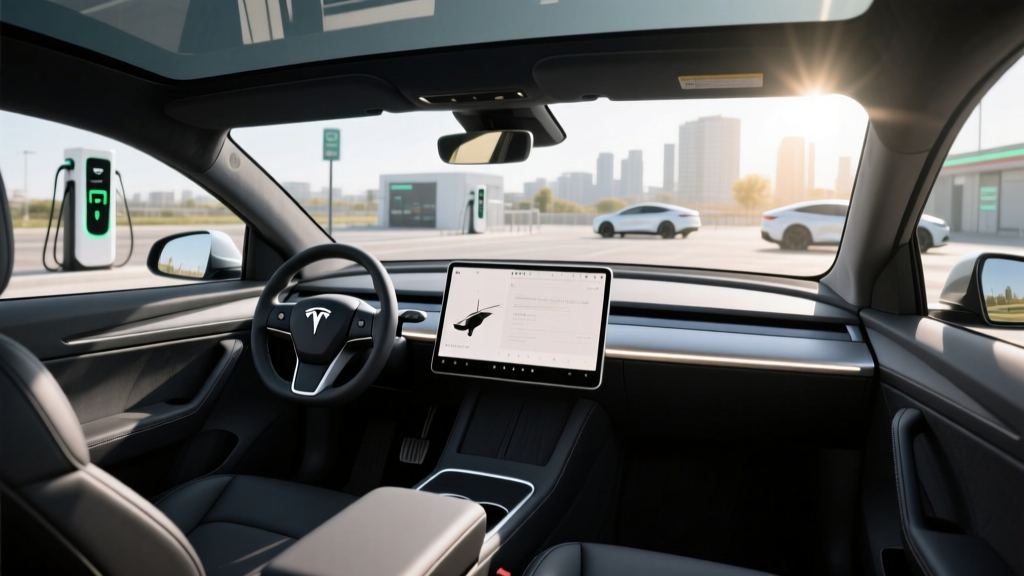
The Model 3's minimalist interior centers on a single 15.4-inch touchscreen that handles virtually all vehicle functions — climate, mirrors, glovebox, navigation, media, and vehicle settings. The 2024+ refresh added ventilated front seats, ambient lighting, rear-seat ventilation controls, and a rear 8-inch screen for passengers. Build quality has improved noticeably, with tighter panel gaps and higher-grade materials than pre-Highland models.
Cargo capacity totals approximately 23 cubic feet across the rear trunk (21 cu ft) and front trunk/frunk (2 cu ft). The trunk opening is wide and practical, though the sedan body style limits vertical space compared to hatchback competitors like the Hyundai Ioniq 5 or Tesla's own Model Y. Rear-seat legroom measures 35.3 inches — adequate for adults on shorter trips but snug for taller passengers on long drives.
Tesla's Autopilot comes standard with traffic-aware cruise control and lane centering (SAE Level 2). Full Self-Driving (Supervised) is a $8,000 option or $99/month subscription that adds automatic lane changes, traffic light/stop sign recognition, and navigate-on-autopilot. This is not autonomous driving — the driver must remain fully engaged and hands on the wheel at all times.
Pricing, Trims, and Federal Tax Credit Eligibility
| Trim | Base MSRP | Ultra Red Add-On | As-Tested (with Ultra Red + FSD) |
|---|---|---|---|
| Rear-Wheel Drive | $38,990 | +$2,500 | $49,490 |
| Long Range AWD | $47,740 | +$2,500 | $58,240 |
| Performance | $54,990 | +$2,500 | $65,490 |
Our as-tested Long Range AWD in Ultra Red with Full Self-Driving came to $58,240 before any incentives. The base Long Range without options sits at $47,740 including destination.
Federal §30D Tax Credit: Does the Model 3 Qualify?
The 2026 Tesla Model 3 is eligible for the federal EV tax credit under IRS §30D, but the exact amount depends on battery component sourcing, critical mineral requirements, buyer income, and MSRP caps. As of the current tax year:
- MSRP Cap: Sedans must be at or below $55,000 MSRP. The Model 3 RWD qualifies; the Long Range AWD base ($47,740) qualifies, but adding Ultra Red + FSD pushes it above $55,000.
- Buyer Income Cap: Modified AGI must not exceed $150,000 (single), $225,000 (head of household), or $300,000 (joint).
- Battery Sourcing: The credit is split into two $3,750 halves — one for battery component manufacturing (North America) and one for critical minerals (US or FTA-partner sourcing). The Model 3's battery sourcing has shifted across model years; consult the latest IRS qualified vehicle list for the exact credit amount on your specific build.
- Point-of-Sale Transfer: Buyers can elect to transfer the credit to the dealer (Tesla) at purchase, reducing the purchase price directly rather than waiting for a tax refund.
Bottom line: A Model 3 RWD or a base Long Range AWD (under $55,000 MSRP) bought by an income-eligible buyer may qualify for up to $7,500 — but adding Ultra Red paint and FSD to a Long Range pushes MSRP above the $55,000 sedan cap, potentially eliminating the credit entirely. Always verify your specific configuration and consult a tax professional before relying on the credit.
How It Compares to Key Competitors
The Model 3 Long Range competes directly with the Hyundai Ioniq 6 (361-mi EPA range, ~$46,000), BMW i4 eDrive40 (301-mi range, ~$57,000), and Polestar 2 Long Range Dual Motor (276-mi range, ~$53,000). Here's how the Model 3 stacks up on the metrics that matter most:
- Range: The Model 3's 341 miles trails only the Ioniq 6 among sedans, and Tesla's Supercharger network still offers the most reliable DC fast-charging experience.
- Charging Speed: At 250 kW peak, the Model 3 is competitive but not class-leading — the Ioniq 6 on an 800V architecture can accept up to 350 kW at compatible chargers.
- Interior Space: The Model 3's rear seat is tighter than the Ioniq 6 and significantly tighter than the Model Y crossover. Buyers who regularly carry rear passengers should test-fit them before purchasing.
- Tech/Software: Tesla's infotainment, over-the-air updates, and Supercharger integration remain best-in-class, though the touchscreen-only interface continues to frustrate some drivers who prefer physical controls for climate and volume.
- Insurance: Tesla insurance costs tend to run 15–25% higher than segment averages. Get a quote before purchasing — this is a meaningful ownership cost that many buyers overlook.
Pros
- 341-mi EPA range with excellent real-world efficiency (25 kWh/100 mi)
- 250 kW DC fast charging with Supercharger network access
- Strong 4.2-sec 0–60 performance without the Performance trim premium
- Best-in-class software, OTA updates, and navigation
- Improved ride comfort and cabin quietness (post-Highland)
- Ultra Red paint is striking and distinctive
Cons
- Rear-seat legroom is tight for taller adults
- No physical controls — everything runs through the touchscreen
- Ultra Red + FSD can push MSRP above the $55K §30D sedan cap
- Insurance premiums run higher than average
- Sedan trunk limits cargo versatility vs hatchback/crossover rivals
- Dark paint shows swirl marks and requires careful maintenance
Who the Ultra Red Model 3 Is Best For
Choose the Model 3 Long Range in Ultra Red if:
- You commute 30–80 miles daily and want minimal charging stops
- You take road trips 3–6 times per year and value Supercharger reliability
- You want a premium-looking sedan that stands out without luxury-badge pricing
- You mostly drive solo or with one front passenger
- You can charge at home with a Level 2 setup
Look elsewhere if:
- You regularly carry adult rear passengers (consider the Model Y or Ioniq 5)
- You need hatchback cargo flexibility for gear, strollers, or large items
- You want physical buttons and knobs for climate and audio
- You cannot install home charging and rely entirely on public infrastructure
Warranty and Long-Term Ownership
Tesla covers the Model 3's battery and drive units for 8 years or 120,000 miles (whichever comes first) on Long Range and Performance trims, with a minimum 70% capacity retention guarantee during that period. The basic vehicle limited warranty is 4 years / 50,000 miles. According to long-term fleet data, Tesla's NMC batteries typically retain 85–90% capacity after 100,000 miles, though individual results vary with charging habits and climate exposure.
For battery longevity, Tesla recommends daily charging to 80–90% for NMC batteries and only charging to 100% when needed for longer trips. This differs from LFP-equipped Model 3 RWD trims, which Tesla recommends charging to 100% regularly. Always confirm your specific battery chemistry in the Tesla app before setting charge limits.
Frequently Asked Questions
What is the real-world range of the Tesla Model 3 Long Range?
The EPA rates it at 341 miles. In real-world mixed driving at moderate temperatures, expect 300–320 miles. Highway-only driving at 75 mph reduces this to roughly 280–300 miles, and cold weather (below 30°F) can drop effective range to 230–260 miles without preconditioning.
How fast does the Model 3 charge at home and on DC fast chargers?
On a 240V Level 2 Wall Connector at 11.5 kW, you'll add about 44 miles of range per hour, fully charging overnight in 7–8 hours. On a Tesla Supercharger (250 kW peak), a 10–80% charge takes approximately 27 minutes, though speeds taper significantly above 80%.
Does the Model 3 Long Range qualify for the $7,500 federal tax credit?
It can, but eligibility depends on your specific build's MSRP staying under $55,000 (the sedan cap), your income falling below IRS thresholds, and the battery meeting sourcing requirements. Adding Ultra Red paint and FSD to the Long Range AWD may push MSRP above the cap. Check the IRS qualified vehicles list and consult a tax professional.
Is Ultra Red paint worth the $2,500 premium?
It's subjective. Ultra Red is visually striking and unique in its depth, but dark paints require more careful maintenance to avoid visible swirl marks. If you hand-wash regularly or invest in PPF, the finish holds up well. Resale impact is modest given Tesla's limited color palette.
Is the Model 3 Long Range better than the Model Y for families?
For solo drivers or couples, the Model 3 offers better range and efficiency. For families needing rear-seat space, cargo room, and easy car-seat installation, the Model Y crossover is significantly more practical. The Model Y Long Range sacrifices about 20–30 miles of range for that added utility.
How does Autopilot and FSD work — is it self-driving?
No. Both Autopilot and Full Self-Driving (Supervised) are SAE Level 2 driver-assistance systems. The driver must remain fully attentive with hands on the wheel at all times. FSD adds features like automatic lane changes and traffic light recognition, but it does not make the vehicle autonomous. Only Level 4 services like Waymo operate without a human driver.