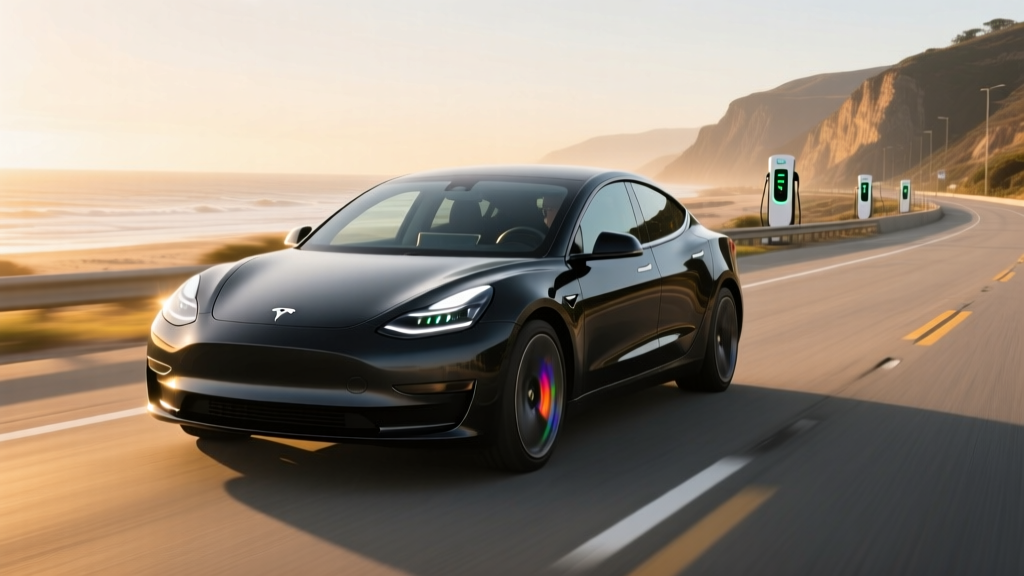
The Tesla Model 3 remains the benchmark electric sedan in 2026, but buyers asking about top speed in Tesla vehicles often discover that the answer depends heavily on which trim they choose. From the efficiency-focused Long Range to the track-capable Performance model, the Model 3 lineup offers dramatically different speed profiles — and understanding those differences is critical before you sign a purchase agreement.
This review covers every current 2026 Model 3 variant with exact EPA range figures, real-world efficiency data, DC fast-charge curves, and the federal tax credit math that determines your actual out-of-pocket cost. Whether you care about straight-line acceleration or highway passing power, the numbers below will tell you which Model 3 actually fits your driving style.
2026 Tesla Model 3 Lineup: Speed, Range & Power at a Glance
| Spec | Model 3 Long Range RWD | Model 3 Long Range AWD | Model 3 Performance |
|---|---|---|---|
| Top Speed | 125 mph | 125 mph | 163 mph |
| 0-60 mph | 5.8 sec | 4.2 sec | 2.9 sec |
| Horsepower | ~271 hp | ~346 hp | ~510 hp |
| Drivetrain | RWD (single motor) | AWD (dual motor) | AWD (dual motor) |
| EPA Range | 363 mi | 341 mi | 315 mi |
| Battery (usable) | ~75 kWh (NMC) | ~75 kWh (NMC) | ~75 kWh (NMC) |
| MPGe (combined) | 132 MPGe | 125 MPGe | 115 MPGe |
| kWh/100 mi | 25 | 27 | 29 |
| Base MSRP | $44,130 | $47,130 | $54,630 |
| Max DC Fast Charge | 170 kW | 170 kW | 250 kW |
| 10-80% DCFC Time | ~28 min | ~28 min | ~18 min |
Tesla publishes top speed as an electronically governed limit. The Long Range variants cap at 125 mph, which is more than sufficient for any legal U.S. highway. The Performance model unlocks 163 mph — a figure that matters primarily for track-day enthusiasts, since no public road in America allows speeds anywhere near that threshold. What matters more in daily driving is the 0-60 time and mid-range acceleration, where the dual-motor AWD models deliver a decisive advantage.
Real-World Range: What the EPA Sticker Doesn't Tell You
EPA Estimated: 341 miles
Real-World Highway (70 mph, 72°F): ~280–300 miles
Cold Weather (30°F, highway): ~220–250 miles
City/Commuter (regenerative braking): ~330–350 miles
The EPA test cycle includes a mix of city and highway driving with moderate temperatures. In practice, sustained highway speeds above 70 mph increase aerodynamic drag significantly — EVs are especially sensitive to this because they lack a multi-speed transmission to optimize efficiency at high velocity. On a road trip from Denver to Salt Lake City in summer conditions, expect to use roughly 290 miles of range before needing to stop.
Cold weather compounds the effect. Lithium-ion NMC chemistry becomes less efficient below freezing, and the battery thermal management system draws energy to keep cells in their optimal temperature window. Tesla's heat pump (standard on all 2026 Model 3 trims) mitigates cabin-heating energy draw compared to older resistive heaters, but you should still plan for 25–35% range reduction in sustained sub-40°F highway driving. Preconditioning the battery while plugged in at home — a feature accessible through the Tesla app — recovers some of this loss by warming the pack before departure.
For the Performance trim, real-world range drops further if you regularly exploit its acceleration capability. Aggressive driving with frequent high-power draws will push consumption toward 35+ kWh/100 mi, cutting effective range to roughly 210 miles. Drive it like a Long Range, and the 315 EPA miles translate to about 260–275 highway miles.
Charging Speed: DC Fast Charge and Home Level 2 Breakdown
| Charging Method | Power | Miles Added per Hour | Notes |
|---|---|---|---|
| Level 1 (120V household) | ~1.4 kW | ~5 mi/hr | Emergency/trickle only |
| Level 2 (240V, 32A Mobile Connector) | ~7.7 kW | ~30 mi/hr | Standard Tesla Mobile Connector |
| Level 2 (240V, 48A Wall Connector) | ~11.5 kW | ~44 mi/hr | Tesla Wall Connector; requires 60A circuit |
| DC Fast Charge (Long Range) | Peak 170 kW | ~200 mi in 15 min | Tapers above 60% SoC |
| DC Fast Charge (Performance) | Peak 250 kW | ~200 mi in 15 min | Supercharger V3/V4 capable |
The difference between the Long Range and Performance charging architectures is significant. The Performance model's 250 kW peak capability on Tesla V3 and V4 Superchargers means a 10–80% session takes roughly 18 minutes under ideal conditions (warm battery, low state of charge at arrival). The Long Range models peak at 170 kW, stretching that same 10–80% session to about 28 minutes.
A critical concept here is the charge curve. No EV sustains its peak kW rate for the entire session. The Model 3 Performance might hit 250 kW at 10% state of charge (SoC), but by 50% SoC it drops to roughly 150 kW, and above 80% it falls below 50 kW. This is why manufacturers quote 10–80% times rather than 0–100% — the final 20% can take as long as the first 70%. If you're road-tripping, plan to charge to 80% and move on; waiting for 100% at a Supercharger wastes time and, on NMC chemistry, accelerates long-term degradation.
For home charging, the Tesla Wall Connector at 48 amps (11.5 kW) adds roughly 44 miles of range per hour. An overnight 8-hour session restores about 350 miles — more than enough to refill any Model 3 from near-empty. Installation typically requires a 60-amp dedicated circuit; expect $500–$1,500 for a licensed electrician to run the line if your panel is nearby, or $2,000–$4,000+ if a panel upgrade to 200A service is needed. Per Tesla's home charging guide, the Wall Connector itself retails for roughly $475.
Performance Deep Dive: Why Top Speed Matters (and Why It Doesn't)
If you're researching top speed in Tesla vehicles, the Model 3 Performance is the sedan that delivers supercar territory numbers: 2.9 seconds to 60 mph and a governed top speed of 163 mph. Tesla's dual-motor all-wheel-drive system provides instantaneous torque vectoring, and the 2026 Performance model includes Adaptive Dampers, a track-oriented drive mode, and high-performance braking hardware.
But here's the honest assessment: in 95% of American driving scenarios, the difference between 125 mph and 163 mph top speed is academic. What you'll actually feel every day is the 0–60 time and the instant throttle response that EVs deliver from zero RPM. The Long Range AWD's 4.2-second sprint to 60 mph is quicker than most V6 sports sedans and provides effortless highway merging. The RWD Long Range at 5.8 seconds still outpaces the average compact sedan.
The Performance model's real advantage isn't top speed — it's the chassis tuning, adaptive suspension, and higher-performance tires that make it genuinely capable on a road course. If you don't plan to attend track events or regularly drive aggressive canyon roads, the Long Range AWD delivers 90% of the thrill with 8% more range and a $7,500 lower base price.
Pricing, Trims & Federal Tax Credit Eligibility
| Trim | Base MSRP | As-Tested (typical options) | Est. Federal Credit (§30D) | Effective Price |
|---|---|---|---|---|
| Long Range RWD | $44,130 | $45,630 (w/ paint + wheels) | Up to $7,500* | ~$38,130 |
| Long Range AWD | $47,130 | $49,630 (w/ paint + FSD) | Up to $7,500* | ~$42,130 |
| Performance | $54,630 | $56,130 (w/ paint) | Up to $7,500* | ~$48,630 |
*Federal tax credit eligibility under IRS §30D depends on multiple requirements that change periodically:
- MSRP Cap: Sedans must have a base MSRP at or below $55,000. The Long Range RWD and AWD qualify; the Performance model at $54,630 is under the cap but leaves minimal room for dealer-installed options before exceeding it.
- Buyer Income Limits: Modified AGI must not exceed $150,000 (single), $225,000 (head of household), or $300,000 (joint filers).
- Battery Sourcing: The full $7,500 requires meeting both critical-mineral and battery-component sourcing thresholds. As of 2026, Tesla's Fremont-built Model 3 with NMC cells sourced from Panasonic's Nevada Gigafactory generally qualifies for the full credit, but verify at fueleconomy.gov before purchasing — sourcing rules tighten annually.
- Point-of-Sale Transfer: You can transfer the credit to the dealer at purchase, reducing your out-of-pocket cost immediately rather than waiting for a tax refund.
The Performance model's proximity to the $55,000 MSRP cap is a practical concern. Adding certain dealer accessories or destination charges could push the vehicle above the threshold, eliminating the credit entirely. Confirm the final MSRP on the window sticker before signing.
Interior, Cargo & Daily Livability
The 2026 Model 3 (the "Highland" refresh generation) carries over the minimalist interior introduced in late 2023, with incremental material and noise-reduction improvements. Rear legroom measures 35.3 inches — adequate for adults on shorter trips but tighter than a Hyundai Ioniq 6 or BMW i4. Front headroom is generous at 40.3 inches.
Cargo volume stands at 23 cubic feet behind the rear seats, with a 60/40 split-folding rear seat enabling longer items. The front trunk (frunk) adds approximately 3.1 cubic feet — useful for charging cables, a small bag, or groceries. Total enclosed volume is competitive with compact luxury sedans, though the trunk opening is narrower than a hatchback or liftback design.
The 15.4-inch center touchscreen handles all vehicle controls, navigation, and media. There are no physical buttons for climate, mirrors, or glovebox — everything routes through the display. This is the Model 3's most polarizing trait: some owners appreciate the clean aesthetic, while others find it distracting to adjust fan speed through a touchscreen while driving. A rear 8-inch screen for passengers was added in the Highland generation, controlling rear climate and media.
Driver Assistance, Tech & Notable Drawbacks
Tesla's Autopilot (standard) provides adaptive cruise control and lane-centering on highways. The optional FSD (Supervised) package — currently $8,000 or $99/month — adds automatic lane changes, traffic-light recognition, and city-street navigation. Despite the "Full Self-Driving" name, this remains a Level 2 system requiring constant driver oversight. NHTSA continues to scrutinize Tesla's Autopilot and FSD through standing general orders and defect investigations; review the latest findings at nhtsa.gov before purchasing.
- Drive without an attentive human driver present
- Handle all weather conditions (heavy rain, snow, fog degrade performance)
- Navigate construction zones reliably without intervention
- Replace your legal responsibility as the driver — you are liable for all vehicle actions
Notable drawbacks of the 2026 Model 3 include the absence of Apple CarPlay and Android Auto (Tesla uses its proprietary infotainment exclusively), a firm ride on the Performance trim's low-profile tires, and limited rear visibility due to the sloping rear glass. Tesla's service center network, while expanding, still has coverage gaps in rural regions compared to legacy automakers.
Who the Model 3 Suits Best — And Who Should Look Elsewhere
- Class-leading efficiency (25 kWh/100 mi on Long Range RWD)
- Access to Tesla Supercharger network — the most reliable DC fast-charge infrastructure in the U.S.
- Strong real-world range across all trims (260+ highway miles achievable)
- Over-the-air updates continuously add features
- Performance model offers supercar acceleration at sedan pricing
- Heat pump standard for cold-climate efficiency
- No Apple CarPlay / Android Auto
- Touchscreen-only controls require eyes-off-road for basic adjustments
- Rear seat space is tighter than key competitors
- Performance trim's top speed advantage is irrelevant for public roads
- FSD subscription cost adds significantly to ownership expense
- Service access can be limited outside major metro areas
Best for: Solo commuters and couples who prioritize efficiency, access to the best fast-charging network, and strong acceleration. The Long Range AWD is the sweet-spot trim — 341 EPA miles, 4.2-second 0-60, and a tax-credit-adjusted price near $42,000 make it one of the best-value premium electric sedans available.
Look elsewhere if: You regularly carry rear-seat adults (consider the Hyundai Ioniq 6 or BMW i4 for more space), need Apple CarPlay integration, or want a physical button interface. If you tow, the Model 3 is not rated for towing — step up to the Model Y or a truck-based EV.
Warranty Coverage
Tesla provides a 4-year/50,000-mile limited vehicle warranty and an 8-year/120,000-mile battery and drive unit warranty for the Model 3 Long Range and Performance (the RWD variant carries an 8-year/100,000-mile battery warranty). The battery warranty guarantees at least 70% capacity retention during the coverage period. In practice, NMC packs in the Model 3 have demonstrated roughly 5–8% degradation over the first 100,000 miles based on fleet data, meaning most owners will remain well within the warranty threshold.
Frequently Asked Questions
What is the top speed in Tesla Model 3 trims?
The 2026 Model 3 Long Range (RWD and AWD) has an electronically limited top speed of 125 mph. The Model 3 Performance is governed at 163 mph. These limits are set in software and cannot be owner-adjusted.
What is the real-world range of the Tesla Model 3?
The Long Range AWD delivers roughly 280–300 highway miles in mild weather and 220–250 miles in freezing conditions, against its 341-mile EPA rating. The Performance trim averages 240–275 highway miles against its 315-mile EPA estimate, depending on driving style.
How fast does the Model 3 charge at home and on the road?
At home on a 240V/48A Tesla Wall Connector, the Model 3 gains about 44 miles of range per hour (11.5 kW). On DC fast chargers, the Performance peaks at 250 kW (10–80% in ~18 minutes), while the Long Range peaks at 170 kW (10–80% in ~28 minutes).
Does the Tesla Model 3 qualify for the $7,500 federal EV tax credit?
The Long Range RWD ($44,130) and Long Range AWD ($47,130) fall under the $55,000 MSRP sedan cap. The Performance ($54,630) also qualifies but sits close to the limit. Buyer income caps and battery-sourcing requirements apply — verify current eligibility at fueleconomy.gov and the IRS before purchasing.
Is the Model 3 Performance worth it over the Long Range AWD?
If you value track capability, adaptive dampers, and 2.9-second 0–60 times, yes. For daily commuting and road trips, the Long Range AWD provides excellent acceleration (4.2 sec), more range (341 vs. 315 EPA miles), and costs $7,500 less — making it the better value for most buyers.
Is Tesla Autopilot self-driving?
No. Autopilot and FSD (Supervised) are SAE Level 2 driver-assist systems. You must remain fully attentive, keep your eyes on the road, and be prepared to take control at any moment. Only Level 4 services like Waymo operate without a human driver.