If you're searching for a VW electric truck, here's the direct answer: Volkswagen does not currently sell a traditional electric pickup truck in the United States as of early 2026. The closest electrified VW product available is the ID. Buzz — a retro-styled electric minivan offered in passenger and commercial cargo configurations. While VW has registered trademarks and teased concepts hinting at a future electric pickup (potentially built on the Scalable Systems Platform, or SSP), no production timeline or US-market commitment has been confirmed. For buyers who need a truck today, VW's portfolio doesn't have one; for those open to an electric commercial van or curious about VW's truck roadmap, the ID. Buzz and upcoming SSP platform are worth understanding.
What VW Actually Offers: The ID. Buzz in 2026
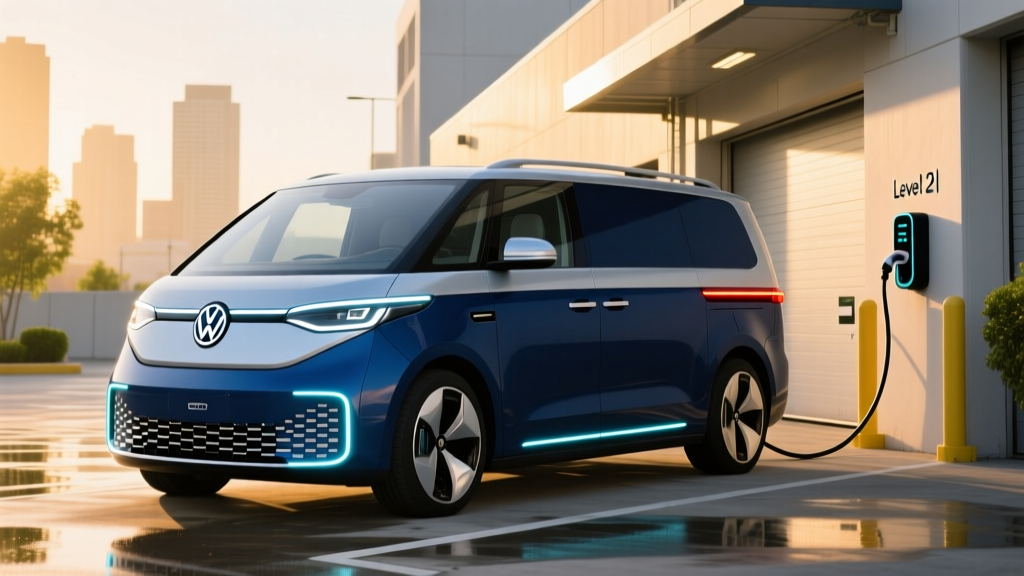
The VW ID. Buzz launched in the US for the 2025 model year in passenger form, and the commercial ID. Buzz Cargo variant targets fleet and small-business buyers who need enclosed hauling capacity rather than an open bed. It rides on VW's MEB platform — the same architecture underpinning the ID.4 crossover — and shares its powertrain fundamentals.
| Spec | ID. Buzz Passenger (AWD) | ID. Buzz Cargo (Est.) |
|---|---|---|
| Battery (usable) | 86 kWh (NMC) | 86 kWh (NMC) |
| EPA Range | ~234 mi (est.) | ~220 mi (est., lower due to weight/aero) |
| Motor / Drivetrain | Dual motor AWD, 335 hp | Rear motor RWD, ~282 hp |
| 0-60 mph | ~6.5 sec | ~7.5 sec (est.) |
| Peak DC Fast Charge | 200 kW | 200 kW |
| 10-80% DC Charge | ~26 min | ~26 min |
| Level 2 Charge Rate | 11 kW (~7-8 hrs 0-100%) | 11 kW |
| Cargo Volume | ~130 cu ft (seats folded) | ~160+ cu ft (est.) |
| Base MSRP | ~$59,995 | TBD (commercial pricing) |
| Warranty | 4 yr / 50k mi vehicle; 8 yr / 100k mi battery | Similar (fleet terms may vary) |
VW Electric Pickup Truck: Rumors, SSP Platform, and Timeline
VW Group has signaled interest in an electric pickup, particularly for the North American market where trucks dominate sales. Several data points shape the outlook:
- Scalable Systems Platform (SSP): VW's next-generation EV architecture, expected to underpin vehicles from 2027 onward, is designed to support trucks and larger vehicles with improved energy density and faster charging.
- Trademark Filings: VW has filed trademarks for names like "ID. XT" in certain markets, suggesting a rugged or truck-adjacent model is being explored.
- Scout Motors (VW Group subsidiary): VW revived the Scout brand specifically to target the US truck and SUV market with electric vehicles. The Scout Traveler (pickup) and Scout Terra (SUV) are announced, with production targeted for 2027-2028 from a new factory in South Carolina.
- Market Reality: The Ford F-150 Lightning, Rivian R1T, and Chevrolet Silverado EV already occupy the electric truck space. VW's entry would need clear differentiation.
Bottom line: If you want a VW-badged electric pickup, you'll likely be waiting until at least 2028-2029, and it may arrive under the Scout brand rather than wearing a VW emblem. Scout operates independently within VW Group, targeting American truck buyers directly.
Cost Comparison: ID. Buzz vs. Gas-Powered Truck vs. EV Truck Alternatives
Since VW doesn't offer a pickup, let's compare the ID. Buzz Cargo (as a commercial hauler) against a conventional midsize gas truck and an existing electric pickup to illustrate the ownership economics.
| Cost Factor | VW ID. Buzz Cargo (Est.) | Toyota Tacoma (Gas, ~$32k) | Ford F-150 Lightning (~$55k) |
|---|---|---|---|
| Purchase Price (MSRP) | ~$55,000 (est.) | ~$32,000 | ~$55,000 |
| Federal Tax Credit (§30D) | Likely $0 (commercial/classification) | $0 | Up to $7,500 (if eligible) |
| Fuel / Electricity (60k mi) | ~$4,200 (at $0.14/kWh, 2.5 mi/kWh) | ~$9,000 (at $3.50/gal, 22 MPG) | ~$4,200 (at $0.14/kWh) |
| Maintenance (5 yr) | ~$1,500 (no oil, fewer brakes) | ~$4,500 (oil, filters, brakes) | ~$1,800 |
| Insurance (avg.) | ~$9,000 | ~$7,500 | ~$10,500 |
| Estimated Depreciation | ~$22,000 | ~$12,800 | ~$24,000 |
| 5-Year Total (Approx.) | ~$91,700 | ~$65,800 | ~$91,500 (net of credit: ~$84,000) |
Key insight: The ID. Buzz Cargo's fuel savings over gas are substantial (~$4,800 over 5 years), but higher upfront cost and steeper depreciation on a niche vehicle offset those gains. A traditional gas truck remains the budget option, while the F-150 Lightning offers truck utility with EV efficiency — and potential §30D credit eligibility that the ID. Buzz commercial variant may not qualify for due to classification rules.
Real-World Ownership: What a First-Time EV Buyer Needs to Know
Whether you're considering the ID. Buzz, waiting for a VW/Scout truck, or evaluating any EV, these ownership realities matter:
Home Charging Access Is Non-Negotiable for Most Buyers
Public DC fast charging costs $0.35-$0.50/kWh in many areas — nearly erasing fuel savings versus gas. Home Level 2 charging at $0.12-$0.16/kWh is where the economics work. If you can't install a 240V circuit at home (apartment dwellers, street parkers), an EV's cost advantage narrows dramatically. Budget $500-$2,000 for a Level 2 home charger installation, plus potential panel upgrades ($1,500-$3,000) if your electrical service is older or maxed out.
Cold Weather Cuts Range 15-30%
The ID. Buzz's boxy aerodynamics and tall profile make it particularly susceptible to cold-weather range loss. In sub-freezing conditions, battery chemistry slows, cabin heating draws energy, and regenerative braking is limited until the pack warms. Expect 150-180 real-world miles from the ID. Buzz in a Midwest or Northeast winter.
DC Fast Charging Isn't Always "Fast"
The ID. Buzz peaks at 200 kW, but that rate only holds from roughly 10-30% State of Charge (SoC). Above 60%, the charge curve tapers significantly. A 10-80% session takes ~26 minutes under ideal conditions, but add 5-10 minutes if the battery isn't preconditioned or ambient temps are low.
Myths vs. Facts: VW Electric Trucks and EVs in General
| Myth | Fact |
|---|---|
| "VW sells an electric pickup truck in America." | False. The ID. Buzz is a van/minivan. Scout (VW Group) has an electric pickup announced for ~2027-2028. |
| "EV batteries need replacing every 5 years." | Modern NMC and LFP packs are warrantied for 8 years/100,000 miles with minimum 70% capacity retention. Real-world degradation data shows most packs retain 85-90%+ after 100k miles. |
| "Electric trucks can't tow or haul." | The F-150 Lightning tows up to 10,000 lbs; the Rivian R1T tows 11,000 lbs. Range drops 30-50% under heavy towing, but capability is real. |
| "I'll save money immediately with an EV." | Higher purchase prices, insurance premiums, and home charger install costs mean break-even often takes 4-7 years depending on mileage and electricity rates. |
| "The $7,500 tax credit applies to every EV." | Under IRS §30D rules, eligibility depends on MSRP caps, buyer income limits, battery sourcing, and critical mineral requirements. Many vehicles and buyers don't qualify. |
Decision Framework: Should You Wait for VW or Buy Now?
Choose the VW ID. Buzz today if:
- You need enclosed cargo space (not an open truck bed) for a small business or fleet
- Your daily routes are under 150 miles with overnight Level 2 charging access
- You value the unique design and VW brand loyalty
- You can accept ~200 miles of real-world range and plan around it
Choose an existing electric pickup (F-150 Lightning, Rivian R1T, Silverado EV) if:
- You need an open bed for hauling lumber, equipment, or towing trailers
- You want §30D tax credit eligibility (up to $7,500) that commercial vans may not offer
- You need proven towing capacity and truck-specific utility
- You want a vehicle available today with established dealer and charging networks
Wait for Scout/VW electric truck if:
- Your current vehicle serves you fine and you're not in a rush
- You specifically want a VW Group product in truck form
- You're comfortable with a 2027-2028+ timeline and unknown pricing/specs
- You can monitor how early production quality and real-world range shake out
FAQ: VW Electric Truck Questions Answered
Will VW ever make an electric pickup truck?
VW Group is highly likely to offer an electric pickup for the US market, but it will probably arrive under the Scout Motors brand (the Scout Traveler pickup) rather than as a VW-badged vehicle. Scout production is targeted for 2027-2028 from a new South Carolina factory. A VW-badged truck on the SSP platform is possible but unconfirmed for the US.
How does the ID. Buzz compare to a gas truck for a small business?
The ID. Buzz Cargo offers dramatically lower per-mile fuel costs (~$0.06/mile vs. ~$0.16/mile for a gas truck) and lower maintenance, but higher upfront cost, lower range, and no open bed. It suits last-mile delivery, urban service routes, and businesses with predictable daily mileage under 150 miles. For construction, landscaping, or towing, a gas or electric pickup remains more practical.
Does the VW ID. Buzz qualify for the $7,500 federal tax credit?
As of 2026, the ID. Buzz passenger variant's eligibility for the §30D clean vehicle credit depends on battery sourcing compliance, buyer income limits ($150k single / $300k joint), and the $80,000 MSRP cap for vans/SUVs. The commercial Cargo variant may fall under different classification rules. Always verify current eligibility on IRS.gov or with a tax professional before purchasing.
What is the real-world range of the VW ID. Buzz?
While the EPA estimate lands around 234 miles for the AWD passenger model, real-world highway driving at 70 mph yields closer to 180-200 miles. In cold weather (below freezing), expect 150-175 miles. The Cargo variant, with potentially different weight and aerodynamics, may see slightly lower figures.
How fast does the ID. Buzz charge?
On a DC fast charger, the ID. Buzz peaks at 200 kW, achieving a 10-80% charge in approximately 26 minutes under ideal conditions (preconditioned battery, moderate ambient temperature). On a Level 2 home charger (11 kW), a full 0-100% charge takes roughly 8 hours. Peak charge rate is not sustained — the curve tapers significantly above 60% SoC.
Should I wait for the Scout Traveler instead of buying a VW?
If you specifically want a pickup truck from the VW Group ecosystem, the Scout Traveler (expected ~2027-2028) is the vehicle to watch. It's designed from the ground up as an American electric truck with a dedicated platform. However, waiting means 2+ years of uncertainty on pricing, specs, production quality, and availability. If you need a truck now, the Ford F-150 Lightning and Rivian R1T are proven alternatives.