Quick Verdict: The Entry EV Benchmark
The Tesla Model 3 Standard Range Rear-Wheel Drive remains the default answer for buyers entering the EV market without stretching into luxury pricing. For 2026, Tesla continues to refine the "Highland" refresh that debuted in late 2023 — tighter panel gaps, a quieter cabin, ventilated seats, and ambient lighting have elevated what was once a spartan interior into something genuinely competitive with the Hyundai Ioniq 6 and BMW i4. But the real story is value: at a base MSRP of $38,990 (before destination), the Model 3 RWD undercuts most rivals while delivering class-leading efficiency, access to the Supercharger network, and a software ecosystem that still leads the industry.
This isn't a perfect car. The all-screen interface demands a learning curve, rear visibility is compromised, and the LFP battery's cold-weather range loss is more pronounced than NMC chemistries. But if your priority is cost-per-mile efficiency, reliable DC fast charging, and a proven platform, the Model 3 Standard Range RWD earns its reputation.
| Spec | Value |
|---|---|
| EPA Range | 272 miles |
| Battery (usable) | ~57.5 kWh, LFP (Lithium Iron Phosphate) |
| Drivetrain | Rear-Wheel Drive (single motor) |
| Horsepower | 271 hp |
| 0–60 mph | 5.8 seconds |
| Top Speed | 125 mph |
| DC Fast Charge (peak) | 170 kW |
| 10–80% DC Charge Time | ~25 minutes |
| Level 2 Charge Rate | 11.5 kW (~44 mi/hr) |
| EPA Efficiency | 132 MPGe combined / 25 kWh/100 mi |
| Cargo Volume | 23 cu ft (rear trunk + frunk) |
| Base MSRP | $38,990 + $1,390 destination |
| Battery Warranty | 8 years / 100,000 miles (70% retention) |
Range & Efficiency: EPA vs. the Real World
The EPA rates the 2026 Tesla Model 3 Standard Range RWD at 272 miles on a full charge. That figure comes from the vehicle's ~57.5 kWh usable LFP battery pack and an EPA combined efficiency of 132 MPGe (25 kWh per 100 miles) — making it one of the most efficient sedans in its class, trailing only the Lucid Air in raw kWh-per-mile thriftiness.
EPA sticker: 272 miles
Highway driving (70–75 mph, moderate climate): expect ~230–245 miles
Cold weather (below 32°F, highway): expect ~185–210 miles (LFP chemistry loses 20–30% in deep cold without preconditioning)
City/mixed with regen: 260–275 miles is achievable
Bottom line: plan trips around ~220 miles of usable range in normal conditions and ~190 in winter. The LFP pack's thermal characteristics mean preconditioning is essential before DC fast charging in cold weather — skip it and your charge speed will drop significantly.
The LFP (lithium iron phosphate) chemistry in the Standard Range Model 3 trades energy density for longevity and cost. Unlike NMC (nickel manganese cobalt) packs, LFP batteries tolerate regular 100% charging — Tesla actually recommends charging to 100% at least weekly for LFP vehicles to maintain accurate state-of-charge calibration. This is a meaningful ownership advantage: you get full use of the pack's capacity daily, not just on road trips.
On a fueleconomy.gov comparison, the Model 3 RWD's 25 kWh/100mi efficiency beats the Hyundai Ioniq 6 SE (27 kWh/100mi) and significantly outperforms the BMW i4 eDrive40 (31 kWh/100mi). Over 15,000 annual miles at $0.16/kWh (national average residential electricity rate), that translates to roughly $600 in annual home-charging fuel cost — about a quarter of what a comparable 30 MPG gas sedan spends at $3.50/gallon.
Charging Speed: Supercharger Access Is the Differentiator
The Model 3 Standard Range RWD peaks at 170 kW on DC fast chargers — lower than the Long Range AWD's 250 kW, but still competitive for a base-trim EV. On a V3 Tesla Supercharger (250 kW capable), the car will charge from 10% to 80% in approximately 25 minutes, adding roughly 175 miles of range.
| Charging Level | Power | Speed (approx.) | Use Case |
|---|---|---|---|
| Level 1 (120V household) | ~1.4 kW | ~5 miles/hour | Emergency / overnight trickle |
| Level 2 (240V home, 48A) | 11.5 kW | ~44 miles/hour | Daily home charging (full charge in ~6 hrs) |
| DC Fast (Tesla Supercharger V3) | Peak 170 kW | 10–80% in ~25 min | Road trips, quick top-ups |
| DC Fast (CCS via adapter) | Peak 150–170 kW | 10–80% in ~27 min | Non-Tesla networks (EA, EVgo) |
Charge curve reality: The 170 kW peak is not sustained. The Model 3 RWD holds peak rate from roughly 5% to 30% state of charge, then tapers progressively. From 80% to 100%, charging slows dramatically — expect that final 20% to take nearly as long as the first 60%. For road trips, plan stops around the 10–80% window for optimal throughput.
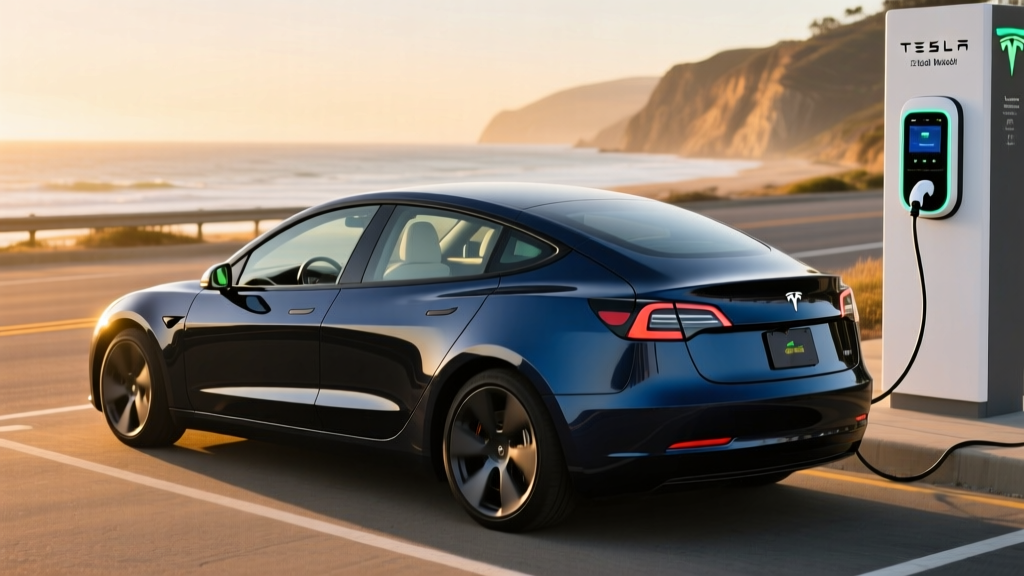
Tesla's native NACS (North American Charging Standard) port is a significant advantage in 2026. The Supercharger network now exceeds 6,500 stations and 65,000 connectors in North America, and with legacy automakers adopting NACS, congestion at popular corridors has increased — but Tesla owners still benefit from native plug-and-charge reliability without adapter fumbling. A Tesla Supercharger map shows coverage along virtually every major US interstate corridor.
For home Level 2 charging, a Tesla Wall Connector ($475) on a 60-amp circuit delivers the full 11.5 kW / 44 miles per hour. A typical overnight session (8 hours) adds roughly 350 miles — more than enough to replenish any daily driving. Budget $800–$1,500 for professional installation depending on your electrical panel's proximity to the garage; a panel upgrade (200A service) can add $1,500–$3,000 if needed.
Performance & Driving Dynamics
The single rear-mounted motor produces 271 horsepower and launches the Model 3 RWD to 60 mph in 5.8 seconds. That's quick enough to merge confidently and entertaining on back roads, but it's not the neck-snapping acceleration of the dual-motor variants. The RWD layout gives the Model 3 a more balanced, tail-happy character than the AWD Long Range — enthusiasts will appreciate the lighter front end and more communicative steering.
Ride quality improved substantially with the Highland refresh. Tesla retuned the suspension, added frequency-selective dampers, and improved sound insulation. The result is a sedan that absorbs highway expansion joints without crashing and keeps wind and tire noise well-muted at 80 mph. It's not BMW i4 plush, but it's a dramatic improvement over pre-2024 Model 3s.
Regenerative braking: Tesla offers only one regen setting (strong), which enables one-pedal driving in most conditions. There's no adjustable regen or coast mode as you'd find in a Hyundai or Kia EV. Most owners adapt within a week, but if you prefer a traditional coasting feel, this is a test-drive consideration.
Interior, Tech & Cargo
The 2026 Model 3 interior is minimalist by design — a single 15.4-inch touchscreen handles infotainment, climate, navigation, and vehicle settings. There is no instrument cluster; speed and range information appears in the upper-left corner of the main display. The steering wheel houses scroll wheels and buttons, but turn signals remain on a stalk (unlike the controversial Model 3 refresh in some markets).
Standout tech features:
- Tesla Autopilot (standard): SAE Level 2 driver assistance with adaptive cruise, lane centering, and automatic emergency braking. The driver must remain engaged — this is not self-driving.
- Full Self-Driving (Supervised): Optional $8,000 upgrade (or $99/month subscription) adding automated lane changes, traffic light/stop sign recognition, and city-street navigation. Still SAE Level 2 — hands on wheel, eyes on road required at all times.
- Over-the-air updates: Tesla pushes regular software updates that add features, improve efficiency, and refine the UI — no dealer visits required.
- Sentry Mode / Dashcam: Built-in cameras record surroundings when parked, with clip-saving via the app.
- Ventilated front seats: Added with the Highland refresh, a welcome improvement for warm climates.
Notable drawbacks:
- Rear visibility is limited by the sloping rear glass and thick C-pillars — the backup camera is essential.
- No Apple CarPlay or Android Auto — Tesla's native interface is the only option.
- Rear-seat legroom (35.2 inches) is tighter than a Hyundai Ioniq 6 (38.4 inches) and noticeably snug for tall adults on long trips.
- The absence of physical buttons for climate and wipers frustrates some drivers, especially in winter when gloves are involved.
Cargo space: 23 cubic feet total (19.8 cu ft rear trunk + 3.1 cu ft frunk). The trunk opening is narrower than a hatchback, which limits loading bulky items. The Ioniq 6 offers 11.2 cu ft of trunk space but no frunk; the Polestar 2's hatchback design provides 14.4 cu ft and is easier to load.
Pricing, Tax Credits & Total Cost
The 2026 Tesla Model 3 Standard Range RWD starts at $38,990 plus a $1,390 destination charge, for a total of $40,380 before incentives. Tesla frequently adjusts pricing, and referral discounts or promotional financing may apply — always check the current configurator.
| Item | Amount |
|---|---|
| Base MSRP | $38,990 |
| Destination Fee | $1,390 |
| Total Before Incentives | $40,380 |
| Federal §30D Tax Credit (if eligible) | Up to $7,500 |
| Effective Price (with full credit, point-of-sale) | ~$32,880 |
- MSRP cap: Vehicle must be under $55,000 (sedans). The Model 3 RWD qualifies at $38,990. ✓
- Buyer income cap: Modified AGI must not exceed $150,000 (single), $225,000 (head of household), or $300,000 (joint). Check IRS guidelines for current-year thresholds.
- Battery sourcing: Critical minerals and battery components must meet phased-in domestic/content requirements. Tesla's LFP cells for the Standard Range have historically been sourced from CATL (China), which may affect eligibility depending on 2026 FEOC (Foreign Entity of Concern) rules. Verify current eligibility on the IRS qualified vehicles list before purchase.
- Point-of-sale transfer: Eligible buyers can transfer the credit to the dealer at purchase, reducing the upfront price rather than waiting for a tax refund.
Consult a tax professional and check irs.gov before relying on credit eligibility. Rules change and vary by buyer.
5-Year Ownership Cost Snapshot: Factoring in home electricity at $0.16/kWh, 15,000 miles/year, no oil changes, reduced brake wear from regen, and typical EV insurance premiums (~15–25% higher than gas equivalents), the Model 3 RWD's 5-year total cost of ownership lands in the $38,000–$44,000 range (including depreciation), competitive with a Toyota Camry Hybrid when the federal credit applies.
Warranty & Battery Longevity
Tesla covers the Model 3's battery and drive unit for 8 years or 100,000 miles (whichever comes first), with a guaranteed minimum 70% capacity retention over that period. The limited vehicle warranty runs 4 years / 50,000 miles.
LFP batteries generally demonstrate excellent cycle life — laboratory data and fleet telemetry suggest LFP packs can exceed 3,000 charge cycles before significant degradation, which translates to well over 300,000 miles in normal use. Real-world degradation for the Model 3 RWD's LFP pack typically shows 5–8% capacity loss over the first 100,000 miles based on owner-reported data, well within the warranty threshold.
One LFP-specific ownership note: these packs have a flatter voltage curve, which makes state-of-charge estimation harder for the battery management system. Tesla recommends charging to 100% at least once per week to recalibrate. Skipping this can lead to range-display inaccuracy — the car may show 200 miles when the pack actually holds 240.
Pros, Cons & Who Should Buy
- Class-leading efficiency (25 kWh/100mi) keeps fuel costs minimal
- Supercharger network access — the most reliable DC fast-charging ecosystem
- LFP battery longevity and daily 100% charging tolerance
- Strong over-the-air update cadence keeps the car improving post-purchase
- Competitive base price, especially with the §30D credit applied
- Improved ride comfort and cabin quietness post-Highland refresh
- LFP cold-weather range loss (20–30%) is significant in northern climates
- 170 kW peak DC charge rate trails the Long Range and some competitors
- No Apple CarPlay / Android Auto
- Rear-seat legroom is tight for adults over 6 feet
- All-screen interface requires adaptation; no physical climate controls
- Battery sourcing may affect §30D credit eligibility — verify before purchase
- Choose this if: You commute 30–80 miles daily, have home Level 2 charging, live in a moderate climate, and prioritize low running costs with reliable road-trip charging infrastructure.
- Look elsewhere if: You regularly drive in sub-freezing temperatures (consider the Long Range AWD with NMC chemistry and heat pump), need spacious rear seating for adults, or depend on Apple CarPlay for your daily workflow.
- Consider the Hyundai Ioniq 6 if: You want more rear-seat space, physical buttons, CarPlay/Android Auto, and comparable efficiency with a CCS charging option.
Frequently Asked Questions
What is the real-world range of the Tesla Model 3 Standard Range RWD?
The EPA rates it at 272 miles. In real-world mixed driving at moderate temperatures, expect 240–260 miles. Highway driving at 75 mph drops this to ~230–245 miles, and cold weather (below freezing) can reduce range to 185–210 miles due to the LFP battery's sensitivity to low temperatures. Always precondition the battery in cold weather to minimize losses.
How fast does the Model 3 RWD charge at home and on DC fast chargers?
On a DC fast charger (Tesla Supercharger V3), it peaks at 170 kW and charges from 10% to 80% in approximately 25 minutes. At home on a Level 2 Wall Connector (11.5 kW / 48A), it adds about 44 miles per hour, fully recharging in roughly 6 hours. On a standard 120V outlet (Level 1), expect about 5 miles per hour — suitable only for emergency or very low-mileage use.
Does the Tesla Model 3 Standard Range qualify for the $7,500 federal tax credit?
It may, but eligibility depends on several factors. The MSRP ($38,990) is well under the $55,000 sedan cap. Your income must fall under IRS thresholds ($150K single / $300K joint). The critical variable is battery sourcing — the LFP cells have historically come from CATL in China, and FEOC (Foreign Entity of Concern) rules under §30D may limit eligibility. Always check the current IRS qualified clean vehicle list and consult a tax professional before relying on the credit.
Is the Model 3 RWD worth buying over competitors like the Ioniq 6 or BMW i4?
It depends on priorities. The Model 3 RWD wins on efficiency, Supercharger access, software, and price. The Hyundai Ioniq 6 offers more rear-seat space, CarPlay, and 800V charging architecture (though at a higher base price). The BMW i4 delivers premium materials and driving dynamics but starts over $52,000. For pure value and running-cost efficiency, the Model 3 RWD is hard to beat.
How long will the LFP battery last?
LFP chemistry is known for exceptional cycle life — data suggests 3,000+ cycles before significant degradation, equating to 300,000+ miles in normal driving. Tesla warrants the battery for 8 years / 100,000 miles at 70% minimum capacity. Real-world owner data typically shows 5–8% degradation over the first 100,000 miles. Charge to 100% weekly as Tesla recommends to maintain accurate range estimation.
Is Tesla Autopilot self-driving?
No. Tesla Autopilot and the optional Full Self-Driving (Supervised) package are both SAE Level 2 driver-assistance systems. The driver must keep hands on the wheel and eyes on the road at all times. The system can steer, accelerate, and brake within its lane, but it cannot handle all driving scenarios and requires active human supervision. True self-driving (Level 4) is currently limited to geofenced robotaxi services like Waymo.