The Tesla Model 3 has long been the default entry point into premium electric-vehicle ownership, and the refreshed "Highland" generation continues that tradition into 2026. For buyers weighing a Tesla Model 3 Standard lease, the value proposition hinges on three variables: real-world range from its LFP battery, access to the Supercharger network, and whether the federal §30D tax credit applies to your income and the vehicle's battery sourcing. This review dissects the numbers that matter.
2026 Tesla Model 3 Standard Range: Quick Verdict
The base Model 3 (badged simply as the rear-wheel-drive Standard Range in 2026) delivers an EPA-estimated 341 miles of range, 255 horsepower, and a 0-60 mph time of 5.8 seconds. Its lithium iron phosphate (LFP) battery prioritizes longevity and daily 100% charging tolerance over peak energy density. For urban commuters and moderate road-trippers with reliable home charging, it remains one of the most cost-efficient EVs on the market. For those who regularly drive 300+ miles in cold weather or need all-wheel drive, the Long Range AWD trim is a necessary upgrade.
Range, Efficiency, and the LFP Reality
The 2026 Model 3 Standard Range pairs a rear-mounted permanent-magnet motor with a BYD-sourced LFP battery pack. Tesla does not publish official usable capacity figures, but teardown data and EPA test submissions indicate approximately 60 kWh of usable energy.
EPA estimate: 341 miles
Real-world highway (70 mph, 70°F): ~280–300 miles
Cold-weather highway (30°F, cabin heat): ~220–250 miles
Mixed city/highway commuting: ~310–330 miles
LFP chemistry holds voltage flat across most of its state of charge, which means range estimation is less accurate at extreme SoC levels. Unlike NMC packs, Tesla recommends charging LFP to 100% at least once a week for cell balancing — a practice that actually helps daily drivers who want the full 341 miles available each morning.
Efficiency on the combined EPA cycle is rated at 132 MPGe, translating to roughly 25 kWh per 100 miles. In real-world highway driving at 75 mph, expect consumption closer to 28–30 kWh/100mi, which is still among the most efficient sedans in its class thanks to the Model 3's low drag coefficient (0.219 Cd) and heat-pump-based thermal management.
Charging Speed: DC Fast, Level 2, and Supercharger Access
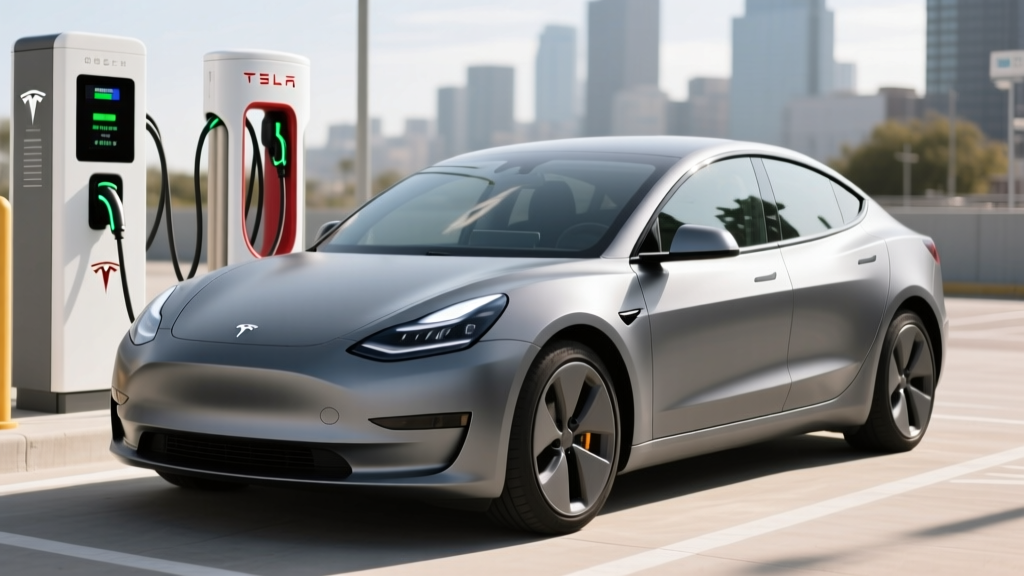
Charging remains one of Tesla's strongest ownership advantages, primarily due to the proprietary NACS connector and the reliability of the Supercharger network, which now serves most major EV brands via adapters.
| Charging Level | Power / Rate | 10–80% Time / Miles per Hour |
|---|---|---|
| Level 1 (120V household) | ~1.4 kW | ~4 miles per hour |
| Level 2 (240V home / Wall Connector) | 11.5 kW (48A) | ~44 miles per hour; 0–100% in ~7 hours |
| DC Fast Charge (V3 Supercharger) | Peak 170 kW | 10–80% in ~25 minutes |
| DC Fast Charge (V4 / CCS adapter) | Peak 170 kW | 10–80% in ~25–28 minutes |
Charging-curve reality: The LFP pack in the Standard Range Model 3 peaks at 170 kW but sustains that rate only between roughly 10% and 45% SoC. Above 60%, the curve tapers significantly, dropping below 60 kW past 85%. This is why Tesla and most fast-charging etiquette guides recommend stopping at 80% on road trips — the last 20% can take as long as the first 70%.
For home charging, the Tesla Wall Connector at 48 amps on a 60-amp circuit delivers a full charge overnight. Installation typically costs $800–$2,000 depending on panel proximity and whether a 200-amp service upgrade is required. Always have a licensed electrician confirm your panel's spare capacity before committing to a 48-amp circuit.
Performance, Drivetrain, and Daily Drivability
| Specification | 2026 Model 3 Standard Range |
|---|---|
| Drivetrain | Rear-Wheel Drive (single motor) |
| Horsepower | 255 hp |
| Torque | 307 lb-ft |
| 0–60 mph | 5.8 seconds |
| Top Speed | 125 mph |
| Battery Chemistry | LFP (Lithium Iron Phosphate) |
| Usable Battery Capacity | ~60 kWh |
| EPA Range | 341 miles |
| EPA Efficiency | 132 MPGe (25 kWh/100mi) |
| Cargo Volume | 23 cu ft (trunk + frunk) |
| Rear Legroom | 35.3 inches |
| Curb Weight | ~3,862 lbs |
The single-motor RWD setup provides linear, responsive acceleration that merges effortlessly onto highways. The Highland refresh improved ride quality substantially — revised suspension bushings, frequency-selective dampers, and acoustic glass make this the quietest Model 3 Tesla has built. Regenerative braking remains strong and predictable, though Tesla removed the user-adjustable regen setting; one-pedal driving is the default and only mode.
Pricing, Lease Economics, and Federal Tax Credit Eligibility
The 2026 Tesla Model 3 Standard Range starts at an MSRP of $38,990 (including destination). Adding common options — Ultra Red paint ($2,000), 19-inch Nova wheels ($1,500), or Full Self-Driving Supervised ($8,000) — can push the as-tested price above $50,000.
| Cost Factor | Amount |
|---|---|
| Base MSRP (Standard Range RWD) | $38,990 |
| Typical Lease (36 mo / 10K mi, well-qualified) | $329–$399/month |
| Lease Due at Signing (est.) | $2,500–$3,999 |
| §30D Federal Tax Credit (purchase) | Up to $7,500 (if eligible) |
| §25D Commercial Clean Vehicle Credit (lease) | Up to $7,500 passed through by lessor |
Critical lease vs. buy distinction: When you lease a Tesla Model 3, the §30D consumer credit does not apply directly to you. Instead, the leasing company (Tesla's finance arm) claims the §45W Commercial Clean Vehicle Credit and may pass the savings as a reduced capitalized cost — effectively lowering your monthly payment. Tesla has historically passed this through, but it is not guaranteed by statute. Always confirm the lease quote reflects any credit pass-through before signing.
For purchases, the §30D credit has strict eligibility requirements per IRS guidelines:
- MSRP cap: Sedans must be under $55,000 (the Model 3 qualifies at base; optioned trims may exceed the cap)
- Buyer income cap: MAGI ≤ $150,000 single / $300,000 joint / $225,000 head of household
- Battery sourcing: Critical minerals and battery components must meet phased-in domestic/free-trade sourcing thresholds (increasing annually through 2026)
- FEOC restriction: Vehicles with battery components from a "foreign entity of concern" (primarily Chinese manufacturers) may be disqualified — LFP cells from BYD have drawn scrutiny under this rule
- Point-of-sale transfer: Eligible buyers can transfer the credit to the dealer at purchase for an immediate price reduction
Because the Model 3 Standard Range uses BYD LFP cells, buyers should verify current-year FEOC compliance on fueleconomy.gov before assuming the full $7,500 credit applies. Partial credit ($3,750) may be available if only one of the two sourcing thresholds is met.
Tech, Interior, and Driver Assistance
The Highland interior is a study in minimalism: a single 15.4-inch touchscreen handles infotainment, climate, and vehicle controls, supplemented by an 8-inch rear passenger screen. Notable features include ventilated front seats, ambient lighting, a 17-speaker audio system, and power-folding heated mirrors. Build quality has improved measurably over pre-2024 models, with tighter panel gaps and higher-grade materials.
Driver assistance: Every Model 3 ships with Tesla's Basic Autopilot (lane-keeping, traffic-aware cruise control). Enhanced Autopilot ($6,000) adds auto lane-change, autosteer on highways, and Smart Summon. Full Self-Driving (Supervised) at $8,000 adds traffic-light recognition and city-street autosteer.
All Tesla driver-assist features — including FSD (Supervised) — are SAE Level 2 systems. The driver must remain fully engaged, hands on or near the wheel, and eyes on the road at all times. These are not autonomous or self-driving systems. Only Level 4 robotaxi services like Waymo operate without a human driver in geofenced areas.
Pros
- 341-mile EPA range at a sub-$40K price point
- Supercharger network access (most reliable public charging in the US)
- LFP battery tolerates daily 100% charging with minimal degradation
- Industry-leading efficiency (25 kWh/100mi combined)
- Over-the-air updates continuously add features
- Improved Highland ride quality and cabin quietness
Cons
- RWD only — no AWD option on Standard Range trim
- 170 kW peak DC charge rate trails Hyundai/Kia 800V competitors
- No physical buttons; all controls on touchscreen
- Rear legroom (35.3") is tight for tall passengers
- FSD subscription/purchase cost adds significantly to total price
- BYD LFP sourcing may limit §30D credit eligibility in some years
Warranty Coverage and Long-Term Battery Outlook
Tesla provides the following coverage on the 2026 Model 3:
- Basic vehicle: 4 years / 50,000 miles
- Battery and drive unit: 8 years / 100,000 miles (whichever comes first), with a minimum 70% capacity retention threshold
LFP batteries historically exhibit slower degradation than NMC chemistries, with real-world fleet data suggesting 8–12% total capacity loss over 150,000 miles under normal use. The 70% retention threshold at 100,000 miles is a conservative warranty floor — most LFP packs should retain well above that. Tesla does not publish a separate "corrosion" or structural warranty beyond the basic term; third-party extended warranties are available but vary in EV-specific coverage.
Who Should Lease the Model 3 Standard Range?
Choose the Model 3 Standard Range lease if:
- You commute 30–80 miles round-trip and have reliable Level 2 home charging
- You live in a moderate climate where cold-weather range loss is manageable
- You value Supercharger network access for occasional road trips under 250 miles
- You want to lock in a predictable monthly cost without long-term depreciation risk
Consider the Model 3 Long Range AWD or a competitor if:
- You regularly drive 250+ miles in freezing temperatures
- You need all-wheel drive for snow/ice performance
- You require faster DC charging (look at Hyundai Ioniq 6 or Kia EV6 with 800V architecture)
- You need more rear-seat space for car seats or tall passengers
Competitor Comparison
Against the Hyundai Ioniq 6 SE (EPA 361 miles, 800V charging at 240 kW, ~$42,000), the Model 3 gives up some range and significant DC charging speed but wins on Supercharger reliability and software integration. The BMW i4 eDrive40 (EPA 301 miles, ~$52,000) offers a more traditional luxury interior but at a steep premium. The Chevrolet Equinox EV undercuts on price but delivers less range and slower charging. For pure value-per-mile, the Model 3 Standard Range remains the benchmark.
Frequently Asked Questions
What is the real-world range of the 2026 Tesla Model 3 Standard Range?
The EPA estimates 341 miles. In real-world highway driving at 70 mph, expect 280–300 miles. In cold weather (below freezing) with cabin heating, range drops to approximately 220–250 miles.
How fast does the Model 3 Standard Range charge?
On a V3 Supercharger, it peaks at 170 kW and charges from 10–80% in about 25 minutes. At home on a 240V Wall Connector (11.5 kW), a full charge takes roughly 7 hours, adding about 44 miles of range per hour.
Does a Tesla Model 3 lease qualify for the federal EV tax credit?
Leased vehicles are technically eligible for the §45W Commercial Clean Vehicle Credit claimed by the lessor (Tesla). If Tesla passes this through as a cap-cost reduction, your monthly payment decreases. The consumer §30D credit applies only to purchases. Always confirm the pass-through is reflected in your lease quote.
How much does a 2026 Tesla Model 3 Standard Range lease cost?
Well-qualified lessees typically see offers between $329 and $399 per month for 36 months and 10,000 annual miles, with $2,500–$3,999 due at signing. Exact terms depend on credit score, region, and whether any federal credit is passed through.
Is the Model 3 Standard Range worth it over competitors?
For buyers prioritizing charging-network reliability, software features, and efficiency, yes. If ultra-fast DC charging or AWD is essential, the Hyundai Ioniq 6 or a Model 3 Long Range AWD are better fits. Verify your tax-credit eligibility on fueleconomy.gov before finalizing any purchase.
What is the battery warranty on the Model 3?
Tesla covers the battery and drive unit for 8 years or 100,000 miles with a guaranteed minimum 70% capacity retention. LFP chemistry historically degrades more slowly than NMC, and fleet data supports long-term durability well above the warranty threshold.